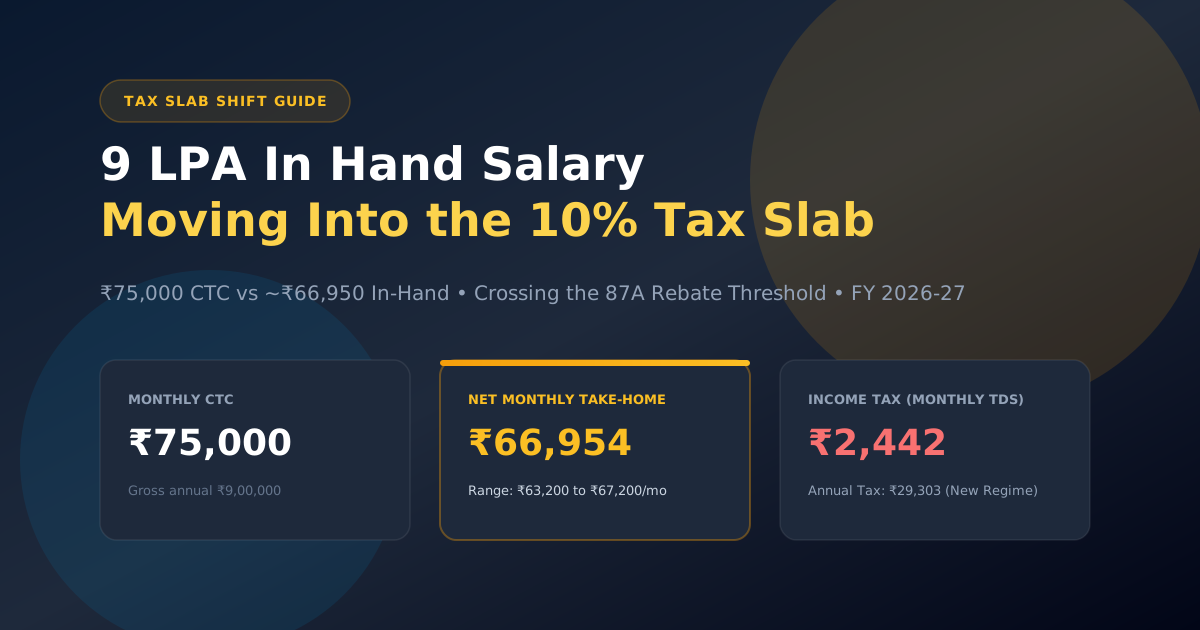
The 9 LPA Level in India's Corporate Hierarchy
An annual Cost to Company (CTC) of ₹9,00,000 (9 LPA) marks a profound transition in the Indian compensation hierarchy. Typically achieved by software engineers with 3 to 6 years of experience, senior financial analysts, operations team leads, product designers, and corporate managers, 9 LPA represents the entry into genuine mid-tier professional authority.
When an employment contract states an annual CTC of ₹9,00,000, candidates naturally execute simple division:
₹9,00,000 ÷ 12 months = ₹75,000.00 per month
However, when your monthly salary credit notification arrives, the credited sum is consistently between ₹63,200 and ₹66,954. A difference of roughly ₹8,000 to ₹11,800 per month is deducted.
Why does this happen? Unlike packages of 5 LPA, 6 LPA, or 7 LPA—which are completely shielded from income tax by the Section 87A rebate—an employee earning 9 LPA crosses the statutory ₹7,00,000 net taxable threshold. This ends your zero-tax era and introduces real monthly Tax Deducted at Source (TDS) into the 10% tax bracket.
The CTC Disconnect: Why ₹75,000 Never Reaches Your Bank
Under Indian payroll conventions, Cost to Company (CTC) is an employer-centric metric. It captures the entire corporate expenditure incurred to retain you on the payroll for twelve months. It is not an agreement to transfer ₹75,000 into your savings account.
The difference between your gross CTC and net bank credit stems from three statutory deduction layers:
- Employer-Side Retiral Provisions: Statutory contributions paid by the organization into mandatory retiral trusts (Employer EPF contribution) and accounting reserves held for statutory severance (Gratuity). These are included inside the quoted CTC package but do not appear as earnings on your payslip.
- Employee-Side Statutory Withholdings: Compulsory deductions carved directly out of your gross salary on the paystub, including your personal Employee EPF share and State Professional Tax.
- Income Tax (TDS): Compulsory central government income tax withholdings carved directly out of your monthly earnings based on your applicable tax regime slab rates.
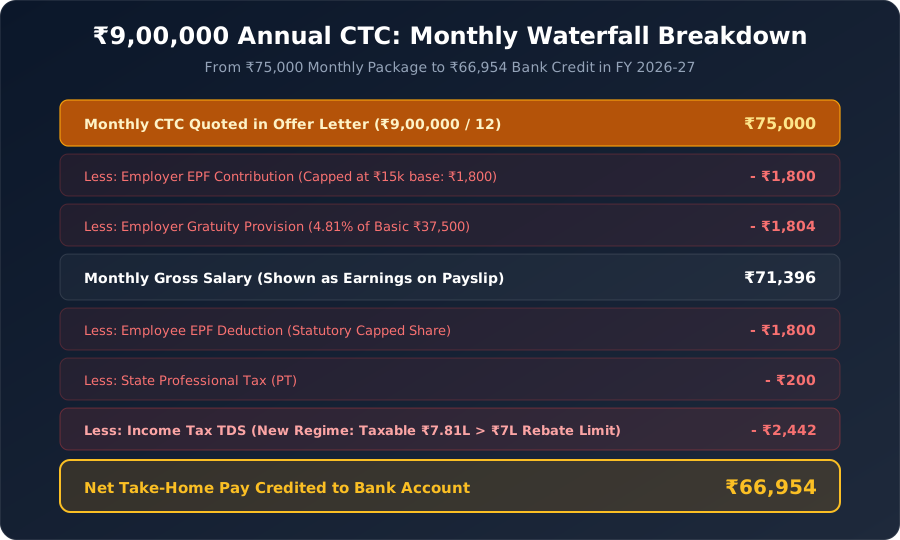 Figure 1: Visual waterfall tracing how a ₹75,000 monthly CTC is distributed into statutory retirals, income tax, and ₹66,954 net take-home pay.
Itemized Paystub Breakdown: From ₹75,000 to ₹66,954
Let us inspect the exact mathematics of a typical 9 LPA corporate pay structure under the standard 50% Basic Salary structure with capped Employee Provident Fund (EPF):
| Salary Component | Calculation Rule | Annual (INR) | Monthly (INR) | Classification |
|---|---|---|---|---|
| Basic Salary | 50% of CTC | ₹4,50,000 | ₹37,500 | Taxable Base Earnings |
| House Rent Allowance (HRA) | 40% of Basic (Non-Metro) | ₹1,80,000 | ₹15,000 | Taxable / Exempt u/s 10(13A) |
| Special Allowance | Balancing Residual Component | ₹2,26,755 | ₹18,896 | Fully Taxable Allowance |
| Gross Pay (Earnings on Paystub) | Basic + HRA + Special Allowance | ₹8,56,755 | ₹71,396 | Gross Payslip Earnings |
| Employer EPF Contribution | Capped at ₹15,000 ceiling (12%) | ₹21,600 | ₹1,800 | Employer Retiral (Part of CTC) |
| Gratuity Provision | 4.81% of Basic Salary | ₹21,645 | ₹1,804 | Statutory Reserve (Part of CTC) |
| Total Cost to Company (CTC) | Gross Pay + Employer Retirals | ₹9,00,000 | ₹75,000 | Recruiter Quoted Package |
| Employee EPF Deduction | 12% statutory deduction | ₹21,600 | ₹1,800 | Deduction to EPFO Account |
| Professional Tax (PT) | State slab (KA, MH, TS, WB) | ₹2,400 | ₹200 | State Government Withholding |
| Income Tax (TDS - New Regime) | Calculated on ₹7,81,755 taxable | ₹29,303 | ₹2,442 | Monthly Income Tax Withholding |
| Net Monthly In-Hand Salary | Gross Pay − Deductions | ₹8,03,452 | ₹66,954 | Net Credited to Bank Account |
When an employer applies the standard capped EPF mechanism, your gross earnings equal ₹71,396 per month. Deducting ₹1,800 for your EPF, ₹200 for state professional tax, and ₹2,442 for monthly income tax yields an exact in-hand salary of ₹66,954 per month. You can verify your personalized salary numbers instantly with our CTC to In-Hand Salary Calculator.
Crossing the Section 87A Ceiling: The 10% Slab Breakdown
At 9 LPA, you cross into taxable territory. Let us inspect the exact legal tax computation under the default New Tax Regime for FY 2026-27 (AY 2027-28):
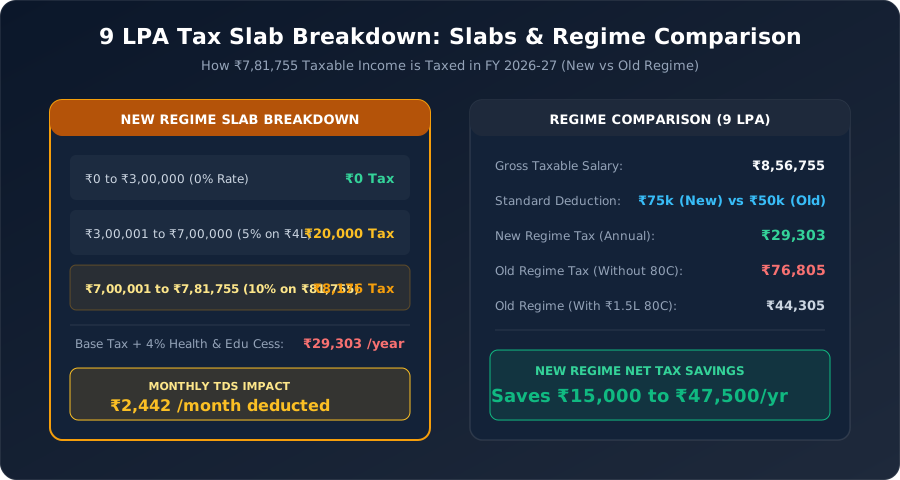 Figure 2: New Tax Regime slab decomposition showing how taxable income above ₹7 Lakhs enters the 10% bracket.
- Gross Salary Earned: ₹8,56,755 (excluding employer retirals).
- Standard Deduction (Section 16 ia): The New Tax Regime grants a flat ₹75,000 standard deduction.
- Net Taxable Income: ₹8,56,755 − ₹75,000 = ₹7,81,755.
- Applying the New Tax Regime Slabs:
- From ₹0 to ₹3,00,000: NIL (0%) = ₹0
- From ₹3,00,001 to ₹7,00,000 (₹4,00,000 band): 5% = ₹20,000
- From ₹7,00,001 to ₹7,81,755 (₹81,755 band): 10% = ₹8,175.50
- Total Base Tax Computed: ₹20,000 + ₹8,175.50 = ₹28,175.50.
- Section 87A Tax Rebate: Because your taxable income of ₹7,81,755 exceeds the statutory threshold of ₹7,00,000, no Section 87A rebate applies.
- Health and Education Cess (4%): 4% of ₹28,175.50 = ₹1,127.02.
- Final Annual Tax Payable: ₹28,175.50 + ₹1,127.02 = ₹29,303 (or roughly ₹2,442 per month).
Old vs New Tax Regime at 9 LPA: A Rigorous Comparison
Should someone earning 9 LPA stick with the default New Tax Regime or switch to the Old Tax Regime to claim tax deductions?
| Parameter | New Tax Regime (Default) | Old Tax Regime (No Deductions) | Old Tax Regime (Full ₹1.5L 80C) |
|---|---|---|---|
| Standard Deduction | ₹75,000 | ₹50,000 | ₹50,000 |
| Section 80C Deductions | Not Allowed | ₹0 | ₹1,50,000 |
| Net Taxable Income | ₹7,81,755 | ₹8,06,755 | ₹6,56,755 |
| Base Tax Calculated | ₹28,176 | ₹73,851 | ₹43,851 |
| Health & Edu Cess (4%) | ₹1,127 | ₹2,954 | ₹1,754 |
| Total Annual Tax Payable | ₹29,303 | ₹76,805 | ₹45,605 |
The Takeaway: Even if you invest the maximum ₹1,50,000 into Section 80C instruments (ELSS, PPF, life insurance), you still pay ₹45,605 under the Old Regime—which is ₹16,302 MORE than the New Regime's effortless ₹29,303 tax! To make the Old Regime equal the New Regime at 9 LPA, you would need over ₹2.4 Lakhs in total deductions (combining 80C, 80D health insurance, and significant HRA rent receipts). For most professionals, the New Tax Regime remains undeniably superior. Compare your tax scenarios with our Income Tax Calculator.
Capped EPF (₹1,800) vs Uncapped 12% (₹4,500)
At 9 LPA, your monthly basic salary is ₹37,500. This opens two distinct operational choices in corporate payroll:
| EPF Contribution Model | Monthly Employee PF | Monthly Employer PF | Total Monthly PF Saved | Net Monthly In-Hand |
|---|---|---|---|---|
| Statutory Capped PF (₹15,000 base) | ₹1,800 | ₹1,800 | ₹3,600 /mo | ₹66,954 |
| Uncapped PF (12% of actual ₹37,500 base) | ₹4,500 | ₹4,500 | ₹9,000 /mo | ₹63,200 |
The Compounding Advantage: Choosing the uncapped scheme reduces your immediate monthly take-home by ₹3,754. However, it directs a massive ₹9,000 every month into your sovereign-backed EPF account. At an annual interest rate of 8.25%, this additional saving builds over ₹6.9 Lakhs of tax-free retirement capital in just 5 years. Check your custom compounding with our EPF Calculator.
Gratuity Reserves & 5-Year Vesting Realities
Every 9 LPA offer letter typically budgets roughly ₹21,645 per year (₹1,804/month) under the heading of Gratuity. Under the Payment of Gratuity Act, 1972, this sum is not paid monthly. It represents a mandatory employer accrual payable when you separate from the company after completing 5 continuous years of service (or upon retirement or death).
The statutory formula for gratuity payout is:
Gratuity = (15 × Last Drawn Basic Salary × Tenure in Years) ÷ 26
If you work for 5 years at a final basic salary of ₹37,500, your statutory gratuity payout is (15 × 37,500 × 5) / 26 = ₹1,08,173. Check your future retiral payouts using our free Gratuity Calculator.
Professional Tax Variations Across Tech Hubs
Salaried professionals in India are subject to state-level Professional Tax (PT). For a 9 LPA package (monthly gross ~₹71,400), here is how your base location affects your take-home pay:
- Karnataka (Bengaluru): ₹200/month (Annual: ₹2,400). Monthly In-Hand: ~₹66,954.
- Maharashtra (Mumbai / Pune): ₹200/month for 11 months, ₹300 in February (Annual: ₹2,500). Monthly In-Hand: ~₹66,954 (₹66,854 in Feb).
- Telangana (Hyderabad): ₹200/month (Annual: ₹2,400). Monthly In-Hand: ~₹66,954.
- Tamil Nadu (Chennai): Levied half-yearly at ₹1,250 (Annual: ₹2,500, approx. ₹208/month). Monthly In-Hand: ~₹66,946.
- Delhi NCR & Haryana (Gurugram): No Professional Tax levied. Monthly In-Hand: ~₹67,154 (highest in India).
Building Wealth on a ₹67,000 Monthly In-Hand Salary
Taking home ₹67,000 per month grants comfortable urban living across Indian metro hubs while maintaining strong compounding potential. A practical financial allocation for a professional earning ₹67,000 per month:
Rent (comfortable 2BHK flat), electricity, groceries, high-speed Wi-Fi, maid/cook services, and commuting.
Dining out, entertainment, weekend trips, clothing, gadgets, and personal professional certifications.
Automated monthly SIP into diversified equity index funds and emergency contingency reserves.
If you invest ₹20,000 every month in an equity mutual fund SIP delivering an annualized compound return of 12%, your investment trajectory unfolds as follows:
- After 5 Years: Over ₹16.5 Lakhs (invested: ₹12 Lakhs).
- After 10 Years: Over ₹46.4 Lakhs (invested: ₹24 Lakhs).
- After 15 Years: Over ₹1.01 Crore (crosses the Crore milestone!).
- After 20 Years: Over ₹2.00 Crores of financial freedom!
Model your customized SIP accumulation milestones with our SIP Calculator.
Next Career Move: Breaking Through to 12 LPA
When transitioning from 9 LPA to a senior role or switching organizations, professionals typically target a 30% to 40% increment, pushing compensation into the 11.5 LPA to 12.5 LPA bracket.
A 35% increment elevates your package to ₹12.15 LPA, lifting your monthly in-hand from ₹66,954 to roughly ₹86,500. You can simulate multiple offer letters and calculate your exact hike percentage using our free Salary Hike Calculator.
Frequently Asked Questions
What is the exact monthly take-home salary for 9 LPA in India?
On a 9 LPA CTC package, your monthly take-home pay is typically ₹66,954 if your employer caps EPF at ₹1,800 per month, and roughly ₹63,200 if your employer calculates an uncapped 12% EPF on your actual basic salary.
Why is income tax deducted on 9 LPA when 7 LPA is tax-free?
Under the New Tax Regime, Section 87A rebate provides up to ₹25,000 tax relief only if your net taxable income is ₹7,00,000 or below. At 9 LPA, your gross salary after standard deduction is ₹7,81,755, exceeding the ₹7,00,000 limit. This disqualifies you from Section 87A rebate and introduces an annual tax of ₹29,303 (~₹2,442/month).
How can I reduce income tax on a 9 LPA salary?
Under the New Tax Regime, deductions are limited to the ₹75,000 standard deduction and employer NPS contribution under Section 80CCD(2) up to 14% of basic salary. Enrolling in Corporate NPS through your employer can reduce taxable income by over ₹50,000, lowering your tax bill significantly.
Can I take a home loan on a 9 LPA salary?
Yes. With a stable monthly net take-home salary of roughly ₹67,000, leading banks typically approve home loans of ₹40 Lakhs to ₹50 Lakhs at an EMI of roughly ₹32,000 to ₹38,000 per month for a 20-year tenure. You can calculate your exact loan EMIs using our EMI Calculator.
Why does my employer deduct gratuity from my CTC?
Under the Payment of Gratuity Act, 1972, gratuity is payable after completing 5 continuous years of service. Companies budget for this statutory liability by allocating 4.81% of your basic salary (approx. ₹1,804/month) within your annual CTC package structure.
Is filing an Income Tax Return mandatory for 9 LPA?
Yes, filing ITR-1 is mandatory under Section 139(1) of the Income Tax Act because your total gross income exceeds the basic exemption limit. Filing is also essential for maintaining financial compliance and securing easy loan approvals.