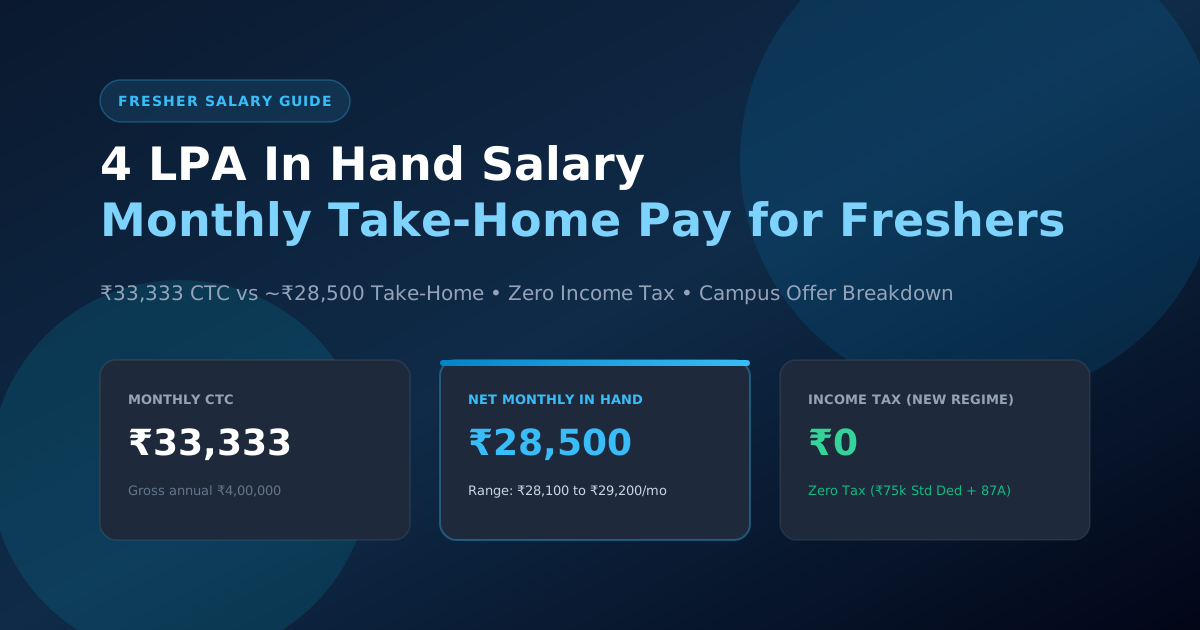
The 4 LPA Placement Reality: Why CTC ≠ In-Hand
Securing your first job offer through campus placements or off-campus recruitment drives is a monumental milestone. In the Indian engineering and corporate ecosystem, an annual Cost to Company (CTC) of ₹4,00,000 (4 LPA) represents one of the most common compensation tiers. Major service companies such as Tata Consultancy Services (TCS Ninja/Digital Foundation), Infosys (Systems Engineer), Wipro (Elite Talent), Cognizant (GenC Elevate), Accenture (Associate Software Engineer), and Capgemini frequently recruit thousands of graduates at packages ranging between ₹3.6 LPA and ₹4.25 LPA.
When fresh graduates receive an offer letter stating "Annual CTC: INR 4,00,000", the immediate calculation most perform is elementary arithmetic:
₹4,00,000 ÷ 12 months = ₹33,333.33 per month
However, when the first salary notification arrives via SMS from HDFC, ICICI, SBI, or Axis Bank on the last working day of the month, the credited sum is almost invariably between ₹28,100 and ₹29,200. This sudden difference of roughly ₹4,500 to ₹5,200 every single month often creates confusion, frustration, or concern among young professionals who assumed that companies were arbitrarily withholding their rightful earnings.
To demystify this discrepancy, you must understand the legal definition of Cost to Company (CTC). CTC does not denote what an employer agrees to deposit into your bank account. Instead, it reflects the total financial burden the organization bears to retain you on their payroll for twelve months. This total includes employer-borne statutory retirement benefits, company insurance overheads, and retention reserves before your individual earnings are finalized.
Itemized Monthly Paystub Breakdown: From ₹33,333 to ₹28,500
To understand where the missing ₹4,800 goes, let us analyze a standard corporate compensation structure for a 4 LPA package under Indian labor statutes. In most organized private companies, your CTC is split into three distinct financial compartments:
- Employer Retirals & Provisions: Statutory reserves kept by the company (Employer EPF and Gratuity) that form part of the CTC package but never enter your monthly payslip earnings.
- Gross Earnings (Pay Slip Gross): The components listed under the "Earnings" column on your paystub (Basic Salary, House Rent Allowance, and Special Allowance).
- Employee Salary Deductions: Mandatory withholdings deducted from your gross pay (Employee EPF share and State Professional Tax).
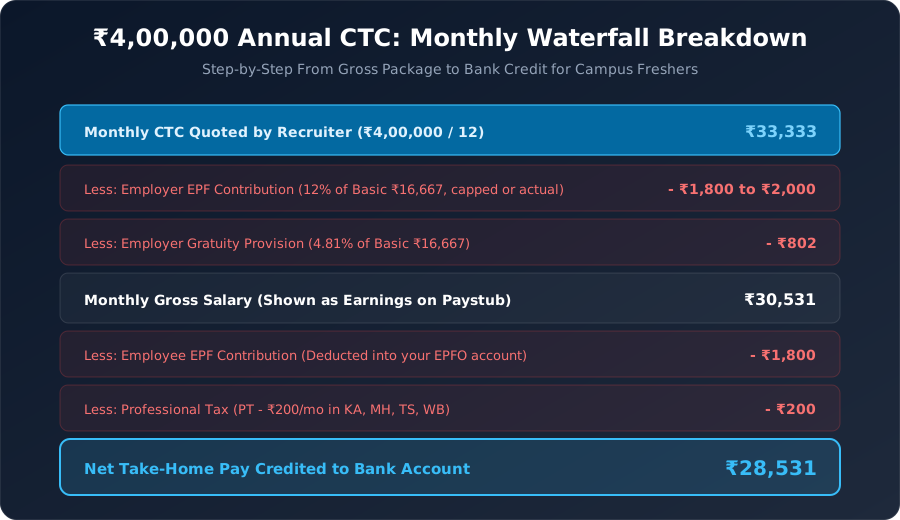 Figure 1: Visual waterfall tracing the monthly transition from ₹33,333 CTC to ₹28,531 net in-hand take-home pay.
Let us trace this exact mathematical journey line by line using standard corporate parameters where Basic Salary is structured at 50% of annual CTC:
| Salary Component | Calculation Basis | Annual Value (INR) | Monthly Value (INR) | Category |
|---|---|---|---|---|
| Basic Salary | 50% of CTC | ₹2,00,000 | ₹16,667 | Taxable Earnings |
| House Rent Allowance (HRA) | 40% of Basic | ₹80,000 | ₹6,667 | Taxable / Exempt u/s 10(13A) |
| Special Allowance | Balancing Component | ₹86,380 | ₹7,198 | Fully Taxable Allowance |
| Gross Pay (Earnings on Slip) | Basic + HRA + Special Allowance | ₹3,66,380 | ₹30,532 | Gross Monthly Pay |
| Employer EPF Contribution | Capped at ₹15,000 wage ceiling (12%) | ₹21,600 | ₹1,800 | Employer Retiral (Part of CTC) |
| Gratuity Provision | 4.81% of Basic Salary | ₹9,620 | ₹802 | Statutory Reserve (Part of CTC) |
| Total Cost to Company (CTC) | Gross Pay + Employer Retirals | ₹4,00,000 | ₹33,334 | Recruiter Quoted Package |
| Employee EPF Deduction | 12% statutory contribution | ₹21,600 | ₹1,800 | Deduction to EPFO Account |
| Professional Tax (PT) | State slab (KA, MH, TS, WB) | ₹2,400 | ₹200 | State Government Withholding |
| TDS / Income Tax | New Tax Regime (Section 87A) | ₹0 | ₹0 | Zero Tax Liability |
| Net Monthly In-Hand Salary | Gross Pay − Deductions | ₹3,42,380 | ₹28,532 | Net Credited to Bank |
As verified in the table above, your nominal monthly gross pay is ₹30,532. When employee EPF (₹1,800) and professional tax (₹200) are subtracted, the actual cash deposited in your bank account is ₹28,532 per month. You can verify your specific company parameters using our real-time CTC to In-Hand Salary Calculator.
Comparing 3 Common Campus Offer Structures
Not every company packages a 4 LPA CTC in identical fashion. Depending on industry norms, company size, and accounting practices, human resource departments structure salary packages differently. Freshers frequently receive offers from three primary company profiles:
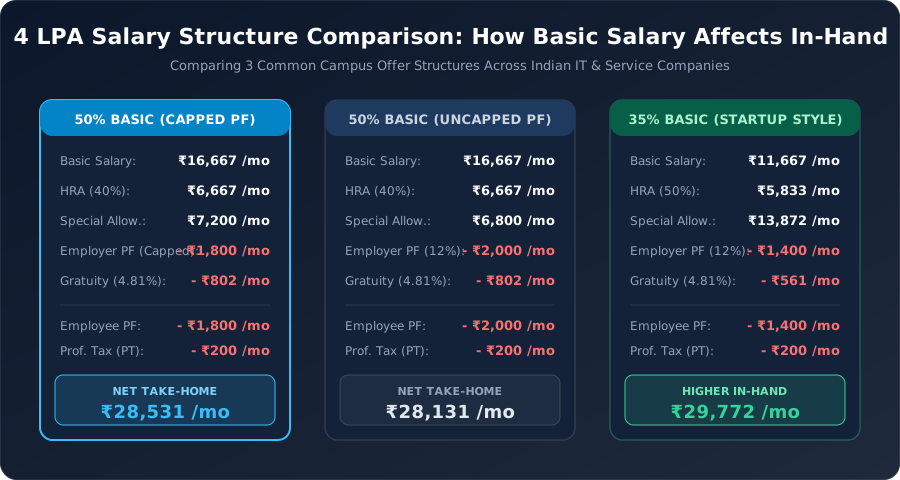 Figure 2: Architectural comparison of 3 common 4 LPA offer letters in India showing impact on take-home pay.
1. Tier-1 IT Services Model (Capped EPF)
Companies like TCS, Infosys, and Cognizant frequently cap the Employee Provident Fund contribution at the statutory wage ceiling of ₹15,000 per month, regardless of whether your actual basic salary is ₹16,667. By limiting the 12% calculation to ₹15,000, exactly ₹1,800 is deducted for employee EPF, and ₹1,800 is added as employer EPF. This structure yields a steady monthly take-home of ₹28,500 to ₹28,600.
2. Global Capability Center (GCC) / MNC Model (Uncapped EPF)
Many multinational product firms and global in-house capability centers do not cap PF contributions. They calculate the full 12% on your actual basic salary (12% of ₹16,667 = ₹2,000 per month). Because an additional ₹200 is allocated to your employee EPF and another ₹200 is deducted as employer EPF from your CTC pool, your immediate monthly take-home drops to approximately ₹28,130. While your immediate bank credit is ₹400 lower, an additional ₹400 is saved into your government-backed, interest-bearing EPF account every month.
3. Early-Stage Tech Startup Model (Low Basic, High Allowance)
Startups aiming to offer attractive headline in-hand cash frequently suppress the basic salary to 30% or 35% of CTC (around ₹10,000 to ₹11,667 per month) and inflate the flexible "Special Allowance" bucket. In this structure, 12% EPF on a ₹11,667 basic is only ₹1,400. With lower employer retirals and lower employee deductions, the net take-home climbs to ₹29,750 to ₹30,000 per month. However, this structure reduces future gratuity payouts and retiral wealth accumulation.
Why 4 LPA Is 100% Tax-Free in FY 2026-27
A persistent myth among new entrants to the workforce is that having an annual income of ₹4,00,000 automatically triggers income tax deductions. Let us examine the statutory income tax rules for Financial Year 2026-27 (Assessment Year 2027-28) to see why your tax liability is strictly zero.
Under the default New Tax Regime:
- Gross Salary: ₹3,66,380
- Standard Deduction (Section 16 ia): The Finance Act provides a flat standard deduction of ₹75,000 for salaried employees under the New Regime.
- Net Taxable Income: ₹3,66,380 − ₹75,000 = ₹2,91,380.
- Tax Slab Application: Under the New Tax Regime, the first ₹3,00,000 of income carries an income tax rate of exactly 0% (NIL).
- Calculated Tax: ₹0.
Even if an employer structures your package such that your net taxable income edges slightly above ₹3,00,000 (for example, ₹3,25,000), Section 87A of the Income Tax Act provides a total tax rebate of up to ₹25,000 for all resident individuals whose taxable income does not exceed ₹7,00,000. Therefore, your final tax liability under the New Tax Regime is mathematically ₹0.
EPF Mathematics: Capped ₹1,800 vs Uncapped 12%
The Employees' Provident Fund (EPF) is governed by the Employees' Provident Funds and Miscellaneous Provisions Act, 1952, administered by the EPFO. For employees earning a basic wage above the statutory threshold of ₹15,000, two operational methods exist in Indian payroll departments:
The Statutory Ceiling Method (₹1,800/month): The Central Government sets the mandatory EPF wage ceiling at ₹15,000 per month. Under paragraph 26A of the EPF Scheme, an employer is only legally mandated to calculate contributions up to this ₹15,000 threshold. 12% of ₹15,000 equals exactly ₹1,800 per month (₹21,600 annually). This amount is deducted from your salary, matched by ₹1,800 from your employer, and credited to your Universal Account Number (UAN).
The Actual Basic Wage Method (12% Uncapped): Alternatively, many organizations and employees exercise an option to contribute 12% of the actual basic pay. On a basic pay of ₹16,667, 12% equals ₹2,000 per month. Over a year, this results in an additional ₹4,800 flowing into your retiral corpus, compounding at the statutory EPFO annual interest rate (historically 8.15% to 8.25% tax-free). To track your compound growth over time, use our EPF Calculator.
Why ESI Is Not Deducted at 4 LPA
A common question asked by freshers who previously completed college internships or student training is: "Why was ESI deducted from my previous stipend or temporary job, but absent from my 4 LPA full-time salary slip?"
The Employee State Insurance (ESI) scheme provides medical and disability benefits to workers in India. However, under Ministry of Labour guidelines, ESI coverage is legally applicable only to employees whose gross monthly wage is ₹21,000 or below (or ₹25,000 for employees with certified disabilities).
On a 4 LPA package, your gross monthly earnings stand at approximately ₹30,530. Because ₹30,530 substantially exceeds the statutory threshold of ₹21,000, you are entirely outside the statutory purview of ESI. Neither the employer ESI share (3.25%) nor the employee ESI share (0.75%) can be legally deducted from your salary. Instead, reputable employers provide group medical insurance coverage (GMC) for employees and their dependents.
State-by-State Professional Tax Variations
While income tax is a central levy uniform across all states, Professional Tax (PT) is enacted by state legislatures under Article 276 of the Constitution of India, subject to a constitutional maximum of ₹2,500 per year. Depending on where your office branch or base location is registered, your take-home pay varies slightly:
| State / Union Territory | Monthly Gross Salary | Applicable Monthly PT | Annual Deduction | Impact on 4 LPA Take-Home |
|---|---|---|---|---|
| Karnataka (Bengaluru) | Above ₹25,000 | ₹200 | ₹2,400 | In-hand: ~₹28,530 /mo |
| Maharashtra (Mumbai / Pune) | Above ₹10,000 | ₹200 (₹300 in Feb) | ₹2,500 | In-hand: ~₹28,530 /mo (₹28,430 Feb) |
| Telangana (Hyderabad) | Above ₹20,000 | ₹200 | ₹2,400 | In-hand: ~₹28,530 /mo |
| Tamil Nadu (Chennai) | Above ₹20,000 | ₹208 (₹1,250 half-yearly) | ₹2,500 | In-hand: ~₹28,520 /mo |
| West Bengal (Kolkata) | ₹25,001 to ₹40,000 | ₹150 | ₹1,800 | In-hand: ~₹28,580 /mo |
| Delhi NCR / Haryana (Gurugram) | Any amount | ₹0 | ₹0 | In-hand: ~₹28,730 /mo (Highest take-home) |
Realistic Living Budget on a ₹28,500 Monthly Salary
Earning your first independent income of ₹28,500 per month is empowering, but moving to major technology hubs like Bengaluru, Hyderabad, Pune, Gurugram, or Chennai comes with substantial living costs. How can a fresher allocate ₹28,500 sustainably without running into debt before the month ends?
Double-sharing PG or 1BHK split with flatmates, including Wi-Fi, electricity, and water bills.
PG meals, basic groceries, office cafeteria lunches, and occasional weekend dining.
Metro pass, shared auto, bus travel, mobile recharges, and personal essentials.
Automated mutual fund SIP (Nifty 50 index fund) and building a 3-month emergency reserve.
Movies, books, social outings, OTT subscriptions, and personal hobbies.
Starting a disciplined ₹4,500 monthly investment in your early twenties can transform your financial trajectory. At a conservative 12% annualized return over 15 years, a ₹4,500 monthly SIP accumulates into over ₹22.7 Lakhs. Calculate your exact growth trajectory using our free SIP Calculator.
5 Critical Offer Letter Mistakes Freshers Make
Before signing your joining acceptance, watch out for these recurring pitfalls in fresher compensation letters:
- Confusing Joining Bonus with Base Pay: A one-time joining bonus (e.g., ₹50,000) is frequently clubbed into the first-year CTC to quote a 4 LPA figure. In year two, your CTC drops unless your base increments compensate for it. Always check whether the bonus is one-time and if it carries a clawback clause if you exit within 12 months.
- Overlooking Service Agreements / Bonds: Many Indian IT companies require campus recruits to sign an employment agreement or bond spanning 12 to 24 months with penalty clauses ranging from ₹1,00,000 to ₹2,00,000 for premature departure. Understand the legal enforceability and terms before committing.
- Variable Pay Ambiguity: If your 4 LPA offer consists of ₹3.4 LPA fixed and ₹60,000 variable/performance bonus, your monthly in-hand is calculated strictly on the ₹3.4 LPA fixed portion (~₹24,200/mo). The variable component is paid quarterly or annually based on company performance.
- Failing to Track Your EPF Account: Ensure your employer creates a valid Universal Account Number (UAN) during your first payroll cycle. Log in to the EPFO Member Portal to verify that both your ₹1,800 deduction and the employer's matching contribution are deposited monthly.
- Skipping Annual ITR Filing: Many employees assume that zero tax equals no requirement to file an Income Tax Return. Filing your ITR-1 establishes creditworthiness, facilitates easy approval for credit cards and loans, and builds a verified financial track record for international study or work visas.
Frequently Asked Questions
What is the exact monthly take-home salary for 4 LPA in India?
For a 4 LPA CTC package, the monthly take-home pay ranges between ₹28,100 and ₹29,200. The exact figure depends on your basic pay percentage (typically 40% to 50%), whether EPF is capped at ₹1,800 or uncapped at 12%, and your state professional tax rate (₹0 to ₹200 per month).
Do I need to pay any income tax on a 4 LPA salary?
No. Under the default New Tax Regime for FY 2026-27, a salaried individual receives a standard deduction of ₹75,000, bringing taxable income down to ₹3,25,000 or lower. Under Section 87A rebate, any tax payable on total income up to ₹7,00,000 is 100% rebated. Your tax liability is strictly ₹0.
Why is ESI not deducted on a 4 LPA offer?
Employee State Insurance (ESI) is applicable only if an employee's monthly gross wage is ₹21,000 or below. At 4 LPA, your gross monthly pay is roughly ₹30,500, which exceeds this legal limit. Hence, ESI deductions do not apply.
Can I opt out of Provident Fund (EPF) to increase my take-home?
Under EPFO regulations, opting out of EPF (using Form 11) is permitted only if your monthly basic wage at the time of your first employment exceeds ₹15,000 and you do not already possess an active EPF member ID. However, most large corporate employers mandate EPF as standard company policy. Furthermore, contributing to EPF ensures a guaranteed 8.15%+ tax-free retirement corpus plus matching employer funds.
What will be my salary hike percentage when transitioning from 4 LPA to a new job?
In the Indian technology market, freshers switching jobs after 1 to 2 years commonly negotiate salary hikes ranging between 30% and 60%, moving from 4 LPA to 5.2 LPA – 6.5 LPA. You can accurately model future hike increments and evaluate new offers with our free Salary Hike Calculator.
Should I open a separate salary account or use my existing student savings account?
Most companies mandate opening a corporate salary account through their partnered bank (such as HDFC, ICICI, Axis, or Kotak). Corporate salary accounts offer zero minimum balance requirements, free unlimited ATM withdrawals, complimentary debit cards, and automatic credit card pre-approvals after three consecutive monthly salary credits.