The 6 LPA Inflection Point in Indian Careers
An annual Cost to Company (CTC) of ₹6,00,000 (6 LPA) represents a quintessential career milestone across India's technology, consulting, banking, and manufacturing sectors. For campus hires recruited into premier digital cohorts (such as TCS Digital, Accenture Advanced App Engineering, or Cognizant GenC Next), 6 LPA serves as an exceptional starting baseline. For mid-level professionals with 2 to 4 years of solid domain experience, hitting 6 LPA signifies established market value and strong technical competency.
When an employment contract states an annual CTC of ₹6,00,000, candidates naturally execute simple division:
₹6,00,000 ÷ 12 months = ₹50,000.00 per month
Yet, when the first month's salary credit SMS arrives from the bank, the net deposit is typically between ₹42,600 and ₹45,000. This monthly variance of ₹5,000 to ₹7,400 often catches professionals off guard. At 6 LPA, the salary structure enters an intriguing financial zone: while taxable income crosses the fundamental exemption threshold, the application of standard deductions, Section 87A rebates, and statutory EPF limits creates sharp differences between what you earn, what is taxed, and what hits your wallet.
Why ₹50,000 per Month Never Reaches Your Bank
Under Indian payroll jurisprudence, your Cost to Company (CTC) is an employer-centric metric. It reflects the entire financial outlay required to maintain you as a full-time employee on the corporate books for twelve months. It is not an agreement to transfer ₹50,000 into your savings account each month.
The difference between your gross CTC and net bank credit stems from two statutory deductions:
- Employer-Side Retiral Provisions: Statutory contributions paid by the organization into mandatory retiral trusts (Employer EPF contribution) and accounting reserves held for statutory severance (Gratuity). These are included inside the quoted CTC package but do not appear as earnings on your payslip.
- Employee-Side Statutory Withholdings: Compulsory deductions carved directly out of your gross salary on the paystub, including your personal Employee EPF share and State Professional Tax.
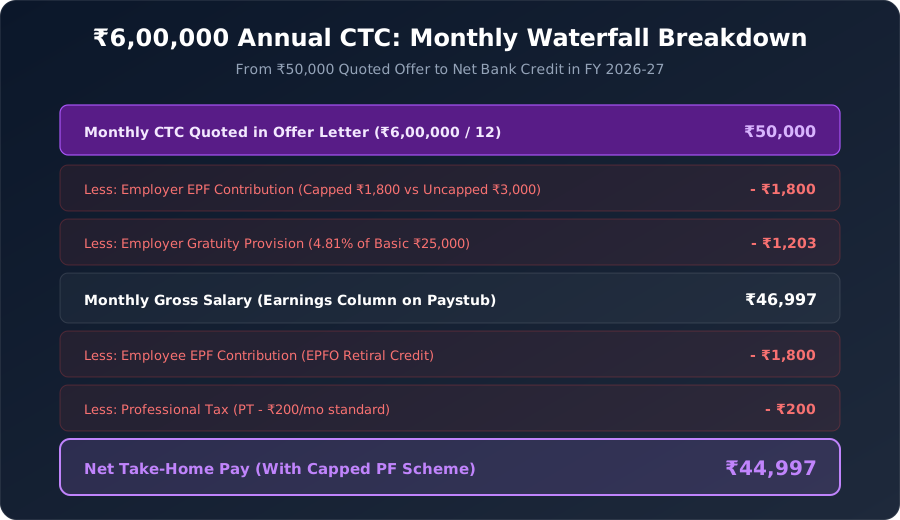 Figure 1: Step-by-step waterfall diagram showing how ₹50,000 monthly CTC is distributed into statutory retirals and net in-hand pay.
Itemized Paystub Breakdown: From ₹50,000 to ₹45,000
To see how each rupee is allocated, let us examine a standard 6 LPA compensation structure where the Basic Salary is set at 50% of CTC under the statutory capped EPF scheme:
| Salary Component | Calculation Basis | Annual Value (INR) | Monthly Value (INR) | Classification |
|---|---|---|---|---|
| Basic Salary | 50% of CTC | ₹3,00,000 | ₹25,000 | Taxable Base Earnings |
| House Rent Allowance (HRA) | 40% of Basic (Non-Metro) | ₹1,20,000 | ₹10,000 | Taxable / Exempt u/s 10(13A) |
| Special Allowance | Balancing Residual Component | ₹1,43,964 | ₹11,997 | Fully Taxable Allowance |
| Gross Pay (Earnings on Paystub) | Basic + HRA + Special Allowance | ₹5,63,964 | ₹46,997 | Gross Payslip Earnings |
| Employer EPF Contribution | Capped at ₹15,000 ceiling (12%) | ₹21,600 | ₹1,800 | Employer Retiral (Part of CTC) |
| Gratuity Provision | 4.81% of Basic Salary | ₹14,436 | ₹1,203 | Statutory Reserve (Part of CTC) |
| Total Cost to Company (CTC) | Gross Pay + Employer Retirals | ₹6,00,000 | ₹50,000 | Recruiter Quoted Package |
| Employee EPF Deduction | 12% statutory deduction | ₹21,600 | ₹1,800 | Deduction to EPFO Account |
| Professional Tax (PT) | State slab (KA, MH, TS, WB) | ₹2,400 | ₹200 | State Government Withholding |
| Income Tax (TDS - New Regime) | Standard Deduction + Sec 87A | ₹0 | ₹0 | 100% Tax Free via Rebate |
| Net Monthly In-Hand Salary | Gross Pay − Deductions | ₹5,39,964 | ₹44,997 | Net Credited to Bank Account |
When an employer applies the standard capped EPF mechanism, your gross earnings equal ₹46,997 per month. Deducting ₹1,800 for your EPF and ₹200 for state professional tax yields an exact in-hand salary of ₹44,997 per month. You can verify your personalized salary numbers instantly with our CTC to In-Hand Salary Calculator.
Old vs New Tax Regime Deep Dive: Why Regime Choice Matters at 6 LPA
At 6 LPA, the choice between the Old Tax Regime and the New Tax Regime ceases to be an academic question—it directly dictates whether you pay zero tax or inadvertently lose nearly ₹15,000.
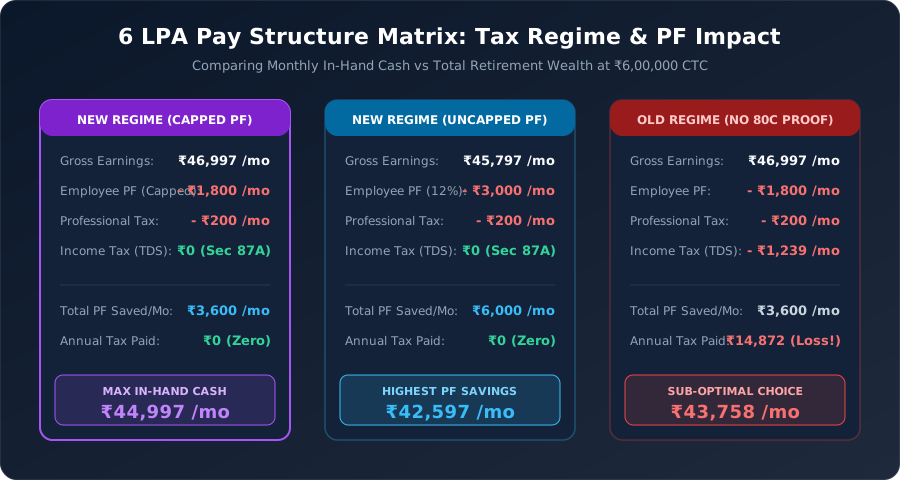 Figure 2: Architectural comparison of 3 common 6 LPA scenarios showing why New Regime prevents tax loss.
Scenario A: The New Tax Regime (Recommended Default)
Under the default New Tax Regime for FY 2026-27 (AY 2027-28):
- Gross Salary: ₹5,63,964
- Standard Deduction (Section 16 ia): ₹75,000
- Net Taxable Income: ₹5,63,964 − ₹75,000 = ₹4,88,964
- Tax Computation:
- ₹0 to ₹3,00,000 @ 0% = ₹0
- ₹3,00,001 to ₹4,88,964 (₹1,88,964) @ 5% = ₹9,448
- Section 87A Tax Rebate: In the New Tax Regime, any resident individual with taxable income up to ₹7,00,000 receives a full tax rebate up to ₹25,000.
- Net Tax Liability: ₹9,448 − ₹9,448 = ₹0.00.
Under the New Tax Regime, your tax liability is literally zero. You do not have to purchase expensive insurance policies, maintain rent receipts, or lock away capital in ELSS mutual funds.
Scenario B: The Old Tax Regime (The Accidental Tax Trap)
Under the Old Tax Regime, the standard deduction is capped at ₹50,000. Gross salary of ₹5,63,964 minus ₹50,000 leaves a taxable income of ₹5,13,964.
Under Old Regime rules, the Section 87A rebate is available only if your net taxable income is ₹5,00,000 or below. Because ₹5,13,964 exceeds ₹5,00,000 by just ₹13,964, the entire Section 87A rebate is disqualified!
Unless the employee proactively submits additional deductions (such as HRA exemption or extra Section 80C investments like ELSS or PPF beyond their ₹21,600 EPF), their tax liability jumps to:
- Tax on ₹2,50,000 to ₹5,00,000 (5%) = ₹12,500
- Tax on ₹5,00,001 to ₹5,13,964 (20%) = ₹2,793
- Health & Education Cess (4%) = ₹612
- Total Old Regime Tax: ₹15,905 (an unnecessary monthly loss of ~₹1,325 in take-home pay).
Compare your exact tax scenario across both regimes with our Income Tax Calculator.
EPF Mathematics: Capped ₹1,800 vs Uncapped 12%
At 6 LPA, your monthly basic salary is ₹25,000, which exceeds the EPFO statutory wage ceiling of ₹15,000. This opens two distinct operational choices in corporate payroll:
| EPF Contribution Model | Monthly Employee PF | Monthly Employer PF | Total Monthly PF Saved | Net Monthly In-Hand |
|---|---|---|---|---|
| Statutory Capped PF (₹15,000 base) | ₹1,800 | ₹1,800 | ₹3,600 /mo | ₹44,997 |
| Uncapped PF (12% of actual ₹25,000 base) | ₹3,000 | ₹3,000 | ₹6,000 /mo | ₹42,597 |
Which is better? In the uncapped scheme, you sacrifice ₹2,400 of immediate in-hand cash each month. However, an additional ₹2,400 (₹1,200 from your salary + ₹1,200 from employer matching funds) enters your government-guaranteed EPF account every single month. Over a 5-year span, this difference alone accumulates into more than ₹1.85 Lakhs of sovereign-backed, compound tax-free retiral wealth. Model your long-term PF compounding with our EPF Calculator.
Gratuity Calculations & Vesting Rules
Every 6 LPA offer letter typically budgets roughly ₹14,400 per year (₹1,203/month) under the heading of Gratuity. Under the Payment of Gratuity Act, 1972, this sum is not paid monthly. It represents a mandatory employer accrual payable when you separate from the company after completing 5 continuous years of service (or upon retirement or death).
The statutory formula for gratuity payout is:
Gratuity = (15 × Last Drawn Basic Salary × Tenure in Years) ÷ 26
If you work for 5 years at a final basic salary of ₹25,000, your statutory gratuity payout is (15 × 25,000 × 5) / 26 = ₹72,115. Check your future retiral payouts using our free Gratuity Calculator.
State-by-State Professional Tax Variations
Salaried professionals in India are subject to state-level Professional Tax (PT). For a 6 LPA package (monthly gross ~₹47,000), here is how your base location affects your take-home pay:
- Karnataka (Bengaluru): ₹200/month (Annual: ₹2,400). Monthly In-Hand: ~₹44,997.
- Maharashtra (Mumbai / Pune): ₹200/month for 11 months, ₹300 in February (Annual: ₹2,500). Monthly In-Hand: ~₹44,997 (₹44,897 in Feb).
- Telangana (Hyderabad): ₹200/month (Annual: ₹2,400). Monthly In-Hand: ~₹44,997.
- Tamil Nadu (Chennai): Levied half-yearly at ₹1,250 (Annual: ₹2,500, approx. ₹208/month). Monthly In-Hand: ~₹44,989.
- Delhi NCR & Haryana (Gurugram): No Professional Tax levied. Monthly In-Hand: ~₹45,197 (highest in India).
Smart Budgeting & Wealth Allocation on ₹45,000 In-Hand
Taking home ₹45,000 per month grants comfortable urban living across Indian metro hubs while maintaining strong compounding potential. A practical financial allocation for a young professional earning ₹45,000 per month:
Rent (independent 1BHK or comfortable 2BHK flatshare), electricity, groceries, Wi-Fi, and transport.
Dining out, entertainment, weekend leisure, apparel, and personal skill development courses.
Automated monthly SIP into diversified equity index funds and building a 6-month emergency reserve.
Investing ₹14,000 every month in an equity mutual fund SIP delivering an annualized return of 12% compounds into:
- After 5 Years: Over ₹11.5 Lakhs (invested capital: ₹8.4 Lakhs).
- After 10 Years: Over ₹32.5 Lakhs (invested capital: ₹16.8 Lakhs).
- After 15 Years: Over ₹70.6 Lakhs (invested capital: ₹25.2 Lakhs).
Calculate your custom investment compounding milestones with our SIP Calculator.
4 Strategic Offer Negotiation Tactics at 6 LPA
When negotiating a 6 LPA offer letter, these four tactics help you maximize disposable take-home pay and avoid common traps:
- Insist on 100% Fixed Base: Ensure your ₹6,00,000 CTC does not hide 15% to 20% in "discretionary performance bonus". A ₹6,00,000 offer with 20% variable means your fixed pay is only ₹4.8 LPA, dropping your monthly guaranteed in-hand from ₹45,000 down to ₹35,800.
- Request Capped EPF if In-Hand Cash is Priority: If you need immediate liquidity to service education loans or manage family commitments, formally request HR to cap your EPF contribution at the statutory ₹1,800/month limit.
- Inspect Health Insurance Inclusions: Check whether company group health insurance is paid as an employer perk or deducted from your Special Allowance bucket.
- Target a 35% to 45% Next Increment: When switching from a 6 LPA role after 2 years of proven performance, target a 35% to 45% hike to reach 8.1 LPA to 8.7 LPA. You can simulate future increments with our Salary Hike Calculator.
Frequently Asked Questions
What is the exact monthly take-home salary for 6 LPA in India?
On a 6 LPA CTC package, your monthly take-home salary is ₹44,997 if your employer caps EPF at ₹1,800 per month, and roughly ₹42,600 if your employer deducts an uncapped 12% EPF on your actual basic pay of ₹25,000.
Do I have to pay any income tax on 6 LPA in FY 2026-27?
No. Under the default New Tax Regime, your standard deduction of ₹75,000 reduces taxable income to ₹4,89,000. Under Section 87A rebate, all taxable income up to ₹7,00,000 is 100% tax-free. Your income tax liability is exactly ₹0.
What happens if I accidentally choose the Old Tax Regime at 6 LPA?
Under the Old Regime, the standard deduction is only ₹50,000, leaving a taxable income of ₹5,13,964. If you fail to submit sufficient Section 80C investment proofs, you lose the Section 87A rebate and will be taxed approximately ₹15,900 per year (~₹1,325/month). Always select the New Tax Regime unless you have substantial home loan interest and 80C deductions.
Does ESI deduction apply to a 6 LPA salary?
No. Employee State Insurance (ESI) is applicable only if an employee's monthly gross wage is ₹21,000 or below. At 6 LPA, your gross monthly pay is approximately ₹47,000, far above the statutory ESI limit.
Can I take an education loan or car loan on a 6 LPA salary?
Yes. With a stable monthly net take-home salary of roughly ₹45,000, banks typically approve car loans or personal loans with monthly EMIs up to 40% to 50% of your net pay (₹18,000 to ₹22,500/month). You can calculate your exact loan EMIs using our EMI Calculator.
Should I file an ITR on 6 LPA even if my tax is zero?
Yes, filing ITR-1 is mandatory under Section 139(1) of the Income Tax Act because your gross total income (₹5,64,000) exceeds the basic exemption limit before standard deductions. Furthermore, your ITR acknowledgment is essential for financial compliance and loan approvals.