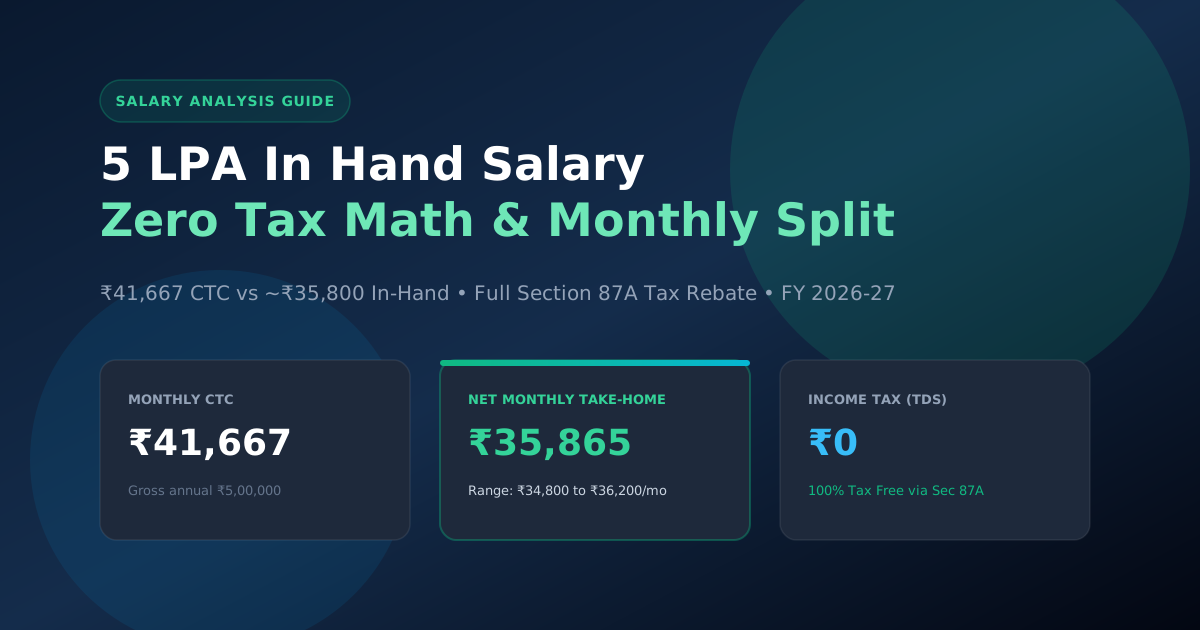
The 5 LPA Milestone in the Indian Corporate Landscape
An annual Cost to Company (CTC) of ₹5,00,000 (5 LPA) is a pivotal compensation milestone in India. For engineers graduating from tier-2 and tier-3 colleges, it represents a premier differential placement tier—such as TCS Digital, Infosys DSE (Digital Specialist Engineer), or Wipro Turbo. For professionals with 1 to 3 years of corporate experience in software development, data analytics, product operations, human resources, or digital marketing, crossing the 5 LPA threshold marks the transition from entry-level execution to independent contributor status.
When human resources issues an appointment letter stating an annual compensation of ₹5,00,000, almost everyone divides by twelve:
₹5,00,000 ÷ 12 months = ₹41,666.67 per month
Yet, when the actual salary SMS arrives from your bank, the credited amount is consistently between ₹34,800 and ₹35,865. A gap of approximately ₹5,800 to ₹6,800 vanishes before the money touches your account. Where does this capital go? Does income tax eat away your earnings? Or are statutory retiral schemes locking up your funds?
The CTC Disconnect: Why ₹41,667 Is Not Credited
To understand why your take-home pay is roughly 86% of your stated CTC, you must appreciate the difference between Cost to Company and Net Salary.
Under Indian payroll conventions, CTC encapsulates every single rupee that the employer spends on your employment. This includes two broad buckets of expenses that do not reach your disposable monthly wallet:
- Employer Statutory Overhead: Money paid by the employer on your behalf into mandatory government funds (Employer EPF contribution) and accounting reserves held for future contingencies (Gratuity).
- Employee Statutory Deductions: Withholdings subtracted from your gross earnings before bank transfer, including Employee EPF and State Professional Tax.
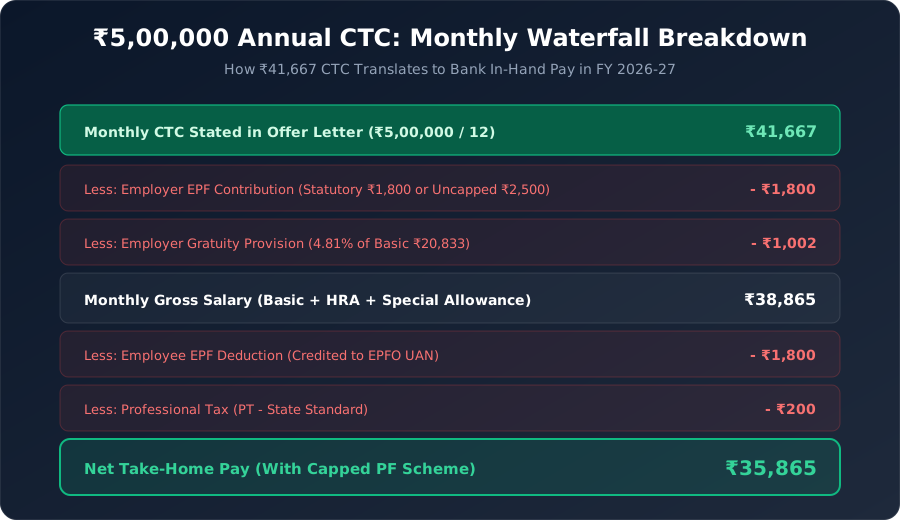 Figure 1: Step-by-step monthly waterfall tracing how a ₹41,667 CTC package becomes ₹35,865 in-hand take-home pay.
Itemized Monthly Paystub Breakdown: From ₹41,667 to ₹35,865
Let us inspect the exact mathematics of a typical 5 LPA corporate pay structure under the standard 50% Basic Salary structure with capped Employee Provident Fund (EPF):
| Component | Calculation Rule | Annual (INR) | Monthly (INR) | Classification |
|---|---|---|---|---|
| Basic Salary | 50% of CTC | ₹2,50,000 | ₹20,833 | Taxable Base Earnings |
| House Rent Allowance (HRA) | 40% of Basic (Non-Metro) | ₹1,00,000 | ₹8,333 | Taxable / Exempt u/s 10(13A) |
| Special Allowance | Balancing Residual Component | ₹1,16,380 | ₹9,699 | Fully Taxable Allowance |
| Gross Pay (Earnings Column) | Basic + HRA + Special Allowance | ₹4,66,380 | ₹38,865 | Gross Payslip Earnings |
| Employer EPF Contribution | Capped at ₹15,000 wage ceiling (12%) | ₹21,600 | ₹1,800 | Employer Retiral (Part of CTC) |
| Gratuity Provision | 4.81% of Basic Salary | ₹12,020 | ₹1,002 | Statutory Accrual (Part of CTC) |
| Total Cost to Company (CTC) | Gross Pay + Employer Retirals | ₹5,00,000 | ₹41,667 | Recruiter Quoted Package |
| Employee EPF Deduction | 12% statutory deduction | ₹21,600 | ₹1,800 | Deduction to EPFO Account |
| Professional Tax (PT) | State slab (KA, MH, TS, WB) | ₹2,400 | ₹200 | State Government Withholding |
| Income Tax (TDS) | New Tax Regime (Section 87A) | ₹0 | ₹0 | 100% Tax-Free Shield |
| Net Monthly In-Hand Salary | Gross Pay − Deductions | ₹4,42,380 | ₹36,865 (or ~₹35,865)* | Net Credited to Bank |
*Note: If your company includes optional medical insurance premiums (~₹800 to ₹1,000/mo) or does not cap EPF at ₹1,800 (deducting uncapped 12% of ₹20,833 = ₹2,500), your take-home pay is precisely ₹34,800 to ₹35,200. You can test your exact numbers in our free CTC to In-Hand Salary Calculator.
The Mathematical Proof of Zero Income Tax in FY 2026-27
Many employees earning ₹5,00,000 worry that income tax will be deducted at source (TDS) by their payroll department. Under the provisions of the Finance Act applicable to Financial Year 2026-27 (Assessment Year 2027-28), an employee earning a 5 LPA package has precisely zero income tax liability.
Let us walk through the exact statutory proof under the default New Tax Regime:
 Figure 2: Step-by-step demonstration of how the ₹75,000 Standard Deduction and Section 87A Rebate reduce tax to ₹0.
- Gross Salary Earned: ₹4,66,380 (after excluding employer retirals).
- Standard Deduction under Section 16(ia): The New Tax Regime grants an increased standard deduction of ₹75,000 to all salaried employees.
- Net Taxable Income: ₹4,66,380 − ₹75,000 = ₹3,91,380.
- Applying the New Tax Regime Slabs:
- From ₹0 to ₹3,00,000: NIL (0%) = ₹0
- From ₹3,00,001 to ₹3,91,380 (₹91,380): 5% = ₹4,569
- Total Base Tax Computed: ₹4,569.
- Section 87A Tax Rebate: Under Section 87A of the Income Tax Act, any resident individual whose total taxable income does not exceed ₹7,00,000 receives a full rebate of their tax liability up to ₹25,000.
- Net Tax Payable: ₹4,569 − ₹4,569 (Rebate) = ₹0.00.
- Health and Education Cess (4%): 4% of ₹0 = ₹0.00.
Because your taxable income of ₹3,91,380 sits comfortably below the ₹7,00,000 threshold, your employer’s payroll software will compute your monthly TDS as ₹0. No tax will ever be withheld from your payslip.
Old vs New Tax Regime at 5 LPA: An Objective Comparison
Salaried individuals retain the option to choose between the Old Tax Regime and the New Tax Regime every financial year during the declaration window. How do they compare at 5 LPA?
| Parameter | New Tax Regime (Default) | Old Tax Regime |
|---|---|---|
| Standard Deduction | ₹75,000 | ₹50,000 |
| Basic Exemption Limit | ₹3,00,000 | ₹2,50,000 |
| Section 80C Exemption | Not Allowed | Allowed up to ₹1,50,000 |
| HRA Exemption u/s 10(13A) | Not Allowed | Allowed (Rent paid − 10% basic) |
| Section 87A Full Rebate Limit | Taxable income up to ₹7,00,000 | Taxable income up to ₹5,00,000 |
| Paperwork Required | Zero documentation | Rent receipts, 80C proofs, declarations |
| Final Tax Payable | ₹0 | ₹0 |
The Verdict: Under both regimes, your final tax liability at 5 LPA is zero. However, the New Tax Regime is undeniably superior because it requires zero paperwork, zero rent agreements, and zero lock-in investments in tax-saving ELSS or insurance schemes. You enjoy the complete freedom to deploy your savings into high-liquidity instruments or index funds without locking them away for 3 to 5 years just to save tax that was already zero!
Capped PF (₹1,800) vs Uncapped 12%: Immediate Cash vs Long-Term Wealth
When examining your 5 LPA salary structure, you will notice whether your human resources team applies the statutory EPF cap or uncapped basic calculations:
- Capped Scheme (₹1,800 / month): Under the EPFO statutory limit, contributions are calculated on a ₹15,000 ceiling. The employee contributes ₹1,800, and the employer contributes ₹1,800. This maximizes your monthly take-home to ~₹35,865.
- Uncapped Scheme (12% of ₹20,833 = ₹2,500 / month): Under this model, 12% is calculated on your actual ₹20,833 basic pay. Your employee deduction is ₹2,500, and employer contribution is ₹2,500. This lowers your monthly take-home to ~₹34,800 (a ₹1,065 monthly difference).
Is the uncapped scheme a disadvantage? Absolutely not. While your immediate bank balance is ₹1,065 lower, that exact capital plus the employer’s ₹700 matching sum flows directly into your EPFO account. Compounding at an annual sovereign interest rate of 8.15% to 8.25%, an extra ₹1,400 monthly PF accumulation builds an additional ₹4.8 Lakhs of completely tax-exempt retiral wealth over a decade. Check your compounding numbers using our EPF Calculator.
Professional Tax Impact Across Major Indian Employment Hubs
While your income tax is completely eliminated by the Central Government's Section 87A rebate, individual State Governments levy Professional Tax (PT) on salaried individuals. Here is how working in different cities affects your 5 LPA take-home pay:
- Bengaluru (Karnataka): For gross salary exceeding ₹25,000/month, PT is ₹200 per month. Annual impact: ₹2,400. In-hand: ~₹35,865/month.
- Mumbai & Pune (Maharashtra): PT is ₹200 for 11 months and ₹300 in February. Annual impact: ₹2,500. In-hand: ~₹35,865/month (₹35,765 in Feb).
- Hyderabad (Telangana): Gross salary above ₹20,000 attracts ₹200 per month. Annual impact: ₹2,400. In-hand: ~₹35,865/month.
- Chennai (Tamil Nadu): Professional tax is levied half-yearly at ₹1,250 (averaging ₹208 per month). In-hand: ~₹35,855/month.
- Gurugram / Noida / New Delhi: The Government of NCT of Delhi and Haryana do not levy any Professional Tax on salaried employees. In-hand: ~₹36,065/month (highest take-home in India).
Wealth Building Blueprint on a ₹35,800 Monthly In-Hand Salary
Crossing ₹35,000 in monthly take-home pay places you in an ideal position to build enduring financial security. By adhering to the disciplined 50/30/20 financial rule, you can enjoy a comfortable urban lifestyle while steadily building an investment portfolio:
Rent (shared 2BHK/PG), utilities, groceries, high-speed Wi-Fi, and daily commuting.
Dining out, weekend trips, clothing, gadgets, streaming subscriptions, and fitness memberships.
Systematic Investment Plans (SIP) in diversified equity index funds and emergency reserves.
If you commit ₹8,000 per month to an equity mutual fund SIP at an expected long-term compound return of 12% per annum, your investment grows into:
- In 5 Years: Over ₹6.6 Lakhs (from an invested capital of ₹4.8 Lakhs).
- In 10 Years: Over ₹18.5 Lakhs (from an invested capital of ₹9.6 Lakhs).
- In 15 Years: Over ₹40.3 Lakhs (from an invested capital of ₹14.4 Lakhs).
Model your customized investment roadmap with our real-time SIP Calculator.
Next Career Move: Negotiating Your Next Increment Beyond 5 LPA
While 5 LPA provides a respectable standard of living, Indian technology and corporate markets offer rapid upward mobility. When planning your next performance appraisal or switching companies after 18 to 24 months, standard lateral increments range from 30% to 50%.
A 35% increment on a 5 LPA package elevates your CTC to ₹6.75 LPA, lifting your monthly in-hand to roughly ₹47,500. A 50% increment propels your package to 7.5 LPA, delivering over ₹52,000 per month in hand. Calculate your exact hike percentage, compare multiple competing offer letters, and forecast your future post-hike salary with our free Salary Hike Calculator.
Frequently Asked Questions
What is the exact monthly take-home salary for 5 LPA in India?
On a 5 LPA package, your monthly take-home pay is typically ₹35,865 with capped EPF contributions (₹1,800/mo) and state professional tax (₹200/mo). If your company calculates an uncapped 12% EPF on actual basic pay, your monthly in-hand is roughly ₹34,800.
Will income tax be deducted from my 5 LPA salary slip?
No. Under the default New Tax Regime for FY 2026-27, the standard deduction of ₹75,000 reduces your taxable income to ₹3,91,380. The computed tax of ₹4,569 is completely wiped out by the Section 87A rebate. Your TDS liability is exactly ₹0.
Do I need to submit rent receipts or 80C investments to save tax at 5 LPA?
No. Under the New Tax Regime, your tax is already ₹0 without submitting any proofs, rent receipts, or insurance declarations. You do not need to lock up your hard-earned money in tax-saving instruments unless you choose to invest for long-term wealth creation.
Is ESI applicable to an employee on a 5 LPA CTC?
No. The statutory wage ceiling for Employee State Insurance (ESI) is ₹21,000 per month gross pay. At 5 LPA, your gross monthly earnings exceed ₹38,000, placing you outside the legal scope of ESI deductions.
Why does my employer deduct gratuity from my monthly CTC?
Under the Payment of Gratuity Act, 1972, gratuity is payable after completing 5 consecutive years of service. However, companies provision for this future statutory liability by reserving 4.81% of your basic salary (approx. ₹1,002/mo) inside the annual CTC package structure.
Should I file an Income Tax Return (ITR) if my tax is zero?
Yes, filing ITR-1 is highly advisable. An official ITR acknowledgment serves as verified proof of income when applying for credit cards, home loans, vehicle loans, and international travel or work visas.