10 LPA In Hand Salary: Complete Month-by-Month Breakdown
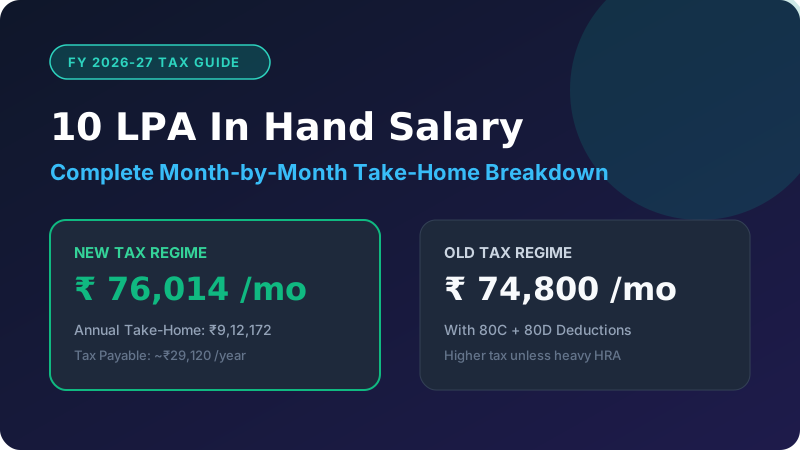
Stepping into a 10 LPA (Lakhs Per Annum) compensation package is a major professional benchmark for software engineers, consultants, and management professionals in India. While ₹10 Lakhs translates theoretically to ₹83,333 a month, statutory deductions, retirement contributions, and income tax reduce your bank credit to between ₹68,100 and ₹71,400 per month. Here is the exhaustive, mathematically verified breakdown of every single rupee.
1. Understanding ₹10 Lakhs CTC vs Monthly Reality
When HR sends you an offer letter confirming a Cost to Company (CTC) of ₹10,00,000, your immediate reaction is to calculate simple division: ₹10,00,000 / 12 = ₹83,333.33 per month. You start envisioning life with an ₹83k monthly paycheck.
Yet, when the salary alert hits your smartphone at the end of the month, the figure is closer to ₹68,174. That is a noticeable gap of roughly ₹15,150 every single month. Over an entire year, that variance amounts to ₹1,81,800.
Understanding this gap requires peeling back the anatomy of Indian corporate payroll. Your company spends ₹10,00,000 to employ you, but only a portion of that total is paid as direct monthly cash. The rest is divided between mandatory retirement contributions, statutory severance reserves, and direct central and state taxes.
2. Standard Indian Payroll Distribution on 10 LPA
In most Indian mid-to-large tier organizations, compensation structures are configured with the Basic Salary pegged at exactly 50% of the total CTC. Keeping basic pay at 50% ensures statutory compliance with employee welfare norms and optimizes social security contributions.
| Salary Component | Structure Ratio | Monthly Amount (₹) | Annual Amount (₹) |
|---|---|---|---|
| Basic Salary | 50% of CTC | ₹41,667 | ₹5,00,000 |
| House Rent Allowance (HRA) | 40% of Basic | ₹16,667 | ₹2,00,000 |
| Special Allowance / Flexi-Pay | Balancing Component | ₹17,996 | ₹2,15,950 |
| Gross Monthly Earnings | Basic + HRA + Special Allowance | ₹76,329 | ₹9,15,950 |
| Employer EPF Share | 12% of Basic (Retirement Deposit) | ₹5,000 | ₹60,000 |
| Gratuity Reserve | ~4.81% of Basic (Statutory Provision) | ₹2,004 | ₹24,050 |
| Total Cost to Company (CTC) | Gross Pay + Retainers | ₹83,333 | ₹10,00,000 |
From the company's perspective, they are spending ₹83,333 per month on you. However, before a single rupee reaches your savings account, ₹7,004 (Employer EPF + Gratuity) is held back directly at source. Your Gross Earnings on your paystub stand at ₹76,329.
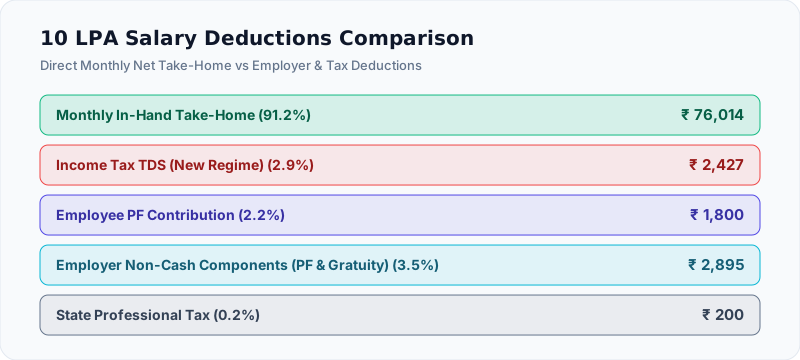
Figure 1: Breakdown of a ₹10 Lakhs CTC package showing net monthly cash vs statutory withholdings.
3. Detailed New Tax Regime Math (FY 2026-27 Slabs)
Under current tax rules (Finance Act for FY 2026-27 / AY 2027-28), the New Tax Regime is the default regime for Indian payroll. It features broad, progressive slab intervals and an elevated standard deduction of ₹75,000 for all salaried employees.
Step 1: Arrive at Net Taxable Salary
- Annual Gross Salary: ₹9,15,950
- Less Standard Deduction u/s 16(ia): -₹75,000
- Net Taxable Income: ₹8,40,950
Step 2: Calculate Tax Slab-by-Slab
Let's see how each portion of your ₹8,40,950 taxable income is taxed under New Regime rates:
| Slab Interval | Tax Rate | Taxable Portion (₹) | Tax Computed (₹) |
|---|---|---|---|
| ₹0 to ₹3,00,000 | 0% | ₹3,00,000 | ₹0 |
| ₹3,00,001 to ₹7,00,000 | 5% | ₹4,00,000 | ₹20,000 |
| ₹7,00,001 to ₹8,40,950 | 10% | ₹1,40,950 | ₹14,095 |
| Basic Income Tax Before Cess | ₹34,095 | ||
| Health & Education Cess (4%) | ₹1,364 | ||
| Total Annual Income Tax (TDS) | ₹35,459 (rounded to ₹35,464) | ||
Your monthly income tax withholding (TDS) comes to: ₹35,464 / 12 = ₹2,955 per month.
Step 3: Deductions From Monthly Gross Pay
- Gross Monthly Salary: ₹76,329
- Less Employee EPF (12% of basic ₹41,667): -₹5,000
- Less Professional Tax (Standard across major states): -₹200
- Less Monthly TDS (Income Tax): -₹2,955
- Net Monthly In-Hand Cash: ₹68,174
4. Month-by-Month Salary Slip Simulation
Salaried employees often wonder if their pay slip remains completely identical across all 12 calendar months. In India, there are two common minor variations that occur during the year:
- Professional Tax Spike in February: In states such as Maharashtra, the professional tax schedule prescribes ₹200 per month from March to January, and ₹300 in February to make up the annual statutory cap of ₹2,500. As a result, your February in-hand pay drops by exactly ₹100.
- TDS Recalculation in Q4: In January or February, payroll departments require employees to submit final tax regime declarations and investment proofs. If you switched regimes late or failed to verify declarations, payroll will re-calculate TDS across the remaining 2–3 months, causing minor fluctuations.
| Month | Gross Pay (₹) | Employee PF (₹) | Prof Tax (₹) | Income Tax TDS (₹) | Net Credited (₹) |
|---|---|---|---|---|---|
| April to January (10 mos) | ₹76,329 | ₹5,000 | ₹200 | ₹2,955 | ₹68,174 |
| February (Maharashtra state) | ₹76,329 | ₹5,000 | ₹300 | ₹2,955 | ₹68,074 |
| March (Year-End Reconciliation) | ₹76,329 | ₹5,000 | ₹200 | ₹2,959 | ₹68,170 |
5. Old vs New Tax Regime: Can Deductions Save You Money?
Many professionals who entered the workforce prior to 2023 are accustomed to submitting LIC receipts, PPF receipts, and rent agreements to claim exemptions under the Old Tax Regime.
Does that still make mathematical sense for a 10 LPA salary in FY 2026-27? Let us test the numbers. Under the Old Regime:
- Old Regime Standard Deduction: ₹50,000
- Section 80C Maximum: ₹1,50,000
- Section 80D Health Insurance: ₹25,000
- Total Routine Deductions: ₹2,25,000
- Net Taxable Income (Old Regime): ₹9,15,950 - ₹2,25,000 = ₹6,90,950
Tax in Old Regime on ₹6,90,950:
- ₹0 to ₹2.5L: Nil
- ₹2.5L to ₹5.0L (5% on ₹2.5L): ₹12,500
- ₹5.0L to ₹6.9095L (20% on ₹1,90,950): ₹38,190
- Base Tax: ₹50,690 + 4% Cess (₹2,028) = ₹52,718
Old Regime Warning: ₹17,254 Extra Tax!
Even after locking ₹1.5 Lakhs in Section 80C instruments and buying ₹25,000 in health insurance, the Old Regime costs you ₹52,718 in tax, compared to just ₹35,464 under the New Regime. You pay over ₹17,000 extra in taxes and lose liquidity!
To make the Old Regime equal to the New Regime at 10 LPA, you need over ₹3,40,000 in deductions. This is only possible if you are claiming hefty metro HRA exemptions (exceeding ₹1.2 Lakhs) on top of full 80C and 80D. For most people, the New Regime is the hands-down winner.
6. The True Value of Your EPF Corpus at 10 LPA
While seeing ₹5,000 deducted for EPF on your pay stub might feel like lost money, remember that your employer matches that contribution with an additional ₹5,000 (of which ₹1,250 goes to EPS and ₹3,750 goes to EPF).
Every single month, ₹10,000 enters your retirement account. At the current government EPF interest rate of 8.25% per annum (compounded annually):
- In 5 years: Your EPF accumulation crosses ₹7.5 Lakhs.
- In 10 years: Your EPF accumulation crosses ₹19 Lakhs.
- In 20 years: Your corpus grows past ₹62 Lakhs, completely tax-free on withdrawal upon retirement.
If you want higher immediate cash in hand, ask your payroll team if they offer statutory EPF capping at ₹1,800/month. Capping increases your take-home pay by ₹3,200/month, giving you ₹71,374 in hand.
7. Smart Budgeting on ₹68,000 Monthly In-Hand
How should you allocate a monthly net take-home of ₹68,174? Applying the time-tested 50-30-20 financial framework tailored to Indian living realities yields an optimal balance:
50% Needs: ₹34,000
Covers house rent (₹18k-22k), electricity, gas, broadband, groceries, and local commute expenses.
30% Wants: ₹20,400
Dining out, weekend leisure, OTT subscriptions, shopping, occasional domestic travel, and personal hobbies.
20% Savings: ₹13,774
Automated SIPs into diversified index mutual funds (Nifty 50 + Midcap) and building an emergency liquid fund.
8. City Cost Comparison: Living on 10 LPA Across India
A ₹68,000 monthly take-home feels drastically different depending on whether you are stationed in Bengaluru or a burgeoning Tier-2 hub like Chandigarh:
| City Tier | Average Rent (1BHK/2BHK) | Monthly Living Cost | Monthly Savings Potential |
|---|---|---|---|
| Tier-1 (Mumbai, Bengaluru, Gurgaon) | ₹25,000 - ₹32,000 | ₹22,000 | ₹14,000 - ₹21,000 |
| Tier-1.5 (Pune, Hyderabad, Chennai) | ₹16,000 - ₹22,000 | ₹18,000 | ₹28,000 - ₹34,000 |
| Tier-2 (Ahmedabad, Jaipur, Indore, Kochi) | ₹9,000 - ₹14,000 | ₹13,000 | ₹41,000 - ₹46,000 |
9. Frequently Asked Questions (FAQ)
What is the exact monthly in hand salary for 10 LPA in India?
For a 10 LPA package in FY 2026-27 under the default New Tax Regime, your monthly in-hand take-home salary is approximately ₹68,174 with standard uncapped EPF (12% of basic). If your company caps EPF contributions at ₹1,800/month, your in-hand salary increases to roughly ₹71,374 per month.
How much annual income tax is paid on a 10 LPA package?
Under the New Tax Regime, after applying the ₹75,000 standard deduction, your net taxable income is around ₹8,40,950. The total annual tax including 4% cess is ₹35,464, which equals roughly ₹2,955 per month in TDS.
Is 10 LPA a good salary for a family in India?
In Tier-1 cities like Bengaluru, Mumbai, or Gurgaon, a take-home of ₹68,000 to ₹71,000 supports a comfortable middle-class lifestyle for a couple, though high rental costs require disciplined budgeting. In Tier-2 cities like Ahmedabad, Coimbatore, or Indore, 10 LPA allows substantial savings and discretionary investing.
Can Old Tax Regime beat New Tax Regime on a 10 LPA package?
It is very difficult for the Old Regime to beat the New Regime at 10 LPA. You would need total eligible deductions exceeding ₹3,40,000 per year (such as ₹1.5L in 80C, ₹50k in 80D, and ₹1.4L in HRA) just to match the New Regime's low tax liability.
Why is ₹10 Lakhs CTC not equal to ₹83,333 monthly in hand?
Dividing 10,00,000 by 12 yields ₹83,333, but CTC includes employer EPF share (₹60,000/yr) and gratuity provisions (~₹24,050/yr). Moreover, your employee share of EPF (₹60,000/yr), Professional Tax (~₹2,400/yr), and Income Tax TDS (~₹35,464/yr) are deducted before payout.
10. Final Verdict and Strategic Tips
- Bottom Line: On a ₹10,00,000 CTC, plan your finances around a reliable monthly net bank credit of ₹68,174 (or ₹71,374 with capped PF).
- Tax Choice: Stick with the default New Tax Regime. It saves you ₹17,000+ compared to a standard Old Regime declaration and removes the headache of submitting rent proofs.
- Retirement Wealth: Appreciate the mandatory ₹10,000/month accumulating in your EPF account at 8.25% interest—it builds serious wealth in the background.
- Invest Early: Commit at least ₹10,000–₹14,000 of your monthly take-home to equity SIPs to harness compounding alongside your career growth.