12 LPA In Hand Salary: Monthly Take-Home Under Old and New Tax Regime
Receiving an offer letter of ₹12,00,000 per annum is an exciting career milestone. But when the salary SMS arrives on the last day of the month, the actual amount credited is never ₹1,00,000. Here is the realistic, itemized breakdown of what you actually take home every month, backed by statutory payroll math and tax provisions.
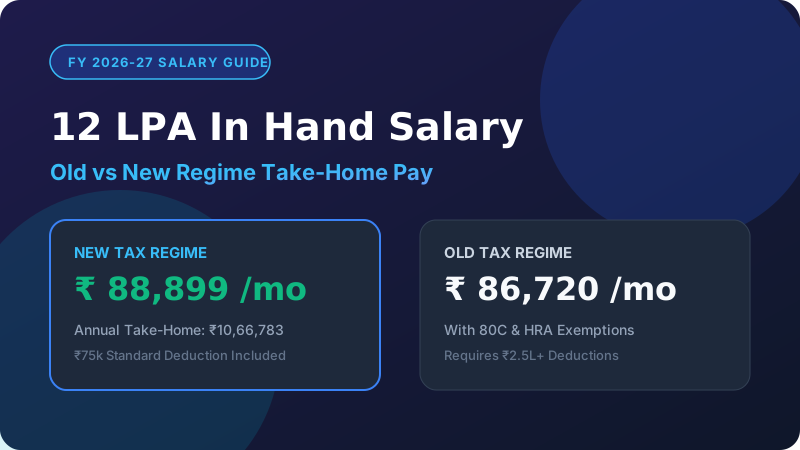
1. The 12 LPA Reality: Why ₹1,00,000 Is a Myth
When you receive an offer of 12 LPA (Lakhs Per Annum), your first mental calculation is simple: ₹12,00,000 divided by 12 equals ₹1,00,000 per month. You start planning rent, EMIs, household budgets, and discretionary investments around this six-figure monthly inflow.
However, Indian corporate payroll structures operate under a multi-layered filter of statutory deductions, employer retainers, social security allocations, and direct tax withholdings. By the time your salary transitions from Cost to Company (CTC) into Gross Pay and finally lands as Net Salary in your bank account, you typically receive between ₹80,500 and ₹85,200 per month.
Where does the remaining ₹15,000 to ₹19,500 disappear every month? It goes into three broad buckets:
- Non-cash company allocations: Employer Provident Fund (EPF) and statutory gratuity accruals that are part of your package but never paid in your monthly pay slip.
- Employee retirement savings: Your own Employee Provident Fund contribution (12% of basic pay), deducted automatically before pay disbursement.
- Direct government taxes: State Professional Tax (typically ₹200/month) and Central Income Tax (TDS) calculated as per your chosen tax regime.
2. Standard Salary Structure on a ₹12,00,000 Package
To calculate take-home pay, we first examine how Indian companies structure an annual compensation package of ₹12,00,000. In corporate payroll, the basic salary is generally fixed at 40% to 50% of the total CTC. Setting the basic at 50% (₹6,00,000 per year or ₹50,000 per month) has become standard practice across India's IT, banking, and services sectors to align with the proposed Code on Wages guidelines.
Here is how a standard corporate payroll department distributes a 12 LPA package:
| Salary Component | Calculation Basis | Monthly Amount (₹) | Annual Amount (₹) |
|---|---|---|---|
| Basic Salary | 50% of CTC | ₹50,000 | ₹6,00,000 |
| House Rent Allowance (HRA) | 40% of Basic (Non-Metro) or 50% (Metro) | ₹20,000 | ₹2,40,000 |
| Special Allowance / Flexi-Pay | Balancing figure | ₹21,595 | ₹2,59,140 |
| Gross Salary (Earnings) | Basic + HRA + Special Allowance | ₹91,595 | ₹10,99,140 |
| Employer EPF Contribution | 12% of Basic (Retirement benefit) | ₹6,000 | ₹72,000 |
| Gratuity Provision | ~4.81% of Basic (Statutory accrual) | ₹2,405 | ₹28,860 |
| Total Cost to Company (CTC) | Gross + Employer PF + Gratuity | ₹1,00,000 | ₹12,00,000 |
Notice that out of the ₹1,00,000 monthly CTC, your gross salary is ₹91,595. The company retains ₹6,000 for its matching share of Provident Fund and reserves ₹2,405 toward your gratuity corpus. Gratuity is only payable after five years of continuous service under the Payment of Gratuity Act, 1972, meaning you cannot touch this money until you resign or retire.
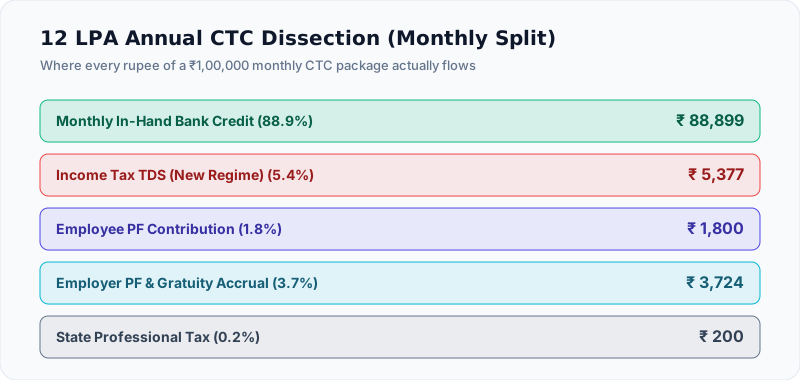
Figure 1: Net monthly take-home vs statutory deductions for 12 LPA under New and Old tax regimes.
3. Detailed New Tax Regime Calculation (FY 2026-27)
Under the Finance Act provisions governing FY 2026-27 (Assessment Year 2027-28), the New Tax Regime is the default tax regime for all salaried individuals. It offers lower slab rates and a generous standard deduction of ₹75,000 for salaried employees (up from the earlier ₹50,000).
Step 1: Arrive at Taxable Income
- Gross Salary: ₹10,99,140 (or ₹11,00,000 rounded)
- Less Standard Deduction: ₹75,000
- Net Taxable Income: ₹10,24,140 (rounded to ₹10,25,000)
Step 2: Apply the FY 2026-27 New Tax Slabs
The New Tax Regime levies tax in slabs of ₹3,00,000:
| Income Slab (New Regime) | Tax Rate | Tax on 12 LPA (₹) |
|---|---|---|
| ₹0 to ₹3,00,000 | Nil (0%) | ₹0 |
| ₹3,00,001 to ₹7,00,000 | 5% on ₹4,00,000 | ₹20,000 |
| ₹7,00,001 to ₹10,00,000 | 10% on ₹3,00,000 | ₹30,000 |
| ₹10,00,001 to ₹10,25,000 | 15% on ₹25,000 | ₹3,750 |
| Total Basic Income Tax | - | ₹53,750 |
| Health & Education Cess | 4% of ₹53,750 | ₹2,150 |
| Total Annual Income Tax (TDS) | - | ₹55,900 |
Your total annual income tax is ₹55,900, which results in a monthly Tax Deducted at Source (TDS) of approximately ₹4,658.
Step 3: Calculating Monthly In-Hand (New Regime)
Now we deduct employee payroll withholdings from the monthly gross pay:
- Monthly Gross Pay: ₹91,595
- Less Employee EPF (12% of basic ₹50,000): -₹6,000
- Less Professional Tax (Karnataka, Maharashtra, etc.): -₹200
- Less Monthly Income Tax (TDS): -₹4,658
- Net In-Hand Salary Credited: ₹80,737 per month
If your annual bonus or variable pay is included in this CTC, your monthly fixed salary will be slightly lower during the year, culminating in a lump-sum payout during appraisal season.
4. Detailed Old Tax Regime Calculation (With Deductions)
Under the Old Tax Regime, the tax slab rates are significantly steeper (20% starts right at ₹5,00,000), but you are permitted to claim itemized exemptions and deductions under Chapter VI-A.
Let us consider an aggressive tax-saver scenario where you claim every standard deduction available to a salaried professional:
- Standard Deduction (Old Regime): ₹50,000
- Section 80C (PPF, ELSS, EPF, Term Insurance): ₹1,50,000
- Section 80D (Health Insurance for self and parents): ₹35,000
- Section 10(13A) HRA Exemption (claiming ₹20,000/mo rent in Pune or Bangalore): ₹1,40,000
- Section 24(b) Home Loan Interest: Nil (assuming rented house)
- Total Deductions Claimed: ₹3,75,000
Tax Math on Old Regime
- Gross Salary: ₹10,99,140
- Less Allowable Deductions: -₹3,75,000
- Net Taxable Income: ₹7,24,140
- Tax on ₹0 to ₹2.5L: ₹0
- Tax on ₹2.5L to ₹5L (5% on ₹2.5L): ₹12,500
- Tax on ₹5L to ₹7.24L (20% on ₹2,24,140): ₹44,828
- Total Base Tax: ₹57,328
- Add 4% Health & Education Cess: ₹2,293
- Total Annual Tax (Old Regime): ₹59,621 (Monthly TDS: ₹4,968)
- Net Monthly In-Hand (Old Regime): ₹80,427 per month
Notice something astonishing? Even after locking away ₹1.5 Lakhs in Section 80C, paying ₹35,000 for medical insurance, and gathering rent receipts for ₹1.4 Lakhs in HRA exemptions, you still pay ₹3,721 MORE in tax under the Old Regime than in the New Regime!
5. Side-by-Side Comparison: Old vs New Regime
Here is the direct annual and monthly comparison between the two tax systems for a 12 LPA package in FY 2026-27:
| Particulars | New Tax Regime (Default) | Old Regime (With ₹3.75L Deductions) |
|---|---|---|
| Annual Gross Earnings | ₹10,99,140 | ₹10,99,140 |
| Standard Deduction | ₹75,000 | ₹50,000 |
| HRA & Chapter VI-A Deductions | ₹0 (Not applicable) | ₹3,25,000 (80C + 80D + HRA) |
| Net Taxable Income | ₹10,24,140 | ₹7,24,140 |
| Annual Income Tax + Cess | ₹55,900 | ₹59,621 |
| Annual Employee EPF | ₹72,000 | ₹72,000 |
| Annual Professional Tax | ₹2,400 | ₹2,400 |
| Net Annual Take-Home Cash | ₹9,68,840 | ₹9,65,119 |
| Net Monthly In-Hand Salary | ₹80,737 / mo | ₹80,427 / mo |
The 12 LPA Breakeven Threshold: ₹3,95,000
To make the Old Tax Regime worthwhile at 12 LPA, your total eligible deductions must cross ₹3,95,000 per year. Unless you are servicing a heavy home loan (where Section 24b provides up to ₹2,00,000 deduction on interest) alongside high metro HRA, opting for the New Tax Regime is simpler, hassle-free, and saves more cash without locking funds in 5-year lock-in instruments.
6. The PF Dilemma: Capped (₹1,800) vs Uncapped (12%)
One of the biggest factors determining whether you receive ₹80,700 or ₹84,900 per month is your company’s policy regarding the Employees' Provident Fund (EPF).
Under the Employees' Provident Funds and Miscellaneous Provisions Act, 1952, the statutory wage ceiling for mandatory PF participation is ₹15,000 per month. 12% of ₹15,000 is ₹1,800 per month.
Option A: Uncapped PF (Standard in large IT MNCs)
The company deducts a full 12% of your actual Basic Salary (₹50,000):
- Employee Share deducted from salary: ₹6,000 / month
- Employer Share deposited in EPF: ₹6,000 / month
- Total monthly addition to your retirement corpus: ₹12,000 / month (earning government-backed compounding interest at 8.25%).
- Monthly In-Hand Salary: ~₹80,737
Option B: Capped Statutory PF (Common in startups and mid-size firms)
The company restricts PF contribution to the statutory ₹15,000 wage ceiling:
- Employee Share deducted: ₹1,800 / month
- The remaining ₹4,200 is diverted into your Special Allowance and paid in cash.
- Monthly In-Hand Salary increases to: ~₹84,937
Which is better? If you are disciplined and invest the surplus ₹4,200 into equity mutual funds via monthly SIPs, the capped option gives you superior liquidity and wealth potential. If you tend to spend whatever is in your bank account, uncapped PF enforces automated, sovereign-backed retirement compounding.
7. Five Practical Ways to Increase Your Monthly Take-Home
If you are negotiating a 12 LPA package or seeking ways to maximize your monthly cash flow, consider these five actionable payroll adjustments:
- Request Statutory PF Capping: Ask HR if your company allows capping EPF at ₹1,800/month. This single adjustment boosts take-home pay by ₹50,400 annually.
- Opt for Corporate NPS under Section 80CCD(2): Even under the New Tax Regime, employer contributions to the National Pension System (NPS) up to 14% of basic salary remain 100% tax-free! At 12 LPA, this can save an additional ₹15,000 in tax.
- Maximize Non-Taxable Reimbursements: If your company offers flexible benefit plans (FBP), opt for fuel allowances, driver salary, gadget allowances, and broadband reimbursements against official expense bills.
- Avoid Unnecessary Insurance-cum-Investment Policies: Do not buy expensive endowment or ULIP policies merely to claim Section 80C deductions under the Old Regime. The New Regime is cheaper and leaves you free to invest in liquid instruments.
- Verify Professional Tax Slabs: In states like Karnataka, Maharashtra, and West Bengal, PT is ₹200/month (with ₹300 in February for Maharashtra). Ensure your payroll department has applied the correct state slab.
7.1 Impact of Variable Pay and Joining Bonuses on 12 LPA
In modern Indian corporate hiring, offer letters rarely consist of 100% fixed guaranteed compensation. A ₹12 Lakh package is frequently structured with a 10% to 15% variable performance component. For example:
- Fixed CTC: ₹10,50,000 (87.5%)
- Annual Performance Bonus / Target Variable: ₹1,50,000 (12.5%)
If your offer contains variable pay, your regular monthly take-home is computed strictly on the ₹10,50,000 fixed portion. This drops your monthly bank credit from ~₹80,737 down to approximately ₹70,600 per month during the first 11 months of the financial year.
The ₹1,50,000 bonus is disbursed as a single lump-sum payout at the end of the appraisal cycle (usually in April or July). Crucially, bonuses in India are treated as normal salary income and taxed at your marginal slab rate (15% under the New Regime), alongside applicable cess and potential employer adjustments. Never budget your monthly fixed living costs (such as apartment rent or car EMIs) against variable pay components.
7.2 City-by-City Cost of Living on a 12 LPA Salary
How far does an ₹80,700 monthly in-hand salary actually go across India's premier employment hubs? Because living costs diverge sharply between metro centers, your surplus savings rate will vary substantially depending on where you report to work:
| City Location | Typical 1BHK/2BHK Rent (₹) | Monthly Utilities & Groceries | Estimated Discretionary Surplus (₹) |
|---|---|---|---|
| Bengaluru (Outer Ring Rd / Whitefield) | ₹26,000 - ₹34,000 | ₹18,000 | ₹28,000 - ₹36,000 |
| Mumbai (Western Suburbs) | ₹35,000 - ₹45,000 | ₹20,000 | ₹15,000 - ₹25,000 |
| Hyderabad (Hitec City / Gachibowli) | ₹18,000 - ₹25,000 | ₹15,000 | ₹40,000 - ₹47,000 |
| Pune (Hinjawadi / Kharadi) | ₹16,000 - ₹23,000 | ₹14,000 | ₹43,000 - ₹50,000 |
| Tier-2 Cities (Coimbatore, Indore, Kochi) | ₹10,000 - ₹15,000 | ₹11,000 | ₹54,000 - ₹59,000 |
7.3 Reconciling Form 16: Part A vs Part B
At the conclusion of each financial year (typically around mid-June), your employer issues Form 16, which is your definitive certificate of tax deducted at source under Section 203 of the Income Tax Act. Every 12 LPA employee should verify two parts:
- Part A (TRACES Certificate): Displays your employer's TAN, your PAN, and quarterly deposits of TDS matched against Challan Identification Numbers. Ensure the total TDS deposited matches the ~₹55,900 deducted from your monthly slips.
- Part B (Salary Computation Annexure): Details your exact Gross Salary under Section 17(1), exemptions under Section 10, the ₹75,000 standard deduction under Section 16(ia), and final net tax computed. Check that your declared regime (New vs Old) was accurately captured.
8. Frequently Asked Questions (FAQ)
What is the exact monthly in hand salary for 12 LPA in India?
For a 12 LPA package in FY 2026-27 under the default New Tax Regime, your monthly in-hand salary is approximately ₹80,737 with uncapped PF (12% of basic). If your company caps EPF to ₹1,800 per month, your in-hand increases to approximately ₹84,937.
How much income tax is deducted on a 12 LPA salary in FY 2026-27?
Under the New Tax Regime, the standard deduction is ₹75,000. Your net taxable income is ₹10,25,000, attracting an annual base tax of ₹53,750 plus 4% cess (₹2,150), totalling ₹55,900 per year (or ₹4,658/month).
Is Old Tax Regime better than New Tax Regime for 12 LPA?
No, for 90% of salaried professionals at 12 LPA, the New Tax Regime is superior. You would need total Chapter VI-A deductions and HRA exemptions exceeding ₹3,95,000 per year before the Old Regime yields any monetary savings.
Why is 12 LPA divided by 12 not equal to ₹1,00,000?
Because CTC includes non-cash items such as employer PF contributions (₹72,000/yr), gratuity provisions (~₹28,860/yr), and group insurance. Furthermore, monthly gross earnings are subject to mandatory deductions: Employee PF, Professional Tax, and Income Tax (TDS).
Can I claim HRA exemption under the New Tax Regime?
No. HRA exemption under Section 10(13A) is not available under the New Tax Regime. In exchange, the government provides lower slab rates and a flat ₹75,000 standard deduction with zero documentation or rent receipts required.
9. Key Takeaways and Summary
- Expected In-Hand: Expect ₹80,500 to ₹85,000 per month in your account on a 12 LPA offer.
- Default Regime Wins: The New Tax Regime beats the Old Regime by default unless your total deductions exceed ₹3.95 Lakhs.
- Retirement Inflow: Besides your monthly cash take-home, you accumulate ₹12,000 monthly in EPF (employee + employer shares), building a robust compounding nest egg.
- Negotiation Advice: During compensation discussions, pay close attention to fixed vs variable components; ask HR for statutory PF capping if you prioritize upfront liquidity.