15 LPA In Hand Salary: What You Actually Take Home
Securing a 15 LPA (Lakhs Per Annum) compensation package is a premier benchmark for mid-level software engineers, team leads, and product managers across India. While the paper figure represents ₹1,25,000 each month, the reality of tax brackets, EPF retentions, and statutory reserves shapes an actual monthly take-home between ₹98,145 and ₹1,03,260. Here is the rigorous, component-by-component payroll math.

1. The 15 LPA Milestone: From CTC to Real Cash
Earning 15 LPA puts a professional firmly into the upper bracket of Indian salaried compensation. On paper, ₹15,00,000 divided by 12 implies a paycheck of ₹1,25,000 every single month.
However, 15 LPA is also the exact income range where Indian income tax brackets begin to exert significant drag. Under the New Tax Regime, your income enters the 20% tax bracket, and under the Old Tax Regime, you collide directly with the punitive 30% tax slab.
After taking into account your employee EPF contribution (₹7,500/month), monthly TDS tax (~₹8,650/month), and state professional tax (₹200/month), your take-home cash settles at ₹98,145 per month under standard corporate terms. If your employer allows statutory PF capping, that number climbs to ₹1,03,260 per month.
2. Standard Salary Structure for ₹15 Lakhs CTC
In leading Indian technology firms, financial institutions, and multinational corporations, an ₹15 Lakh CTC package is typically divided as follows:
| Salary Component | Percentage / Basis | Monthly Amount (₹) | Annual Total (₹) |
|---|---|---|---|
| Basic Salary | 50% of CTC | ₹62,500 | ₹7,50,000 |
| House Rent Allowance (HRA) | 40% of Basic | ₹25,000 | ₹3,00,000 |
| Special Allowance / Flexi-Pay | Balancing figure | ₹26,994 | ₹3,23,925 |
| Gross Monthly Earnings | Basic + HRA + Special Allowance | ₹1,14,494 | ₹13,73,925 |
| Employer EPF Share | 12% of Basic | ₹7,500 | ₹90,000 |
| Gratuity Reserve | ~4.81% of Basic | ₹3,006 | ₹36,075 |
| Total Cost to Company (CTC) | Gross Pay + Retainers | ₹1,25,000 | ₹15,00,000 |
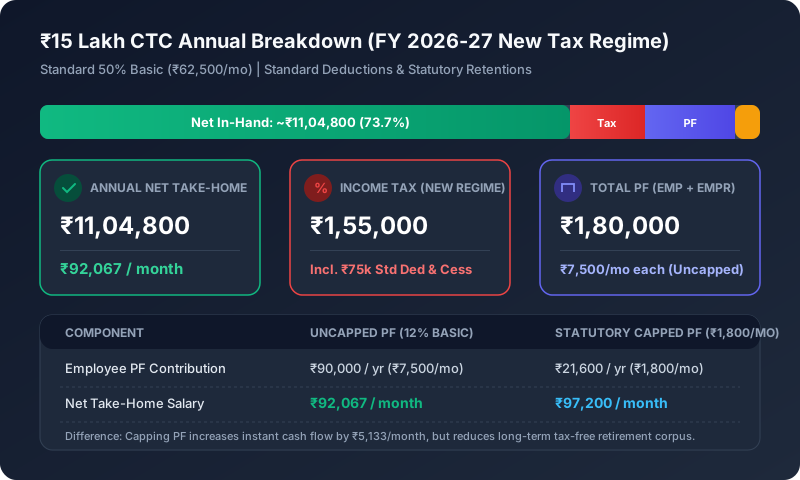
Figure 1: Visual comparison of net take-home pay on 15 LPA with uncapped vs capped EPF contributions.
3. FY 2026-27 New Tax Slabs Applied to 15 LPA
Under the New Tax Regime, every salaried employee receives a flat standard deduction of ₹75,000 without requiring receipts or insurance bills.
Step 1: Compute Net Taxable Pay
- Annual Gross Salary: ₹13,73,925
- Less Standard Deduction u/s 16(ia): -₹75,000
- Net Taxable Salary: ₹12,98,925 (rounded to ₹12,99,000)
Step 2: Slab-Wise Calculation
| Income Slab | Tax Rate | Tax Amount (₹) |
|---|---|---|
| ₹0 to ₹3,00,000 | 0% | ₹0 |
| ₹3,00,001 to ₹7,00,000 | 5% on ₹4,00,000 | ₹20,000 |
| ₹7,00,001 to ₹10,00,000 | 10% on ₹3,00,000 | ₹30,000 |
| ₹10,00,001 to ₹12,00,000 | 15% on ₹2,00,000 | ₹30,000 |
| ₹12,00,001 to ₹12,98,925 | 20% on ₹98,925 | ₹19,785 |
| Basic Tax Before Cess | ₹99,785 | |
| Health & Education Cess (4%) | ₹3,991 | |
| Total Annual Income Tax (TDS) | ₹1,03,776 (approx ₹1,03,792) | |
Your annual tax liability comes to ₹1,03,792, which results in a monthly TDS deduction of ₹8,649.
4. Step-by-Step Monthly Pay Slip Simulation
Here is how your monthly pay stub appears on the 30th of each month under the default New Tax Regime:
| Earnings Head | Amount (₹) | Deductions Head | Amount (₹) |
|---|---|---|---|
| Basic Salary | ₹62,500 | Employee EPF (12%) | ₹7,500 |
| House Rent Allowance (HRA) | ₹25,000 | Professional Tax | ₹200 |
| Special Allowance | ₹26,994 | Income Tax (TDS) | ₹8,649 |
| Total Gross Earnings | ₹1,14,494 | Total Monthly Deductions | ₹16,349 |
| Net Monthly Bank Credit | ₹98,145 per month | ||
5. How to Cross ₹1,00,000/Month: Capped vs Uncapped EPF
One psychological milestone for any professional on a 15 LPA package is seeing a monthly bank credit starting with ₹1,00,000+. At ₹98,145, you are tantalizingly close, missing the six-figure mark by less than ₹1,900.
The solution lies in the statutory EPF wage ceiling. By law, mandatory EPF is only required on basic wages up to ₹15,000 per month (12% of ₹15,000 = ₹1,800/month).
If your company enables statutory EPF capping:
- Your employee PF deduction plummets from ₹7,500 down to ₹1,800 per month.
- Your monthly take-home increases immediately to ₹1,03,260 per month!
- You gain ₹5,115 in additional liquid cash every single month.
However, remember that uncapped PF enforces a mandatory monthly investment of ₹15,000 (employee + employer shares) into an account earning 8.25% sovereign interest. If you cap PF, make sure to divert that ₹5,115 into an automated equity mutual fund SIP.
6. Old vs New Tax Regime: The 30% Slab Reality
Under the Old Tax Regime, any taxable income above ₹10,00,000 is taxed at the highest marginal rate of 30% (31.2% with cess).
In contrast, under the New Tax Regime, the 20% slab applies from ₹12 Lakhs to ₹15 Lakhs, and the 30% rate only kicks in above ₹15,00,000!
| Particulars | New Tax Regime | Old Regime (With Typical ₹2.5L Deductions) |
|---|---|---|
| Gross Salary | ₹13,73,925 | ₹13,73,925 |
| Standard Deduction | ₹75,000 | ₹50,000 |
| Deductions (80C, 80D, HRA) | ₹0 | ₹2,00,000 (80C ₹1.5L + 80D ₹50k) |
| Net Taxable Income | ₹12,98,925 | ₹11,23,925 |
| Total Annual Tax + Cess | ₹1,03,792 | ₹1,55,665 |
| Net Annual Savings in New Regime | +₹51,873 Cash in Your Pocket! | |
Unless your total deductions (including large home loan interest and HRA) exceed ₹4,25,000 per year, opting for the Old Regime will cost you more than ₹50,000 in excess tax!
7. Corporate NPS: The Secret to Saving ₹21,000 in Tax
One of the least utilized tax provisions by high earners under the New Tax Regime is Section 80CCD(2)—the Corporate National Pension System.
While individual 80C and 80CCD(1B) deductions are discontinued in the New Tax Regime, employer contributions to NPS (up to 14% of basic salary) remain 100% tax-exempt!
- Basic Salary at 15 LPA: ₹7,50,000
- 10% Employer NPS contribution: ₹75,000 per year
- This ₹75,000 is deducted directly from your taxable income under the New Regime.
- At your marginal tax slab (20% + 4% cess = 20.8%), this saves you ₹15,600 to ₹21,000 in direct tax!
Ask your company's payroll department if they have a Corporate NPS tie-up (offered by providers like NSDL/Protean and KFintech). It is the single most powerful legal tax deduction available to 15 LPA earners today.
8. Wealth Building on a ₹98,000 Monthly In-Hand
With an inflow close to ₹1,00,000 every month, your primary financial priority should be aggressive wealth compounding before lifestyle creep expands your fixed expenses:
Fixed Expenses: ₹42,000 (43%)
2BHK apartment rent in prime areas (₹26k-30k), utilities, grocery bills, maintenance, and vehicle fuel.
Lifestyle: ₹24,000 (24%)
Weekend dining, electronic gadgets, holiday travel, fitness memberships, and personal family commitments.
Core Investing: ₹32,145 (33%)
Monthly SIPs divided across Nifty 50 Index funds, Mid-Cap funds, and building an emergency liquid buffer of 6 months' expenses.
9. Frequently Asked Questions (FAQ)
What is the monthly in hand salary for 15 LPA in India?
For a 15 LPA CTC under the FY 2026-27 New Tax Regime, your monthly in-hand salary is approximately ₹98,145 with standard uncapped EPF (12% of basic). If your employer caps EPF at the statutory limit of ₹1,800/month, your in-hand salary crosses six figures to approximately ₹1,03,260 per month.
How much income tax is deducted on a 15 LPA salary in FY 2026-27?
Under the New Tax Regime, after applying the ₹75,000 standard deduction, your taxable income is ₹12,98,925. The total annual income tax including 4% cess is ₹1,03,792, which translates to a monthly TDS deduction of ₹8,649.
Does Old Tax Regime save more tax than New Regime on 15 LPA?
No. Under the Old Tax Regime, taxable income above ₹10 Lakhs is taxed at 30%. You would need total eligible deductions exceeding ₹4,25,000 per year before the Old Regime breaks even with the New Regime.
Why is ₹15 Lakhs CTC not equal to ₹1,25,000 per month?
Dividing 15,00,000 by 12 yields ₹1,25,000. However, CTC includes employer EPF contributions (₹90,000/yr) and gratuity reserves (~₹36,075/yr). Additionally, employee EPF (₹90,000/yr), Professional Tax (~₹2,400/yr), and Income Tax TDS (~₹1,03,792/yr) are deducted from your gross pay.
Can I save tax using Corporate NPS on 15 LPA?
Yes. Under Section 80CCD(2), employer contributions to the National Pension System (NPS) up to 14% of basic salary are deductible even in the New Tax Regime. At 15 LPA, this can save you over ₹21,000 in additional tax annually.
10. Summary and Negotiation Checklist
- Expected In-Hand: Anticipate a monthly bank deposit of ₹98,145 (or ₹1,03,260 with statutory capped PF).
- New Regime Preference: The New Tax Regime saves over ₹50,000 in tax compared to a standard Old Regime declaration and removes documentation burdens.
- Leverage NPS: Activate Corporate NPS through Section 80CCD(2) to legally cut your taxable income further by up to ₹75,000.
- Automate Wealth: Channel at least ₹30,000 monthly into equity index funds to translate your six-figure earnings into long-term financial independence.