Table of Contents
- 1. The 3 LPA Reality: Why ₹25,000 Is Not Credited to Your Bank
- 2. Standard Indian Payroll Distribution on a ₹3,00,000 CTC
- 3. Visual Waterfall Breakdown: Where Each Rupee Flows
- 4. Why Income Tax Is Absolutely ₹0 on 3 LPA in FY 2026-27
- 5. How Provident Fund (EPF & EPS) Operates at 3 LPA
- 6. ESI Applicability: The Crucial ₹21,000 Gross Ceiling
- 7. State-Wise Professional Tax Deductions (PT)
- 8. Practical Survival Budgeting on ₹21,500 Monthly In-Hand
- 9. Frequently Asked Questions (FAQ)
- 10. Summary & Career Leap Strategy
1. The 3 LPA Reality: Why ₹25,000 Is Not Credited to Your Bank
An offer letter of ₹3,00,000 per annum (popularly referred to as 3 LPA) is one of the most common starting packages in India for campus freshers, customer support executives, junior software developers, retail managers, and back-office operations associates.
When a young professional receives this offer letter, their instinctive mathematical impulse is elementary:
₹3,00,000 Annual CTC / 12 Months = ₹25,000 per month
Armed with this calculation, fresh graduates begin budgeting: planning room rent in shared PGs in Bengaluru, Pune, Hyderabad, or Gurgaon, budgeting daily food expenses, and anticipating discretionary leisure funds.
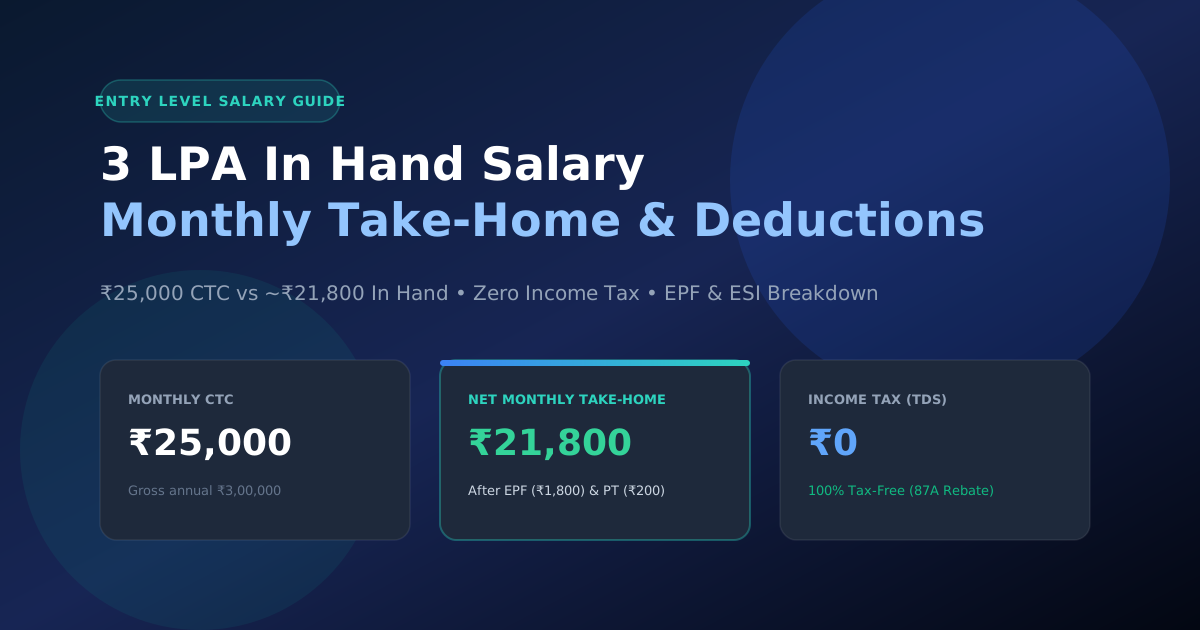
However, on the last working day of their first month, when the automated bank SMS chimes, the actual amount credited is approximately ₹21,199 (or between ₹20,800 and ₹22,200 depending on company structuring).
Where did the missing ₹3,800 go? It did not vanish into thin air. It was withheld for statutory social security and payroll deductions:
- Employer Provident Fund Retainer: The company earmarks ₹1,500/month as its mandatory employer contribution to your EPFO account.
- Statutory Gratuity Reserve: The employer reserves roughly ₹601/month for future gratuity liability under the Payment of Gratuity Act, 1972.
- Employee Provident Fund (EPF): ₹1,500/month is deducted directly from your earnings and transferred into your retirement PF ledger.
- Professional Tax (PT): The state government levies up to ₹200/month depending on where your office is located.
2. Standard Indian Payroll Distribution on a ₹3,00,000 CTC
In Indian corporate human resources, total compensation is framed as Cost to Company (CTC). CTC represents the total expenditure the employer incurs to hire and maintain you on their payroll.
Here is the typical distribution of a 3 LPA salary structure where Basic Pay is configured at the standard 50% ratio:
| Salary Component | Calculation Basis | Monthly (₹) | Annual (₹) |
|---|---|---|---|
| Basic Salary | 50% of CTC | ₹12,500 | ₹1,50,000 |
| House Rent Allowance (HRA) | 40% of Basic Pay | ₹5,000 | ₹60,000 |
| Special Allowance | Balancing Earnings figure | ₹5,399 | ₹64,788 |
| Gross Salary (Paystub Earnings) | Basic + HRA + Special Allowance | ₹22,899 | ₹2,74,788 |
| Employer EPF Share | 12% of Basic Pay | ₹1,500 | ₹18,000 |
| Gratuity Reserve | ~4.81% of Basic Pay | ₹601 | ₹7,212 |
| TOTAL COST TO COMPANY (CTC) | Gross + Retirals | ₹25,000 | ₹3,00,000 |
Observe that while your CTC is ₹25,000 per month, the actual Gross Salary printed on your payslip is ₹22,899. The employer's retiral allocations (Employer PF of ₹1,500 + Gratuity of ₹601 = ₹2,101) are absorbed before the paystub earnings are finalized.
3. Visual Waterfall Breakdown: Where Each Rupee Flows
To understand the journey from your nominal CTC to the bank credit, review this step-by-step waterfall chart:
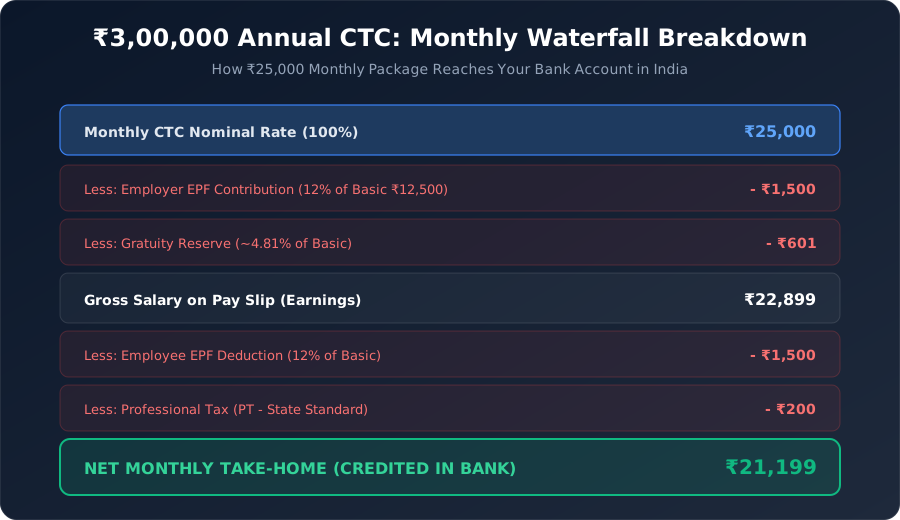
When we take the Monthly Gross Salary of ₹22,899 and subtract the employee-side withholdings:
- Employee EPF Deduction: 12% of ₹12,500 = ₹1,500.
- State Professional Tax: Capped at ₹200 in Maharashtra, Karnataka, Telangana, Tamil Nadu, and West Bengal.
- Income Tax (TDS): Exactly ₹0.
- Final Net Monthly In-Hand: ₹22,899 − ₹1,500 − ₹200 = ₹21,199.
4. Why Income Tax Is Absolutely ₹0 on 3 LPA in FY 2026-27
One fear that many first-time job holders have is whether they will lose a substantial portion of their salary to Central Income Tax.
The definitive answer for FY 2026-27 (AY 2027-28) is that you pay ZERO income tax on a 3 LPA salary. In fact, you do not even need to make tax-saving investments or submit rent receipts!
Calculation Under the New Tax Regime (Default)
- Gross Salary: ₹2,74,788 (or ₹3,00,000 if bonuses included).
- Less: Section 16(ia) Standard Deduction: -₹75,000.
- Net Taxable Income: ₹2,74,788 − ₹75,000 = ₹1,99,788.
- Under New Regime tax slabs, income up to ₹3,00,000 has a 0% tax rate.
- Total Income Tax Payable = ₹0. Zero TDS will be deducted by your company payroll.
Calculation Under the Old Tax Regime (Optional)
- Gross Salary: ₹2,74,788.
- Less: Standard Deduction: -₹50,000.
- Net Taxable Income: ₹2,24,788.
- Under the Old Regime, the basic exemption limit is ₹2,50,000. Because your taxable income is below ₹2.5 Lakhs, your tax is ₹0.
Because your tax liability is nil under both regimes without claiming any special deductions, choosing the default New Tax Regime is completely hassle-free: no Form 12BB investment proofs or LIC receipts are required.
5. How Provident Fund (EPF & EPS) Operates at 3 LPA
While losing ₹1,500 from your monthly paycheck can feel painful on an entry-level salary, the Employees' Provident Fund (EPF) is actually your most lucrative forced investment.
Under the Employees' Provident Funds and Miscellaneous Provisions Act, 1952, any establishment employing 20 or more persons must enroll employees whose basic wage is below ₹15,000 per month. Because your Basic salary is ₹12,500, EPF participation is mandatory by law.
Here is where your ₹3,000 total monthly contribution flows:
- Your Employee Contribution (₹1,500): 100% of this goes into your EPF account, earning an attractive 8.25% sovereign interest rate compounded annually.
- Employer Contribution (₹1,500):
- 8.33% of your Basic salary (₹1,041) is diverted into the Employees' Pension Scheme (EPS-95) for your post-58 retirement pension.
- The remaining 3.67% (₹459) is deposited into your EPF account alongside an additional 0.5% EPFO administrative charge paid by the company.
Every month, ₹1,959 in pure capital is added to your personal EPF passbook, backed by sovereign government guarantees and full EEE (Exempt-Exempt-Exempt) tax exemption.
6. ESI Applicability: The Crucial ₹21,000 Gross Ceiling
A major point of confusion for employees in the 2.5 LPA to 3.5 LPA salary bracket is whether they are covered under the Employees' State Insurance (ESI) scheme.
Under ESIC regulations, coverage is mandatory for all non-seasonal employees whose Gross Monthly Wages do not exceed ₹21,000 (₹25,000 for employees with disabilities).

Case 1: Standard IT / Corporate Structuring (No ESI)
If your Monthly Gross Pay is ₹22,899 (as shown in our main table), you are comfortably above the ₹21,000 statutory limit. You will have zero ESI deductions. Your monthly take-home will be approximately ₹21,199.
Case 2: Contractual or Manufacturing Payroll (ESI Covered)
If your employer structures your salary with a higher variable component or retiral provision such that your Gross Pay is pegged at ₹20,500:
- Employee ESI Deduction: 0.75% of Gross = ₹154/month.
- Employer ESI Contribution: 3.25% of Gross = ₹666/month.
- Your monthly in-hand drops slightly to around ₹18,826, but you and your dependent family members receive 100% free medical treatment, consultations, and hospitalization at ESIC hospitals across India.
7. State-Wise Professional Tax Deductions (PT)
Professional Tax is a state-level tax levied under Article 276 of the Constitution of India. It is deducted by your employer and remitted directly to the respective state government:
| State | Monthly Gross Pay | Professional Tax Deducted | Net Impact on 3 LPA |
|---|---|---|---|
| Karnataka (Bangalore) | > ₹15,000 | ₹200 / month | ₹2,400 per year |
| Maharashtra (Mumbai/Pune) | > ₹10,000 (Men) | ₹200 / mo (₹300 in Feb) | ₹2,500 per year |
| Telangana (Hyderabad) | > ₹20,000 | ₹200 / month | ₹2,400 per year |
| Tamil Nadu (Chennai) | ₹21,001 to ₹30,000 | ~₹171 / month (half-yearly) | ₹2,050 per year |
| Delhi, Haryana (Gurgaon), UP (Noida) | Any Amount | ₹0 (No Professional Tax) | +₹200 extra take-home! |
Notice that if you work in Gurgaon or Noida, neither Haryana nor Uttar Pradesh levies professional tax on salaried employees. That gives you an immediate ₹2,400 annual bonus in take-home pay compared to a peer working in Bengaluru or Pune!
8. Practical Survival Budgeting on ₹21,500 Monthly In-Hand
Surviving in Tier-1 Indian tech hubs (Bengaluru, Mumbai, Gurgaon) on a ₹21,500 monthly take-home requires rigorous financial discipline. Here is a realistic 50/30/20 budget framework optimized for freshers:
1. Fixed Needs: Shared PG & Food (₹11,000 — 51%)
Opt for a 2-sharing or 3-sharing PG near your office that includes breakfast and dinner (typically ₹8,000 to ₹9,500 in Electronic City, Hinjewadi, or Madhapur). This eliminates separate electricity, Wi-Fi, and grocery bills. Allocate ₹2,000 for office lunches and daily commuting.
2. Discretionary Lifestyle & Connectivity (₹5,500 — 26%)
Mobile phone recharge (₹300), personal hygiene and clothing (₹1,500), weekend outings or movies (₹2,500), and occasional ride-hailing emergencies (₹1,200).
3. Emergency Fund & Skill Upgrades (₹4,500 — 21%)
Never spend 100% of your salary. Keep ₹2,500 in a high-yield savings account or liquid fund until you accumulate a ₹30,000 emergency buffer. Invest the remaining ₹2,000 into certifications (AWS, Azure, data analytics courses) that will enable you to make a 100% salary jump to 6 LPA within two years!
9. Frequently Asked Questions (FAQ)
Why is a 3 LPA CTC divided by 12 not equal to ₹25,000 in hand?
CTC includes non-cash retiral costs: Employer EPF (12% of basic) and gratuity reserves (~4.81% of basic). In addition, your payslip incurs employee EPF deductions and state professional tax before funds reach your bank.
Do I have to pay any income tax on a 3 LPA salary in FY 2026-27?
No. Under the New Tax Regime, taxable income up to ₹3,00,000 has a 0% tax rate. Under the Old Tax Regime, the basic exemption is ₹2,50,000 and standard deduction wipes out the rest. Your tax is completely ₹0 under both systems.
Is ESI (Employee State Insurance) mandatory on a 3 LPA package?
ESI applies only if your monthly gross salary is ₹21,000 or below. If structured at ₹22,000+, you are legally exempt. If gross is under ₹21,000, an employee deduction of 0.75% applies, giving you free ESIC hospital access.
How much Provident Fund (EPF) is deducted from a 3 LPA salary?
With a standard 50% basic pay (₹12,500/month), employee EPF deduction is 12% of basic, which equals ₹1,500 per month. The employer contributes a matching ₹1,500 into your EPFO ledger.
What is the exact monthly in-hand range for a 3 LPA fresher offer?
Depending on your company's basic pay percentage and state professional tax rules, your net take-home salary will be between ₹20,800 and ₹22,200 per month.
10. Summary & Career Leap Strategy
A 3 LPA salary is your launchpad into corporate India:
- Expected Bank Credit: Count on receiving approximately ₹21,200 per month.
- Zero Income Tax: Do not worry about tax filings or deductions; your income falls entirely below taxable slabs.
- Retirement Compounding: Your EPF account quietly builds an annual nest egg of over ₹23,000 at 8.25% sovereign interest.
- Next Step: Focus your first 18 months on mastering high-demand skills to negotiate a 70% to 100% hike into the 5 LPA to 6 LPA bracket!
Curious what your take-home will look like after your first appraisal? Simulate different increment percentages on our free Salary Hike Calculator or test custom structures on our CTC to In-Hand Salary Calculator.