How to Negotiate Salary Using CTC Breakdown Secrets
Most job candidates celebrate when an HR recruiter offers a 30% jump on their annual CTC. But in the corporate hiring world, headline CTC figures are frequently engineered to look massive on paper while keeping the employer's monthly cash outflow minimal. Two candidates receiving identical ₹18 Lakh CTC offers can experience a monthly take-home gap of over ₹27,000 per month simply because of salary structure. Here is how to negotiate like an executive.

1. The Illusion of CTC: Why Headline Numbers Lie
When an HR recruiter calls to announce: "We are delighted to offer you ₹20 Lakhs per annum!", they are delivering a sales pitch. In modern talent acquisition, HR managers are measured by two conflicting metrics: securing top candidate talent while keeping the company's monthly fixed payroll burn as low as possible.
To accomplish this, employers inflate the headline Cost to Company (CTC) using variable bonuses, deferred equity, and non-cash statutory provisions. If you negotiate solely on the headline CTC figure, you fall straight into this trap. A skilled professional negotiates on **Salary Architecture**, ensuring that the headline number translates into guaranteed monthly cash in the bank.
2. Deconstructing the Corporate Offer Letter
Every Indian corporate compensation package is assembled from six distinct building blocks. Before negotiating, you must categorize every rupee in your offer into one of these buckets:
1. Fixed Base Pay (Guaranteed)
Basic Salary + HRA + Special Allowance. This is the only guaranteed monthly cash you receive regardless of company revenue or individual performance ratings.
2. Variable Performance Pay (Contingent)
Annual bonuses paid at year-end. Highly subjective, tied to complex management multipliers, department budgets, and company EBITDA targets.
3. One-Time Signing Bonus
A single upfront cash payment. Often spread across 12-24 months and accompanied by aggressive clawback terms requiring full repayment if you resign early.
4. Employer Retainers
Employer EPF (12% of basic) and Gratuity reserves (~4.81% of basic). Statutory costs of doing business that the employer shifts onto your package.
3. Case Study: Two ₹18 LPA Offers With a ₹27,000 Gap
To witness how salary structure dictates financial reality, consider two software developers who each received an ₹18 Lakhs offer letter:
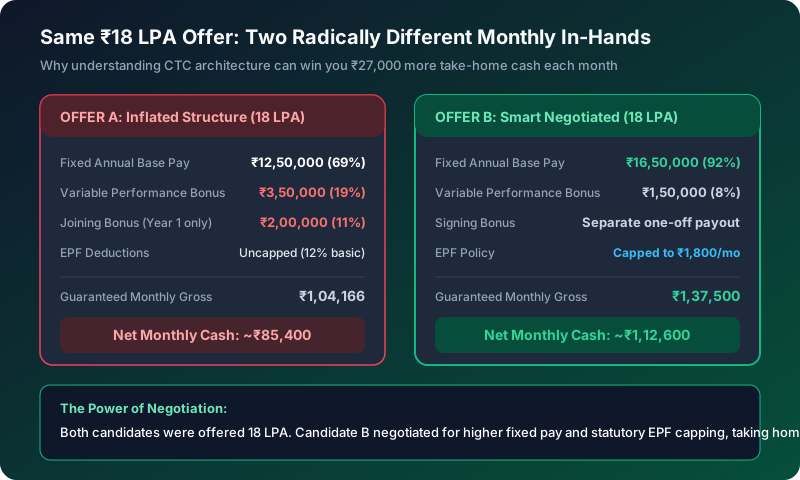
Figure 1: How Candidate B secured ₹27,200 more monthly liquid cash on the identical 18 LPA CTC.
| Component | Candidate A (Unnegotiated Offer) | Candidate B (Negotiated Structure) |
|---|---|---|
| Total Advertised CTC | ₹18,00,000 | ₹18,00,000 |
| Fixed Annual Base Pay | ₹12,50,000 (69.4%) | ₹16,50,000 (91.6%) |
| Variable Bonus | ₹3,50,000 (19.4%) | ₹1,50,000 (8.4%) |
| Joining Bonus (Year 1 only) | ₹2,00,000 | Excluded (Paid separately) |
| EPF Policy | Uncapped (12% of basic) | Capped to ₹1,800/month |
| Net Monthly In-Hand Cash | ₹85,400 / mo | ₹1,12,600 / mo |
Candidate B takes home an astounding ₹27,200 extra every month. Over a single year, that represents over ₹3.26 Lakhs in direct liquidity. In addition, when annual appraisals arrive, Candidate B's percentage hike compounds on a ₹16.5 Lakh base rather than Candidate A's depressed ₹12.5 Lakh base!
4. The 5 Most Powerful Levers in Salary Negotiation
When reviewing an offer letter, deploy these five levers in your counter-negotiations:
Lever 1: The 85% Fixed Pay Mandate
Never sign an offer where fixed guaranteed pay represents less than 85% of total CTC. If a recruiter insists on offering ₹15 LPA with ₹3 LPA variable, counter by requesting: "Could we rebalance this to ₹13.8 Lakhs fixed and ₹1.2 Lakhs performance bonus?"
Lever 2: Remove Joining Bonus from the Annual CTC Calculation
Joining bonuses are one-time payments. When companies bundle a ₹2 Lakh signing bonus into your 12-month CTC, your actual recurring compensation drops in Year 2! Insist that your annual CTC represents permanent recurring earnings, with the joining bonus treated as an annexure incentive.
Lever 3: Flexible Benefit Plans (FBP)
Ask whether the organization supports flexible component structuring. Diverting ₹5,000 to ₹10,000 monthly into tax-free meal vouchers, driver allowances, and home office internet reimbursements reduces taxable gross pay legally.
5. How Statutory EPF Capping Unlocks Thousands in Cash
Under the Employees' Provident Funds Act, mandatory participation is legally required only up to a basic salary of ₹15,000 per month (12% of ₹15,000 = ₹1,800/month).
However, most companies automatically calculate 12% on your entire basic pay (e.g., ₹60,000 basic = ₹7,200/month deduction). By requesting statutory EPF capping:
- Your monthly deduction drops from ₹7,200 to ₹1,800.
- The employer's matching ₹5,400 is redirected to your Special Allowance.
- Your monthly bank credit jumps by ₹4,500 to ₹7,000 immediately!
6. Demanding Corporate NPS (Section 80CCD-2)
During salary negotiation, ask HR if they support Corporate National Pension System (NPS) under Section 80CCD(2).
Under the New Tax Regime, almost all personal deductions are banned, but employer contributions to NPS (up to 14% of basic salary) remain 100% tax-exempt! If your basic salary is ₹10 Lakhs, opting for Corporate NPS saves up to ₹43,680 in income tax every year.
7. Word-for-Word Email Scripts to Send Recruiter HR
Use this battle-tested, professional email template when countering an offer with heavy variable pay or unclear CTC terms:
Subject: Re: Offer Discussion - [Your Name] - [Position Title]
Dear [Recruiter Name],
Thank you for extending this offer. I am thrilled about the opportunity to contribute to [Team/Company Name] and work on [Key Project].
In reviewing the detailed compensation breakup, I noticed that the annual CTC of ₹[Total Offer] includes a [X]% variable performance component and a one-time joining bonus. To align with my financial commitments, I would appreciate exploring two structural adjustments:
- Could we rebalance the package to anchor a fixed base pay of ₹[Target Fixed], adjusting the variable pool accordingly?
- Does the company support statutory capping of EPF to ₹1,800/month, as well as enrollment in Corporate NPS under Section 80CCD(2)?
With these adjustments in place, I will be delighted to sign the formal offer immediately and look forward to joining on [Target Date].
Warm regards,
[Your Name]
8. Frequently Asked Questions (FAQ)
What is the best way to negotiate a salary offer in India?
The most effective way is to anchor your negotiation on Fixed Base Pay rather than total CTC. Insist that at least 85% to 90% of your total compensation consists of guaranteed monthly fixed salary, and treat variable bonuses, joining bonuses, and ESOPs as secondary upside.
How do employers inflate CTC in offer letters?
Employers inflate CTC by bundling unachievable performance bonuses (20%-35%), stretching one-time signing bonuses over multiple years with clawback terms, including employer EPF and gratuity reserves, and adding speculative ESOP valuations into the headline number.
Can you ask HR to cap your EPF contribution?
Yes. While EPFO participation is mandatory, the statutory wage ceiling requires 12% contribution only on wages up to ₹15,000 per month (₹1,800/month). You can request HR to restrict EPF to ₹1,800/month, which diverts the remaining basic salary into cash allowances and increases monthly take-home.
What is a joining bonus clawback clause?
A clawback clause is a legal stipulation requiring you to return the full joining bonus (often pre-tax) if you resign from the company within a specified retention period (typically 12 to 24 months).
How does salary structure affect future appraisals?
Future percentage hikes during annual appraisals are almost universally calculated on your Fixed Base Pay. A higher fixed base ensures that a 10% or 15% increment yields larger monetary gains than an offer loaded with one-off signing bonuses or variable pools.
9. Pre-Signing Due Diligence Checklist
- Check 1: Is Fixed Base Pay at least 85% of total advertised CTC?
- Check 2: Is the variable bonus paid quarterly or annually, and what was the historical payout percentage?
- Check 3: Are joining bonuses treated as separate line items or artificially inflating year-one CTC?
- Check 4: Does the company allow statutory EPF capping to maximize take-home pay?
- Check 5: Run the offer through our free CTC to In-Hand Calculator before sending your acceptance!