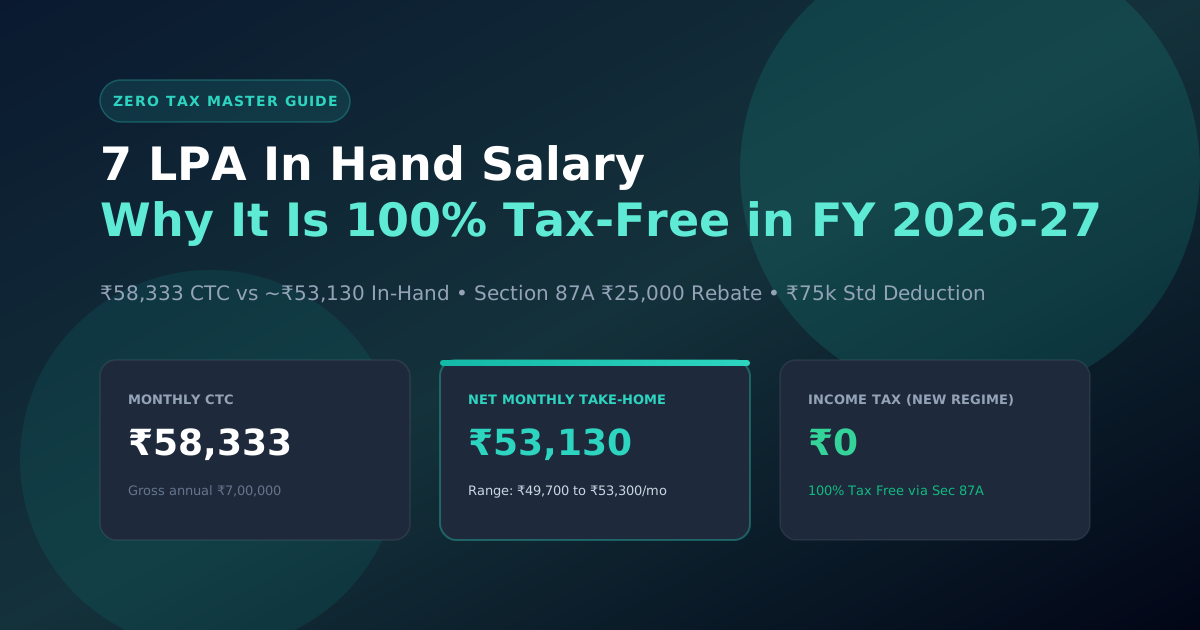
The 7 LPA Benchmark in India's Professional Landscape
An annual Cost to Company (CTC) of ₹7,00,000 (7 LPA) occupies a legendary status among Indian salaried earners. For professionals working in software development, cloud infrastructure, investment banking operations, management consulting, and digital product marketing, crossing 7 LPA represents true financial independence. It places an employee well within the top 5% of individual income earners nationwide.
When an employment contract states an annual CTC of ₹7,00,000, candidates naturally execute simple division:
₹7,00,000 ÷ 12 months = ₹58,333.33 per month
Yet, when the actual salary SMS arrives from your bank, the credited amount is consistently between ₹49,700 and ₹53,130. Where does the missing ₹5,200 to ₹8,600 go? Most importantly: Does an employee earning ₹7,00,000 pay any income tax under Indian tax laws?
The resounding answer under the statutory tax code for Financial Year 2026-27 (Assessment Year 2027-28) is that you pay precisely zero income tax. Not a single rupee of Tax Deducted at Source (TDS) is legally withheld from your paystub under the New Tax Regime. Let us examine the exact mathematics behind both your monthly take-home pay and your complete tax immunity.
The CTC Disconnect: Why ₹58,333 Never Lands in Your Account
Under Indian labor and tax statutes, your Cost to Company (CTC) is an employer-centric metric. It measures the total financial cost incurred by the enterprise to retain you on their payroll for twelve full months.
The difference between your gross CTC and net bank credit stems from two statutory deductions:
- Employer-Side Retiral Provisions: Statutory contributions paid by the organization into mandatory retiral trusts (Employer EPF contribution) and accounting reserves held for statutory severance (Gratuity). These are included inside the quoted CTC package but do not appear as earnings on your payslip.
- Employee-Side Statutory Withholdings: Compulsory deductions carved directly out of your gross salary on the paystub, including your personal Employee EPF share and State Professional Tax.
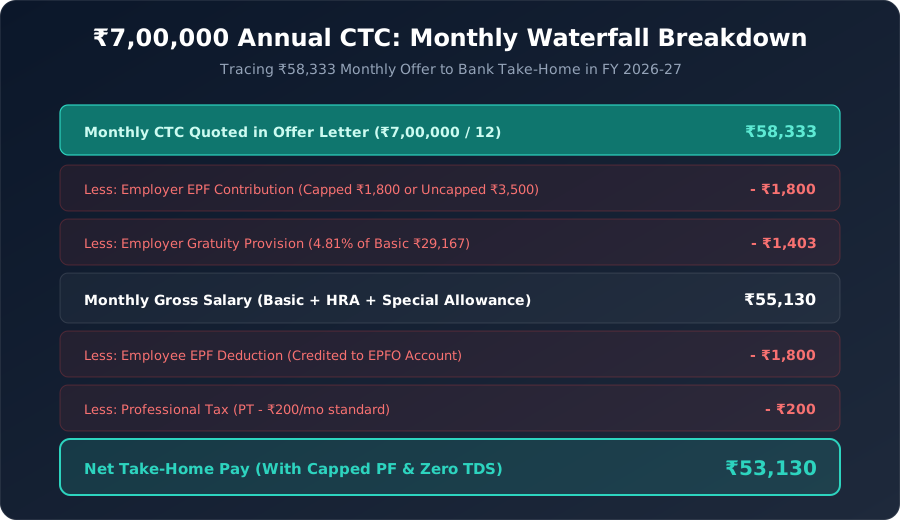 Figure 1: Visual waterfall tracing how a ₹58,333 monthly CTC becomes ₹53,130 net take-home pay under the standard capped PF scheme.
Itemized Paystub Breakdown: From ₹58,333 to ₹53,130
Let us inspect the exact mathematics of a typical 7 LPA corporate pay structure under the standard 50% Basic Salary structure with capped Employee Provident Fund (EPF):
| Salary Component | Calculation Rule | Annual (INR) | Monthly (INR) | Classification |
|---|---|---|---|---|
| Basic Salary | 50% of CTC | ₹3,50,000 | ₹29,167 | Taxable Base Earnings |
| House Rent Allowance (HRA) | 40% of Basic (Non-Metro) | ₹1,40,000 | ₹11,667 | Taxable / Exempt u/s 10(13A) |
| Special Allowance | Balancing Residual Component | ₹1,71,564 | ₹14,297 | Fully Taxable Allowance |
| Gross Pay (Earnings on Paystub) | Basic + HRA + Special Allowance | ₹6,61,564 | ₹55,130 | Gross Payslip Earnings |
| Employer EPF Contribution | Capped at ₹15,000 ceiling (12%) | ₹21,600 | ₹1,800 | Employer Retiral (Part of CTC) |
| Gratuity Provision | 4.81% of Basic Salary | ₹16,836 | ₹1,403 | Statutory Reserve (Part of CTC) |
| Total Cost to Company (CTC) | Gross Pay + Employer Retirals | ₹7,00,000 | ₹58,333 | Recruiter Quoted Package |
| Employee EPF Deduction | 12% statutory deduction | ₹21,600 | ₹1,800 | Deduction to EPFO Account |
| Professional Tax (PT) | State slab (KA, MH, TS, WB) | ₹2,400 | ₹200 | State Government Withholding |
| Income Tax (TDS - New Regime) | Standard Deduction + Sec 87A | ₹0 | ₹0 | 100% Tax Free via Rebate |
| Net Monthly In-Hand Salary | Gross Pay − Deductions | ₹6,37,564 | ₹53,130 | Net Credited to Bank Account |
When an employer applies the standard capped EPF mechanism, your gross earnings equal ₹55,130 per month. Deducting ₹1,800 for your EPF and ₹200 for state professional tax yields an exact in-hand salary of ₹53,130 per month. You can verify your personalized salary numbers instantly with our CTC to In-Hand Salary Calculator.
The Statutory Proof: Why 7 LPA Is 100% Tax-Free
Why is a 7 LPA package 100% tax-free under Indian law? Many employees assume that earning ₹7,00,000 lands them in the 10% or 15% tax bracket. Let us examine the official legal calculation under the default New Tax Regime for FY 2026-27 (AY 2027-28):
- Gross Salary Earned: ₹6,61,564 (after excluding employer retirals).
- Standard Deduction (Section 16 ia): The Finance Act provides a flat standard deduction of ₹75,000 for all salaried individuals.
- Net Taxable Income: ₹6,61,564 − ₹75,000 = ₹5,86,564.
- Applying the New Tax Regime Slabs:
- ₹0 to ₹3,00,000 @ 0% = ₹0
- ₹3,00,001 to ₹5,86,564 (₹2,86,564) @ 5% = ₹14,328
- Base Income Tax Computed: ₹14,328.
- Section 87A Tax Rebate: Under Section 87A of the Income Tax Act, any resident individual whose total taxable income does not exceed ₹7,00,000 is entitled to a full tax rebate of up to ₹25,000.
- Net Tax Payable: ₹14,328 − ₹14,328 (Rebate) = ₹0.00.
- Health and Education Cess (4%): 4% of ₹0 = ₹0.00.
Because your taxable income of ₹5,86,564 sits comfortably beneath the ₹7,00,000 statutory limit, the entire ₹14,328 tax liability is eliminated. Your company’s payroll software will calculate your TDS as ₹0 every month.
The Section 87A Tax Shield: How Incomes Up to ₹7.75 LPA Pay ₹0 Tax
A profound structural feature of the Indian tax system is what economists and chartered accountants call the Section 87A Tax Shield. Under the New Tax Regime, any salaried employee earning a gross income up to ₹7,75,000 enjoys completely tax-free status.
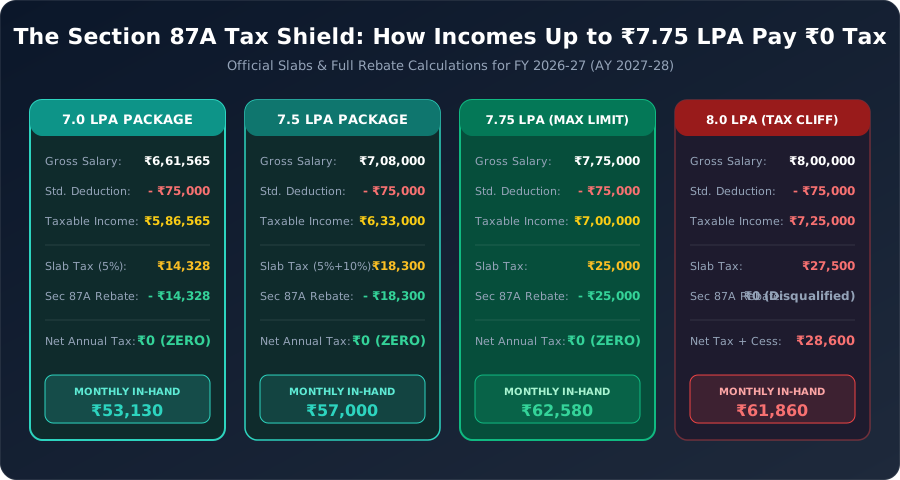 Figure 2: Architectural comparison demonstrating why gross incomes up to ₹7.75 LPA pay ₹0 tax, while 8.0 LPA triggers an immediate tax cliff.
Consider how this shield operates across salary tiers:
- At 7.0 LPA: Gross ₹6.61L − ₹75k Std Ded = ₹5.86L Taxable. Slab Tax: ₹14,328. Rebate: ₹14,328. Net Tax = ₹0.
- At 7.5 LPA: Gross ₹7.08L − ₹75k Std Ded = ₹6.33L Taxable. Slab Tax: ₹18,300. Rebate: ₹18,300. Net Tax = ₹0.
- At 7.75 LPA (The Maximum Limit): Gross ₹7.75L − ₹75k Std Ded = ₹7.00L Taxable. Slab Tax: ₹25,000. Rebate: ₹25,000. Net Tax = ₹0.
- At 8.0 LPA (The Tax Cliff): Gross ₹8.00L − ₹75k Std Ded = ₹7.25L Taxable. Because taxable income crosses ₹7,00,000 by ₹25,000, the entire Section 87A rebate is instantly forfeited! Total tax payable jumps to ₹28,600 (including 4% cess).
This explains why a professional earning ₹7.5 LPA takes home virtually the same net monthly pay as someone earning ₹8.0 LPA! You can test any salary figure across all brackets using our Income Tax Calculator.
Old vs New Tax Regime at 7 LPA: The ₹45,000 Deduction Chasm
If you consider opting for the Old Tax Regime at 7 LPA, you must recognize the massive deduction burden required to match the New Regime's effortless zero-tax outcome:
- Under the Old Regime, the standard deduction is only ₹50,000. Gross salary of ₹6,61,564 drops to a taxable base of ₹6,11,564.
- Under the Old Regime, the Section 87A rebate is available only if taxable income is ₹5,00,000 or below.
- To pull taxable income down from ₹6,11,564 to ₹5,00,000, you must claim at least ₹1,11,564 in additional deductions (e.g., ₹1,50,000 in Section 80C plus HRA exemption).
- If you do not have sufficient deductions, your tax liability under the Old Regime is ₹36,205!
Under the New Tax Regime, you receive zero tax status automatically, with zero paperwork, zero rent verification, and complete liquidity to invest where you choose.
Capped vs Uncapped EPF: Cash In-Hand vs Sovereign Compounding
At 7 LPA, your monthly basic salary is ₹29,167, well above the EPFO statutory wage ceiling of ₹15,000. Depending on your organization's payroll policy:
| EPF Contribution Model | Monthly Employee PF | Monthly Employer PF | Total Monthly PF Saved | Net Monthly In-Hand |
|---|---|---|---|---|
| Statutory Capped PF (₹15,000 base) | ₹1,800 | ₹1,800 | ₹3,600 /mo | ₹53,130 |
| Uncapped PF (12% of actual ₹29,167 base) | ₹3,500 | ₹3,500 | ₹7,000 /mo | ₹49,730 |
The Compounding Advantage: Choosing the uncapped scheme reduces your immediate monthly take-home by ₹3,400. However, it directs a massive ₹7,000 every month into your sovereign-backed EPF account. At an annual interest rate of 8.25%, this additional saving builds over ₹5.4 Lakhs of tax-free retirement capital in just 5 years. Check your custom compounding with our EPF Calculator.
Professional Tax Variations Across Major Tech Hubs
Salaried professionals in India are subject to state-level Professional Tax (PT). For a 7 LPA package (monthly gross ~₹55,000), here is how your base location affects your take-home pay:
- Karnataka (Bengaluru): ₹200/month (Annual: ₹2,400). Monthly In-Hand: ~₹53,130.
- Maharashtra (Mumbai / Pune): ₹200/month for 11 months, ₹300 in February (Annual: ₹2,500). Monthly In-Hand: ~₹53,130 (₹53,030 in Feb).
- Telangana (Hyderabad): ₹200/month (Annual: ₹2,400). Monthly In-Hand: ~₹53,130.
- Tamil Nadu (Chennai): Levied half-yearly at ₹1,250 (Annual: ₹2,500, approx. ₹208/month). Monthly In-Hand: ~₹53,122.
- Delhi NCR & Haryana (Gurugram): No Professional Tax levied. Monthly In-Hand: ~₹53,330 (highest take-home in India).
Building a ₹1 Crore Corpus on a ₹53,000 In-Hand Salary
Earning ₹53,000 per month with zero tax liability creates an extraordinary opportunity to achieve long-term financial independence early in your career. By implementing the 50/30/20 financial rule, you can live comfortably in major Indian cities while aggressively building wealth:
Rent (independent 1BHK or comfortable 2BHK flatshare), utilities, groceries, high-speed Wi-Fi, and commuting.
Dining out, entertainment, weekend trips, clothing, gadgets, and personal professional certifications.
Automated monthly SIP into diversified equity index funds and emergency contingency reserves.
If you invest ₹16,000 every month in an equity mutual fund SIP delivering an annualized compound return of 12%, your investment trajectory unfolds as follows:
- After 5 Years: Over ₹13.2 Lakhs (invested: ₹9.6 Lakhs).
- After 10 Years: Over ₹37.1 Lakhs (invested: ₹19.2 Lakhs).
- After 15 Years: Over ₹80.7 Lakhs (invested: ₹28.8 Lakhs).
- After 17 Years: Crosses the legendary ₹1.0 Crore Milestone!
Model your customized SIP accumulation milestones with our SIP Calculator.
Next Career Move: Navigating the 7 LPA to 10 LPA Leap
When transitioning from 7 LPA to a senior role or switching organizations, professionals typically target a 30% to 45% increment, pushing compensation into the 9 LPA to 10.5 LPA bracket.
However, crossing into 10 LPA moves your taxable income past the ₹7,00,000 threshold, which ends your zero-tax era and triggers real income tax obligations. Negotiating a 10 LPA offer requires evaluating the exact increase in take-home pay after tax. A 35% CTC hike from 7 LPA to 9.5 LPA elevates your net monthly in-hand from ₹53,130 to roughly ₹67,500. You can simulate multiple offer letters and calculate your exact hike percentage using our free Salary Hike Calculator.
Frequently Asked Questions
What is the exact monthly take-home salary for 7 LPA in India?
On a 7 LPA package, your monthly take-home pay is typically ₹53,130 if your employer caps EPF at ₹1,800 per month, and roughly ₹49,700 if your employer calculates an uncapped 12% EPF on your actual basic salary.
Why is 7 LPA 100% tax-free in FY 2026-27?
Under the default New Tax Regime, your standard deduction of ₹75,000 reduces taxable income to ₹5,86,564. Because this figure is below ₹7,00,000, Section 87A of the Income Tax Act provides a 100% tax rebate of up to ₹25,000, reducing your net tax liability to exactly ₹0.
What happens if my salary is increased from 7 LPA to 8 LPA?
At 8 LPA, your gross taxable income after standard deduction exceeds ₹7,00,000. As a result, the entire Section 87A tax rebate is lost, creating an immediate tax liability of roughly ₹28,600 per year (~₹2,380/month). Your take-home increases only marginally despite the ₹1,00,000 CTC jump.
Can I take a home loan on a 7 LPA salary?
Yes. With a stable monthly net take-home salary of roughly ₹53,000, leading banks typically approve home loans of ₹30 Lakhs to ₹38 Lakhs at an EMI of roughly ₹24,000 to ₹27,000 per month for a 20-year tenure. You can calculate your exact loan EMIs using our EMI Calculator.
Why does my employer deduct gratuity from my CTC?
Under the Payment of Gratuity Act, 1972, gratuity is payable after completing 5 continuous years of service. Companies budget for this statutory liability by allocating 4.81% of your basic salary (approx. ₹1,403/month) within your annual CTC package structure.
Is filing an Income Tax Return mandatory for 7 LPA?
Yes, filing ITR-1 is mandatory under Section 139(1) of the Income Tax Act because your total gross income (₹6,61,564) exceeds the basic exemption limit before standard deductions. Filing is also crucial for maintaining a clean financial record and securing easy loan approvals.