
1. Real Estate Gains & The 54EC Alternative
When an individual or HUF sells immovable real estate in India, they are frequently confronted with a difficult dilemma. Reinvesting under Section 54 or 54F requires committing hundreds of lakhs to purchase or construct another residential property. For senior citizens, retirees, or individuals looking to simplify their estates, acquiring another brick-and-mortar property introduces unwelcome complications: stamp duty overheads of 5% to 7%, municipal property taxes, tenant management hassles, and construction delays.
To provide a streamlined, zero-maintenance alternative, Parliament introduced Section 54EC into the Income-tax Act, 1961. Under this section, an assessee who generates Long-Term Capital Gains (LTCG) from the sale of land or building can shelter up to ₹50,00,000 (₹50 Lakh) of capital gains from tax by investing in notified government-backed infrastructure bonds.
Following the Budget restructuring of capital gains tax rates to 12.5% without indexation (or 20% with indexation under grandfathering provisions for pre-July 23, 2024 acquisitions), investing ₹50 Lakh in Section 54EC bonds yields an immediate, upfront cash tax saving of at least ₹6,25,000 (12.5% of ₹50L), and up to ₹8,97,000 when factoring in peak surcharges and health cess.
2. Eligible Transferred Assets: Land & Building
A common misconception among retail investors is that Section 54EC bonds can be purchased using capital gains from any asset, such as equity mutual funds, gold, or shares. Historically, earlier versions of the Act permitted this, but the Finance Act strictly narrowed the scope of eligible transfers.
To qualify under Section 54EC:
- Holding Period: The land or building must have been held by the taxpayer for a period exceeding 24 months (2 years) immediately preceding the date of transfer. Short-term real estate gains cannot be sheltered under Section 54EC.
- Eligible Property Types: The asset can be residential flats, independent bungalows, commercial retail shops, commercial office buildings, industrial factory land, or urban agricultural land that is treated as a capital asset under Section 2(14).
- Disqualified Assets: Capital gains derived from listed stocks, mutual funds, unlisted shares, physical gold, sovereign gold bonds (SGBs), debentures, or cryptocurrencies are completely disqualified from claiming Section 54EC exemption.
3. Approved Bond Issuers: REC, PFC, NHAI, IRFC
You cannot buy standard corporate debentures or commercial paper to claim Section 54EC relief. The law mandates that the investment must be made into long-term specified assets notified by the Central Government in the Official Gazette. For FY 2026-27 (AY 2027-28), four sovereign and quasi-sovereign public sector undertakings (PSUs) are authorized to issue 54EC bonds:
| Issuer Entity | Government Ownership | Credit Rating | Allotment Frequency | Annual Coupon Rate |
|---|---|---|---|---|
| REC Limited (formerly Rural Electrification Corp) | Navratna PSU (Subsidiary of PFC / Ministry of Power) | CRISIL AAA / ICRA AAA | Monthly (Last day of month) | 5.25% p.a. (Annual payout) |
| Power Finance Corporation (PFC) | Maharatna PSU (Ministry of Power) | CRISIL AAA / CARE AAA | Monthly (Last day of month) | 5.25% p.a. (Annual payout) |
| National Highways Authority of India (NHAI) | Autonomous Govt Body (MoRTH) | CRISIL AAA / IND AAA | Monthly (Last day of month) | 5.25% p.a. (Annual payout) |
| Indian Railway Finance Corporation (IRFC) | Schedule 'A' Miniratna (Ministry of Railways) | CRISIL AAA / ICRA AAA | Monthly (Last day of month) | 5.25% p.a. (Annual payout) |
All four issuers carry the highest possible domestic credit ratings (CRISIL AAA / ICRA AAA / CARE AAA) with a sovereign-equivalent safety profile. Default risk on principal and interest is practically negligible.
4. The ₹50 Lakh Annual Ceiling & Legal Traps
The statute imposes a non-negotiable statutory cap on the maximum investment permitted under Section 54EC. Sub-section (1) establishes:
$$\text{Maximum Exemption under Section 54EC} = \min(\text{LTCG from Land/Building}, ₹50,00,000)$$
The limit applies per assessee across all 54EC bond issues combined during the financial year.
The Two-Financial-Year Loophole and the Proviso
In the past, taxpayers who transferred property in the second half of a financial year (between October and March) attempted to claim ₹1 Crore in exemptions. Because the 6-month investment window crossed over into the next financial year (starting April 1), they invested ₹50 Lakh in March and another ₹50 Lakh in April, arguing that the ₹50 Lakh cap applied per financial year of investment.
Parliament shut down this aggressive tax planning by enacting the second proviso to Section 54EC(1):
In simple terms: if you sell a property in February 2027, you can only claim a maximum of ₹50 Lakh in Section 54EC exemption for that transaction, whether you invest entirely in FY 2026-27, entirely in FY 2027-28, or split the investment between the two years.
5. Rigid 6-Month Reinvestment Window (No CGAS)
The single most dangerous trap in Section 54EC is the timeline. The statute specifies that the investment must be made within a period of six months after the date of such transfer.
How "6 Months" is Legally Counted
Judicial precedents, including rulings from the Madras High Court and ITAT benches, have clarified that "six months" means six British calendar months, not strictly 180 days. For example, if you sell a property on October 15, your six-month window terminates on April 14 of the following year.
The Fatal CGAS Misconception
Many property sellers mistakenly assume that if their 6-month window is expiring, they can simply deposit the capital gains into a Capital Gains Account Scheme (CGAS) bank account before their July 31 ITR due date and purchase 54EC bonds later.
This is completely illegal. Under the Income-tax Act:
- The CGAS mechanism is authorized only for Sections 54, 54B, and 54F.
- Section 54EC contains no provision whatsoever recognizing or permitting deposits into a Capital Gains Account Scheme.
- If you fail to remit the funds to REC, PFC, NHAI, or IRFC before the 6-month clock runs out, your right to claim Section 54EC exemption is extinguished forever.
6. Section 54EC Operational Lifecycle Flowchart
The infographic below illustrates the complete operational journey of a Section 54EC bond investment, highlighting key transition gates, statutory lock-in milestones, and post-maturity tax treatments:

Figure 1: Five-stage operational lifecycle of Section 54EC capital gains bonds from asset transfer to maturity.
7. 5-Year Lock-In & Loan Pledging Restrictions
Prior to April 1, 2018, Section 54EC bonds carried a 3-year lock-in period. Under the Finance Act, the lock-in period was extended to 5 years (60 months) for all bonds issued on or after April 1, 2018.
The Non-Pledgeable Safe Harbour
Under sub-section (2) of Section 54EC, the bonds are subject to strict anti-encumbrance covenants:
- Non-Transferable: The bonds cannot be transferred, gifted, or traded on secondary stock exchanges during the 5-year lock-in.
- Ban on Loan Collateral: The investor cannot pledge, mortgage, hypothecate, or assign the bonds as collateral or security to obtain any bank loan, overdraft facility, or commercial advance.
- Statutory Clawback: If an investor violates this clause and takes a loan against the bonds, the entire capital gain that was originally exempted is deemed to be long-term capital gain of the previous year in which the loan is taken.
8. Interest Coupon Yield & Tax Treatment
While Section 54EC bonds provide an exceptional tax-saving shield on the principal capital gain, their income profile is conservative and fully taxable:
- Current Coupon Rate: 54EC bonds currently offer an annual coupon rate of 5.25% per annum, payable annually (typically on June 30 or July 31 depending on the issuer).
- Taxability of Interest: The interest received is 100% taxable in the hands of the investor under the head "Income from Other Sources". It is added to your total income and taxed at your applicable slab rates (e.g., 30% in higher slabs).
- Exemption on Redemption: When the 5-year tenure concludes, the full principal amount (up to ₹50 Lakh) is credited back to your bank account with zero capital gains tax and zero income tax.
- TDS Exemption: Under Section 193 of the Income-tax Act, no Tax Deducted at Source (TDS) is deducted by REC, PFC, NHAI, or IRFC on interest paid on 54EC bonds held by resident individuals, provided the bonds are held in demat mode or the interest is credited directly via ECS. However, the investor must report this interest income in their ITR.
9. Decision Matrix: Bonds vs Property vs 12.5% Tax
Should you lock your capital into 5.25% bonds, reinvest in residential real estate, or simply pay the 12.5% capital gains tax and invest the balance into high-performing equity mutual funds? The analytical comparison matrix below evaluates the financial trade-offs:
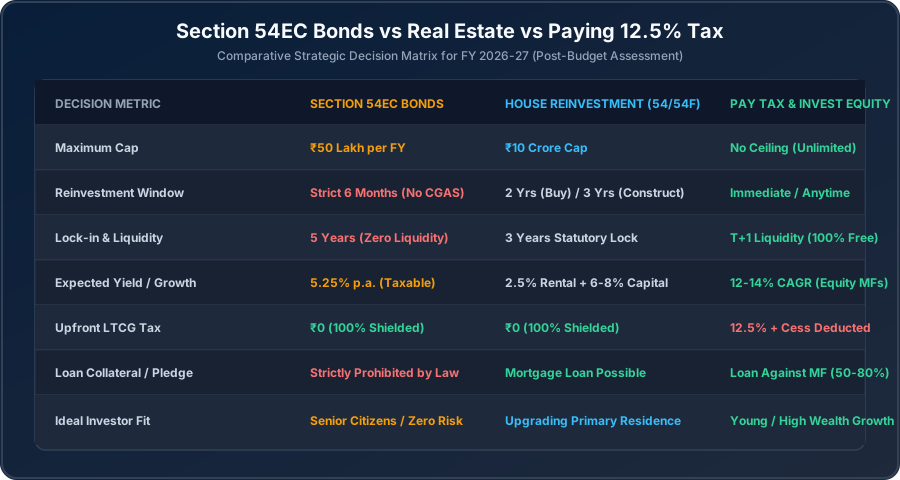
Figure 2: Strategic comparison of Section 54EC bonds vs real estate reinvestment vs upfront tax payment for FY 2026-27.
Mathematical Comparison: 54EC Bonds vs Paying Tax & Index Funds
Let us evaluate a scenario where a taxpayer realizes a Long-Term Capital Gain of ₹50,00,000 on land sale:
| Parameter | Strategy A: Invest in 54EC Bonds | Strategy B: Pay 12.5% Tax & Invest in Nifty 50 Index |
|---|---|---|
| Capital Gain Generated | ₹50,00,000 | ₹50,00,000 |
| Upfront LTCG Tax Paid (12.5% + 4% Cess) | ₹0 | ₹6,50,000 |
| Net Amount Invested | ₹50,00,000 in REC/NHAI Bonds | ₹43,50,000 in Equity Mutual Funds |
| Annual Yield / Expected CAGR | 5.25% p.a. (Fixed) | 12.00% p.a. (Historical CAGR) |
| Annual Post-Tax Income / Growth (30% Slab) | ₹50L × 5.25% × (1 - 0.312) = ₹1,80,600/yr | Reinvested compounding growth |
| Portfolio Value After 5 Years | ₹50,00,000 principal + ₹9,03,000 net interest = ₹59,03,000 | ₹43,50,000 × (1.12)5 = ₹76,66,220 |
| Taxes on Liquidation at Year 5 | ₹0 | 12.5% LTCG on ₹33.16L gain = ₹4,14,500 |
| Net In-Hand Wealth After 5 Years | ₹59,03,000 | ₹72,51,720 (+₹13.48 Lakh higher) |
The Strategic Insight: If you are a young investor or mid-career professional with a high risk tolerance and an investment horizon exceeding 5 years, paying the 12.5% tax upfront and compounding the remaining 87% in equities often yields higher net terminal wealth than locking money into 5.25% taxable bonds. However, for retirees needing capital preservation and zero volatility, Section 54EC bonds remain the gold standard.
10. Step-by-Step Subscription & Demat Allotment
Investing in Section 54EC bonds is straightforward. Taxpayers can subscribe through online portals or via physical application forms distributed through authorized banking branches.
Execution Steps
- Choose the Issuer: Download the official 54EC application form from REC Limited, PFC, NHAI, or IRFC website, or collect it from authorized brokers (HDFC Securities, ICICI Direct, SBI Cap Securities, etc.).
- Mode of Holding: You can hold bonds in Demat Form (recommended for easy tracking and zero loss risk) or in Physical Bond Certificate form. For Demat holding, provide your 16-digit Beneficiary DP ID and Client ID along with a Client Master List (CML) copy.
- Payment Execution: Remit payment via RTGS/NEFT directly into the designated collection account of the issuer. Ensure the remitter name matches the applicant's name. Cheque payments are also accepted, but the date of realization of the cheque is treated as the date of investment by the tax authorities—make sure cheques are deposited well before the 6-month deadline!
- Allotment Advice: Once processed (usually on the last calendar day of each month), the issuer transmits an Allotment Advice and credit slip. The bonds are credited directly into your Demat account within 30 to 45 days.
- Filing in ITR: While filing your ITR (ITR-2 or ITR-3), report the sale of land/building under "Schedule CG" (Capital Gains), disclose the Section 54EC deduction under "Exemptions under Section 54/54EC/54F", and enter the bond distinctive numbers, date of investment, and amount invested.
11. Real-World Computational Case Studies
Case Study 1: Senior Citizen Monetizing a Suburban Plot
Rameshwar Dayal, aged 68, sells an inherited vacant plot in Lucknow for ₹85,00,000 in October 2026. The indexed cost of acquisition is ₹35,00,000, leaving an LTCG of ₹50,00,000. Rameshwar does not wish to construct or buy another house because he already owns his home.
- Within 4 months of the sale, Rameshwar subscribes ₹50,00,000 in REC Section 54EC Bonds.
- Tax Exemption: The entire ₹50,00,000 LTCG is 100% exempt from tax under Section 54EC.
- Upfront tax saved: ₹6,50,000 (at 12.5% + 4% cess).
- Annual cash inflow: Rameshwar receives ₹2,62,500 every year as interest payout, which supplements his retirement pension. Under Section 80TTB, he claims senior citizen interest deductions on his savings yields.
Case Study 2: Joint Property Co-Owners Doubling the Shield
Suresh and his wife Sunita co-own a commercial shop with equal 50:50 undivided shares. They sell the shop in December 2026 for ₹1,80,00,000, incurring a total LTCG of ₹1,00,00,000 (₹1 Crore).
- Because Suresh and Sunita are independent taxpayers filing separate ITRs, each co-owner's share of the LTCG is ₹50,00,000.
- The ₹50 Lakh cap under Section 54EC applies per assessee, not per property asset.
- Suresh invests ₹50,00,000 in NHAI Bonds, and Sunita invests ₹50,00,000 in PFC Bonds.
- Total Exemption Claimed: ₹1,00,00,000 (₹1.00 Crore). Both spouses achieve a combined tax liability of exactly ₹0, legally sheltering the entire ₹1 Crore gain.
Case Study 3: Combining Section 54 and Section 54EC
Deepak sells an ancestral residential bungalow in Jaipur for ₹3,00,00,000, incurring an LTCG of ₹1,80,00,000. He buys a smaller flat for ₹1,30,00,000. This leaves ₹50,00,000 of LTCG exposed to tax.
- Deepak claims Section 54 exemption of ₹1,30,00,000 against the purchase of the new flat.
- For the remaining ₹50,00,000 LTCG, Deepak subscribes to Section 54EC bonds within 6 months of the sale date.
- Result: Section 54 (₹1.30 Cr) + Section 54EC (₹0.50 Cr) = ₹1.80 Crore total exemption. Total capital gains tax payable is completely eliminated to ₹0.
12. Frequently Asked Questions (FAQs)
Can an NRI invest in Section 54EC bonds?
Yes. Non-Resident Indians (NRIs) who generate long-term capital gains from the sale of land or building in India are fully eligible to invest in Section 54EC bonds through their NRO (Non-Resident Ordinary) bank accounts. However, interest credited to an NRI is subject to TDS under Section 195 (unless protected by a Double Tax Avoidance Agreement or a Nil TDS certificate).
What happens if the bondholder passes away during the 5-year lock-in?
In the event of the demise of the bondholder before the completion of the 5-year tenure, the bonds are transmitted to the registered nominee or legal heirs. The transmission of bonds to legal heirs does not constitute a transfer under Section 2(47), and therefore no tax clawback or penalty is triggered. The nominee continues to hold the bonds until maturity and receives the principal and interest.
Can a company, LLP, or partnership firm invest in 54EC bonds?
Yes. Unlike Section 54 and Section 54F (which are strictly restricted to Individuals and HUFs), Section 54EC uses the universal term "assessee". Any taxable entity—including private limited companies, LLPs, partnership firms, and associations of persons (AOPs)—can invest in Section 54EC bonds to exempt capital gains on land or building sale up to ₹50 Lakh.
Is there any secondary market to sell 54EC bonds before 5 years?
No. Section 54EC bonds are strictly unlisted and non-negotiable. They cannot be listed or traded on the NSE or BSE, nor can they be transferred to any third party in off-market transactions. Premature redemption is strictly barred by the issuers and CBDT regulations.
What is the minimum investment amount in 54EC bonds?
The face value of each 54EC bond is ₹10,000. Most issuers mandate a minimum subscription of 2 bonds (₹20,000) and in multiples of 1 bond (₹10,000) thereafter, up to the statutory maximum of 500 bonds (₹50,00,000).