Section 80C Deductions: 15 Investment Options, ₹1.5L Limit & Tax Rules (FY 2026-27)
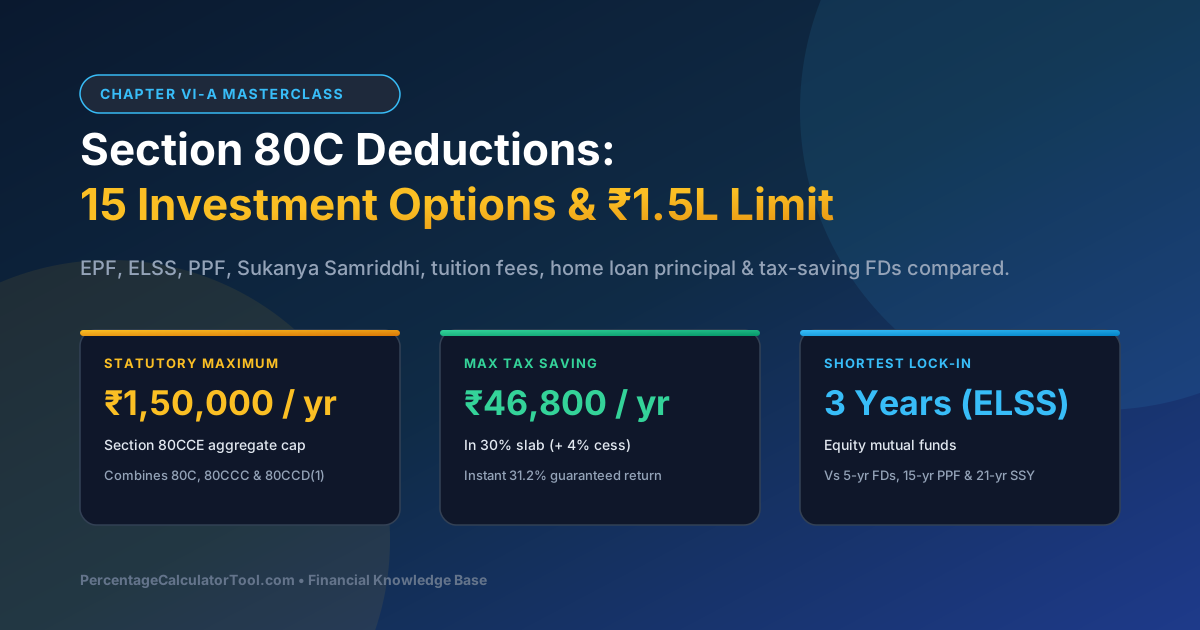
Section 80C remains the bedrock of personal tax planning in India. Discover every one of the 15 statutory instruments eligible under the ₹1,50,000 Section 80CCE ceiling—from EPF, ELSS, and PPF to tuition fees, home loan principal, and Sukanya Samriddhi—with complete returns, lock-in tenures, and tax efficiency analysis for Assessment Year 2027-28.
§ Table of Contents
- 1. The Legislative Architecture: Section 80C & Section 80CCE
- 2. The True Math of ₹1.5 Lakhs: Bracket-by-Bracket Tax Saved
- 3. The 4 Strategic Buckets of Section 80C Instruments
- 4. Exhaustive Breakdown of All 15 Eligible Options
- 5. Visual Taxonomy: Risk, Lock-in & Wealth Orientation
- 6. Tax Status Deep-Dive: EEE vs. EET vs. ETE Explained
- 7. Non-Investment Deductions: Tuition Fees, Home Principal & Stamp Duty
- 8. Head-to-Head Comparative Analytical Matrix
- 9. Beyond 80C: The Additional ₹50,000 NPS Under 80CCD(1B)
- 10. New Tax Regime vs. Old Tax Regime: Is 80C Still Worth It?
- 11. Practical Case Study: Optimizing ₹1.5L for a ₹18 LPA Professional
- 12. Frequently Asked Questions (Direct Tax FAQs)
1. The Legislative Architecture: Section 80C & Section 80CCE
Introduced under Chapter VI-A of the Income-tax Act, 1961, Section 80C allows individual taxpayers and Hindu Undivided Families (HUFs) to claim deductions from their Gross Total Income (GTI) in respect of specified long-term savings, pension contributions, insurance premiums, and critical domestic capital outlays.
However, Section 80C does not operate in isolation. It is bound by Section 80CCE, an umbrella legislative restriction that mandates:
Section 80CCE Umbrella Limit:
Total Deduction = Section 80C + Section 80CCC (Annuity/Pension) + Section 80CCD(1) (Employee NPS)
Maximum Aggregate Allowable Deduction = ₹1,50,000 per financial year
Even if an ambitious investor contributes ₹1,50,000 to EPF, deposits ₹1,50,000 in PPF, invests ₹1,00,000 in ELSS mutual funds, and pays ₹80,000 in school tuition fees (totaling ₹4,80,000), their statutory deduction against taxable income is rigidly capped at ₹1,50,000.
2. The True Math of ₹1.5 Lakhs: Bracket-by-Bracket Tax Saved
A common financial misconception is viewing Section 80C as a "tax refund of ₹1.5 Lakhs". In direct tax law, Section 80C is a deduction from gross taxable income, not a direct tax credit. The actual cash saved in your pocket is directly determined by your top marginal tax slab:
| Old Regime Tax Slab | Base Tax Rate | Rate with 4% Health & Edu Cess | Net Annual Tax Saved on ₹1.5L |
|---|---|---|---|
| ₹2.5 Lakh to ₹5 Lakh | 5.00% | 5.20% | ₹7,800 |
| ₹5 Lakh to ₹10 Lakh | 20.00% | 20.80% | ₹31,200 |
| Above ₹10 Lakh (Standard) | 30.00% | 31.20% | ₹46,800 |
| Income ₹50 Lakh - ₹1 Crore (10% Surcharge) | 33.00% | 34.32% | ₹51,480 |
| Income ₹1 Crore - ₹2 Crore (15% Surcharge) | 34.50% | 35.88% | ₹53,820 |
For high-earning salaried professionals in the 30% tax bracket, deploying the full ₹1.5 Lakhs yields an instant, guaranteed tax reduction of ₹46,800, translating into an immediate 31.2% risk-free return on capital deployed.
3. The 4 Strategic Buckets of Section 80C Instruments
To prevent random or emotionally driven year-end tax investments, sophisticated financial planners segment the 15 eligible instruments into four clear functional buckets:
Government-backed, capital-guaranteed instruments offering safe compound interest. Includes EPF, VPF, PPF, Sukanya Samriddhi Yojana (SSY), Senior Citizens Savings Scheme (SCSS), National Savings Certificates (NSC), and 5-Year Bank Tax Saver FDs.
Equity-oriented instruments designed to beat inflation and compound wealth aggressively over long horizons. Primarily comprises Equity Linked Savings Schemes (ELSS mutual funds) and Unit Linked Insurance Plans (ULIPs).
Premiums paid toward pure term life insurance or traditional life insurance policies safeguarding financial dependents against mortality risks, subject to Section 10(10D) capital constraints.
Everyday capital expenses you already incur without investing fresh cash: Home loan principal repayments, property stamp duty and registration fees, and school/college tuition fees for children.

4. Exhaustive Breakdown of All 15 Eligible Options
Let us systematically evaluate each of the 15 statutory instruments eligible for deduction under Section 80C of the Income-tax Act:
1. Employees' Provident Fund (EPF) 8.25% p.a. • EEE Status
The employee's 12% statutory basic salary deduction automatically qualifies under Section 80C. For most corporate employees earning a basic salary of ₹60,000+ per month, EPF alone consumes ₹86,400 to the entire ₹1,50,000 limit without needing any outside investments. Note: Employer’s matching 12% contribution is exempt under Section 17(1) and does not count toward your 80C limit.
2. Voluntary Provident Fund (VPF) 8.25% p.a. • EEE Status
Salaried employees can voluntarily instruct HR to deduct additional salary (up to 100% of Basic + DA) into their EPF account. VPF earns identical interest to EPF and qualifies under 80C, subject to the overall ₹2.5 Lakh annual PF contribution threshold for tax-free interest under Section 10(11)/(12).
3. Public Provident Fund (PPF) 7.10% p.a. • 15-Year Lock-In
Open to all Indian residents (salaried, professionals, self-employed). Minimum deposit ₹500, maximum ₹1,50,000 per financial year. Enjoys pure Exempt-Exempt-Exempt (EEE) status—contributions are deductible, annual interest is 100% tax-free, and maturity proceeds are completely tax-exempt. Partial withdrawals permitted from year 7; loan facilities from year 3.
4. Equity Linked Savings Scheme (ELSS) 12% - 15% Historic • 3-Year Lock-In
Diversified equity mutual funds with mandatory 3-year lock-in (the shortest among all 80C avenues). Offers long-term wealth compounding by investing 80%+ of corpus in Indian equities. Post-Finance Act 2024, Long-Term Capital Gains (LTCG) upon redemption are exempt up to ₹1,25,000 per year across all equity assets, and taxed at a flat 12.5% on gains beyond ₹1.25 Lakhs.
5. Sukanya Samriddhi Yojana (SSY) 8.20% p.a. • Girl Child Welfare
Can be opened by parents/guardians for a girl child below 10 years of age (maximum two accounts for two daughters). Features EEE tax status, zero sovereign default risk, and one of the highest interest yields in government savings. Account matures after 21 years from opening date or upon marriage after age 18.
6. Senior Citizens Savings Scheme (SCSS) 8.20% p.a. • Age 60+ (5-Year Lock-In)
Reserved exclusively for senior citizens aged 60+ (or 55+ for voluntary retirees). Maximum investment limit is ₹30 Lakhs, but 80C deduction is capped at ₹1,50,000. Pays guaranteed quarterly interest. Interest is taxable under "Income from Other Sources", eligible for Section 80TTB ₹50,000 deduction.
7. National Savings Certificate (NSC) 7.70% p.a. • 5-Year Maturity
5-year post office certificate. Interest compounds annually and is paid at maturity. Unique Tax Feature: Interest accrued in the first 4 years is legally deemed to be reinvested and qualifies as a fresh Section 80C deduction for those respective years!
8. 5-Year Bank Tax-Saver Fixed Deposit 6.50% - 7.50% • EET Status
Issued by scheduled commercial banks with a strict 5-year lock-in. Cannot be pledged as collateral for loans, and premature liquidation is prohibited. While initial investment is deductible under 80C, annual interest is 100% taxable at your slab rate and subject to Section 194A TDS.
9. 5-Year Post Office Time Deposit (POTD) 7.50% p.a. • Government Backed
Only the 5-year tenure POTD qualifies under Section 80C (1, 2, and 3-year term deposits do NOT qualify). Interest is calculated quarterly but paid annually, and is fully taxable at your marginal slab rate.
10. Life Insurance Premiums (Term & Traditional) Pure Protection • Section 10(10D)
Premiums paid for life insurance policies covering self, spouse, or children qualify. Under Section 10(10D), the annual premium cannot exceed 10% of the minimum sum assured (i.e., sum assured must be at least 10 times the annual premium). For traditional non-unit-linked policies issued on or after 1 April 2023, maturity proceeds are taxable if aggregate annual premium exceeds ₹5,00,000.
11. Unit Linked Insurance Plans (ULIPs) 5-Year Lock-In • ₹2.5L Premium Cap
Combines insurance cover with equity or debt market investments. Under Section 10(10D) amendments, if total annual premium paid across all ULIPs exceeds ₹2,50,000, maturity gains are taxed as capital gains (identical to equity mutual funds).
12. Home Loan Principal Repayment Mandatory Expense • 5-Yr Resale Lock
Principal portion of EMIs paid toward a home loan taken from banks, HFCs, or central/state governments for purchasing or constructing a residential house. Crucial Lock-in Proviso: You cannot sell or transfer the house within 5 years from the end of the financial year in which possession was obtained, otherwise all past deductions claimed are reversed and taxed as income!
13. Stamp Duty & Property Registration Charges One-Time Acquisition Outflow
Stamp duty, registration charges, and official transfer fees paid for acquiring a residential property are deductible under 80C in the financial year of payment, even if you did not avail of a housing loan.
14. Children's School & College Tuition Fees Up to 2 Children • Full-Time India
Tuition fees paid to any recognized school, college, university, or educational institution situated in India for full-time education of up to two children. Strictly excludes development fees, capitation donations, school bus transport charges, hostel charges, and private coaching fees.
15. NABARD Rural Infrastructure Bonds Notified Government Bonds
Subscriptions to notified rural infrastructure bonds issued by the National Bank for Agriculture and Rural Development (NABARD). Highly secure, but infrequently issued in recent fiscal years.

6. Tax Status Deep-Dive: EEE vs. EET vs. ETE Explained
When evaluating tax-saving investments, sophisticated investors analyze the three lifecycle stages of capital: Contribution, Accumulation (Interest/Gains), and Maturity (Withdrawal).
Exempt - Exempt - Exempt
100% tax-free across all three stages. Contribution is deductible, interest compounds completely tax-free, and maturity withdrawal is zero tax. Examples: PPF, Sukanya Samriddhi Yojana, EPF (under ₹2.5L).
Exempt - Tax-deferred - Taxed
Contribution is deductible, gains accumulate without annual tax, but redemption gains are subject to capital gains tax. Example: ELSS Mutual Funds (12.5% LTCG above ₹1.25 Lakhs).
Exempt - Taxed - Taxed
Contribution is deductible under 80C, but annual interest is taxed at your full marginal slab rate (up to 31.2%). Example: 5-Year Bank Tax Saver Fixed Deposits & Post Office TD.
Tax Planning Insight: Investing in 5-year bank FDs is structurally inefficient for individuals in the 30% slab because the post-tax return on a 7% FD collapses to ~4.8%, lagging inflation.
7. Non-Investment Deductions: Tuition Fees, Home Principal & Stamp Duty
Many Indian families unnecessarily lock up fresh liquid cash in 5-year FDs or insurance endowment policies simply because they do not realize that their routine living outflows already exceed the ₹1.5 Lakh 80C ceiling!
School & College Tuition Fees
If you pay ₹80,000 per term in school tuition fees for two children, you have already spent ₹1,60,000 on qualifying 80C expenses. Obtain a formal fee receipt from the school principal explicitly breaking out the "Tuition Fee" line item.
Home Loan Principal EMIs
Download your annual Home Loan Provisional Interest Certificate from your bank. While Section 24(b) handles interest up to ₹2,00,000, the principal amortization component (typically ₹1.2 Lakh to ₹2.5 Lakh per year) flows straight into Section 80C.
8. Head-to-Head Comparative Analytical Matrix
The chart above demonstrates why asset allocation matters inside Section 80C:
- Best for Pure Capital Growth: ELSS mutual funds offer high equity returns (12-15% CAGR) with the lowest lock-in (3 years).
- Best for Sovereign Stability: Public Provident Fund (PPF) and Sukanya Samriddhi Yojana (SSY) provide pure EEE tax protection with zero volatility.
- Least Tax Efficient: 5-Year Bank FDs and National Savings Certificates, due to annual interest taxability.
9. Beyond 80C: The Additional ₹50,000 NPS Under 80CCD(1B)
Once you exhaust your ₹1,50,000 Section 80C ceiling, you can unlock an exclusive additional deduction under Section 80CCD(1B).
Section 80CCD(1B) provides an exclusive deduction of up to ₹50,000 for voluntary deposits into the National Pension System (NPS Tier-1). Because this is completely outside and over the ₹1.5 Lakh 80CCE umbrella, an individual filing under the Old Tax Regime can achieve a total Chapter VI-A deduction of ₹2,00,000!
Combined 80C + 80CCD(1B) Tax Saving
₹1,50,000 (Section 80C) + ₹50,000 (Section 80CCD(1B)) = ₹2,00,000 total deduction. In the 30% tax bracket (31.2% effective rate), this reduces your direct income tax by ₹62,400 per year!
10. New Tax Regime vs. Old Tax Regime: Is 80C Still Worth It?
Under the Finance Act, the New Tax Regime under Section 115BAC serves as the statutory default system. A cornerstone rule of Section 115BAC is that Section 80C deductions are 100% abolished!
When does claiming Section 80C justify staying in the Old Tax Regime?
| Scenario | Old Regime Worthwhile? | Breakeven Deduction Threshold |
|---|---|---|
| Only Section 80C (₹1.5 Lakhs) Claimed | NO (New Regime wins decisively) | New Regime lower slabs save more tax than ₹1.5L 80C alone |
| 80C (₹1.5L) + HRA (₹2.5L) + 80D (₹50k) | YES (Old Regime wins by ₹30k - ₹50k) | Total deductions exceed ₹4.25 Lakhs |
| 80C (₹1.5L) + Home Loan Interest (₹2L) + 80D | YES (Old Regime is highly superior) | Total deductions exceed ₹4.5 Lakhs |
Section 80C on its own is no longer enough to beat the New Tax Regime. However, when stacked alongside substantial HRA, Home Loan Interest under Section 24(b), and Section 80D health insurance, Section 80C serves as a vital component of the Old Tax Regime tax shield.
11. Practical Case Study: Optimizing ₹1.5L for a ₹18 LPA Professional
Let us observe how Rohan, a Senior Business Analyst in Bengaluru earning ₹18,00,000 per annum, structures his Section 80C portfolio without locking up unnecessary liquidity:
12. Frequently Asked Questions (Direct Tax FAQs)
Can I invest more than ₹1.5 Lakhs in PPF in a single financial year? ▼
No. Under the Public Provident Fund Scheme, 2019, the statutory annual deposit cap is strictly ₹1,50,000 across all accounts held in an individual's name (including accounts opened on behalf of minor children). Any excess sum deposited beyond ₹1.5 Lakhs earns 0% interest and is refunded.
Can both spouses claim tuition fee deduction for the same children?
▼
Yes. Each parent is entitled to claim deduction for up to two children under Section 80C. For example, if a couple has two children, one spouse can claim for Child A and the other spouse can claim for Child B, or both can claim if fees are split, provided the total claimed does not exceed actual fees paid.
What happens if I stop paying insurance premiums within two years?
▼
Under Section 80C(5), if a life insurance policy is terminated, surrendered, or lapses within two years from commencement (or within 5 years for ULIPs), all tax deductions claimed in past assessment years are deemed as income in the year of termination and taxed.
Can I claim principal repayment on a commercial shop or office loan?
▼
No. Section 80C(2)(xviii) strictly restricts the housing loan principal repayment deduction to residential house property. Loans taken for purchasing commercial offices, shops, industrial sheds, or vacant land are completely ineligible under Section 80C.