EPF vs VPF vs PPF: Which Provident Fund Gives Maximum Wealth? (2026-27)
The ultimate fixed-income wealth showdown for Indian salaried employees, investors, and professionals for FY 2026-27 (AY 2027-28). Unpack the 8.25% sovereign yield of EPF and VPF, the pure EEE tax shelter of PPF, Rule 9D interest taxation above ₹2.5 Lakhs, and 20-year wealth compounding models.
Executive Summary: The Bedrock of Guaranteed Indian Wealth
In a financial world dominated by volatile equity markets, crypto swings, and real estate liquidity crunches, the humble Provident Fund (PF) remains the unshakable bedrock of the Indian middle class's retirement dreams. Backed by sovereign government guarantees and conferring statutory immunity against debt collection or court attachment under the Provident Funds Act, these instruments offer a rare combination of absolute capital preservation and inflation-beating real yields.
However, most earners conflate the three primary provident funds available in India:
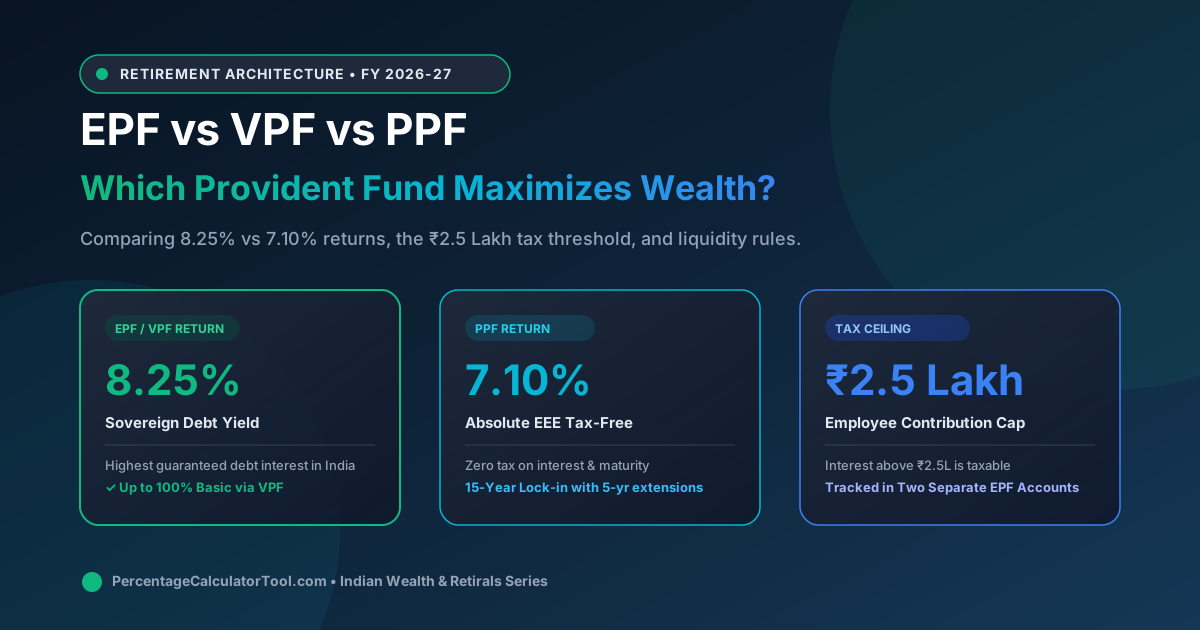
- Employees' Provident Fund (EPF): The mandatory retirement savings vehicle for salaried formal employees, offering a market-topping 8.25% per annum sovereign yield.
- Voluntary Provident Fund (VPF): An elective financial booster allowing salaried employees to contribute up to 100% of their basic pay at that identical 8.25% interest rate.
- Public Provident Fund (PPF): A universal 15-year wealth builder open to all resident Indian citizens (including freelancers, homemakers, children, and business proprietors) offering 7.10% tax-free interest.
With the introduction of Rule 9D under Section 10(11) and 10(12)—which taxes interest accrued on annual employee PF contributions exceeding ₹2.5 Lakhs—optimizing your fixed-income asset allocation requires mathematical precision. This comprehensive guide analyzes returns, tax implications, withdrawal rules, and long-term compounding across all three funds.
1. The Three Pillars of Indian Provident Funds
The Indian social security architecture separates retirement capital accumulation into three distinct institutional schemes. Each serves a specific purpose in an individual's personal financial lifecycle:
- The Statutory Safety Net (EPF): Mandated by the Employees' Provident Funds and Miscellaneous Provisions Act, 1952, for all commercial enterprises employing 20 or more individuals. It forces automated, disciplined monthly savings co-funded by both employer and employee.
- The High-Earner Debt Booster (VPF): An extension of EPF designed for salaried corporate professionals who wish to allocate a larger percentage of their monthly cash flow into safe, government-backed debt yields without opening separate retail accounts.
- The Universal Sovereign Vault (PPF): Established under the Public Provident Fund Act, 1968 (now governed by the Government Savings Promotion Act), designed to extend retirement security to the unorganized sector, self-employed professionals, traders, and non-working dependents.
2. Employees' Provident Fund (EPF): Mandatory Salaried Engine
For every formal corporate employee earning a basic salary in India, EPF is the default deduction. Under statutory regulations:
- Employee Contribution: Exactly 12% of Basic Salary + Dearness Allowance (DA) is deducted from the monthly paycheck.
- Employer Contribution: The employer contributes a matching 12% of Basic + DA, which is bifurcated into two separate statutory pools:
- 3.67% is credited directly to the employee's EPF account.
- 8.33% is diverted into the Employees' Pension Scheme (EPS), capped at a statutory basic salary ceiling of ₹15,000 per month (yielding a maximum monthly EPS contribution of ₹1,250). Any surplus employer contribution above ₹1,250 flows back into the EPF pool.
The interest rate—currently fixed at 8.25% for FY 2026-27—is recommended annually by the Central Board of Trustees (CBT) of the EPFO and officially notified by the Ministry of Finance. Interest is calculated on monthly running balances and credited to the member's passbook at the close of the financial year.
3. Voluntary Provident Fund (VPF): The 8.25% Supercharger
While EPF caps the mandatory employee contribution at 12% of Basic, the Voluntary Provident Fund (VPF) allows employees to voluntarily increase their monthly contribution up to 100% of their Basic Salary and Dearness Allowance.
Crucial characteristics of VPF include:
- Zero Employer Matching: Your employer is under no legal obligation to match any rupee contributed under VPF; their matching liability remains strictly pegged to the mandatory 12% EPF.
- Payroll Integration: VPF is initiated by submitting a formal declaration form to your employer's HR or payroll team (typically during the April declaration window or mid-year review). The specified amount or percentage is automatically deducted from your monthly gross pay.
- Unified Liquidity: VPF shares the identical withdrawal, transfer, and advance rules as EPF. When you switch corporate jobs, your VPF corpus transfers automatically alongside your EPF via the EPFO unified member portal.
4. Public Provident Fund (PPF): The Universal Pure EEE Fortress
Unlike EPF and VPF, which require an employer-employee nexus, the Public Provident Fund (PPF) is open to any Indian resident individual. Accounts can be opened at any nationalized bank (SBI, PNB, Canara Bank), authorized private bank (HDFC, ICICI, Axis), or India Post Office.
The fundamental tenets of PPF include:
- Investment Limits: Minimum deposit of ₹500 per financial year; maximum deposit capped at ₹1,50,000 per financial year across all accounts held in the individual's name (including accounts opened on behalf of a minor child).
- 15-Year Statutory Maturity: The account matures at the end of 15 full financial years from the year of opening (effectively 16 years). Upon maturity, the account can be extended in blocks of 5 years indefinitely, with or without continuing fresh contributions.
- The Pure EEE Paradigm: Contributions qualify for Section 80C deduction (under Old Regime), interest earned is 100% tax-free, and the entire maturity proceeds are 100% tax-free without any monetary caps.
- Current Interest Rate: Set quarterly by the Ministry of Finance; currently stands at 7.10% compounded annually. Deposits made between the 1st and 5th of a month earn interest for that entire calendar month.
5. Tri-Fund Structural Matrix & Key Parameters
To make an informed allocation decision, compare the legal, operational, and financial dimensions of each vehicle side-by-side.
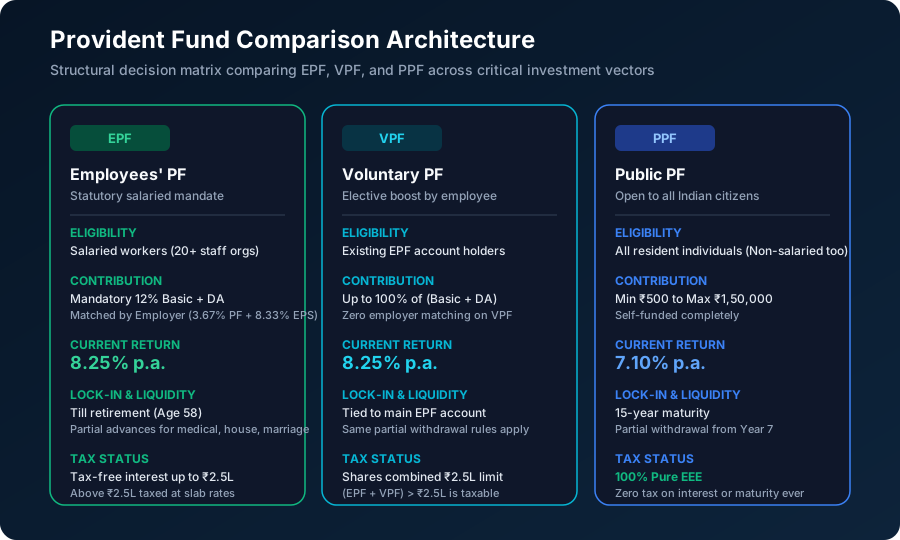
| Feature | EPF (Statutory) | VPF (Voluntary) | PPF (Public) |
|---|---|---|---|
| Eligibility | Salaried employees (20+ staff orgs) | Existing EPF members only | All resident Indians (including minors) |
| Current Interest (2026-27) | 8.25% p.a. | 8.25% p.a. | 7.10% p.a. |
| Annual Contribution Limit | 12% of Basic + DA | Up to 100% of (Basic + DA) | Min ₹500 to Max ₹1,50,000 |
| Employer Contribution? | Yes (Matching 12%) | No (0% from employer) | No (Self-funded) |
| Tenure & Lock-in | Till retirement (Age 58) | Till retirement (Age 58) | 15 Years (Extendable in 5-yr blocks) |
| Tax on Interest > ₹2.5L? | Yes (Section 10(11)/(12)) | Yes (Shares ₹2.5L limit with EPF) | No (100% Tax-Free EEE) |
| Section 80C Deduction? | Yes (Up to ₹1.5L in Old Regime) | Yes (Shares ₹1.5L 80C limit) | Yes (Shares ₹1.5L 80C limit) |
| Court Attachment Immunity? | Absolute Immunity | Absolute Immunity | Absolute Immunity |
6. The ₹2.5 Lakh Tax Trap: Demystifying Rule 9D Dual Accounts
Prior to April 1, 2021, high-net-worth salaried executives routinely dumped ₹20 Lakhs to ₹50 Lakhs annually into VPF to earn tax-free 8.5% interest, effectively treating the EPFO as a private tax-free fixed deposit.
To eliminate this arbitrage, Finance Act 2021 amended Section 10(11) and Section 10(12), introducing a statutory threshold:
To execute this mandate, CBDT notified Rule 9D of the Income Tax Rules, creating an automatic ledger bifurcation inside your EPFO UAN:
- Non-Taxable Contribution Account: Aggregates your closing balance as on March 31, 2021, plus all subsequent employee contributions up to ₹2,50,000 in every financial year, along with interest accrued thereon. This account remains 100% tax-free.
- Taxable Contribution Account: Tracks all employee contributions (mandatory EPF + elective VPF) in excess of ₹2,50,000 made during the financial year, plus interest accrued on this surplus capital.
How Taxable PF Interest is Deducted and Taxed
Interest accrued in the Taxable Account is taxable at your marginal income tax slab rate. Furthermore, under Section 194A, the EPFO is statutorily required to deduct 10% TDS on this taxable interest component at the time of credit if the taxable interest exceeds ₹5,000.
For an executive in the 30% tax bracket (effective 31.2% with cess):
$$\text{Post-Tax Return on VPF above ₹2.5L} = 8.25\% \times (1 - 0.312) = 5.676\%$$
Notice this critical mathematical inflection: once you cross the ₹2.5 Lakh employee contribution mark, your post-tax return on VPF drops to 5.68%. In comparison, PPF yields 7.10% completely tax-free. Therefore, every rupee contributed beyond ₹2.5 Lakhs in EPF/VPF yields significantly less net wealth than investing in PPF or tax-efficient arbitrage funds.
7. 20-Year Wealth Trajectory Case Study: The 115 bps Dividend
To understand why the 115 basis points (bps) difference between EPF/VPF (8.25%) and PPF (7.10%) is transformative over long horizons, consider an investor committing ₹10,000 per month (₹1,20,000 annually) over 20 years. Because this annual contribution is well below the ₹2.5 Lakh tax threshold, both vehicles enjoy 100% tax-free accumulation.
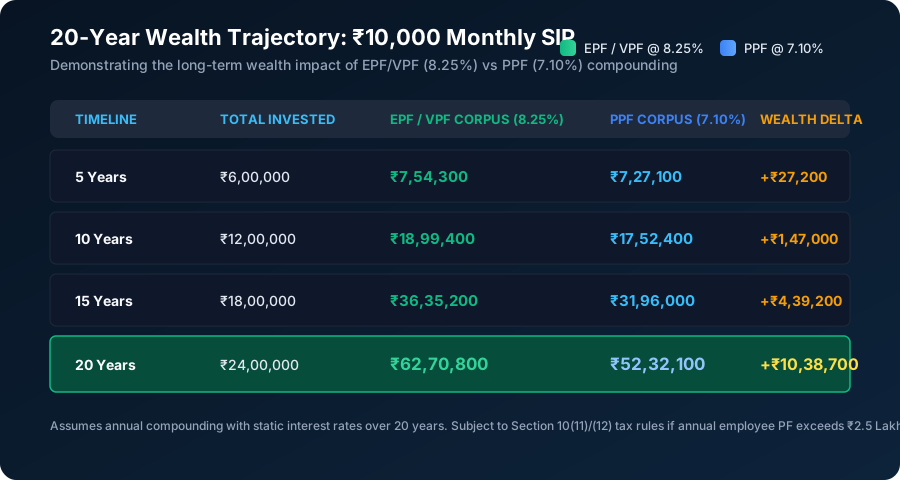
The mathematical progression reveals the immense compounding power of the EPF interest premium:
| Milestone | Cumulative Principal | PPF Corpus (@ 7.10%) | EPF / VPF Corpus (@ 8.25%) | Guaranteed Wealth Delta |
|---|---|---|---|---|
| Year 5 | ₹6,00,000 | ₹7,27,100 | ₹7,54,300 | +₹27,200 |
| Year 10 | ₹12,00,000 | ₹17,52,400 | ₹18,99,400 | +₹1,47,000 |
| Year 15 | ₹18,00,000 | ₹31,96,000 | ₹36,35,200 | +₹4,39,200 |
| Year 20 | ₹24,00,000 | ₹52,32,100 | ₹62,70,800 | +₹10,38,700 |
On a total out-of-pocket investment of ₹24 Lakhs, the 8.25% rate generates an astonishing ₹10,38,700 in extra tax-free wealth over PPF. This demonstrates why salaried professionals should always prioritize maxing out their combined EPF and VPF contributions up to the ₹2.5 Lakh tax threshold before turning to PPF.
8. Liquidity, Partial Advances & Premature Exit Rules Compared
Retirement funds are designed for patient capital, but life emergencies require liquidity. The three funds govern access under very different statutory mechanisms:
A. EPF and VPF Partial Advances (Form 31)
EPF allows non-refundable advances for specific life events without needing to resign:
- Residential Property / Construction: Permitted after 5 years of continuous service. You can withdraw up to 36 times monthly basic salary for house construction, or up to 24 times basic for purchasing land.
- Medical Emergencies (Para 68J): For serious illness of self, spouse, children, or dependent parents. No minimum service tenure required; up to 6 months of basic salary can be withdrawn.
- Higher Education & Marriage (Para 68K): Available after 7 years of service. You can withdraw up to 50% of the employee's aggregate contribution for self, children, or siblings.
- Pre-Retirement Advance: At age 57 (one year before statutory retirement), up to 90% of the total balance can be withdrawn.
B. PPF Loans & Partial Withdrawals
PPF provides statutory liquidity based on account vintage:
- Loan Facility (Years 3 to 6): A loan can be taken starting from the 3rd financial year up to the 6th financial year. The loan amount is capped at 25% of the balance at the end of the second preceding financial year. Interest is charged at 1% per annum above the prevailing PPF rate.
- Partial Withdrawals (Year 7 Onward): From the 7th financial year, one partial withdrawal is permitted per year. The withdrawal is capped at 50% of the balance at the end of the 4th preceding year or 50% of the balance at the end of the preceding year, whichever is lower.
- Premature Closure (After 5 Years): Allowed only under specific compassionate grounds: life-threatening diseases of account holder/family, higher education of child, or change in residency status (becoming an NRI). A penalty of 1% interest reduction is levied across the entire tenure.
Model Your Provident Fund & SIP Growth
Curious how much wealth you will accumulate across EPF, VPF, and mutual fund SIPs by retirement? Use our 100% free, private client-side calculators to plan your financial independence.
9. Frequently Asked Questions (FAQ)
What are the current interest rates for EPF, VPF, and PPF in FY 2026-27?
For FY 2026-27, the Employees' Provident Fund (EPF) and Voluntary Provident Fund (VPF) yield an interest rate of 8.25% per annum as declared by the Central Board of Trustees (CBT) and ratified by the Ministry of Finance. The Public Provident Fund (PPF) earns a government-administered interest rate of 7.10% compounded annually.
What is the ₹2.5 Lakh tax ceiling on EPF and VPF interest?
Under Section 10(11) and Section 10(12) amended by Finance Act 2021, if an employee's aggregate annual contribution to EPF and VPF exceeds ₹2,50,000 in a financial year, interest accrued on the excess contribution is taxable at normal slab rates. If the employer does not contribute to the fund, this threshold increases to ₹5,00,000.
Is Public Provident Fund (PPF) interest taxable above ₹2.5 Lakhs?
No. PPF retains 100% pure EEE (Exempt-Exempt-Exempt) tax status. However, the maximum allowable deposit into a PPF account is statutorily capped at ₹1,50,000 per financial year across all accounts held by an individual.
Can an employer match voluntary contributions made to VPF?
No. Employers are only legally required to contribute up to 12% of the employee's basic salary and dearness allowance under statutory EPF rules. Any voluntary additional contribution made by an employee under VPF is funded entirely by the employee without employer matching.
How does Rule 9D divide my EPF account into taxable and non-taxable parts?
Under Rule 9D of the Income Tax Rules, EPFO maintains two separate digital ledgers within your EPF account: a Non-Taxable Contribution Account (containing all contributions up to March 31, 2021, and subsequent contributions up to ₹2.5L annually) and a Taxable Contribution Account (containing employee contributions exceeding ₹2.5L annually and its accrued interest).
Can self-employed individuals or freelancers invest in EPF or VPF?
No. EPF and VPF are strictly restricted to salaried employees working in commercial or industrial establishments covered under the Employees' Provident Funds and Miscellaneous Provisions Act, 1952. Self-employed professionals and freelancers can invest in PPF or the National Pension System (NPS).
What is the lock-in period for PPF vs EPF?
PPF has a mandatory 15-year maturity period, after which it can be extended indefinitely in 5-year blocks. Partial withdrawals are permitted from the 7th financial year. EPF is locked in until retirement (age 58), though the full balance can be withdrawn if an employee remains unemployed for more than 2 months, or partial advances can be taken for specific life events (housing, illness, marriage).
Which provident fund gives the highest net wealth after 20 years?
EPF and VPF generate significantly higher wealth than PPF due to the 115 basis points interest premium (8.25% vs 7.10%). A monthly investment of ₹10,000 over 20 years accumulates to approximately ₹62.70 Lakhs in EPF/VPF compared to ₹52.32 Lakhs in PPF—yielding over ₹10.38 Lakhs in additional wealth.