Section 80CCD(2) Corporate NPS: Save Up to ₹1.5L Extra Tax Legally (FY 2026-27)
When the Indian government introduced the Revised New Tax Regime (Section 115BAC), it systematically eliminated almost every cherished salaried deduction: Section 80C (PPF, ELSS, Life Insurance), Section 80D (Health Insurance), Section 24(b) (Home Loan Interest), and standard HRA rent exemptions were all swept away. For middle-class and high-earning professionals, it appeared that the era of tax planning was dead.
Except for one extraordinary statutory exception: Section 80CCD(2) of the Income Tax Act, 1961.
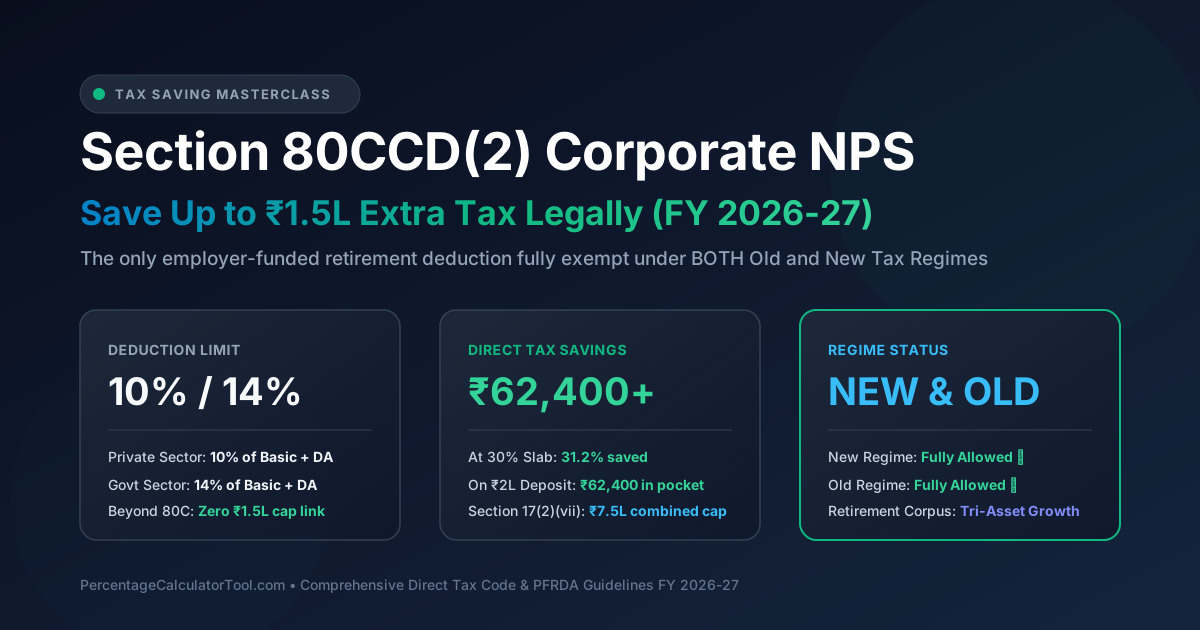
Section 80CCD(2) governs Corporate National Pension System (NPS) contributions made by an employer on behalf of an employee. In an unprecedented legislative design, Parliament intentionally preserved this deduction under Section 115BAC(1A). Whether you choose the default New Tax Regime or the legacy Old Tax Regime, employer contributions to your Tier-1 NPS PRAN account remain 100% tax-exempt up to 10% of your Basic Salary (or 14% for government staff).
For salaried professionals earning anywhere from ₹10 Lakhs to ₹50 Lakhs and beyond, utilizing Corporate NPS is the single most lucrative tax maneuver available in India today. Depending on your salary level and tax bracket, it delivers between ₹31,200 and ₹93,600 in cold, hard annual tax savings, while simultaneously building a compounding multi-crore retirement corpus at sovereign management fees of just 0.09%.
In this comprehensive operational guide, we dissect the exact legal provisions of Section 80CCD(2), trace how cash routes through corporate payroll, compare all three NPS tax sections, review the ₹7.5 Lakh cap under Section 17(2)(vii), and provide step-by-step instructions to enroll through your HR desk.
Table of Contents
- 1. The Legal Framework: Why Section 80CCD(2) Is Completely Unique
- 2. How Corporate NPS Works: Pre-Tax Salary Restructuring
- 3. Exact Tax Savings Matrix: ₹10L, ₹15L, ₹25L, & ₹50L Packages
- 4. 80CCD(1) vs 80CCD(1B) vs 80CCD(2): Spotting the Difference
- 5. The ₹7,50,000 Combined Perquisite Cap (Section 17(2)(vii))
- 6. Asset Allocation: Equity (E), Corporate Bonds (C) & Gilts (G)
- 7. Retirement Withdrawal Rules: 60% Tax-Free Lump Sum
- 8. Frequently Asked Questions (FAQ)
1. The Legal Framework: Why Section 80CCD(2) Is Completely Unique
Under standard Indian income tax law, any benefit, allowance, or monetary perk provided by an employer is presumed to be taxable as a salary perquisite under Section 17. However, Section 80CCD(2) creates an explicit statutory exclusion:
"Where, in the case of an assessee being an individual, employed by the Central Government or any other employer, any amount is contributed by the Central Government or any other employer to his account under a pension scheme... the assessee shall, in accordance with and subject to the provisions of this section, be allowed a deduction in the computation of his total income."
Key statutory limits defined under the Finance Act:
- Private Sector Employees: Up to 10% of Salary (where Salary is defined strictly as Basic Pay + Dearness Allowance if forming part of superannuation benefits).
- Central & State Government Employees: Up to 14% of Salary (Basic + DA).
- Zero Linkage to Section 80C: This deduction is totally independent of the ₹1,50,000 ceiling under Section 80C and Section 80CCE.
- Explicit Protection under Section 115BAC: Sub-section (2) of Section 115BAC specifically lists Section 80CCD(2) among the handful of permissible deductions under the New Tax Regime.
2. How Corporate NPS Works: Pre-Tax Salary Restructuring
A widespread misconception is that Corporate NPS requires your employer to pay extra money out of their own balance sheet. In reality, in 99% of Indian private companies, Corporate NPS is implemented via CTC Restructuring (Flexi-Benefit Substitution).
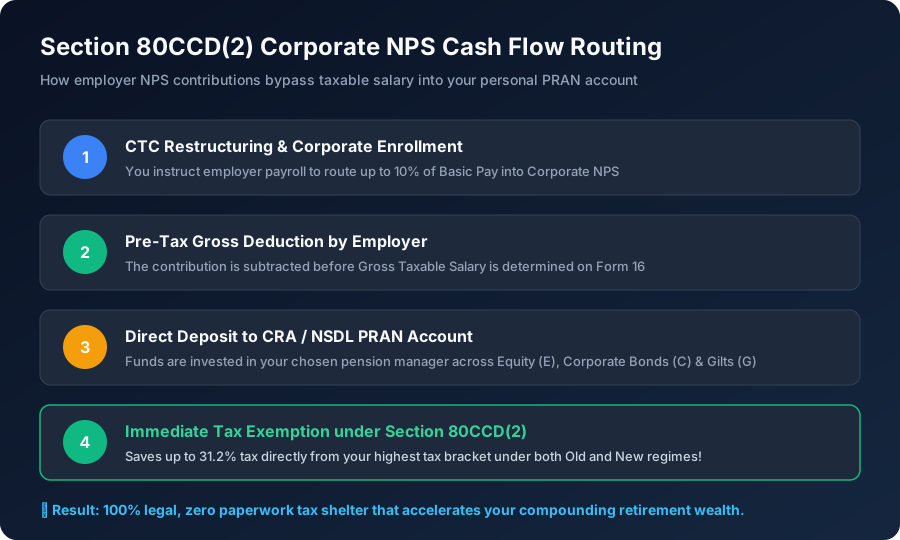
Here is how corporate HR payroll departments execute the restructuring:
- Selection: During annual flexi-benefit declaration or upon joining, you opt to divert 10% of your Basic Salary into Corporate NPS.
- Reallocation: The company payroll deducts this 10% amount from your fully taxable Special Allowance and re-designates it as Employer NPS Contribution. Your total overall CTC remains exactly unchanged.
- Direct Deposit: The employer remits this contribution directly to your designated Permanent Retirement Account Number (PRAN) managed by the Central Recordkeeping Agency (CRA - Protean/NSDL or KFintech).
- Tax Shield: On your Form 16, this amount is excluded from your Gross Taxable Salary or claimed under Section 80CCD(2), immediately lowering your taxable income by that exact amount.
3. Exact Tax Savings Matrix: ₹10L, ₹15L, ₹25L, & ₹50L Packages
Let us examine the concrete mathematical savings generated across different CTC tiers under the New Tax Regime (FY 2026-27), assuming standard 40% basic pay and 10% Corporate NPS restructuring:
| Annual CTC Package | Basic Pay (40%) | 10% NPS Deduction (₹) | Marginal Tax Slab | Direct Annual Tax Saved (₹) |
|---|---|---|---|---|
| ₹10,00,000 (10 LPA) | ₹4,00,000 | ₹40,000 | 10% + 4% Cess | ₹4,160 |
| ₹15,00,000 (15 LPA) | ₹6,00,000 | ₹60,000 | 20% + 4% Cess | ₹12,480 |
| ₹25,00,000 (25 LPA) | ₹10,00,000 | ₹1,00,000 | 30% + 4% Cess | ₹31,200 |
| ₹35,00,000 (35 LPA) | ₹14,00,000 | ₹1,40,000 | 30% + 4% Cess | ₹43,680 |
| ₹50,00,000 (50 LPA) | ₹20,00,000 | ₹2,00,000 | 30% + 4% Cess | ₹62,400 |
At a 25 LPA CTC, opting into Corporate NPS shields ₹1,00,000 from 30% taxation, directly reducing your tax bill by ₹31,200 every single year. Over a 15-year career span, investing that ₹31,200 tax refund alone into mutual fund SIPs at 12% CAGR generates over ₹12.4 Lakhs in additional wealth, created entirely out of saved taxes.
4. 80CCD(1) vs 80CCD(1B) vs 80CCD(2): Spotting the Difference
The National Pension System is governed by three separate sections under Chapter VI-A. Understanding the differences avoids costly errors during tax filing:
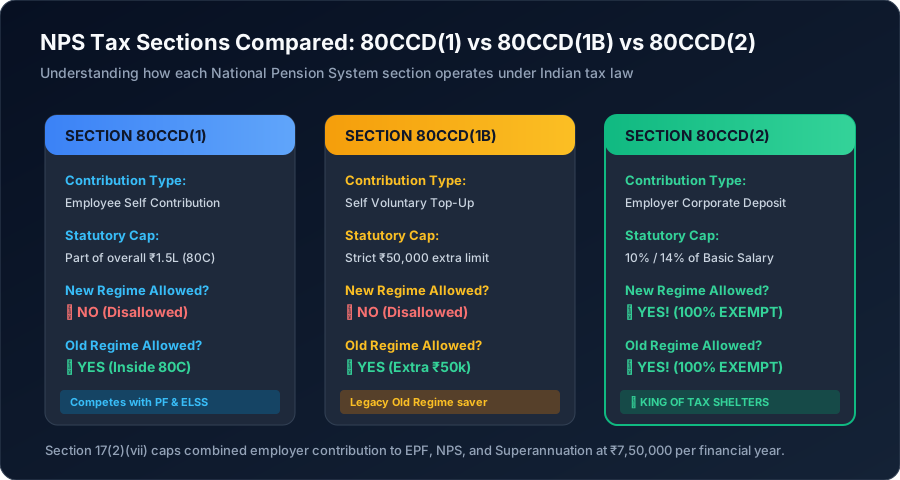
Section 80CCD(1): Self Contribution within 80C
Covers voluntary contributions by salaried or self-employed individuals up to 10% of salary or 20% of gross income, but subject to the overall ₹1,50,000 cap of Section 80C. Because Section 80C is disallowed in the New Tax Regime, this section is only relevant under the Old Regime.
Section 80CCD(1B): The Extra ₹50,000 Window
Provides an additional exclusive deduction of up to ₹50,000 over and above the Section 80C limit for voluntary personal contributions. Crucially, this section is NOT allowed under the New Tax Regime.
Section 80CCD(2): Employer Corporate Contribution
Covers contributions made directly by your employer up to 10% of Basic Pay. Fully allowed under BOTH Old and New Tax Regimes. There is no ₹50,000 or ₹1,50,000 cap. It represents pure, unadulterated tax savings.
5. The ₹7,50,000 Combined Perquisite Cap (Section 17(2)(vii))
While Section 80CCD(2) does not have an internal rupee cap, high-income earners must adhere to Section 17(2)(vii), enacted via Finance Act 2020.
The ₹7.5 Lakh Aggregate Retiral Threshold
Under Section 17(2)(vii), the total combined annual contribution made by an employer toward an employee’s:
- Recognized Provident Fund (Employer EPF contribution)
- National Pension System (Section 80CCD(2))
- Approved Superannuation Fund
...is capped at ₹7,50,000 per financial year. Any combined contribution exceeding ₹7.5 Lakhs is treated as a taxable perquisite in your hands. Furthermore, under Section 17(2)(viia), any interest, dividend, or capital appreciation generated by that excess portion is also taxed every year. For earners below ₹60 LPA CTC, this cap is virtually never breached.
6. Asset Allocation: Equity (E), Corporate Bonds (C) & Gilts (G)
When your corporate NPS account is funded, how should your money be managed? PFRDA regulations grant you complete autonomy over your asset allocation across four asset classes:
- Asset Class E (Equity): High-cap Indian equities and Nifty 50 / Sensex indices. You can allocate up to 75% in Equity under Active Choice up to age 50.
- Asset Class C (Corporate Debt): High-yield corporate debentures, bonds, and infrastructure securities (AAA/AA rated).
- Asset Class G (Government Securities): Sovereign Central and State government gilts offering zero default risk.
- Asset Class A (Alternative Investments): Real estate investment trusts (REITs) and InvITs, capped at a maximum of 5%.
Recommended Allocation for Professionals under 40: Choose Active Choice with 75% Equity (E) + 15% Corporate Debt (C) + 10% Gilts (G). Historically, this blend has generated annualized returns between 11.5% and 13.8% over rolling 10-year periods, far outpacing the 8.25% EPFO rate.
7. Retirement Withdrawal Rules: 60% Tax-Free Lump Sum
Many investors hesitate to utilize Corporate NPS due to myths regarding retirement lock-in and exit taxation. Here are the official PFRDA rules governing exit at age 60:
| Withdrawal Component | Percentage of Corpus | Tax Treatment under Indian Law |
|---|---|---|
| Lump Sum Withdrawal | Up to 60% of total fund | 100% Tax-Free under Section 10(12A) |
| Mandatory Annuity Purchase | Minimum 40% of total fund | Purchase is 100% Tax-Exempt (Monthly pension taxed as income) |
| Corpus Below ₹5 Lakhs | 100% of fund | 100% Tax-Free Lump Sum (No annuity required) |
Calculate Your NPS Tax Savings Instantly
Test different basic pay allocations, verify regime comparisons, and calculate retirement compound wealth:
8. Frequently Asked Questions (FAQ)
Is Section 80CCD(2) deduction allowed in the New Tax Regime? ▼
Yes! Section 80CCD(2) is explicitly preserved under Section 115BAC. Employer contributions to NPS up to 10% of basic pay (14% for government employees) are completely tax-exempt under both the New and Old Tax Regimes.
Can I claim both 80CCD(1B) and 80CCD(2) simultaneously? ▼
Under the Old Tax Regime, yes. You can claim up to 10% of basic under 80CCD(2) PLUS the additional ₹50,000 voluntary contribution under 80CCD(1B). Under the New Tax Regime, however, 80CCD(1B) is disallowed, but 80CCD(2) remains fully claimable.
What if my employer does not currently offer Corporate NPS? ▼
To claim Section 80CCD(2), the contribution must be remitted directly through corporate payroll. If your company is not registered as a Corporate Entity with PFRDA/Protean, you can petition your HR/Payroll team to onboard with Corporate NPS. Onboarding is 100% free for companies and carries zero payroll compliance liability.
Can I transfer my Corporate NPS account when I change jobs? ▼
Yes. Your 12-digit Permanent Retirement Account Number (PRAN) is completely portable throughout your lifetime. When changing employers, you simply submit your existing PRAN to your new company’s HR department to continue seamless payroll deductions.
Can I withdraw from NPS before age 60? ▼
Partial withdrawals of up to 25% of your own contributions are permitted after 3 years for specific life events (higher education, children's marriage, buying a first home, or critical illness). In case of premature complete exit before age 60, you must utilize 80% of the corpus to purchase an annuity, with only 20% available as a lump sum.
Written by the PercentageCalculatorTool Team
Our team of chartered tax advisors and pension analysts help salaried professionals optimize direct taxes, structure executive payrolls, and build long-term retirement wealth.