Section 87A Tax Rebate Explained: Why Up to ₹7.75L Is 100% Zero Tax (FY 2026-27)
In the history of Indian personal taxation, no single statutory clause has provided broader financial relief to the emerging middle class than Section 87A of the Income Tax Act, 1961. While headlines routinely declare that income tax rates begin at 5% for earnings above ₹3,00,000, the reality on the ground is radically different: tens of millions of Indian citizens earning between ₹3 Lakhs and ₹7.75 Lakhs pay exactly zero rupees in income tax.
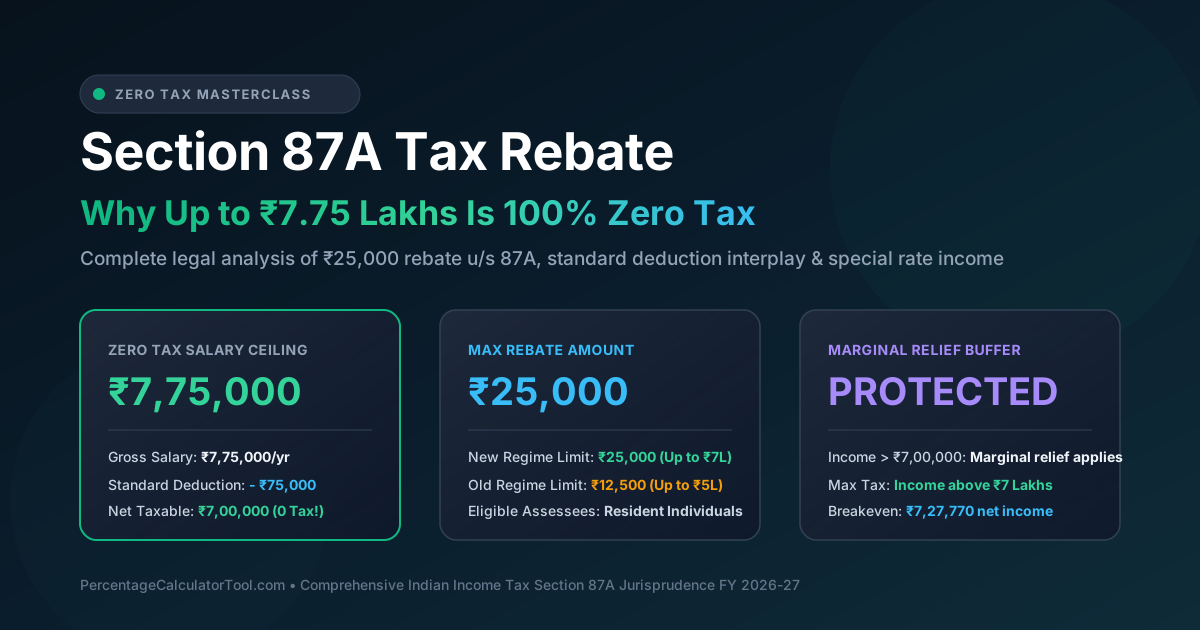
How is this possible? The magic lies in the structural synergy between the ₹75,000 Standard Deduction under Section 16(ia) and the ₹25,000 Tax Rebate under Section 87A. When combined within the Revised New Tax Regime (Section 115BAC), any resident salaried individual earning up to ₹7,75,000 per annum (₹64,583 per month) enjoys 100% legal tax immunity.
However, Section 87A is not without dangerous edge cases. What happens when your salary increases to ₹7,80,000 or ₹7,90,000? Do you suddenly lose the entire ₹25,000 rebate and face a massive tax cliff? How does statutory Marginal Relief step in to save borderline earners? And why is there fierce controversy over whether Section 87A applies to short-term stock market gains under Section 111A?
In this masterclass guide, we unpack the complete jurisprudence and computational mechanics of Section 87A for Financial Year 2026-27 (Assessment Year 2027-28). You will master the exact step-by-step zero-tax formula, examine the marginal relief mathematical buffer, and learn how to avoid common filing traps.
Table of Contents
- 1. The Legal Foundation: How Section 87A Operates
- 2. The ₹7.75 LPA Zero-Tax Calculation: Step-by-Step Proof
- 3. Section 87A in Old vs New Tax Regime
- 4. Marginal Relief: Eliminating the ₹7,00,000 Tax Cliff
- 5. Special Rate Income Conflict: STCG (111A) & LTCG (112A)
- 6. Ineligibility Checklist: NRIs, HUFs & Firms
- 7. Frequently Asked Questions (FAQ)
1. The Legal Foundation: How Section 87A Operates
To understand Section 87A, one must distinguish between a Tax Deduction and a Tax Rebate:
- A Tax Deduction (e.g. 80C, 80D, Standard Deduction): Reduces your taxable income before tax is calculated. A ₹50,000 deduction saves you ₹5,000 in a 10% slab.
- A Tax Rebate (Section 87A): Reduces your calculated tax liability directly rupee-for-rupee. If your calculated tax is ₹20,000, a ₹20,000 rebate reduces your final tax bill to exactly zero!
Under Section 87A, an assessee being an individual resident in India whose total income does not exceed the statutory threshold is entitled to an exemption of an amount equal to 100% of income tax or the prescribed monetary ceiling, whichever is less.
2. The ₹7.75 LPA Zero-Tax Calculation: Step-by-Step Proof
Let us trace the exact mathematics of a salaried professional earning ₹7,75,000 gross CTC under the default New Tax Regime for FY 2026-27:

| Computation Step | Financial Head | Amount (₹) | Statutory Reference |
|---|---|---|---|
| 1 | Gross Salary Earnings | ₹7,75,000 | Annual Payslip CTC |
| 2 | Less: Standard Deduction | - ₹75,000 | Section 16(ia) |
| 3 | Net Taxable Income | ₹7,00,000 | Qualifies for Section 87A |
| 4 | Tax on ₹0 to ₹3,00,000 (0%) | ₹0 | Exemption Slab |
| 5 | Tax on ₹3,00,001 to ₹7,00,000 (5%) | ₹20,000 | 5% of ₹4,00,000 |
| 6 | Total Calculated Income Tax | ₹20,000 | Before 87A Rebate |
| 7 | Less: Section 87A Tax Rebate | - ₹20,000 | 100% Tax Wiped Out |
| ✔ | FINAL INCOME TAX PAYABLE | ₹0 | Zero Tax + Zero Cess |
3. Section 87A in Old vs New Tax Regime
Section 87A exists in both regimes, but the parameters differ drastically between the two systems:
| Parameter | New Tax Regime (Section 115BAC) | Old Tax Regime |
|---|---|---|
| Net Taxable Income Threshold | Up to ₹7,00,000 | Up to ₹5,00,000 |
| Maximum Rebate Amount | ₹25,000 | ₹12,500 |
| Salaried Standard Deduction | ₹75,000 | ₹50,000 |
| Effective Zero-Tax Gross Salary | ₹7,75,000 | ₹5,50,000 (Before 80C) |
4. Marginal Relief: Eliminating the ₹7,00,000 Tax Cliff
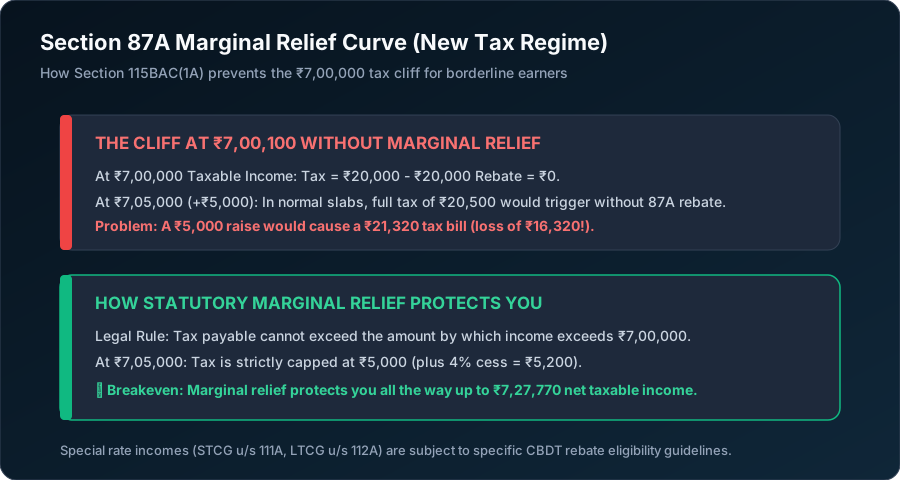
What happens if your net taxable income is ₹7,05,000 (just ₹5,000 above the ₹7 Lakh limit)?
Under a strict reading without relief, crossing ₹7,00,000 would cause you to forfeit the entire ₹25,000 rebate. On ₹7,05,000, your normal slab tax would be ₹20,500 (+ 4% cess = ₹21,320). In effect, earning ₹5,000 extra would cost you ₹21,320 in taxes—a net loss of ₹16,320!
The Section 115BAC(1A) Marginal Relief Safeguard
To prevent this anomaly, the Finance Act introduced Marginal Relief under Section 87A for the New Tax Regime:
On ₹7,05,000 taxable income, your tax payable is strictly capped at ₹5,000 (+ 4% cess = ₹5,200). You never pay more than 100% of your incremental income above ₹7 Lakhs. This protection phases out smoothly at ₹7,27,770, where normal slab tax becomes equal to marginal relief tax.
5. Special Rate Income Conflict: STCG (111A) & LTCG (112A)
An important debate in recent tax filings centers on whether Section 87A rebate applies against special-rate capital gains:
- 1. Short-Term Capital Gains u/s 111A (20% rate): Multiple Income Tax Appellate Tribunal (ITAT) rulings have confirmed that Section 87A rebate is fully deductible against STCG tax under Section 111A, provided total income stays under ₹7 Lakhs.
- 2. Long-Term Capital Gains u/s 112A (12.5% rate): Section 112A(6) contains specific statutory language stating that rebate under Section 87A shall not be allowed against tax computed on LTCG under Section 112A. Hence, even if your total income is below ₹7 Lakhs, tax on equity LTCG exceeding ₹1.25 Lakhs cannot be wiped out by Section 87A.
6. Ineligibility Checklist: NRIs, HUFs & Firms
Before claiming Section 87A, verify that you satisfy the statutory eligibility requirements:
| Taxpayer Category | Section 87A Eligible? | Legal Rationale |
|---|---|---|
| Resident Individual (Salaried / Self-Employed) | ✔ 100% ELIGIBLE | Core target demographic of Section 87A. |
| Non-Resident Indian (NRI) | ❌ INELIGIBLE | Section 87A explicitly requires assessee to be "Resident in India". |
| Hindu Undivided Family (HUF) | ❌ INELIGIBLE | Rebate is restricted strictly to "Individuals". |
| Partnership Firms & Companies | ❌ INELIGIBLE | Corporate entities cannot claim individual rebates. |
Simulate Your Zero-Tax Eligibility
Calculate your exact take-home pay, verify Section 87A rebate eligibility, and compare regimes with our free tools:
7. Frequently Asked Questions (FAQ)
Why is ₹7,75,000 completely tax-free for salaried workers? ▼
Salaried workers get a ₹75,000 standard deduction under the New Tax Regime, reducing taxable income from ₹7,75,000 to ₹7,00,000. Under Section 87A, taxable income up to ₹7,00,000 receives a full tax rebate of up to ₹25,000, reducing tax to ₹0.
What happens if my taxable income is ₹7,01,000? ▼
Due to Marginal Relief under Section 115BAC(1A), your tax is capped at the amount exceeding ₹7 Lakhs, which is ₹1,000 (plus 4% cess = ₹1,040). You do not pay the full slab tax.
Is Section 87A applied automatically in the ITR utility? ▼
Yes. The Income Tax Department e-filing portal automatically computes and applies the Section 87A rebate and marginal relief when computing your final tax liability in Form ITR-1 and ITR-2.
Can senior citizens claim Section 87A rebate? ▼
Yes. Resident senior citizens (aged 60 and above) are fully eligible for Section 87A rebate under both Old and New Tax Regimes, subject to the standard income thresholds.
Do I still need to file an ITR if my tax is ₹0 due to Section 87A? ▼
Yes! If your total income before deductions/rebate exceeds the basic exemption limit (₹3,00,000), you are legally obligated to file an ITR, even if your final tax liability after Section 87A is zero. Filing also enables you to claim refunds for any TDS withheld.
Written by the PercentageCalculatorTool Team
Our chartered accountants and direct tax researchers analyze legislative amendments, statutory rebates, and payroll compliance for Indian taxpayers.