Standard Deduction in India 2026-27: ₹75,000 New vs ₹50,000 Old Regime Complete Rules
Everything salaried employees, pensioners, and corporate professionals must know about Section 16(ia) statutory standard deduction for FY 2026-27 (AY 2027-28). Understand the enhanced ₹75,000 New Regime deduction, the dual employer double-counting trap, and how standard deduction creates a 100% tax-free salary threshold up to ₹7.75 Lakhs.
Executive Summary: The Engine of Salaried Tax Relief
Unlike business owners and freelancers who can debit internet bills, vehicle fuel, office depreciation, and client entertainment directly against their gross top-line revenue, salaried professionals in India historically suffered from an asymmetrical tax structure. To level this playing field without subjecting millions of corporate workers to burdensome receipt-tracking audits, the Parliament reintroduced the Statutory Standard Deduction under Section 16(ia).
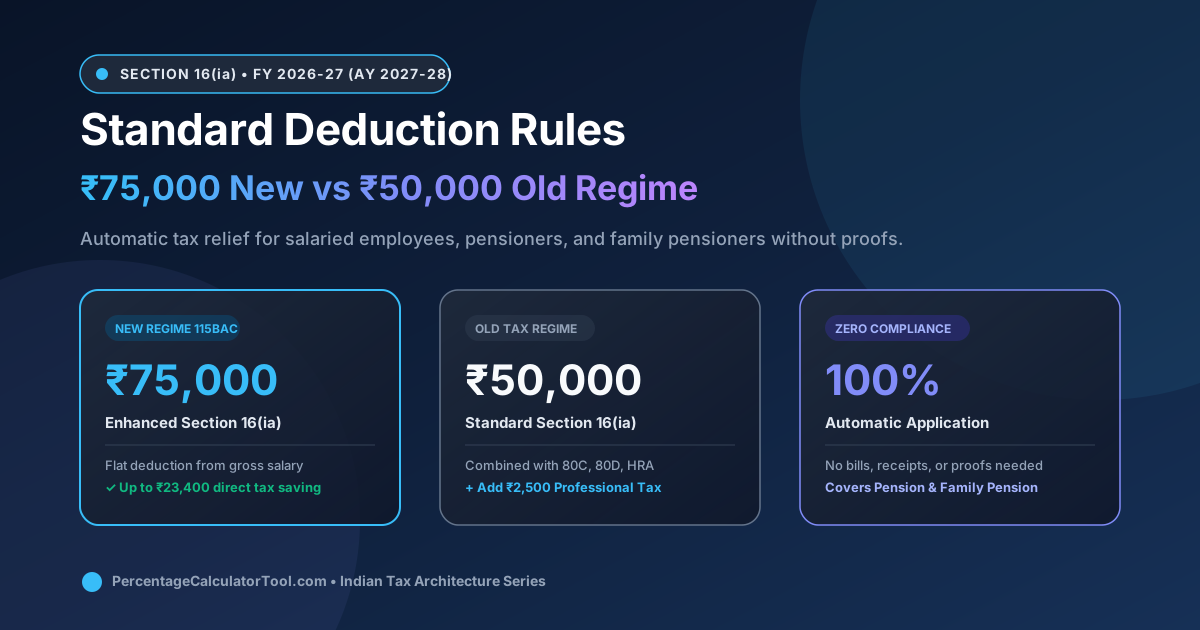
For Assessment Year 2027-28 (Financial Year 2026-27), the standard deduction stands at two distinct statutory figures based on your chosen regime:
- New Tax Regime (Section 115BAC): Enhanced to a flat ₹75,000 per financial year. Combined with the expanded Section 87A rebate, this ensures that any Indian professional earning a gross annual salary of up to ₹7,75,000 owes precisely ₹0 in income tax.
- Old Tax Regime: Retained at ₹50,000 per financial year. This deduction can be combined with Section 16(iii) Professional Tax (up to ₹2,500), Section 80C, Section 80D, Section 24(b) home loan interest, and House Rent Allowance (HRA) under Section 10(13A).
While the deduction is automatic, navigating mid-year corporate resignations, dual Form 16 issuances, and family pension taxation under Section 57(iia) requires rigorous procedural awareness. This comprehensive treatise explores the complete statutory mechanics, tax optimization formulas, and compliance safeguards governing Section 16(ia).
1. Legislative Background & Evolution of Section 16(ia)
To understand why the standard deduction exists in its current form, taxpayers must examine the legislative history of Section 16. In the 1990s and early 2000s, salaried employees enjoyed standard deduction until it was abolished in Union Budget 2005 under the premise that personal tax slab exemptions had been substantially broadened. In its place, the Income Tax Act provided two piecemeal exemptions:
- Medical Reimbursement: Capped at ₹15,000 annually under Section 17(2), requiring employees to collect and submit physical pharmacy receipts, clinical bills, and diagnostic invoices to their payroll departments every January.
- Transport Allowance: Capped at ₹1,600 per month (₹19,200 annually) under Rule 2BB for commuting expenses between home and the workplace.
Together, these two provisions amounted to a maximum deduction of ₹34,200 per year, accompanied by monumental clerical overhead for both corporate HR departments and individual taxpayers.
Recognizing the administrative inefficiency, Union Budget 2018 abolished the ₹15,000 medical reimbursement and the ₹19,200 transport allowance for general employees, replacing them with a flat ₹40,000 standard deduction under the newly inserted Section 16(ia). In interim Budget 2019, this flat deduction was increased to ₹50,000.
When the Concessional New Tax Regime was originally introduced under Section 115BAC via Finance Act 2020, standard deduction was completely prohibited. However, realizing that salaried employees were reluctant to adopt the simplified regime without an equivalent standard deduction, the Ministry of Finance introduced standard deduction of ₹50,000 into the New Regime in Finance Act 2023, and subsequently enhanced it to ₹75,000 in Finance (No. 2) Act 2024, maintaining that statutory figure for FY 2026-27 (AY 2027-28).
The legislative objective is clear: incentivize salaried employees to transition toward the New Tax Regime by providing a 50% higher standard deduction (₹75,000 vs ₹50,000) while dismantling reliance on legacy investment lock-ins.
2. ₹75,000 New Regime vs ₹50,000 Old Regime: Complete Comparative Framework
A common misconception among early-career salaried workers is that standard deduction is an elective benefit that requires choosing specific investment products. In reality, Section 16(ia) is an unconditional deduction automatically deducted from gross salary. However, its interplay with other sections differs drastically between regimes.
| Feature / Provision | New Tax Regime (Sec 115BAC) | Old Tax Regime |
|---|---|---|
| Standard Deduction Limit (Sec 16(ia)) | ₹75,000 | ₹50,000 |
| Professional Tax (Sec 16(iii)) | Disallowed (₹0) | Deductible up to ₹2,500/year |
| Entertainment Allowance (Sec 16(ii)) | Disallowed | Allowed for Govt Employees (Max ₹5,000) |
| Documentary Proof Required | None (Automatic) | None (Automatic for Sec 16) |
| Eligible Income Heads | Salaries & Pension | Salaries & Pension |
| Zero Tax Gross Threshold | ₹7,75,000 (with 87A rebate) | ₹5,52,500 (with Sec 87A + PT) |
| Chapter VI-A Deductions Allowed? | Only Sec 80CCD(2) & Sec 80JJAA | 80C, 80D, 80E, 80G, 80TTA, 24(b), HRA |
In the Old Regime, an employee can claim the ₹50,000 standard deduction and additionally subtract up to ₹2,500 in statutory Professional Tax levied by state governments (such as Maharashtra, Karnataka, Telangana, West Bengal, and Tamil Nadu). This yields a total Section 16 deduction of ₹52,500.
In contrast, the New Regime provides a monolithic ₹75,000 deduction under Section 16(ia) while statutorily excluding Section 16(ii) and Section 16(iii). Despite losing the ₹2,500 Professional Tax deduction, the employee enjoys an immediate net advantage of ₹22,500 in additional deductions (₹75,000 minus ₹52,500) under the New Regime.
3. Salary to Net Taxable Income: Step-by-Step Statutory Waterfall
To understand exactly where Section 16(ia) sits inside your payroll payslip and Form 16, consider the statutory computational flow governed by Sections 15, 16, and 17 of the Income Tax Act. The diagram below illustrates how gross salary is systematically processed into chargeable income.
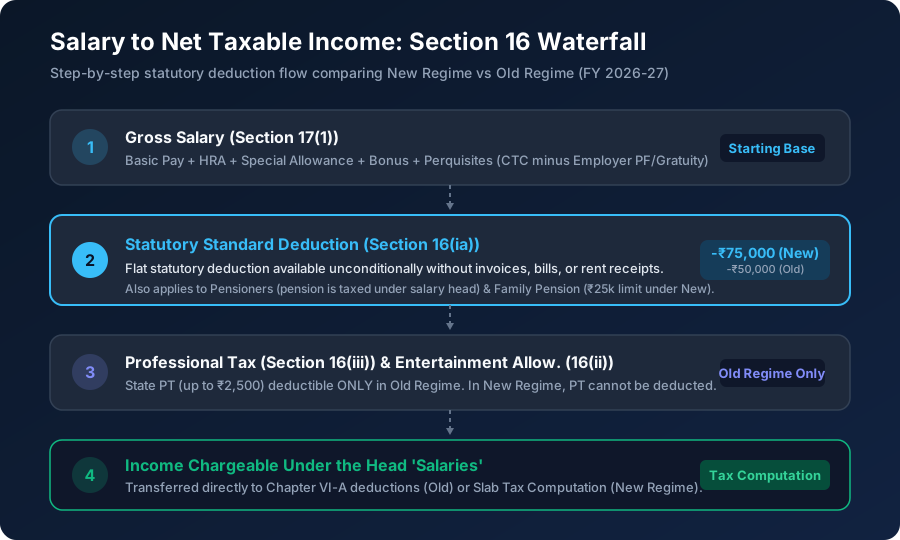
The computational sequence proceeds across four distinct phases:
Phase 1: Aggregation of Gross Salary (Section 17(1))
Gross salary represents the total remuneration paid or due from your employer during the financial year (April 1 to March 31). This comprises Basic Salary, Dearness Allowance (DA), House Rent Allowance (HRA), Special Allowance, Performance Bonus, Leave Travel Allowance (LTA), overtime, and monetary values of employer-provided perquisites (such as company cars, subsidized housing, or ESOP perquisite tax under Section 17(2)). Note that employer contributions to the Employee Provident Fund (EPF up to 12% of basic) and Gratuity allocations are statutory exclusions from gross salary.
Phase 2: Statutory Standard Deduction (Section 16(ia))
The payroll engine applies the standard deduction immediately after computing gross salary. It is a straight subtraction:
$$\text{Net Salary after Sec 16(ia)} = \text{Gross Salary} - \min(\text{Gross Salary}, ₹75,000)$$
If an employee's total gross salary during the year is less than ₹75,000 (e.g., a fresher joining in late March earning ₹45,000), the standard deduction is capped at the actual gross salary (₹45,000). It cannot create a negative salary loss to be carried forward or set off against capital gains.
Phase 3: Ancillary Section 16 Deductions (Old Regime Only)
If the employee opts out of Section 115BAC to file under the Old Tax Regime, the payroll system proceeds to apply entertainment allowance under Section 16(ii) (restricted to government employees up to ₹5,000) and professional tax actually paid under Section 16(iii) (typically ₹200 to ₹300 monthly, capped at ₹2,500 annually).
Phase 4: Income Chargeable Under the Head 'Salaries'
The resultant figure represents "Income Chargeable Under the Head 'Salaries'" as reported in Part B of Form 16 and Schedule S of your ITR form. This net figure forms the starting foundation for Chapter VI-A deductions or direct slab computation.
4. Mathematical Tax Savings Generated Across Salary Brackets
The true financial benefit of the ₹75,000 standard deduction depends directly upon your marginal income tax slab. Because standard deduction knocks ₹75,000 off your top-tier taxable income, the cash saved in your bank account increases proportionally as your compensation climbs into higher tax brackets.
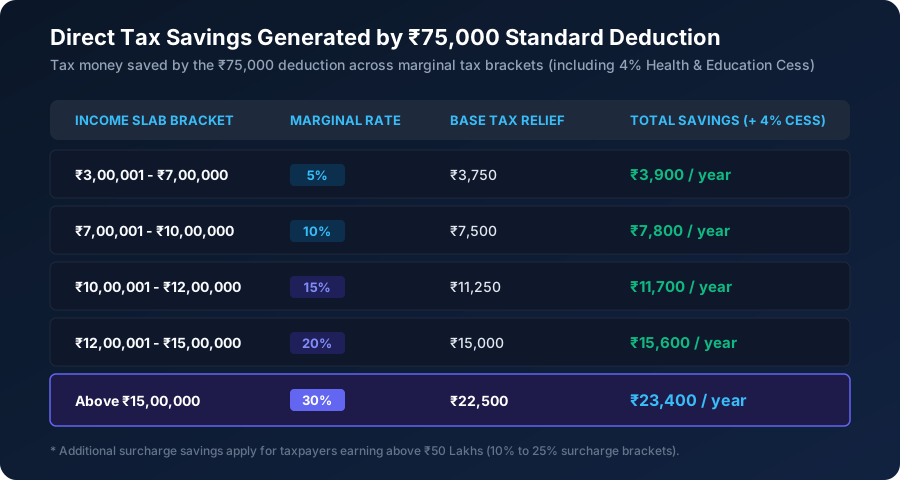
Let us examine the exact mathematical breakdown of direct tax savings across all five tax brackets under Section 115BAC for FY 2026-27:
| Taxable Slab Range | Marginal Rate | Base Tax Saved | 4% Health & Education Cess | Total Annual In-Hand Savings |
|---|---|---|---|---|
| ₹3,00,001 to ₹7,00,000 | 5% | ₹3,750 | ₹150 | ₹3,900 |
| ₹7,00,001 to ₹10,00,000 | 10% | ₹7,500 | ₹300 | ₹7,800 |
| ₹10,00,001 to ₹12,00,000 | 15% | ₹11,250 | ₹450 | ₹11,700 |
| ₹12,00,001 to ₹15,00,000 | 20% | ₹15,000 | ₹600 | ₹15,600 |
| Above ₹15,00,000 | 30% | ₹22,500 | ₹900 | ₹23,400 |
For any professional earning more than ₹15 Lakhs per year (such as mid-level software engineers, team leads, doctors, and chartered accountants), having ₹75,000 deducted from top-bracket income yields an automatic, guaranteed tax relief of ₹23,400 every single year.
Furthermore, for ultra-high earners subject to surcharge under Section 115BAC(1A), the savings are even greater:
- Income between ₹50 Lakhs and ₹1 Crore (10% Surcharge): Base tax saved ₹22,500 + Surcharge ₹2,250 + Cess ₹990 = ₹25,740 saved.
- Income between ₹1 Crore and ₹2 Crores (15% Surcharge): Base tax saved ₹22,500 + Surcharge ₹3,375 + Cess ₹1,035 = ₹26,910 saved.
- Income above ₹2 Crores (25% Surcharge): Base tax saved ₹22,500 + Surcharge ₹5,625 + Cess ₹1,125 = ₹29,250 saved.
5. Pensioners and Family Pension: Distinct Provisions & Section 57(iia)
Senior citizens and retirees frequently query whether standard deduction applies to pension income. The answer hinges upon the crucial legal distinction between Regular Pension and Family Pension.
A. Regular (Annuity / Superannuation) Pension
When an employee retires from central or state government services, public sector undertakings, defense, or private corporate employment, the periodic monthly pension received from the former employer or through the corporate superannuation trust is classified legally as Salary under Section 17(1)(ii).
Because regular pension is taxed under the head 'Salaries', retirees are 100% entitled to the statutory standard deduction under Section 16(ia):
- Retirees under the New Tax Regime receive the full ₹75,000 standard deduction.
- Retirees under the Old Tax Regime receive the standard ₹50,000 deduction.
Pension disbursing agencies (such as State Bank of India, Punjab National Bank, or corporate pension trustees) are legally mandated to deduct this ₹75,000 or ₹50,000 before calculating monthly TDS on pension under Section 192.
B. Family Pension (Section 57(iia))
In contrast, when an employee passes away and monthly pension is paid to their surviving spouse, dependent children, or legal heirs, that income is not salary income because no employer-employee relationship exists between the heir and the deceased's former employer. Instead, family pension is classified under 'Income from Other Sources'.
Consequently, family pensioners cannot claim Section 16(ia). Instead, they are governed by Section 57(iia) of the Income Tax Act:
- New Tax Regime: Section 57(iia) standard deduction is capped at ₹25,000 or 33.33% (one-third) of the gross family pension received, whichever is lower.
- Old Tax Regime: Section 57(iia) standard deduction remains capped at ₹15,000 or 33.33% of the gross family pension received, whichever is lower.
For instance, if a surviving spouse receives an annual family pension of ₹1,80,000:
- One-third of ₹1,80,000 = ₹60,000.
- Under the New Regime, the deduction is restricted to the statutory ceiling of ₹25,000. Taxable family pension = ₹1,80,000 - ₹25,000 = ₹1,55,000.
- Under the Old Regime, the deduction is restricted to ₹15,000. Taxable family pension = ₹1,80,000 - ₹15,000 = ₹1,65,000.
6. The Mid-Year Resignation Trap: Double Counting in Form 16
One of the most frequent triggers of automatic tax demand notices under Section 143(1)(a) is the Dual Standard Deduction Trap. This occurs when an employee switches corporate jobs during the financial year.
Consider this real-world scenario:
- An engineer resigns from Company A in August 2026 after earning ₹6,00,000. Company A generates a Form 16 Part B granting the full statutory standard deduction of ₹75,000, calculating taxable salary as ₹5,25,000 and deducting TDS accordingly.
- The engineer joins Company B in September 2026 with an annual package of ₹18,00,000 and earns ₹9,00,000 for the remainder of the financial year.
- The employee neglects to declare their previous income from Company A to Company B via Form 12B.
- Company B treats the employee as if they worked only for Company B, independent of past history, and applies another full ₹75,000 standard deduction under Section 16(ia) in their payroll system.
When the employee aggregates both Form 16s while filing their ITR on the e-filing portal, the portal will only allow a single ₹75,000 deduction against the combined gross salary of ₹15,00,000. Because both employers withheld TDS assuming a separate ₹75,000 deduction, the employee is suddenly hit with an unhedged tax deficit:
$$\text{Uncredited Tax Base} = ₹75,000 \times 20\% \text{ to } 30\% = ₹15,000 \text{ to } ₹22,500 + \text{Cess}$$
Furthermore, because this tax was not deposited via advance tax installments by March 15, the employee incurs mandatory interest penalties under Section 234B and Section 234C at 1% per month.
How to Avoid the Dual Employer Penalty
To safeguard against this liability:
- Always submit Form 12B to your new employer upon onboarding, detailing gross earnings, standard deduction already utilized, and TDS deducted by your previous employer.
- If you missed submitting Form 12B, calculate your combined tax liability using our free Income Tax Calculator before March 15 and pay any shortfall as self-assessment or advance tax via Challan ITNS 280 (Major Head 0021).
7. Step-by-Step Reporting Guide in ITR-1 (Sahaj) & ITR-2
Filing your annual tax return on the official Income Tax portal (eportal.incometax.gov.in) requires validating that standard deduction is accurately applied in Schedule S (Salaries). Follow this standard procedure:
- Step 1: Download AIS and Form 26AS: Log in to the e-filing portal and inspect your Annual Information Statement (AIS) to ensure all salary disbursements from every employer match Form 16 Part A and Part B.
- Step 2: Access Schedule S (Salary Details): In ITR-1 or ITR-2, navigate to the "Gross Salary" section. Enter your aggregate salary under Section 17(1), perquisites under Section 17(2), and profits in lieu of salary under Section 17(3).
- Step 3: Verify Section 16 Deductions: The system automatically populates Section 16(ia).
- If you selected Section 115BAC (New Regime), the system automatically locks the standard deduction at ₹75,000 (or gross salary, whichever is lower). Fields for Section 16(ii) and Section 16(iii) will be disabled.
- If you opted out of 115BAC into the Old Regime, the system locks standard deduction at ₹50,000. You must manually enter your state professional tax under field 16(iii) (matching Box 16 in your Form 16).
- Step 4: Check Computation of Income: Confirm that the net figure under "Income Chargeable Under the Head 'Salaries'" equals Gross Salary minus ₹75,000 (New) or Gross Salary minus ₹50,000 minus Professional Tax (Old).
- Step 5: E-Verify Return: Proceed to tax calculation, reconcile TDS credits, and e-verify using Aadhaar OTP within 30 days of submission.
Verify Your In-Hand Salary & Standard Deduction
Wondering how standard deduction, EPF, and tax slabs shape your actual take-home paycheck? Use our 100% free, private client-side calculators to model your exact compensation structure under both regimes.
8. Frequently Asked Questions (FAQ)
What is the standard deduction limit for FY 2026-27 (AY 2027-28)?
For FY 2026-27, the standard deduction under Section 16(ia) is ₹75,000 under the New Tax Regime (Section 115BAC) and ₹50,000 under the Old Tax Regime. It applies unconditionally to all salaried employees and pensioners without any requirement to submit expense bills or receipts.
Do I need to submit bills or proof of expenditure to claim standard deduction?
No. The standard deduction is a statutory flat deduction granted automatically under Section 16(ia) of the Income Tax Act. Taxpayers do not need to submit travel tickets, fuel bills, medical receipts, or any documentary evidence to their employer or the Income Tax Department.
Are pensioners eligible for the ₹75,000 standard deduction under the New Tax Regime?
Yes. Pension received from a former employer is classified as salary income under Section 17(1)(ii) of the Income Tax Act. Therefore, pensioners receiving regular pension are entitled to the full ₹75,000 standard deduction under the New Regime and ₹50,000 under the Old Regime.
What is the standard deduction limit for family pension under Section 57(iia)?
Family pension received by legal heirs is taxed under 'Income from Other Sources'. Under the New Tax Regime, legal heirs are eligible for a standard deduction of ₹25,000 or one-third (33.33%) of the pension, whichever is less. Under the Old Regime, this limit remains ₹15,000 or one-third of the pension.
What happens to standard deduction if I change employers during the financial year?
The statutory limit of standard deduction is ₹75,000 (New) or ₹50,000 (Old) per individual taxpayer per financial year, regardless of how many employers you worked for. If both employers provide the deduction in their Form 16, you must reconcile them while filing your ITR to prevent a demand notice with Section 234B and 234C interest.
Can professional tax be claimed alongside standard deduction under the New Regime?
No. Under the New Tax Regime (Section 115BAC), deductions under Section 16(ii) (entertainment allowance) and Section 16(iii) (professional tax) are disallowed. Professional tax up to ₹2,500 per year can only be deducted alongside standard deduction under the Old Tax Regime.
How does standard deduction affect the ₹7.75 Lakh zero-tax threshold in the New Regime?
Under the New Regime, income up to ₹7,00,000 is tax-free due to the Section 87A rebate of up to ₹25,000. When the ₹75,000 standard deduction is applied to a gross salary of ₹7,75,000, the taxable salary reduces exactly to ₹7,00,000, resulting in zero net income tax liability.
Can self-employed professionals or freelancers claim the standard deduction under Section 16(ia)?
No. Section 16(ia) is strictly applicable to income chargeable under the head 'Salaries'. Self-employed professionals, sole proprietors, and freelancers report under 'Profits and Gains of Business or Profession' (PGBP) and can claim actual business expenses or opt for presumptive taxation under Section 44ADA instead.