ITR Filing Guide for Salaried Employees: Choosing Between ITR-1 & ITR-2 (AY 2027-28)

For millions of salaried professionals in India, the arrival of June marks the start of the annual income tax filing season. Armed with their employer’s Form 16, taxpayers flock to the Income Tax e-filing portal (incometax.gov.in) with a straightforward mission: report earnings, claim refunds, and secure the vital acknowledgment receipt (ITR-V) required for home loans, visa applications, and financial underwriting.
Yet every year, tens of thousands of salaried individuals inadvertently trigger Defective Return notices under Section 139(9), receive demand intimations under Section 143(1), or face penalties under the Black Money Act. Why? Because the modern Indian financial life is no longer simple.
A salaried engineer in Bengaluru might have a basic salary, but also holds US company RSUs, trades equity mutual funds on Groww, earns bank interest, and co-owns an apartment. The moment you sell a single mutual fund unit or hold a fraction of a foreign stock, you are strictly disqualified from filing Form ITR-1 (Sahaj). Filing the wrong ITR form is one of the most common—and costly—mistakes in Indian personal taxation.
In this definitive operational guide, we provide a step-by-step masterclass on filing your income tax return for Assessment Year 2027-28 (Financial Year 2026-27). You will discover how to choose between ITR-1 and ITR-2 with 100% certainty, master the pre-filing reconciliation trinity (Form 16, Form 26AS, and AIS/TIS), navigate Schedule FA foreign asset disclosure, and ensure your tax refund is credited to your bank account without delay.
Table of Contents
- 1. The Form Selection Test: Who Qualifies for ITR-1 vs ITR-2?
- 2. The Pre-Filing Tax Reconciliation Trinity: Form 16, 26AS & AIS/TIS
- 3. Schedule FA: Reporting US Stocks, RSUs & Foreign Accounts
- 4. Reporting Other Income: Bank Interest, Dividends & 80TTA/80TTB
- 5. Step-by-Step E-Filing Walkthrough on incometax.gov.in
- 6. E-Verification Protocols & Section 234F Late Penalties
- 7. Frequently Asked Questions (FAQ)
1. The Form Selection Test: Who Qualifies for ITR-1 vs ITR-2?
The Central Board of Direct Taxes (CBDT) prescribes strict statutory boundaries governing which ITR form a taxpayer must submit. Selecting the wrong form invalidates your entire filing:

| Financial Parameter | Form ITR-1 (Sahaj) | Form ITR-2 |
|---|---|---|
| Residential Status | Resident & Ordinarily Resident (ROR) only | ROR, RNOR, and Non-Residents (NRI) |
| Total Annual Income | Up to ₹50,00,000 maximum | Any amount (No upper limit) |
| House Properties Owned | Strictly ONE house property | Multiple house properties supported |
| Capital Gains (Stocks, MFs, Land) | ❌ Strictly PROHIBITED | ✔ Fully supported (STCG & LTCG) |
| Foreign Assets / US RSUs (Schedule FA) | ❌ Strictly PROHIBITED | ✔ Mandatory reporting in Schedule FA |
| Unlisted Company Shares Held | ❌ Disqualified | ✔ Fully supported |
| Company Directorship | ❌ Disqualified | ✔ Mandatory reporting in ITR-2 |
The Golden Rule: If you are a purely salaried employee with a single employer, have no demat trading activity, own at most one house, and earn under ₹50 Lakhs, ITR-1 is your fastest and simplest option. The moment you sell stocks or mutual funds, hold foreign equity, or exceed ₹50 Lakhs, you must migrate to ITR-2.
2. The Pre-Filing Tax Reconciliation Trinity: Form 16, 26AS & AIS/TIS
Never rush to file your ITR based solely on the salary certificate handed out by your human resources desk. In modern digital tax administration, the Income Tax Department's automated compliance engines cross-check three distinct digital ledgers before approving refunds:
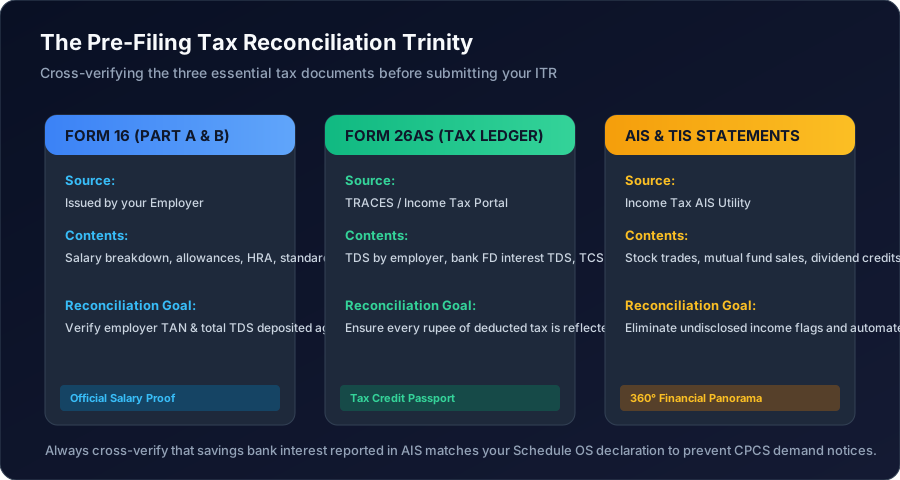
- Form 16 (Parts A & B): Issued by your employer by June 15. Part A reflects quarterly TDS deposits with the government; Part B details your gross salary, allowances, perquisites, and chapter VI-A deductions.
- Form 26AS: Your consolidated sovereign tax passbook generated from TRACES. It reflects all TDS deducted by your employer, bank FD interest TDS, tenant rent TDS, and advance taxes paid.
- Annual Information Statement (AIS) & TIS: The comprehensive 360-degree financial ledger maintained by the tax department. AIS captures savings account interest from every bank, mutual fund dividends, share sale transactions reported by brokerages, foreign remittances, and high-value credit card spending.
How to Reconcile: Log in to the portal, download your AIS and Form 26AS, and verify that the TDS figure in Form 16 matches Form 26AS exactly. If your bank credited ₹25,000 in savings interest that wasn’t declared to your employer, ensure you report it under Income from Other Sources to prevent automated mismatch notices under Section 143(1).
3. Schedule FA: Reporting US Stocks, RSUs & Foreign Accounts
For salaried tech professionals working in multinationals (Google, Amazon, Microsoft, Uber, Cisco) who receive Restricted Stock Units (RSUs) or participate in Employee Stock Purchase Plans (ESPP), completing Schedule FA (Foreign Assets) in Form ITR-2 is mandatory.
The Black Money Act Warning
Under the Black Money (Undisclosed Foreign Income and Assets) and Imposition of Tax Act, 2015, failure to disclose foreign shares (even a single fractional share of Apple or Microsoft) or a foreign brokerage account (e.g., Charles Schwab, Morgan Stanley, E*TRADE) attracts a mandatory flat penalty of ₹10,00,000 (10 Lakhs) per assessment year. Even if your company already deducted 31.2% TDS upon vesting, disclosure in Schedule FA remains legally non-negotiable!
4. Reporting Other Income: Bank Interest, Dividends & 80TTA/80TTB
A widespread misconception among freshers is that savings bank interest is tax-free. In reality:
- Under the Old Tax Regime: Section 80TTA allows a deduction of up to ₹10,000 on savings bank interest for individuals below 60. Senior citizens can claim up to ₹50,000 on both savings and FD interest under Section 80TTB.
- Under the New Tax Regime (Section 115BAC): Section 80TTA and 80TTB are completely disallowed. Every single rupee of savings bank interest and fixed deposit interest is fully taxable at your normal slab rate.
- Dividend Income: All dividends from Indian stocks and mutual funds are taxed as ordinary income under Schedule OS (Other Sources). TDS of 10% is deducted by companies if annual dividend exceeds ₹5,000.
5. Step-by-Step E-Filing Walkthrough on incometax.gov.in
Follow this standardized 6-step workflow to file your return smoothly:
- Log In & Select Assessment Year: Visit incometax.gov.in, log in via PAN, navigate to e-File > Income Tax Returns > File Income Tax Return, and select Assessment Year 2027-28 (Current AY).
- Select Filing Status & Form: Choose "Individual", select between ITR-1 or ITR-2 based on your asset profile, and indicate whether you are filing under the default New Tax Regime or opting for the Old Regime via Form 10-IEA (if applicable).
- Validate Pre-Filled Data: The portal automatically populates salary and TDS data from your Form 16 and 26AS. Cross-check each schedule: Salary, House Property, Capital Gains, and Other Sources.
- Review Chapter VI-A Deductions: If filing under Old Regime, verify 80C (PPF/EPF), 80D (health insurance), and 80CCD(2) Corporate NPS.
- Validate Tax Computation & Refund: The system computes gross tax, applies rebate u/s 87A (if taxable income is up to ₹7 Lakhs), adds 4% cess, subtracts TDS and advance tax, and calculates your net refund or balance tax payable.
- Submit & E-Verify: Confirm bank account details for direct ECS refund deposit and proceed to instant e-verification.
6. E-Verification Protocols & Section 234F Late Penalties
Submitting your return on the portal is only half the journey. An unverified return is legally treated as never filed:
- 30-Day Verification Window: You must e-verify your ITR within 30 days of online transmission using Aadhaar OTP, net banking, or by mailing a physically signed copy of ITR-V to CPC Bengaluru.
- Late Filing Fee (Section 234F): Filing after the July 31 due date attracts a mandatory fee of ₹5,000 (reduced to ₹1,000 for total income up to ₹5,00,000).
- Interest Penalties (Sections 234A/B/C): Late returns incur 1% simple interest per month on any outstanding tax dues from the due date until the actual date of filing.
Verify Your Tax Calculations Before Filing
Calculate your exact slab-wise income tax, test CTC components, and compute percentage savings using our free tools:
7. Frequently Asked Questions (FAQ)
Can I file ITR-1 if I have capital gains from equity mutual funds? ▼
No. Any capital gains or losses—even if within the ₹1,25,000 tax-free exemption limit—disqualify you from filing ITR-1. You must file Form ITR-2.
What happens if I forget to report savings bank interest? ▼
Because all banks report interest credits directly into your AIS, omitting savings interest triggers an automated mismatch notice under Section 143(1)(a), resulting in tax demands plus interest penalties. Always reconcile AIS before filing.
Is it mandatory to file ITR if my income is below the taxable limit? ▼
If your gross total income is below the basic exemption threshold (₹3,00,000), filing is generally not mandatory unless: you want to claim a refund of TDS deducted, have electricity consumption exceeding ₹1 Lakh, deposited over ₹1 Crore in current accounts, or spent over ₹2 Lakhs on foreign travel.
How can I check the status of my income tax refund? ▼
You can monitor your refund status directly on the e-filing portal under e-File > Income Tax Returns > View Filed Returns or via the NSDL TIN refund tracking portal by entering your PAN and Assessment Year.
What should I do if I discover an error after filing my ITR? ▼
You can file a Revised Return under Section 139(5) at any time up to December 31 of the assessment year (or before completion of assessment, whichever is earlier). A revised return completely supersedes your original filing with zero penalty.
Written by the PercentageCalculatorTool Team
Our certified e-return intermediaries and chartered accountants provide practical, step-by-step compliance guidance for salaried professionals and retail investors across India.