Capital Gains Tax India 2026-27: STCG & LTCG on Stocks, Mutual Funds & Property

The Indian capital markets have undergone an unprecedented retail revolution. With over 16 crore registered demat accounts and monthly mutual fund SIP inflows consistently breaking historical records, more Indian households than ever are creating wealth through equities, debt instruments, real estate, and precious metals.
However, the tax architecture governing capital assets was radically reshaped by the landmark Finance Act reforms. The Indian government enacted sweeping structural simplifications: rationalizing holding periods into two standardized buckets (12 months and 24 months), unifying Long-Term Capital Gains (LTCG) rates across financial and non-financial assets at 12.5%, hiking Short-Term Capital Gains (STCG) on equities to 20%, expanding the annual tax-free equity threshold to ₹1,25,000, and overhauling indexation on real estate sales.
For every investor—from a college student trading small-cap stocks on Zerodha or Groww to a seasoned high-net-worth real estate seller—mastering these rules is critical. An ill-timed share sale can trigger 20% short-term tax instead of 12.5%, while overlooking tax-loss harvesting rules can cost thousands of rupees in unoffset gains.
In this comprehensive guide, we provide a complete analysis of capital gains taxation in India for Financial Year 2026-27 (Assessment Year 2027-28). You will understand the exact tax rates for equities, mutual funds, real estate, and gold, learn how to utilize grandfathering rules to minimize property tax, and master tax-loss harvesting strategies.
Table of Contents
- 1. The New Two-Tier Holding Period Framework (12 vs 24 Months)
- 2. Listed Stocks & Equity Mutual Funds: 12.5% LTCG & 20% STCG
- 3. Debt Mutual Funds: Section 50AA Slab Taxation
- 4. Real Estate Capital Gains: The July 2024 Grandfathering Choice
- 5. Rollover Exemptions: Sections 54, 54EC & 54F
- 6. Tax-Loss Harvesting Playbook & Set-Off Rules
- 7. Frequently Asked Questions (FAQ)
1. The New Two-Tier Holding Period Framework (12 vs 24 Months)
Prior to recent legislative reforms, the Indian Income Tax Act maintained a bewildering maze of holding periods (12, 24, and 36 months) across different asset classes. The law has now standardized holding periods into just two distinct categories:

| Asset Category | Short-Term Holding Period | Long-Term Holding Period |
|---|---|---|
| Listed Equity Shares (BSE/NSE) | ≤ 12 Months | > 12 Months |
| Equity-Oriented Mutual Funds & ETFs | ≤ 12 Months | > 12 Months |
| Real Estate (Residential / Commercial / Land) | ≤ 24 Months | > 24 Months |
| Unlisted Company Shares & Pre-IPO Stock | ≤ 24 Months | > 24 Months |
| Physical Gold, Jewellery & Gold ETFs | ≤ 24 Months | > 24 Months |
2. Listed Stocks & Equity Mutual Funds: 12.5% LTCG & 20% STCG
For listed equities and mutual funds where Securities Transaction Tax (STT) has been paid, the statutory tax framework operates under Section 111A and Section 112A:
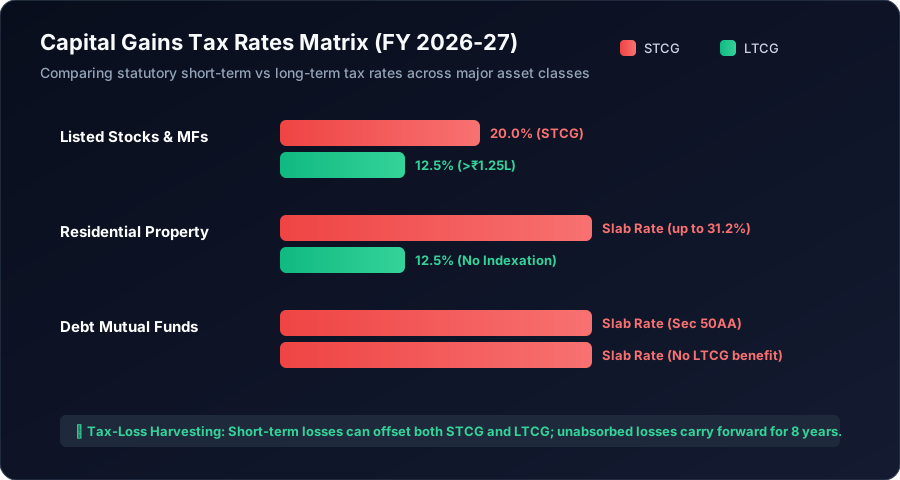
Section 111A: Short-Term Capital Gains (STCG) at 20%
If you buy and sell a listed stock or equity mutual fund within 12 months, your net profit is taxed at a flat rate of 20% plus 4% cess (20.8% effective rate).
Important Benefit for Resident Individuals: If your other taxable income (salary, interest) is below the basic tax exemption limit (₹3,00,000 under the New Regime), the unexhausted basic exemption can be adjusted against your STCG before calculating the 20% tax!
Section 112A: Long-Term Capital Gains (LTCG) at 12.5%
If you hold the asset for more than 12 months, gains are taxed at 12.5% plus 4% cess (13.0% effective rate).
✔ The ₹1.25 Lakh Annual Exemption: The first ₹1,25,000 of aggregate equity LTCG realized across all your mutual funds and stocks in a single financial year is completely tax-free! You pay 12.5% only on the gains exceeding ₹1.25 Lakhs.
3. Debt Mutual Funds: Section 50AA Slab Taxation
A critical shift that every fixed-income investor must understand concerns Specified Mutual Funds under Section 50AA.
Any mutual fund where not more than 35% of total proceeds is invested in equity shares of domestic companies (such as liquid funds, ultra-short duration funds, corporate bond funds, banking & PSU funds, and target maturity debt index funds) is legally classified as a short-term capital asset.
- All capital gains from these funds are added directly to your total taxable income and taxed at your prevailing slab rate (e.g., 5%, 10%, 20%, or 30%).
- There is zero indexation benefit and zero long-term concessional rate, regardless of whether you hold the fund for 1 month or 10 years.
- Conservative Hybrid Funds: Mutual funds investing between 35% and 65% in domestic equities retain the standard 24-month long-term holding period, qualifying for 12.5% LTCG without indexation.
4. Real Estate Capital Gains: The July 2024 Grandfathering Choice
When the Indian government initially eliminated indexation on real estate, immense pushback from homeowners led Parliament to pass a historic Grandfathering Amendment.
For resident individuals and HUFs selling an immovable property (residential house, commercial space, or land) acquired prior to July 23, 2024:
The Dual Computation Right
Taxpayers have the legal right to compute their tax under both methods and pay whichever yields the lower tax bill:
Best for properties that appreciated massively beyond the inflation rate.
Best for properties with modest appreciation where inflation indexation wipes out taxable gain.
For any property acquired on or after July 23, 2024, the tax is strictly 12.5% without indexation if held for over 24 months.
5. Rollover Exemptions: Sections 54, 54EC & 54F
If you sell a capital asset and realize substantial long-term gains, Indian tax law provides statutory mechanisms to reduce your tax bill to zero through reinvestment:
- Section 54: Reinvestment in Residential Property If you sell a residential house held for > 24 months, the entire LTCG is exempt if reinvested in purchasing another residential house (within 1 year before or 2 years after the sale) or constructing one within 3 years. Capped at a maximum deduction of ₹10 Crores.
- Section 54EC: Capital Gains Bonds (NHAI / REC / PFC / IRFC) Exempts LTCG from real estate if invested in designated sovereign 5-year capital gains bonds within 6 months of sale. Capped at a maximum limit of ₹50,00,000 (50 Lakhs) per financial year.
- Section 54F: Selling Stocks/Gold to Buy a House If you sell listed stocks, mutual funds, or gold held for long-term and invest the entire net sale consideration into acquiring a residential house, the entire capital gain is 100% tax-exempt!
6. Tax-Loss Harvesting Playbook & Set-Off Rules
Tax-loss harvesting is the strategic practice of selling losing investment positions before March 31 to realize capital losses that neutralize capital gains made during the financial year:
| Type of Loss Incurred | Eligible to Set Off Against | Carry-Forward Duration |
|---|---|---|
| Short-Term Capital Loss (STCL) | Can offset BOTH Short-Term (STCG) and Long-Term (LTCG) gains across any asset class | Up to 8 Assessment Years |
| Long-Term Capital Loss (LTCL) | Can offset ONLY Long-Term Capital Gains (LTCG) | Up to 8 Assessment Years |
| Capital Loss vs Salary Income | Strictly NOT ALLOWED | Cannot reduce taxable salary |
Crucial Mandatory Rule: Under Section 80 of the Income Tax Act, you cannot carry forward unabsorbed capital losses unless you file your income tax return (Form ITR-2 or ITR-3) on or before the original July 31 due date. Late or belated returns permanently forfeit all carry-forward loss rights!
Simulate Your Returns and Taxes
Calculate your percentage gains, project mutual fund wealth, and estimate income tax with our free tools:
7. Frequently Asked Questions (FAQ)
What is the equity LTCG tax-free exemption limit in FY 2026-27? ▼
The annual tax-free threshold for Long-Term Capital Gains under Section 112A is ₹1,25,000 (increased from ₹1,00,000). You pay 12.5% tax only on cumulative long-term gains that exceed ₹1.25 Lakhs in a financial year.
Can I set off capital losses against my salary income? ▼
No. Under Indian income tax law, losses incurred under the head "Capital Gains" cannot be set off against income from Salaries, House Property, or Business. They can only be set off against other capital gains.
Are unlisted shares and pre-IPO stocks eligible for the 12-month holding rule? ▼
No. The 12-month holding period applies strictly to listed equity securities. For unlisted shares, private limited startup equity, and pre-IPO shares, the holding period for long-term classification is 24 months.
Do I have to pay capital gains tax on mutual fund SIP redemptions? ▼
Yes. Indian tax rules apply the First-In, First-Out (FIFO) method for SIP redemptions. Each monthly SIP installment is evaluated independently based on its own purchase date to determine whether it is short-term (≤ 12 months) or long-term (> 12 months).
Which ITR form is mandatory if I have capital gains from stocks or mutual funds? ▼
Taxpayers with capital gains income cannot file Form ITR-1 (Sahaj). You must file Form ITR-2 (for salaried and capital gains earners) or Form ITR-3 (if you also have business or intraday/F&O trading income).
Written by the PercentageCalculatorTool Team
Our market analysts and tax professionals model portfolio taxation, capital gains compliance, and wealth preservation frameworks for Indian investors.