Section 24(b) Home Loan Tax Exemption: Interest & Principal Claim Rules (FY 2026-27)
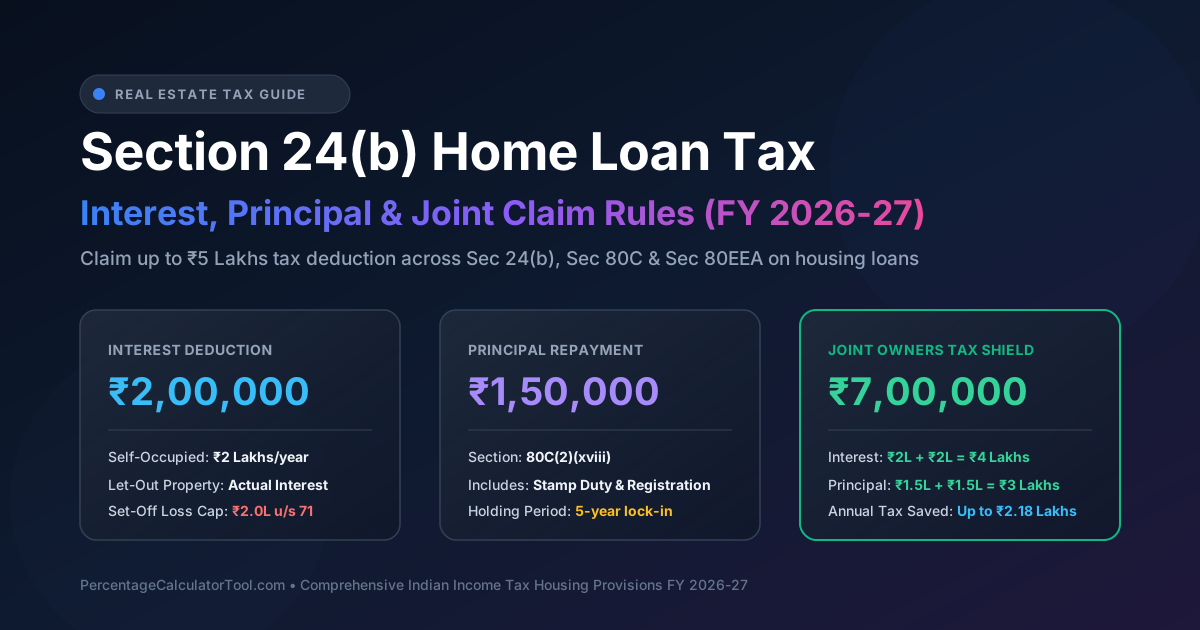
Purchasing residential real estate in India is simultaneously an emotional milestone and the largest long-term financial commitment most salaried families ever undertake. With prime residential interest rates hovering between 8.35% and 9.15%, servicing a 20-year home loan of ₹50 Lakhs to ₹1 Crore entails paying interest that frequently exceeds the original principal borrowed.
To encourage homeownership, the Indian Income Tax Act provides robust tax shelters across three distinct statutory pillars: Section 24(b) for interest repayment, Section 80C for principal amortization and stamp duty, and Section 80EEA for first-time affordable housing buyers. When leveraged strategically—particularly through co-ownership with a working spouse—home loan tax deductions can shelter up to ₹7,00,000 of annual income, returning more than ₹2.18 Lakhs in liquid tax savings back into your family budget every year.
However, tax rules surrounding housing loans have evolved dramatically with the rise of the New Tax Regime (Section 115BAC), strict caps on loss from house property under Section 71, and five-year construction completion stipulations. Understanding how interest is amortized, how pre-construction interest is claimed across five tranches, and how to structure joint co-borrowing agreements is vital to ensuring full compliance while claiming every rupee you are legally owed.
In this definitive guide, we provide a complete, mathematically verified blueprint for claiming home loan tax benefits in Financial Year 2026-27 (Assessment Year 2027-28).
Table of Contents
- 1. Section 24(b) Interest Deduction: Self-Occupied vs Let-Out Rules
- 2. Section 80C: Principal Repayment, Stamp Duty & The 5-Year Lock-In
- 3. Pre-Construction Interest: The 5-Year Amortization Rule
- 4. Joint Home Loan Optimization: Doubling Deductions to ₹7 Lakhs
- 5. Home Loans under New vs Old Tax Regime (FY 2026-27)
- 6. Claiming Both HRA and Home Loan Interest Simultaneously
- 7. Frequently Asked Questions (FAQ)
1. Section 24(b) Interest Deduction: Self-Occupied vs Let-Out Rules
Section 24(b) of the Income Tax Act allows a deduction for interest paid on capital borrowed for the acquisition, construction, repair, renewal, or reconstruction of a residential property. The tax treatment differs fundamentally depending on how the property is utilized:
| Property Status | Maximum Interest Deduction | Mandatory Conditions |
|---|---|---|
| Self-Occupied Property (SOP) | ₹2,00,000 per financial year | Construction must finish within 5 years from end of FY in which loan was taken; lender interest certificate required. |
| Let-Out / Rented Property (LOP) | Actual Interest (No ceiling) | Deductible against rental income. Any resulting loss can be set off against other heads up to ₹2,00,000 u/s 71. |
| Deemed Let-Out Property (DLOP) | Actual Interest | Assessees can treat up to 2 properties as self-occupied; 3rd property is deemed rented even if vacant. |
| Repair & Renovation Loan | ₹30,000 maximum | Interest on loans taken solely for repairs or alterations of an existing house. |
The 5-Year Completion Clause: If you take a loan to acquire or construct a house, but construction is delayed beyond 5 years from the end of the financial year in which the loan was disbursed, your annual interest deduction under Section 24(b) collapses from ₹2,00,000 down to just ₹30,000. Always verify builder delivery milestones when purchasing under-construction inventory.
2. Section 80C: Principal Repayment, Stamp Duty & The 5-Year Lock-In
While Section 24(b) handles the interest component of your EMI, the principal repayment component is eligible for deduction under Section 80C(2)(xviii):
- Deduction Limit: Up to ₹1,50,000 per financial year (shared within the overall Section 80C umbrella along with EPF, PPF, ELSS, and Life Insurance).
- Eligible Lenders: Loans must be sourced from banks (SBI, HDFC, ICICI, etc.), recognized housing finance corporations (HDFC, LIC HFL), or employer housing trusts. Borrowings from friends or relatives do NOT qualify for Section 80C.
- Stamp Duty & Registration Charges: Under Section 80C(2)(xviii)(d), fees paid toward property stamp duty and government registration can be claimed as a deduction in the financial year they are paid, even if you did not take a home loan.
The 5-Year Property Lock-In Trap (Section 80C(5))
If you transfer or sell the residential property within 5 years from the end of the financial year in which possession was obtained, all Section 80C deductions claimed for principal repayment in previous years are completely revoked. The claimed deductions are added back as taxable income in the year of sale and taxed at your prevailing slab rate!
3. Pre-Construction Interest: The 5-Year Amortization Rule
Under Indian tax law, you cannot claim any home loan interest deduction while the property is under construction. However, that interest is not lost forever:
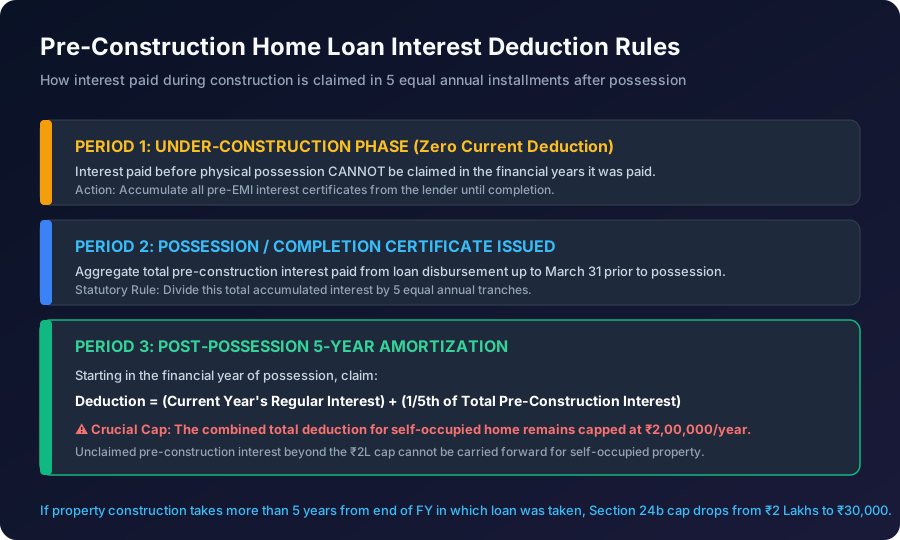
The law defines the Pre-Construction Period as the timeframe starting from the loan disbursement date and ending on March 31 immediately preceding the financial year of possession (or the loan repayment date, whichever is earlier).
Worked Numerical Example:
Suppose you took a loan in July 2022 and paid a total of ₹5,00,000 in pre-EMI interest up to March 31, 2026. You received possession of the flat in June 2026 (FY 2026-27).
- Pre-construction interest installment = ₹5,00,000 ÷ 5 = ₹1,00,000 per year for 5 consecutive financial years (FY 26-27 through FY 30-31).
- If your regular post-possession interest for FY 2026-27 is ₹1,60,000: Total interest = ₹1,60,000 + ₹1,00,000 = ₹2,60,000.
- Because it is self-occupied, your deduction is capped at the statutory maximum of ₹2,00,000. The remaining ₹60,000 lapses.
4. Joint Home Loan Optimization: Doubling Deductions to ₹7 Lakhs
If you are married to a working professional, purchasing a home jointly is the single most powerful tax strategy in Indian real estate:
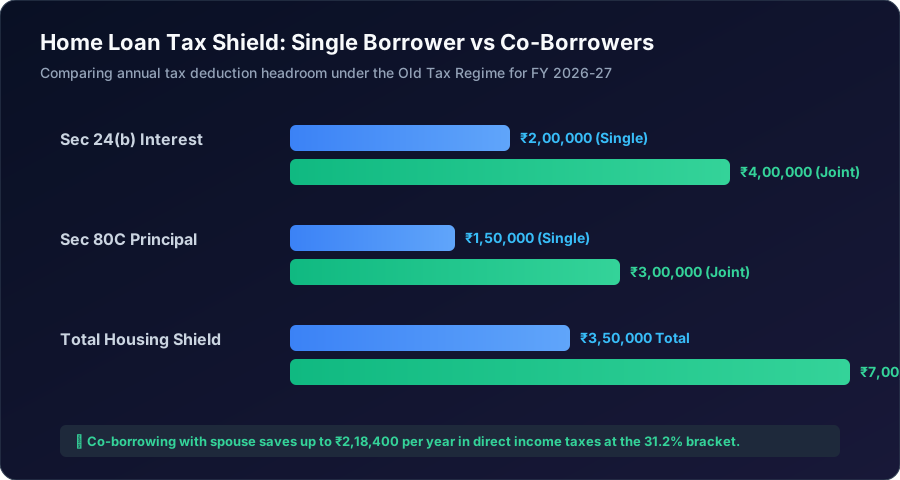
To claim double tax deductions, two conditions must be satisfied simultaneously:
- Co-Ownership: Both individuals must be legal co-owners named in the registered title deed.
- Co-Borrowing: Both individuals must be co-applicants on the loan sanction letter and actively service the EMI through their respective bank accounts in proportion to their ownership share.
When structured properly, the couple can claim:
- Interest Deduction u/s 24(b): ₹2,00,000 (Spouse A) + ₹2,00,000 (Spouse B) = ₹4,00,000 total interest deduction.
- Principal Deduction u/s 80C: ₹1,50,000 (Spouse A) + ₹1,50,000 (Spouse B) = ₹3,00,000 total principal deduction.
- Total Joint Tax Shelter: ₹7,00,000 per year. At a 31.2% tax slab, this saves the household up to ₹2,18,400 in direct cash taxes every single year.
5. Home Loans under New vs Old Tax Regime (FY 2026-27)
Under the Revised New Tax Regime (Section 115BAC), home loan tax incentives have been radically scaled back:
- Self-Occupied Properties: Section 24(b) interest deduction is ZERO. Section 80C principal deduction is ZERO.
- Let-Out Properties: Under the New Regime, interest paid on a rented house CAN be deducted against rental income, but any resulting loss from house property CANNOT be set off against salary or other heads. The loss cannot even be carried forward!
The Decision Rule: If you are a single borrower paying ₹2 Lakhs in home loan interest and maxing out Section 80C (₹1.5L), your total housing deduction is ₹3.5 Lakhs. When combined with ₹50,000 standard deduction and ₹25,000 health insurance, your total deductions reach ₹4.25 Lakhs. For middle-income packages (₹12L to ₹18L CTC), this level of deduction often tips the mathematical balance in favor of the Old Tax Regime. Always run your exact numbers through our calculator before filing.
6. Claiming Both HRA and Home Loan Interest Simultaneously
Can you claim House Rent Allowance (HRA) exemption and Section 24(b) home loan interest deduction in the very same financial year?
The answer is YES, provided genuine commercial and geographical conditions exist:
- Different Cities: You own a home in Pune where your parents reside, but your active workplace requires you to live in a rented apartment in Bengaluru. Both claims are 100% legal.
- Same City, Long Distance: Your owned house is located far from your workplace (e.g., Greater Noida) and commuting daily is practically unviable, requiring you to rent an apartment near your office in Gurugram.
- Documentation Mandatory: Ensure you maintain monthly rent payment receipts, bank transfer records, valid lease agreements, and the landlord’s PAN card to withstand income tax scrutiny.
Simulate Your Home Loan EMI & Tax Impact
Calculate your exact monthly EMI amortization schedule and compare your tax liabilities across regimes:
7. Frequently Asked Questions (FAQ)
Can I claim home loan interest deduction under the New Tax Regime? ▼
For self-occupied homes, no. Section 24(b) interest deduction is disallowed under the New Tax Regime. For rented properties, interest can be deducted up to rental income, but any resulting net loss cannot be set off against your salary income.
What happens to unclaimed pre-construction interest if I exceed ₹2 Lakhs? ▼
For a self-occupied property, the annual cap of ₹2,00,000 applies to the sum total of regular current interest plus 1/5th of pre-construction interest. Any interest above ₹2,00,000 cannot be claimed and lapses permanently.
Can a co-borrower claim tax deductions without being a co-owner? ▼
No. Being a co-borrower on the bank loan is not sufficient. Under Section 24(b) and Section 80C, you must be a registered legal co-owner of the property in the title deed to be eligible for tax deductions.
Is municipal tax paid on property deductible? ▼
Yes, municipal property taxes paid during the financial year to local civic authorities (e.g., BMC, BBMP) are fully deductible from Gross Annual Value (GAV) in computing net income from rented house property, provided they were actually paid by the owner.
What documents are required to claim home loan tax exemption? ▼
You require the final Home Loan Interest Certificate issued by your lender detailing principal and interest components, proof of municipal tax payment, occupancy/possession certificate, and title deed establishing ownership share.
Written by the PercentageCalculatorTool Team
Our real estate and direct taxation analysts provide authoritative, data-backed guidance on housing finance, property acquisitions, and income tax optimization in India.