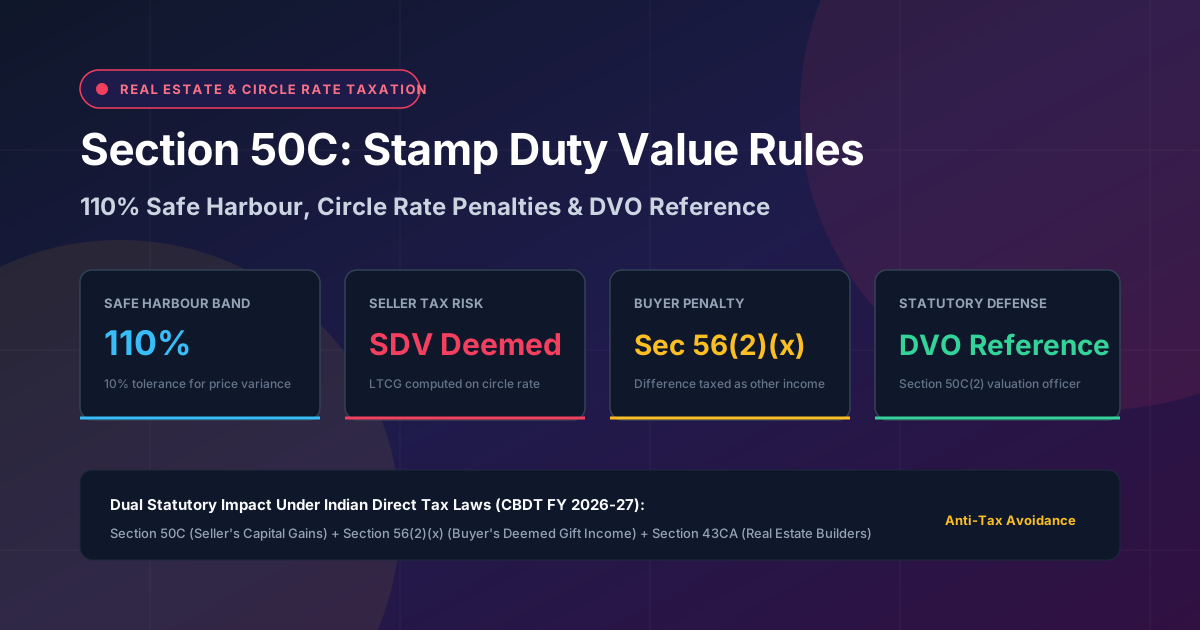
1. The Friction Between Circle Rates & Market Value
In an ideal economic landscape, the statutory benchmark rates established by state revenue authorities—variously referred to as Circle Rates in Delhi and Uttar Pradesh, Ready Reckoner Rates (RRR) in Maharashtra, or Guidance Values in Karnataka—would mirror real-time fair market transactions.
In reality, circle rates are bureaucratic administrative constructs revised periodically on broad geographic zones without regard to micro-level physical realities. A prime penthouse in a gated condominium and an encroached, unapproachable plot in a waterlogged corner of the same revenue village often share the exact same circle rate. Furthermore, during economic downturns, liquidity crunches, or distressed distress sales, actual market prices often plunge 15% to 30% below official government benchmarks.
To curb the historical practice of under-reporting sale consideration to stash unaccounted cash ("black money"), Parliament introduced Section 50C into the Income-tax Act, 1961 via the Finance (No. 2) Act, 2002. However, when applied indiscriminately to genuine commercial distress transactions, Section 50C creates a devastating tax trap: assessing taxpayers on hypothetical income they never earned.
2. Statutory Architecture of Section 50C
Section 50C operates as a non-rebuttable statutory legal fiction for the computation of capital gains under Section 48. Sub-section (1) provides:
Statutory Text of Section 50C(1)
Where the consideration received or accruing as a result of the transfer by an assessee of a capital asset, being land or building or both, is less than the value adopted or assessed or assessable by any authority of a State Government for the purpose of payment of stamp duty in respect of such transfer, the value so adopted or assessed or assessable shall, for the purposes of section 48, be deemed to be the full value of the consideration received or accruing as a result of such transfer.
Key legal components of Section 50C(1):
- Applicable Assets: Applies exclusively to capital assets being land or building or both. It does not apply to movable assets like shares, bonds, or gold.
- Deeming Fiction: The Stamp Duty Value (SDV) automatically replaces the actual consideration in the capital gains formula: $$\text{Capital Gain} = \text{Deemed Consideration (SDV)} - \text{Cost of Acquisition} - \text{Transfer Expenses}$$
- "Assessable" Scope: The word "assessable" was inserted to ensure that even if the parties fail to register the sale deed (e.g., executing an unregistered power of attorney sale), the stamp duty value that would have been payable had the document been presented for registration is still adopted.
3. The 110% Safe Harbour Tolerance Cushion
Recognizing that property valuation is an inexact science influenced by subjective negotiations, floor levels, vaastu orientation, and payment terms, Parliament enacted a statutory tolerance cushion through the third proviso to Section 50C(1).
$$\text{Safe Harbour Condition: } \text{Stamp Duty Value (SDV)} \le 1.10 \times \text{Actual Sale Consideration}$$
If SDV is within 110% of the actual agreed price, the actual price is accepted as the Full Value of Consideration.
Originally introduced as a 5% tolerance band (105%), it was expanded to 10% (110%) by the Finance Act to provide genuine relief to property owners facing sluggish micro-markets.
However, if the circle rate were ₹1,12,00,000 (+12% higher), it breaches the 110% threshold. The entire relief collapses, and your deemed consideration is not ₹1.10 Crore—it jumps to the full ₹1.12 Crore!
4. Decision Tree: Dual Impact on Seller & Buyer
When a transaction takes place below circle rate, it triggers a simultaneous dual assessment under two independent sections of the Income-tax Act. The flowchart below outlines the statutory steps followed by tax authorities during assessment:

Figure 1: Statutory decision flowchart for assessing circle rate discrepancies, safe harbour compliance, and DVO reference procedures.
5. Agreement Date vs Registration Date Rule
In India, months or even years often elapse between signing the formal Agreement to Sell (ATS) and the final execution of the registered Conveyance Deed. If the state government escalates circle rates during this interim period, taxpayers previously faced unfair additions based on rates that did not exist when the commercial bargain was finalized.
The Agreement Date Safe Harbour Proviso
Under the first and second provisos to Section 50C(1), the law allows the Stamp Duty Value on the date of agreement to be adopted instead of the rate on the date of registration, provided the following condition is satisfied:
- Account Payee Cheque
- Account Payee Bank Draft
- Electronic Clearing System (ECS) through a bank account
- Authorized electronic modes (IMPS, UPI, RTGS, NEFT, Net Banking)
The Cash Disqualification: If earnest money or token advance was paid entirely in cash on or before the agreement date, this statutory protection is completely forfeited. Even a token digital transfer of ₹50,000 on the date of signing the agreement legally locks in the prevailing circle rate against future administrative hikes!
6. Section 56(2)(x): Drastic Buyer Deemed Income
While Section 50C targets the seller, the buyer does not escape unscathed. Under Section 56(2)(x)(b) of the Income-tax Act, if any person receives any immovable property for a consideration that is less than the Stamp Duty Value:
- The difference between the Stamp Duty Value and the actual consideration is treated as deemed income from other sources in the hands of the buyer.
- This applies if the difference exceeds ₹50,000 AND the Stamp Duty Value exceeds 110% of the consideration.
- The entire differential is added to the buyer's regular income and taxed at their marginal slab rate (up to 39% in the Old Regime or 30% plus cess in the New Regime).
1. The seller pays capital gains tax on deemed consideration of ₹1.50 Crore (paying tax on ₹50 Lakhs they never received).
2. The buyer pays income tax at slab rates on the same ₹50 Lakh difference as "deemed gift income".
The government collects tax on the same phantom ₹50 Lakh from both parties simultaneously!
Silver Lining for the Buyer: Cost Step-Up
Under Section 49(4), when a buyer pays tax under Section 56(2)(x) on the difference between SDV and purchase price, the cost of acquisition of that property in the hands of the buyer for future sales is stepped up to the Stamp Duty Value (SDV). This prevents triple taxation when the buyer eventually sells the property in the future.
7. Builders & Developers: Section 43CA Parallel
Section 50C applies strictly to capital assets (held as investments). What happens if a real estate developer or builder sells inventory flats held as stock-in-trade?
To plug this gap, Parliament introduced Section 43CA. Section 43CA is the exact clone of Section 50C for business profits:
- If a builder sells an under-construction or ready flat below the circle rate, the business turnover under Section 28 is deemed to be the Stamp Duty Value.
- The identical 110% safe harbour tolerance band applies to Section 43CA transactions.
- The agreement date banking payment proviso applies equally to builders.
8. Statutory Defense: Departmental Valuation Officer (DVO)
What can a seller do if the property was legitimately sold below circle rate due to genuine distress, litigation, physical encumbrances, or high tension power lines running overhead?
The statute provides an indispensable constitutional safeguard under Section 50C(2).
The Mechanics of DVO Reference under Section 50C(2)
Where the assessee claims before any Assessing Officer (AO) that:
- The value adopted or assessable by the stamp valuation authority exceeds the fair market value (FMV) of the property as on the date of transfer; and
- The value so adopted has not been disputed in any appeal or revision before any court, appellate authority, or High Court under state stamp laws;
The Assessing Officer may (and judicially must) refer the valuation of the capital asset to a Departmental Valuation Officer (DVO). The Supreme Court and High Courts have consistently held that the word "may" in Section 50C(2) must be construed as "shall" whenever the assessee formally objects to circle rates.
The Asymmetric Rule of DVO Valuation
Once the DVO inspects the site and submits an official valuation report under Section 50C(3), the law establishes an asymmetric protection that guarantees the taxpayer cannot be worse off:
| DVO Valuation Outcome | Statutory Treatment | Assessee Tax Liability |
|---|---|---|
| DVO Value < Stamp Duty Value (SDV) | DVO Value replaces the Circle Rate. | Reduced: Capital gains are recomputed downwards on the lower DVO value. |
| DVO Value > Stamp Duty Value (SDV) | Stamp Duty Value (SDV) remains the statutory ceiling! | Unchanged: The AO cannot enhance the consideration beyond the state circle rate. |
9. Tolerance & Financial Impact Matrix
The matrix below illustrates the mathematical outcomes across four typical property market scenarios:

Figure 2: Comprehensive impact matrix illustrating circle rate deviations, 110% safe harbour cushion, and DVO downward corrections.
10. Legitimate Grounds for Below-Circle Sales
When presenting your case before the Assessing Officer and the DVO under Section 50C(2), submitting tangible documentary proof of property defects is vital. Common judicially recognized grounds for below-circle valuations include:
- Physical Topography & Shape: Irregular triangular plots, narrow approach roads (< 15 feet), lack of municipal road frontage, or plots situated in low-lying flood-prone zones.
- Severe Structural Damage: Dilapidated buildings, old tenant-occupied premises where eviction is protracted, or structures declared unsafe by municipal corporations.
- Encumbrances & Easement Rights: High-tension electrical transmission wires passing overhead, underground drainage pipelines, or proximity to burial grounds and open sewage nullahs.
- Title Disputes & Litigation: Properties embroiled in pending civil partition suits, injunctions, or family disputes where the buyer accepts defective title risk.
- Distressed Financial Liquidation: Emergency distress sales to repay mounting bank debts or avoid SARFAESI auction proceedings.
11. Comprehensive Computational Case Studies
Case Study 1: Commercial Shop Sold Within Safe Harbour
Siddharth sells a ground-floor commercial shop in Ahmedabad in September 2026 for ₹1,20,00,000 (₹1.20 Cr). The local Jantar/circle rate values the shop at ₹1,28,00,000 (₹1.28 Cr).
- Actual Agreement Consideration: ₹1,20,00,000.
- Stamp Duty Value: ₹1,28,00,000.
- Safe Harbour Benchmark: 110% of ₹1.20 Cr = ₹1,32,00,000.
- Outcome: Because ₹1.28 Cr is less than ₹1.32 Cr, the variation is within the 10% statutory cushion. Section 50C does not deem any additions. Siddharth pays LTCG @ 12.5% on actual gains, and the buyer faces ₹0 penalty under Section 56(2)(x).
Case Study 2: Distress Sale of Encroached Land (DVO Intervention)
Meera inherits a suburban plot in Nagpur with severe encroachment on 40% of its perimeter. She sells the plot for ₹80,00,000 to an investor willing to handle the dispute. The state circle rate for the zone is ₹1,30,00,000 (+62.5% higher).
- During scrutiny assessment, the AO proposes to add ₹50,00,000 (₹1.30 Cr - ₹80L) to Meera's capital gains under Section 50C.
- Meera files a formal objection under Section 50C(2) requesting reference to a DVO, submitting photos of encroachments, police FIRs, and a private government-approved valuer's report.
- The DVO conducts an on-site inspection and evaluates the fair market value at ₹88,00,000 after applying an encroachment discount.
- Result: Under Section 50C(3), the deemed consideration is reduced from ₹1.30 Crore to ₹88,00,000. Meera's taxable capital gains base is reduced by ₹42,00,000, saving her over ₹5.4 Lakhs in tax and penalty!
12. Frequently Asked Questions (FAQs)
Does Section 50C apply to leasehold rights and tenancy rights?
The Supreme Court and Bombay High Court have held that Section 50C applies strictly to the transfer of "land or building or both" where the assessee holds proprietary title. The transfer of tenancy rights or long-term leasehold rights (where ownership remains with a development authority) does not fall under Section 50C, although the AO may examine valuation under Section 50D.
Can the buyer and seller both request a DVO valuation?
Yes. The seller can invoke Section 50C(2) during their assessment of capital gains, while the buyer can invoke Section 56(2)(x) proviso (which cross-references Section 50C(2)) to seek a DVO valuation to reduce their deemed gift income liability.
What if the buyer pays token advance in cash before the agreement date?
If any part of the consideration was paid in cash, the benefit of adopting the agreement date circle rate is completely lost. The circle rate prevailing on the date of final registration will be applied, even if it is significantly higher.
Does Section 50C apply to agricultural land?
Rural agricultural land situated outside specified municipal limits does not qualify as a "capital asset" under Section 2(14), and therefore Section 50C is inapplicable. However, urban agricultural land that falls within the definition of a capital asset is fully subject to Section 50C circle rate adjustments.
Can Section 54 or 54F exemption be claimed on the deemed Section 50C consideration?
Yes. Multiple High Courts (including the Karnataka and Bombay High Courts) have ruled that when the full value of consideration is deemed to be the Stamp Duty Value under Section 50C, that same deemed capital gain must be considered for computing roll-over deductions under Section 54 or Section 54EC.