Section 80D Health Insurance Tax Deduction: Self, Parents & Senior Citizen Rules (FY 2026-27)
Medical inflation in India touches 12% to 14% annually. Explore how Section 80D of the Income-tax Act shields your family against escalating healthcare costs while delivering up to ₹1,00,000 in tax deductions. Master the ₹25k, ₹50k, and ₹75k thresholds, the ₹5,000 cash health checkup rule, and uninsured senior citizen medical expense deductions for Assessment Year 2027-28.
§ Table of Contents
- 1. Statutory Scope of Section 80D of the Income-tax Act
- 2. The 4-Tier Statutory Limit Structure: ₹25k, ₹50k, ₹75k & ₹1 Lakh
- 3. The ₹5,000 Preventive Health Check-Up (PHC) & Cash Rules
- 4. Medical Expenditure for Uninsured Senior Citizens (Section 80D(2)(c))
- 5. Visual Architecture: Step-by-Step Claim Breakdown
- 6. The Banking Channel Mandate: Why Cash Premiums Are Disallowed
- 7. Multi-Year Health Insurance Policies: Proportionate Apportionment
- 8. Corporate Group Health Insurance (GHI) vs. Super Top-Up Plans
- 9. Empirical Modeling: Deductions & Net Tax Saved
- 10. Section 80D in New vs. Old Tax Regime: Strategic Audit
- 11. Practical Case Study: ₹22 LPA Executive with Elderly Parents
- 12. Frequently Asked Questions (Direct Tax FAQs)
1. Statutory Scope of Section 80D of the Income-tax Act
Under Section 80D of Chapter VI-A of the Income-tax Act, 1961, individual taxpayers and Hindu Undivided Families (HUFs) are permitted to claim deductions against their Gross Total Income for health insurance premiums paid, contributions to the Central Government Health Scheme (CGHS), preventive health check-up costs, and actual medical treatment expenditures incurred on senior citizen family members.
Unlike Section 80C—which has remained stagnant at ₹1,50,000 for over a decade—the Central Government progressively enhanced Section 80D deduction limits to reflect the harsh reality of double-digit healthcare inflation across Indian private hospital networks.
A critical operational distinction: Section 80D is completely separate from and in addition to Section 80C. Claiming ₹75,000 or ₹1,00,000 under Section 80D does not consume a single rupee of your ₹1,50,000 Section 80C allowance, creating one of the most substantial combined tax shelters available under the Old Tax Regime.
2. The 4-Tier Statutory Limit Structure: ₹25k, ₹50k, ₹75k & ₹1 Lakh
The statutory limits under Section 80D are governed by the age profile of the covered family members:
| Family Demographic Profile | Self, Spouse & Children | Parents (Mother & Father) | Total Allowable 80D Limit |
|---|---|---|---|
| All Members Below 60 Years | ₹25,000 | ₹25,000 | ₹50,000 / year |
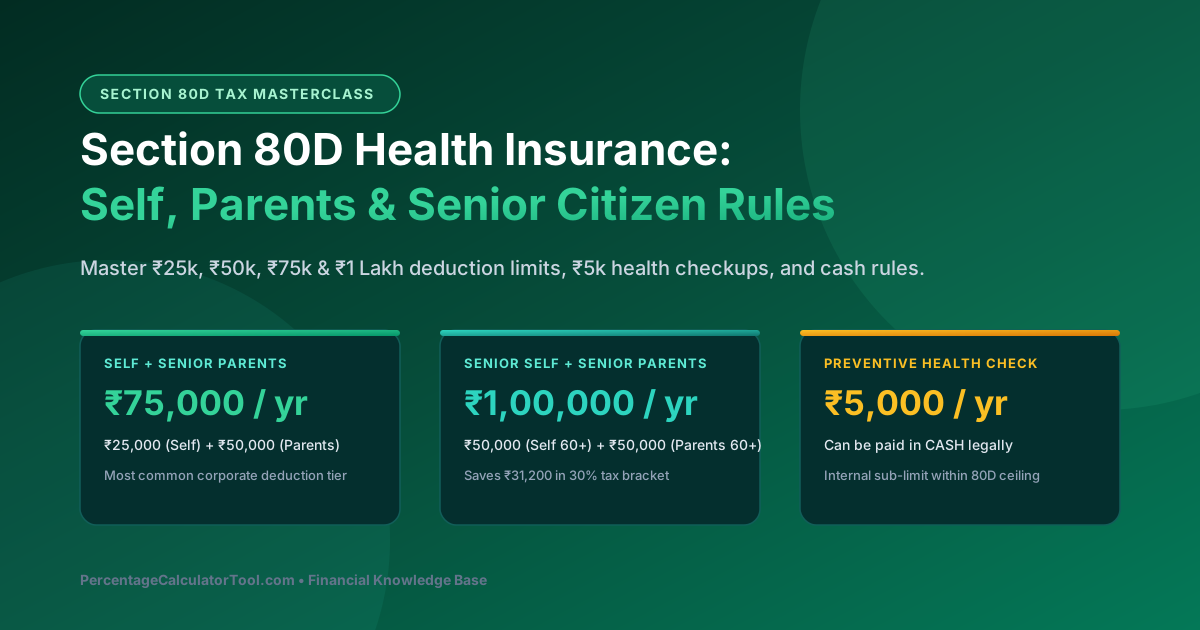
| Self < 60 + Senior Parents (≥ 60) | ₹25,000 | ₹50,000 | ₹75,000 / year |
| Self ≥ 60 (Senior) + Parents < 60 | ₹50,000 | ₹25,000 | ₹75,000 / year |
| Both Self ≥ 60 AND Parents ≥ 60 | ₹50,000 | ₹50,000 | ₹1,00,000 / year (MAX) |
Parents Dependency Rule: Unlike Leave Travel Allowance (LTA) or Medical Reimbursements—where parents must be strictly dependent on you—under Section 80D, parents do NOT need to be financially dependent on the taxpayer! You can pay the medical insurance premium for your independent, pension-earning, or business-owning father and mother and legitimately claim the full ₹50,000 deduction on your personal tax return.
3. The ₹5,000 Preventive Health Check-Up (PHC) & Cash Rules
Under Section 80D(2)(b), the Central Board of Direct Taxes allows an explicit deduction of up to ₹5,000 per financial year for expenses incurred on preventive health check-ups.
The Internal Sub-Limit Rule
The ₹5,000 check-up deduction is an internal sub-limit within the overall ₹25,000 or ₹50,000 bucket, NOT an additional allowance. For example, if you pay ₹22,000 in health insurance premiums for yourself and ₹5,000 for annual full-body blood diagnostics (total ₹27,000), your total deduction is capped at ₹25,000. However, if your insurance premium was ₹18,000, you can claim the full ₹5,000 check-up to deduct ₹23,000.
The Statutory Cash Exception
While regular health insurance premiums paid in cash are strictly void and disqualified for tax deductions, Preventive Health Check-Up expenses can legally be paid in CASH! Ensure you preserve original stamped diagnostic center invoices (e.g., Dr. Lal PathLabs, SRL, Apollo Diagnostics) featuring your name and date.

4. Medical Expenditure for Uninsured Senior Citizens (Section 80D(2)(c))
One of the most compassionate and practical provisions in the direct tax code is Section 80D(2)(c).
Commercial insurance companies routinely reject health insurance applications for super-senior citizens (aged 70+) or impose exorbitant annual premiums (often ₹1,00,000+ per year) loaded with harsh co-payment clauses and severe pre-existing disease waiting periods.
To protect families caring for uninsured elderly parents, the law dictates:
Section 80D(2)(c) Statutory Relief Mandate:
Where a resident senior citizen (aged 60 or above) is NOT covered by any active health insurance policy, a deduction of up to ₹50,000 per financial year is permitted for actual medical expenditures incurred on their health.
Compliance Note: To claim this deduction during tax assessment, maintain all original pharmacy bills, doctor prescription slips, and hospital discharge summaries matching the bank statement withdrawals or digital payment proofs.
5. Visual Architecture: Step-by-Step Claim Breakdown
When preparing your tax documentation for HR verification or direct ITR filing, calculate your 80D claim through these four sequential checks:
- Verify Family Bucket: Sum medical insurance premiums paid for self, spouse, and dependent children. Cap at ₹25,000 (or ₹50,000 if self/spouse is 60+).
- Audit Checkup Bills: If self-bucket spending is under the ceiling, absorb up to ₹5,000 of preventive health checkup bills.
- Verify Parents Bucket: Check whether parents are below 60 (cap at ₹25,000) or 60+ (cap at ₹50,000). If parents have no health insurance, aggregate actual pharmacy and hospital bills up to ₹50,000.
- Payment Mode Audit: Confirm that every insurance premium and medical bill was cleared via banking channels (net banking, UPI, cards, cheque). Disqualify any cash insurance receipts.
6. The Banking Channel Mandate: Why Cash Premiums Are Disallowed
Section 80D(2B) contains an unambiguous statutory bar:
Strict Statutory Payment Method Constraint
"The payment of premium shall be made by any mode, including cash, in respect of any sum paid on account of preventive health check-up, and by any mode OTHER THAN CASH in all other cases."
If you pay a ₹35,000 health insurance premium for your senior citizen mother in physical paper currency at an insurer’s branch counter, your entire tax deduction is permanently destroyed! Even if the insurance company issues an official 80D tax certificate, the Assessing Officer will summarily disallow the claim during scrutiny because the underlying payment mode breached the statutory direct tax mandate.

7. Multi-Year Health Insurance Policies: Proportionate Apportionment
General insurance companies frequently offer 10% to 15% discounts when policyholders purchase multi-year coverage upfront (e.g., paying ₹60,000 for a 3-year family floater policy in a single lump sum).
Under Section 80D(4A), you cannot claim the entire ₹60,000 lump sum in the year of payment. The law requires you to divide the total premium paid by the number of years the policy is active:
Multi-Year Deduction Formula:
Annual Deduction = Total Lump-Sum Premium Paid ÷ Number of Relevant Previous Years
Example: ₹60,000 paid for 3 years = ₹20,000 deduction per year for 3 consecutive years.
This mathematical apportionment ensures policyholders enjoy smooth, uninterrupted tax write-offs across all three financial years without losing out to annual statutory caps.
8. Corporate Group Health Insurance (GHI) vs. Super Top-Up Plans
Many Indian corporate tech workers rely exclusively on employer-provided Group Health Insurance (GHI). Can you claim an 80D deduction for corporate coverage?
- Employer-Paid Base Premium: If your company pays the entire GHI premium, you cannot claim any 80D deduction because the cost was borne as a corporate expense by the enterprise.
- Employee-Paid Parental Voluntary Opt-In: If your employer allows you to add parents to the corporate group cover by deducting a voluntary premium (e.g., ₹24,000/year) from your monthly salary, that deducted amount is 100% eligible for Section 80D deduction on your Form 16!
- Super Top-Up Insurance: A personal ₹25 Lakh or ₹50 Lakh Super Top-Up policy (with a ₹5 Lakh deductible matching your corporate cover) typically costs just ₹4,000 to ₹7,000 per year and qualifies for full 80D deduction, providing robust catastrophic financial protection.
9. Empirical Modeling: Deductions & Net Tax Saved
The chart above outlines how Section 80D operates across diverse demographic scenarios in the 30% tax bracket (31.2% with 4% cess):
- Individual (< 60): ₹18k premium + ₹5k checkup = ₹23,000 deduction → Saves ₹7,176 in tax.
- Family + Parents (< 60): ₹25k (Self) + ₹25k (Parents) = ₹50,000 deduction → Saves ₹15,600 in tax.
- Family + Senior Parents (60+): ₹25k (Self) + ₹50k (Parents) = ₹75,000 deduction → Saves ₹23,400 in tax.
- Senior Self (60+) + Senior Parents (60+): ₹50k + ₹50k = ₹1,00,000 deduction → Saves ₹31,200 in tax.
10. Section 80D in New vs. Old Tax Regime: Strategic Audit
Under the default New Tax Regime (Section 115BAC), Section 80D health insurance deductions are completely eliminated.
If you have senior citizen parents requiring expensive medical maintenance (spending ₹50,000 to ₹75,000 annually), Section 80D provides a massive incentive to calculate whether the Old Tax Regime remains mathematically superior. When combined with ₹1.5 Lakhs (80C), ₹50,000 (80CCD(1B) NPS), and ₹50,000 (standard deduction), adding ₹75,000 of Section 80D pushes total baseline deductions to ₹3,25,000—dramatically reducing the gap against the New Tax Regime!
11. Practical Case Study: ₹22 LPA Executive with Elderly Parents
Consider Amit, a 34-year-old Tech Lead in Gurugram earning ₹22,00,000 per annum. Amit pays for health insurance for his young family and cares for his 67-year-old father, who has a history of cardiovascular illness.
12. Frequently Asked Questions (Direct Tax FAQs)
Can I claim health insurance premium paid for my in-laws? ▼
No. Section 80D strictly restricts the parental deduction to your own parents (father and mother). Premiums paid for mother-in-law or father-in-law cannot be claimed by a son-in-law or daughter-in-law. However, your spouse can independently claim deduction for their own parents on their separate income tax return.
Are Critical Illness and Personal Accident covers eligible under Section 80D? ▼
Critical Illness insurance policies qualify under Section 80D because they indemnify against medical conditions. However, standalone Personal Accident or Disability insurance policies do NOT qualify under Section 80D because they are classified as casualty income-replacement products rather than medical indemnity covers.
Can siblings claim Section 80D for dependent brothers or sisters? ▼
No. Section 80D covers only self, spouse, dependent children, and parents. Siblings (brothers and sisters), grandparents, or grandchildren cannot be claimed under Section 80D, even if they are fully financially dependent on you.
What documents are required to prove medical expenses for uninsured parents? ▼
To claim Section 80D(2)(c) medical expenses for uninsured senior parents, retain: (1) Registered doctor's formal prescription slips, (2) Original GST invoices from diagnostic labs or hospitals, (3) Itemized pharmacy bills with patient's name, and (4) Bank statement or credit card statement verifying digital payment.