
1. The Reinvestment Gap in Real Estate
Under Indian income tax law, taxpayers who sell residential property (Section 54) or other capital assets like vacant plots, gold, or shares (Section 54F) are granted generous timeframes to acquire a new residential house: two years to purchase a ready home or three years to construct a home.
However, an irreconcilable statutory conflict arises between the real estate execution timeline and the annual tax calendar. If you sell a property on October 10, 2026, your 3-year construction window runs until October 9, 2029. Yet, your Income Tax Return (ITR) for Financial Year 2026-27 is due on July 31, 2027.
How can a taxpayer legitimately claim a full tax exemption on their ITR in July 2027 when the money is still sitting in their regular bank account awaiting future construction milestones? If the law required the money to be completely spent before filing the return, the 2-year purchase and 3-year construction windows would be rendered meaningless.
To solve this fundamental timing mismatch, the Central Government framed the Capital Gains Accounts Scheme (CGAS), 1988.
2. Statutory Genesis of CGAS 1988
The statutory authority for the scheme is embedded in the second sub-section of Section 54 and the fourth sub-section of Section 54F (as well as parallel provisions in Sections 54B, 54D, 54G, and 54GB):
Statutory Provision: Section 54(2)
"The amount of the capital gain which is not appropriated by the assessee towards the purchase of the new asset made within one year before the date on which the transfer of the original asset took place, or which is not utilised by him for the purchase or construction of the new asset before the date of furnishing the return of income under section 139, shall be deposited by him before furnishing such return in an account in any such bank or institution as may be specified in, and utilised in accordance with, any scheme which the Central Government may, by notification in the Official Gazette, frame in this behalf..."
By depositing unutilized capital gains (for Section 54) or net sale consideration (for Section 54F) into an authorized CGAS account prior to filing the return, the amount so deposited is statutorily deemed to have been utilized for purchasing or constructing the new residential house.
4. Account Type 'A' (Savings) vs Type 'B' (Term FD)
When establishing a CGAS deposit, the depositor must choose between two distinct operational account formats (or split the deposit between both):
1. Account Type 'A' (Savings Deposit)
Account Type 'A' functions exactly like an ordinary savings bank account. It is issued in the form of a physical passbook.
- Interest Rate: Yields the standard savings bank rate (currently ranging from 2.70% to 3.50% per annum depending on the bank).
- Direct Withdrawals: Funds can be withdrawn directly from Account 'A' using Form 'C' (for the initial withdrawal) and Form 'D' (for subsequent withdrawals) as construction invoices arise.
- Best For: Taxpayers who are already in the midst of construction and need to make frequent milestone payments to contractors, architects, and building material vendors over the next 6 to 12 months.
2. Account Type 'B' (Term Deposit)
Account Type 'B' functions as a fixed term deposit. It is issued in the form of a Term Deposit Receipt (TDR) or Special Term Deposit Receipt (STDR).
- Interest Rate: Yields the bank's prevailing fixed deposit interest rate (typically 6.50% to 7.50% per annum, with senior citizens eligible for an additional 0.50% premium).
- Deposit Options: Can be opened as a Cumulative Deposit (interest compounded quarterly and paid on maturity) or Non-Cumulative Deposit (interest paid out periodically into Account 'A' or your savings account).
- No Direct Withdrawals: You cannot withdraw money directly from Account 'B'. To withdraw funds, you must first convert the required portion from Account 'B' into Account 'A' using Form 'B'.
- Best For: Taxpayers who have booked an under-construction apartment where possession is 2 to 3 years away, allowing the parked capital to earn substantial compounding returns.
5. The Non-Negotiable Section 139(1) Deadline
The most fatal error taxpayers make with CGAS is assuming they have until the end of the assessment year (or until the 3-year construction period ends) to open and fund the account.
For individual taxpayers, the statutory deadline is strictly July 31 of the assessment year (or October 31 if the taxpayer is subject to tax audit under Section 44AB).
Does a Belated Return under Section 139(4) Extend the Deadline?
There has been intense judicial friction on whether a CGAS deposit made after July 31 but before the belated return deadline of December 31 under Section 139(4) is valid.
- Statutory Language: The Act explicitly references sub-section (1) of Section 139, not sub-section (4). The Income Tax Department and the CPC automated processing engine summarily disallow exemption claims where the CGAS deposit receipt is dated after July 31.
- Judicial Divergence: While certain High Courts (e.g., Punjab & Haryana High Court in CIT vs Jagriti Aggarwal and Gauhati High Court in CIT vs Rajesh Kumar Jalan) held that Section 139(4) is an extension of Section 139(1), multiple other ITAT benches have ruled in favor of the Revenue.
- Prudent Tax Strategy: Never rely on belated return litigation. Ensure that funds are credited into the CGAS account on or before July 31 to eliminate litigation risk completely.
6. End-to-End CGAS Lifecycle Flowchart
The operational lifecycle of a Capital Gains Account spans five sequential phases, governed by specialized statutory forms:
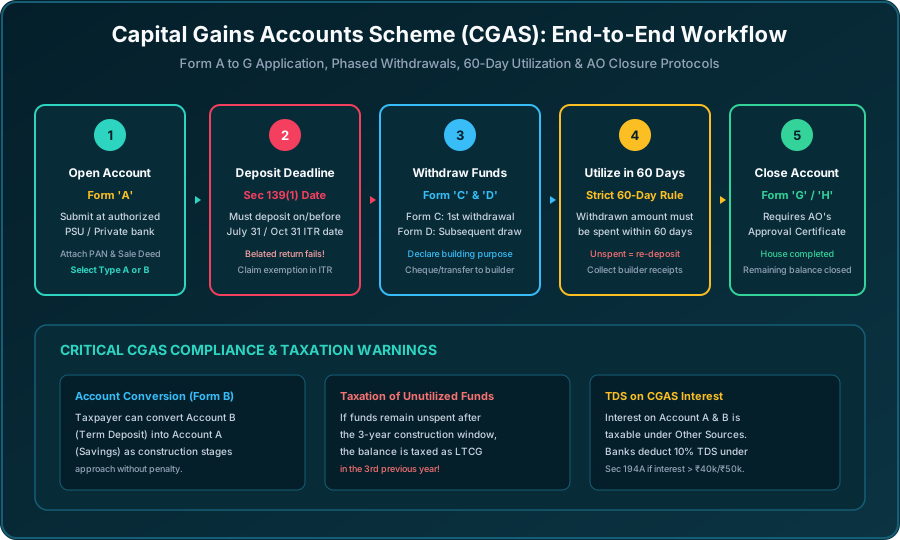
Figure 1: Complete procedural workflow of CGAS from initial Form A deposit to phased withdrawals, 60-day utilization, and AO account closure.
7. Complete Form Directory: Form A to Form H
Every interaction with a CGAS account requires filing a prescribed statutory form with the authorized depository branch:
| Statutory Form | Purpose / Transaction Type | Required Accompanying Documents | Processing Authority |
|---|---|---|---|
| Form 'A' | Application for opening a CGAS Account (Type A or B) | PAN card, Aadhaar, Proof of Asset Sale, Address Proof | Bank Branch Manager |
| Form 'B' | Application for conversion from Account B to A or vice versa | Original Term Deposit Receipt (TDR) / Passbook | Bank Branch Manager |
| Form 'C' | Application for FIRST withdrawal from Account Type 'A' | Statement of purpose (builder agreement, architect estimate) | Bank Branch Manager |
| Form 'D' | Application for SUBSEQUENT withdrawals from Account Type 'A' | Utilization proof of previous withdrawal (receipts/vouchers) | Bank Branch Manager |
| Form 'E' | Application for nomination or change of nomination | Nominee identification and relationship details | Bank Branch Manager |
| Form 'G' | Application for CLOSURE of CGAS Account by the depositor | Mandatory Approval Certificate from Assessing Officer | Assessing Officer + Bank |
| Form 'H' | Application for closure of account by legal heirs / nominees | Death certificate, succession certificate, AO approval | Assessing Officer + Bank |
8. The 60-Day Utilization Rule & Cheque Payments
Withdrawing money from a CGAS account is strictly controlled under Paragraph 9 of the 1988 Scheme to prevent diverted personal usage:
The 60-Day Expenditure Window
Whenever an assessee withdraws funds from Account 'A' using Form 'C' or Form 'D', the entire withdrawn amount must be spent within 60 days from the date of withdrawal exclusively for:
- Paying the seller or developer for the purchase of the residential property; or
- Paying civil contractors, material suppliers, or architects for the ongoing construction of the residential house.
Withdrawal Restrictions
- No Cheque Book or ATM Card: The bank is legally prohibited from issuing standard cheque books or debit/ATM cards for CGAS accounts.
- Crossed Cheque / Direct Transfer: If the withdrawal amount exceeds ₹25,000, the bank does not disburse cash. The withdrawal must be executed via crossed demand draft, banker's cheque, or direct RTGS/NEFT transfer payable directly to the builder, seller, or contractor named in Form C/D.
9. Tax Treatment of Interest & Section 194A TDS
A major point of confusion among depositors is the tax status of interest earned within the CGAS account:
- Interest is FULLY TAXABLE: The capital gains tax exemption applies strictly to the principal amount deposited. The interest credited periodically by the bank on Account 'A' (savings) and Account 'B' (fixed deposit) is 100% taxable in the hands of the depositor.
- Head of Income: All interest earned must be reported under the head "Income from Other Sources" in the ITR of the financial year in which it accrues.
- TDS Deduction under Section 194A: The bank will deduct Tax Deducted at Source (TDS) @ 10% under Section 194A if total interest across branches exceeds ₹40,000 per financial year (or ₹50,000 for resident senior citizens). Depositors can claim credit for this TDS in their annual ITR via Form 26AS / AIS.
- Senior Citizen Relief: Senior citizens holding CGAS accounts can claim deduction up to ₹50,000 under Section 80TTB against this interest income.
10. Account A vs Account B Feature Matrix
The comparison chart below evaluates operational differences, liquidity constraints, and investment strategies between Account Type 'A' and Account Type 'B':
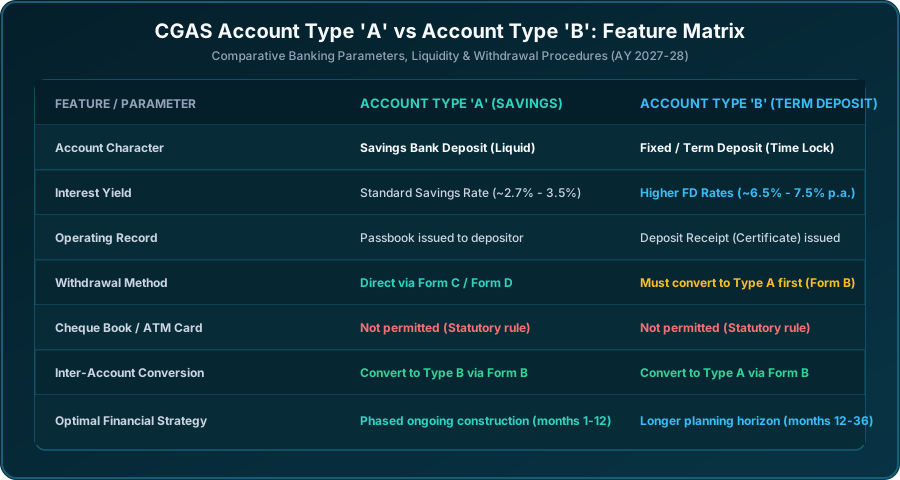
Figure 2: Statutory and operational comparison between CGAS Savings Deposit (Type A) and Term Deposit (Type B).
11. Taxation of Unspent Funds at Year 3
What happens if a depositor puts ₹1 Crore into a CGAS account, spends ₹60 Lakh on building a house, but leaves ₹40 Lakh unutilized when the 3-year construction deadline expires?
The Clawback Mechanics
Under the proviso to Section 54(2) and Section 54F(4):
- If the amount deposited is not utilized wholly or partly for the purchase or construction of the new asset within the specified period (3 years from the date of transfer of the original asset), then: $$\text{Taxable LTCG} = \text{Unutilized Amount Remaining in CGAS}$$
- This unutilized balance is treated as Long-Term Capital Gain of the previous year in which the period of three years expires.
- The taxpayer must report this unutilized gain in their ITR for that third financial year and pay capital gains tax at the prevailing rate (12.5% plus surcharge and cess).
12. Account Closure & Transmission to Heirs
Closing a CGAS account is not like closing an ordinary savings account. Banks cannot release the remaining balance or close the ledger without direct regulatory authorization from the Income Tax Department.
The Mandatory Assessing Officer (AO) Certificate
- The depositor must apply to their jurisdictional Assessing Officer (AO) explaining that the property purchase/construction is complete, or that the statutory 3-year tenure has elapsed and applicable taxes have been discharged.
- The AO verifies the purchase deeds, completion certificates, and tax filings, and issues a formal Approval Certificate for Account Closure.
- The depositor submits Form 'G' along with the AO's original approval certificate and passbook/TDR to the bank branch.
- The bank closes the account and transfers the remaining proceeds into the depositor's regular operational bank account.
Decease of Depositor: Form 'H' Transmission
If the depositor passes away before the funds are utilized or the account is closed:
- The nominee or legal heirs must file Form 'H' with the bank, accompanied by the death certificate and an approval certificate from the jurisdictional Assessing Officer.
- The unutilized balance is transmitted to the legal heirs. Under CBDT Circular No. 743, the unutilized amount is not taxable in the hands of the legal heirs as capital gains, because the transmission occurs by way of inheritance!
13. Computational Case Studies
Case Study 1: Salaried Executive Building a Custom Villa
Kavita sells equity shares and land in January 2027, realizing a net sale consideration of ₹1,60,00,000 (₹1.60 Cr) with an LTCG of ₹1,00,00,000 under Section 54F. She acquires a residential plot and plans to build a villa.
- By July 25, 2027 (before her Section 139(1) due date), Kavita deposits the entire ₹1,60,00,000 into a CGAS account with SBI.
- She puts ₹40,00,000 in Account 'A' (Savings) for immediate foundation and plinth work, and ₹1,20,00,000 in Account 'B' (Term Deposit @ 7.10% p.a.).
- In her ITR filed on July 29, 2027, Kavita claims 100% exemption under Section 54F, entering her SBI CGAS account number and BSR code in Schedule CG. Her net tax payable is ₹0.
- Over the next 24 months, as construction stages conclude, she converts funds from Account B to Account A via Form B and issues direct drafts to contractors via Form C and D.
Case Study 2: The Belated Return Disaster
Alok sold a residential flat in May 2026, earning an LTCG of ₹70,00,000. He failed to deposit the money into CGAS before July 31, 2027, believing that he could do so before filing his belated return on December 20, 2027.
- Alok deposited ₹70,00,000 in a PNB CGAS account on December 15, 2027 and filed his return on December 20, claiming Section 54 exemption.
- The CPC processed his return under Section 143(1) and issued a tax demand of ₹8,75,000 (12.5% LTCG) plus ₹1,20,000 interest under Section 234A/B/C, summarily disallowing the Section 54 claim because the deposit date was after July 31.
- Alok was forced to file an appeal before the CIT(Appeals), facing prolonged litigation and substantial legal expenses that could have been avoided by adhering to the July 31 deadline.
14. Frequently Asked Questions (FAQs)
Can I take a loan against my CGAS Account B deposit?
No. Under the provisions of the Capital Gains Accounts Scheme, 1988, deposits in Account 'A' and Account 'B' cannot be offered as security, collateral, or guarantee for any loan, advance, or overdraft facility. Any lien or hypothecation on a CGAS deposit is legally void.
Can a CGAS account be transferred from one bank branch to another?
Yes. A depositor can apply to transfer their CGAS account from one authorized branch to another branch of the same bank, or even to a branch of another authorized bank, by submitting an application detailing the reasons (such as city relocation) along with the existing passbook and deposit receipts.
Is there any maximum limit on the amount deposited in CGAS?
There is no cap under the CGAS scheme itself. However, under the Finance Act amendments to Section 54 and Section 54F, the maximum capital gains exemption claimable is capped at ₹10 Crore. Consequently, any deposit in CGAS beyond ₹10 Crore will not yield additional tax exemption.
Can an NRI open a Capital Gains Account Scheme account?
Yes. Non-Resident Indians (NRIs) who sell capital assets in India and intend to reinvest under Section 54 or 54F can open a CGAS account with authorized bank branches in India through their NRO accounts.
What proof of CGAS deposit must be submitted with the ITR?
Modern ITR forms are annexure-less, meaning physical deposit receipts cannot be attached online. Instead, the taxpayer must enter specific details in Schedule CG: the Bank Name, Branch Name, BSR Code, CGAS Account Number, Date of Deposit, and Amount Deposited. The physical counterfoil of Form A and deposit receipt should be preserved safely for verification during scrutiny assessments.