HRA Exemption Calculation: Metro vs Non-Metro 50/40 Rule (2026-27)
The ultimate salaried guide to House Rent Allowance (HRA) for FY 2026-27 (AY 2027-28). Unpack the statutory 3-factor Rule 2A formula, why Bengaluru and Hyderabad are legally non-metros, the ₹1 Lakh landlord PAN mandate, Section 194-IB 5% TDS rules, and how to lawfully pay rent to parents.

Executive Summary: Maximizing India's Largest Salary Exemption
For millions of corporate professionals renting apartments in urban tech corridors, House Rent Allowance (HRA) is the single largest tax deduction on their salary slips. Structured under Section 10(13A) and regulated by Rule 2A of the Income Tax Rules, 1962, HRA exists to provide tax relief on the legitimate living expenses incurred by salaried workers residing in rented residential accommodation.
However, because HRA is an exemption rather than a standard deduction, claiming it requires strict statutory compliance. With the Income Tax Department's automated Artificial Intelligence engines cross-referencing rental claims with landlords' Annual Information Statements (AIS) and Form 26AS, arbitrary rent claims and fake rent receipts now trigger automated notices under Section 143(1)(a) and Section 148A.
Key takeaways for Assessment Year 2027-28 (Financial Year 2026-27):
- The Rule 2A 3-Factor Test: HRA exemption is strictly the least of: (1) Actual HRA received, (2) Rent paid minus 10% of salary, or (3) 50% of salary (for 4 metros) or 40% of salary (for non-metros).
- The Metro Anomaly: The 50% rate applies strictly to four historic cities: Delhi, Mumbai, Kolkata, and Chennai. Bengaluru, Hyderabad, Pune, Gurugram, and Noida are legally categorized as "Non-Metros" (40%), regardless of their real estate pricing.
- The ₹1,00,000 Landlord PAN Rule: Under CBDT Circular 08/2013, if your annual rent exceeds ₹1,00,000 (more than ₹8,333 per month), you must report the landlord's valid PAN in Form 12BB to your employer.
- Section 194-IB TDS Mandate: If your monthly rent exceeds ₹50,000, you must deduct 5% TDS from the landlord's rent and deposit it via Form 26QC.
- Regime Exclusion: HRA is disallowed under the New Tax Regime (Section 115BAC). If you opt for the New Regime, 100% of your HRA is taxed at normal slab rates.
1. Statutory Framework: Section 10(13A) & Rule 2A
Section 10(13A) of the Income Tax Act states that any special allowance specifically granted to an employee by his employer to meet expenditure actually incurred on payment of rent in respect of residential accommodation occupied by him is exempt from income tax to the extent prescribed in Rule 2A.
To claim HRA lawfully, four cumulative statutory prerequisites must be satisfied:
- Allowance in Compensation: HRA must form a designated part of your formal salary structure (it cannot be claimed if your employer does not provide a designated HRA component; self-employed individuals must claim under Section 80GG instead).
- Actual Residential Tenancy: You must occupy rented residential premises. You cannot claim HRA for commercial premises, home offices, or storage units.
- Actual Payment of Rent: You must actually disburse rental consideration to a bona fide landlord.
- No Ownership of Occupied Property: You cannot claim HRA if you reside in a residential property that you own wholly or partly.
2. The Rule 2A 3-Way Exemption Funnel Explained
Rule 2A of the Income Tax Rules establishes the mathematical algorithm to determine the tax-exempt component of your House Rent Allowance.

The exempt quantum is the LEAST of the following three amounts:
| Factor Number | Statutory Condition | Legal Definition / Basis |
|---|---|---|
| Condition 1 | Actual HRA Received | Total HRA credited to salary payslips during the tenancy period |
| Condition 2 | Rent Paid - 10% of Salary | Total actual rent disbursed minus 10% of (Basic Salary + Dearness Allowance) |
| Condition 3 | 50% or 40% of Salary | 50% of (Basic + DA) for 4 Metros; 40% of (Basic + DA) for all other locations |
Definition of 'Salary' under Rule 2A
One of the most frequent errors in HRA calculation is using Gross Salary or CTC. Under Explanation to Rule 2A, "Salary" for HRA computation is defined strictly as:
$$\text{Rule 2A Salary} = \text{Basic Salary} + \text{Dearness Allowance (if considered for retirals)} + \text{Commission (if fixed \% of turnover)}$$
Special Allowance, Performance Bonus, Conveyance Allowance, medical reimbursements, and employer PF contributions are strictly excluded from the salary base.
3. The Metro vs Non-Metro Classification Anomaly (50% vs 40%)
A constant source of frustration for salaried employees working in India's leading technology corridors is the Rule 2A Metro Anomaly.
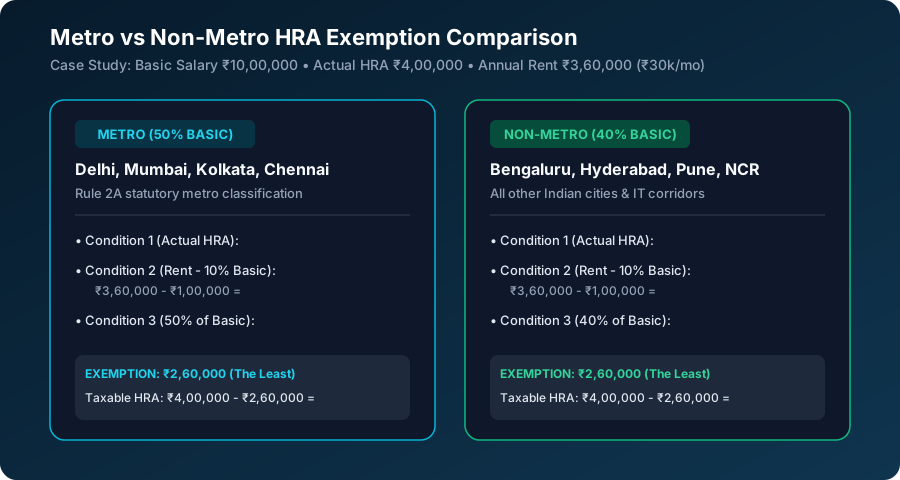
Under Rule 2A, the 50% salary ceiling applies strictly to the municipal boundaries of four cities:
- New Delhi (NCT of Delhi)
- Mumbai (Greater Mumbai, Navi Mumbai, Thane)
- Kolkata
- Chennai
All other Indian cities—including Bengaluru, Hyderabad, Pune, Gurugram, Noida, Ahmedabad, and Kochi—are legally classified as "Non-Metros", capping Condition 3 at 40% of Basic Salary.
Does the 50% vs 40% Difference Always Matter?
Surprisingly, for many mid-to-high income earners, the 50% vs 40% distinction produces zero practical difference in their tax liability.
As demonstrated in Figure 3, Condition 2 (Rent paid minus 10% of basic) is almost always the limiting factor (the least amount). Because Condition 2 is identical regardless of city classification, an engineer paying ₹30,000 monthly rent on a ₹10 LPA basic receives the exact same ₹2,60,000 exemption in Bengaluru (40%) as they would in Mumbai (50%). The 50% metro cap only provides a higher tax shield when rental expenses are exceptionally high relative to basic pay.
4. Step-by-Step Computational Case Study
To illustrate how payroll systems calculate HRA exemption, let us examine the case of Pooja Deshmukh, a senior product manager in Pune:
Case Profile: Pooja Deshmukh
- Annual Basic Salary: ₹12,00,000 (₹1,00,000 per month).
- Actual HRA Received: ₹4,80,000 (₹40,000 per month).
- Monthly Rent Paid: ₹38,000 per month in Baner, Pune (₹4,56,000 annually).
- City Classification: Non-Metro (40% of Basic).
Step-by-Step Exemption Calculus:
Condition 1: Actual HRA Received
$$\text{Condition 1} = ₹4,80,000$$
Condition 2: Rent Paid - 10% of Salary
$$\text{10\% of Salary} = 10\% \times ₹12,00,000 = ₹1,20,000$$ $$\text{Condition 2} = ₹4,56,000 - ₹1,20,000 = ₹3,36,000$$
Condition 3: 40% of Basic Salary (Non-Metro)
$$\text{Condition 3} = 40\% \times ₹12,00,000 = ₹4,80,000$$
Final Exemption Result:
- Comparing the three: Condition 1 (₹4,80,000), Condition 2 (₹3,36,000), Condition 3 (₹4,80,000).
- Tax-Exempt HRA (Section 10(13A)): ₹3,36,000 (The Least).
- Taxable HRA: ₹4,80,000 - ₹3,36,000 = ₹1,44,000.
Pooja successfully shields ₹3.36 Lakhs from income tax, saving approximately ₹1,04,832 in direct cash tax under the 30% slab bracket.
5. Landlord PAN Compliance & CBDT Circular 08/2013
Under CBDT Circular No. 08/2013 and Rule 26C of the Income Tax Rules, corporate payroll departments must enforce strict documentary verification before granting HRA exemption:
Essential compliance guidelines include:
- If Landlord Has No PAN: If the landlord is an elderly citizen or agriculturalist who does not possess a PAN, the employee must obtain and submit a formal declaration signed by the landlord in Form 60 along with their name and residential address.
- Cross-Matching in AIS / 26AS: The Income Tax Department automatically maps the landlord's PAN to their Annual Information Statement (AIS). If your landlord fails to report this rental income in their ITR under "Income from House Property", an automated mismatch notice will be served on both you and the landlord.
- Documentary Trail: Keep signed rent agreements (registered or notarized) and stamped rent receipts for all 12 months. Payments should be executed via banking channels (cheque, NEFT, RTGS, or UPI) to prove money transfer in case of departmental scrutiny.
6. The Legal Playbook for Paying Rent to Parents
A widely utilized and 100% legal tax optimization strategy for young professionals living with their families is paying rent to parents.
Under Indian tax law, you cannot pay rent to yourself. However, if your parents own the family residential house, you can legitimately enter into a landlord-tenant relationship with them.
How to Execute Rent to Parents Without Tax Scrutiny
- Property Ownership Verification: Ensure the residential property is legally registered in the name of your father, mother, or both. You cannot claim HRA if you are a co-owner of the property.
- Execute a Formal Rent Agreement: Draft a valid tenancy agreement on stamp paper stating the monthly rent, security deposit, and tenancy terms between you (tenant) and your parent (landlord).
- Monthly Bank Transfers: Transfer rent electronically from your salary bank account to your parent's bank account every month. Avoid cash handovers.
- Generate Monthly Rent Receipts: Maintain monthly rent receipts signed by your parent with revenue stamps attached.
- Parent Must File ITR: Your parent must declare this rental income under Schedule HP (Income from House Property) in their annual ITR. They are entitled to a flat 30% statutory deduction under Section 24(a), meaning tax is paid on only 70% of the rent received. Furthermore, if your parent is a senior citizen with income below the basic tax exemption limit (₹3 Lakhs), the family pays zero net tax!
7. Section 194-IB: 5% TDS on High-Value Rents (> ₹50,000/mo)
If you rent a luxury apartment, penthouse, or villa where the monthly rent exceeds ₹50,000 per month (or ₹6,00,000 annually), a separate statutory obligation is triggered under Section 194-IB:
- The Withholding Mandate: The individual tenant must deduct 5% TDS from the rent paid to the resident landlord.
- Timing of Deduction: TDS is deducted only once per financial year—in the last month of the tenancy (March) or the month in which the premises are vacated.
- No TAN Required: Unlike corporate deductors who require a Tax Deduction Account Number (TAN), individual tenants remit this TDS using their own PAN via Challan-cum-statement Form 26QC on the e-filing portal.
- Form 16C Issuance: After depositing the TDS within 30 days, download Form 16C from TRACES and furnish it to the landlord as legal proof of tax credit.
8. HRA in New vs Old Tax Regime: The Breakeven Calculus
The decision to file under the Old Tax Regime or the default New Tax Regime (Section 115BAC) almost always hinges on House Rent Allowance.
Because Section 10(13A) is completely disallowed in the New Tax Regime, high-rent payers must calculate their breakeven threshold:
| Gross Salary Range | Annual Rent Paid | Recommended Regime | Key Strategic Driver |
|---|---|---|---|
| Up to ₹7.75 LPA | Any Rent Amount | New Tax Regime | 100% Zero Tax due to Section 87A rebate + ₹75k standard deduction. |
| ₹8 LPA to ₹15 LPA | Rent > ₹20,000/mo | Old Tax Regime | HRA exemption + 80C + 80D easily beats New Regime tax slab savings. |
| ₹15 LPA to ₹25 LPA | Rent > ₹35,000/mo | Old Tax Regime | Substantial HRA exemption (> ₹3.5L) yields lower net tax under 30% slab. |
| Above ₹25 LPA | Rent < ₹25,000/mo | New Tax Regime | Concessional 20% slab up to ₹15L outweighs small HRA deduction. |
Calculate Your HRA Exemption in Seconds
Unsure how much HRA you can claim this financial year? Use our 100% free, private client-side calculators to model your exact exemption and compare New vs Old Regime tax.
9. Frequently Asked Questions (FAQ)
What is the formula to calculate HRA tax exemption under Rule 2A?
Under Rule 2A of the Income Tax Rules, HRA exemption under Section 10(13A) is the least of three statutory amounts: (1) Actual HRA received from the employer, (2) Actual rent paid minus 10% of salary (Basic + DA), or (3) 50% of salary for metro cities (Delhi, Mumbai, Kolkata, Chennai) or 40% of salary for all non-metro cities.
Which cities qualify for the 50% metro HRA exemption?
Under Rule 2A, strictly four municipal boundaries qualify for the 50% metro rate: Delhi, Mumbai, Kolkata, and Chennai. Major modern technology centers like Bengaluru, Hyderabad, Pune, Gurugram, and Noida are statutorily classified as non-metros and qualify for the 40% rate.
When is it mandatory to submit the landlord's PAN to claim HRA?
Under CBDT Circular No. 08/2013 and Rule 26C, an employee must furnish the Permanent Account Number (PAN) of the landlord to their employer via Form 12BB if the aggregate rent paid exceeds ₹1,00,000 per financial year (i.e., more than ₹8,333 per month).
Can I claim HRA exemption by paying rent to my parents?
Yes, legally. You can pay rent to your father or mother provided they are the legal owners of the residential property. You must execute a formal registered or notarized rent agreement, transfer rent via banking channels (cheque/NEFT/UPI), obtain monthly rent receipts, and ensure your parents declare this rental income in their ITR.
Can I claim HRA by paying rent to my spouse?
No. Indian tax tribunals and courts have consistently disallowed HRA exemption for rent paid to a spouse because husband and wife share a matrimonial obligation to live together. Transactions between spouses for residing in a shared household are not viewed as commercial landlord-tenant contracts.
Is HRA exemption available under the New Tax Regime (Section 115BAC)?
No. Section 10(13A) HRA exemption is completely disallowed under the Concessional New Tax Regime (Section 115BAC). HRA received in the New Regime is 100% fully taxable as normal salary income. HRA exemption can only be claimed if you elect to file under the Old Tax Regime.
When must a tenant deduct 5% TDS on rent under Section 194-IB?
Under Section 194-IB, an individual or HUF paying monthly rent exceeding ₹50,000 to a resident landlord must deduct TDS at the rate of 5% once a year (in the last month of tenancy or financial year) and remit it via Challan-cum-statement Form 26QC.
Can I claim both HRA exemption and home loan tax deductions simultaneously?
Yes. If you own a home purchased with a housing loan in one city (or distant suburb) but reside in a rented house in another location due to employment or commercial necessity, you can claim both HRA under Section 10(13A) and home loan interest deduction under Section 24(b) (up to ₹2 Lakhs in Old Regime).