Section 80TTA vs 80TTB: Savings & Fixed Deposit Interest Tax Deductions Explained (FY 2026-27)
Interest income is universally taxable under "Income from Other Sources". Discover how Section 80TTA shields up to ₹10,000 of savings bank interest for working professionals, while Section 80TTB grants senior citizens an extensive ₹50,000 tax shelter across fixed deposits and recurring deposits. Master Section 194A TDS limits, Form 15G/15H, and Section 10(15)(i) post office exemptions for Assessment Year 2027-28.

§ Table of Contents
- 1. The Statutory Framework of Bank Interest Taxation
- 2. Section 80TTA: The ₹10,000 Savings Account Shield
- 3. Why Fixed Deposits (FDs) Are Excluded from Section 80TTA
- 4. Section 80TTB: The ₹50,000 Senior Citizen Super-Shield
- 5. Visual Comparison: 80TTA vs. 80TTB Architecture
- 6. The Hidden Bonus: Section 10(15)(i) Post Office Savings Exemption
- 7. Bank TDS Rules Under Section 194A: Form 15G vs. Form 15H
- 8. Financial Modeling: Non-Senior vs. Senior Citizen Scenarios
- 9. Impact Under New Tax Regime vs Old Tax Regime
- 10. Practical Case Study: Multigenerational Family Interest Audit
- 11. Frequently Asked Questions (Direct Tax FAQs)
1. The Statutory Framework of Bank Interest Taxation
Under the Indian Income-tax Act, 1961, every rupee of interest credited to your bank account—whether originating from a liquid savings account, a sweep-in deposit, a term deposit, or a recurring deposit—is legally classified as taxable income under the head "Income from Other Sources" (Section 56).
Unlike capital gains from mutual funds or equity shares, which enjoy preferential lower tax rates (e.g., 12.5% for LTCG), interest income is taxed at your full marginal income tax slab rate (reaching up to 31.2% or 39% for high-bracket taxpayers).
To prevent micro-taxation of everyday savings and alleviate administrative compliance burdens on ordinary retail savers, Parliament introduced Section 80TTA. Later, recognizing that senior citizens depend almost entirely on fixed deposit interest for their living expenses during retirement, Parliament enacted Section 80TTB as a dedicated, five-fold expanded tax relief measure.
2. Section 80TTA: The ₹10,000 Savings Account Shield
Codified under Chapter VI-A, Section 80TTA provides a deduction from Gross Total Income for interest earned on deposits in a savings account:
- Eligible Entities: Individual taxpayers (aged below 60 years) and Hindu Undivided Families (HUFs).
- Maximum Statutory Deduction: Up to ₹10,000 per financial year. If your total savings account interest across all banks is ₹8,400, your deduction is ₹8,400. If your interest is ₹16,000, your deduction is capped at ₹10,000, and the remaining ₹6,000 is added to your taxable income.
- Eligible Financial Institutions: Savings accounts held with:
- Any banking company governed by the Banking Regulation Act, 1949 (public and private commercial banks like SBI, HDFC, ICICI, Axis).
- Any cooperative bank or cooperative agricultural society.
- Any post office savings bank operating under the Government Savings Banks Act.
3. Why Fixed Deposits (FDs) Are Excluded from Section 80TTA
A widespread and costly mistake made by young salaried taxpayers is attempting to claim Section 80TTA deductions on Fixed Deposits (FDs) or Recurring Deposits (RDs).
Under Section 80TTA(1), the statutory deduction is explicitly restricted to interest on deposits in a "savings account". The statute strictly and unambiguously excludes time deposits (term deposits):
Explanation to Section 80TTA: Time Deposits Bar
"Time deposits means deposits repayable on expiry of fixed periods."
Therefore, for an individual below 60 years of age, 100% of Fixed Deposit and Recurring Deposit interest is fully taxable. If you earn ₹50,000 from 1-year or 3-year bank FDs, you cannot claim a single rupee of Section 80TTA deduction against that FD interest!
4. Section 80TTB: The ₹50,000 Senior Citizen Super-Shield
To protect senior citizens from having their fixed income eroded by income taxes, the government introduced Section 80TTB via the Finance Act, 2018.
Section 80TTB is vastly superior to Section 80TTA in two fundamental dimensions:
₹50,000 Annual Deduction
While working individuals are limited to ₹10,000, senior citizens can deduct up to ₹50,000 per financial year of interest income directly from their gross total income.
Covers Savings + FDs + RDs
Unlike 80TTA, Section 80TTB covers all deposits: savings account interest, regular Fixed Deposits, senior citizen special bank FDs, post office term deposits, and recurring deposits!
Eligibility Litmus Test
The taxpayer must be a resident individual who is of the age of 60 years or more at any time during the relevant financial year. (Non-Resident Indian senior citizens do not qualify for Section 80TTB).
Mutual Exclusivity: Under Section 80TTA(2), a senior citizen claiming Section 80TTB is legally barred from claiming Section 80TTA. The ₹50,000 80TTB limit completely replaces Section 80TTA.

5. Visual Comparison: 80TTA vs. 80TTB Architecture
The infographic above summarizes the direct tax dividing line between working adults and retirees:
| Parameter | Section 80TTA | Section 80TTB |
|---|---|---|
| Eligible Age | Below 60 Years (& HUF) | 60 Years & Above (Senior Residents) |
| Maximum Deduction | ₹10,000 / year | ₹50,000 / year |
| Savings Bank Interest | Included | Included |
| Fixed Deposits (FDs) | 100% EXCLUDED | FULLY INCLUDED |
| Recurring Deposits (RDs) | 100% EXCLUDED | FULLY INCLUDED |
| Bank TDS Threshold (Sec 194A) | ₹40,000 on FDs | ₹50,000 on total interest |
6. The Hidden Bonus: Section 10(15)(i) Post Office Savings Exemption
One of the most overlooked tax-planning secrets in India is the statutory exemption codified under Section 10(15)(i) of the Income-tax Act read alongside Ministry of Finance Notification No. SO 142(E).
Under this provision, interest earned from a Post Office Savings Bank (POSB) account is completely tax-free:
- Up to ₹3,500 per financial year for an individual account.
- Up to ₹7,000 per financial year for a joint account.
How Section 10(15)(i) Stacks with Section 80TTA
Because Section 10(15)(i) is an exemption, the first ₹3,500 (or ₹7,000) of post office interest never enters your Gross Total Income in the first place!
Strategic Example: Suresh holds an individual Post Office savings account earning ₹3,500 interest and commercial bank savings accounts earning ₹10,000 interest (total ₹13,500).
1. Under Section 10(15)(i), the ₹3,500 post office interest is 100% exempt.
2. Under Section 80TTA, the remaining ₹10,000 bank savings interest is fully deducted.
Total Tax-Free Interest Enjoyed = ₹13,500! (Or ₹17,000 with a joint post office account).
7. Bank TDS Rules Under Section 194A: Form 15G vs. Form 15H
To enforce tax compliance on interest, commercial banks deduct Tax Deducted at Source (TDS) under Section 194A when interest payments breach statutory thresholds:
Non-Senior Individuals (Below 60 Years): Form 15G
Banks deduct 10% TDS (20% if PAN is not linked to Aadhaar) on Fixed Deposit interest if total interest from the bank exceeds ₹40,000 in a financial year. If your total taxable income is below the basic exemption limit (₹2.5L/₹3L) and your final tax liability is zero, you can submit Form 15G to the bank at the start of the fiscal year to prevent TDS deduction.
Senior Citizens (Aged 60+): Form 15H
The TDS threshold for resident senior citizens is harmonized with Section 80TTB at ₹50,000. Banks will not deduct any TDS unless your aggregate interest across all branches of that bank exceeds ₹50,000. If a senior citizen's final tax liability is NIL, they can submit Form 15H to prevent TDS deduction entirely.
8. Financial Modeling: Non-Senior vs. Senior Citizen Scenarios
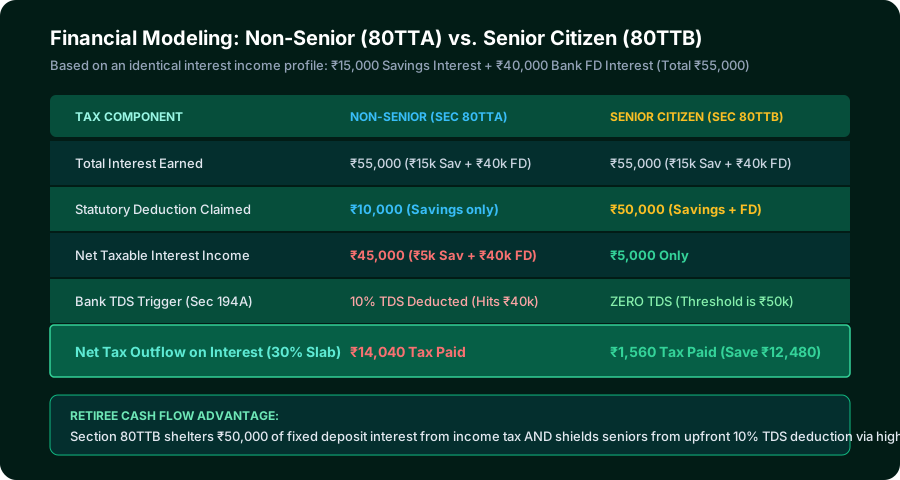
The chart above evaluates two taxpayers—a 35-year-old manager and a 65-year-old pensioner—who each earn an identical interest portfolio of ₹15,000 Savings Interest + ₹40,000 FD Interest (Total ₹55,000) in the 30% tax bracket:
- Non-Senior (80TTA): Deducts ₹10,000 (savings only). Net taxable interest is ₹45,000. Bank deducts 10% TDS on the ₹40k FD. Final tax outflow at 31.2% is ₹14,040.
- Senior Citizen (80TTB): Deducts the full ₹50,000 against combined savings and FD interest. Net taxable interest is a negligible ₹5,000. Bank deducts ZERO TDS. Final tax outflow is only ₹1,560.
- Net Cash Benefit of Section 80TTB: The senior citizen saves ₹12,480 in direct cash on the exact same portfolio!
9. Impact Under New Tax Regime vs Old Tax Regime
Under the default New Tax Regime (Section 115BAC):
| Section | Old Tax Regime | New Tax Regime (Section 115BAC) |
|---|---|---|
| Section 80TTA (₹10,000) | Allowed | DISALLOWED (100% Taxable) |
| Section 80TTB (₹50,000) | Allowed | DISALLOWED (100% Taxable) |
| Section 10(15)(i) Post Office | Allowed (₹3,500/₹7,000) | STILL ALLOWED (Section 10 Exemption) |
Crucial Filing Insight for Retirees: For senior citizens living primarily on bank interest, losing the ₹50,000 Section 80TTB deduction under the New Tax Regime is a major factor. However, because the New Tax Regime offers a ₹75,000 standard deduction (for pensioners) and zero tax on income up to ₹7,75,000 (via Section 87A rebate), most senior citizens earning under ₹7.75 Lakhs still pay ₹0 tax under the New Regime!
10. Practical Case Study: Multigenerational Family Interest Audit
Let us examine the Sharma household in Jaipur, comprising Rajesh (aged 42, VP Marketing) and his retired father, Ramakant (aged 68, Retired Government Officer):
11. Frequently Asked Questions (Direct Tax FAQs)
Can I claim Section 80TTA for interest earned on corporate company FDs? ▼
No. Neither Section 80TTA nor Section 80TTB covers interest from non-banking company fixed deposits (such as corporate FDs from Bajaj Finance, Shriram Finance, or housing finance companies). Only interest earned from banking companies, cooperative banks, and post offices is eligible.
Is interest on sweep-in fixed deposits eligible for Section 80TTA?
▼
No. When a bank's auto-sweep facility transfers surplus funds from your savings account into a short-term fixed deposit, the interest generated on the sweep-in portion is technically classified as term deposit interest, and is excluded from Section 80TTA.
How does the Income Tax Department verify bank interest amounts?
▼
Under Section 285BA, all commercial banks and post offices report interest payments electronically in Statement of Financial Transactions (SFT). The exact rupee figures of both savings and FD interest automatically appear in your Annual Information Statement (AIS) and Form 26AS.
Can an NRI claim Section 80TTB on NRO fixed deposits?
▼
No. Section 80TTB is explicitly restricted to resident senior citizens. Non-Resident Indians (NRIs) cannot claim Section 80TTB, even if they are 60 years of age or older.