Sections 269SS & 269T Cash Transaction Limits: Section 271D & 271E 100% Penalties Guide
An authoritative legal treatise on India's cash transaction limits under Sections 269SS and 269T for AY 2027-28. Master the ₹20,000 threshold aggregation rules, navigate 100% penalties under Sections 271D and 271E, understand the immovable property advance clause, and execute judicial safe harbors under Section 273B.
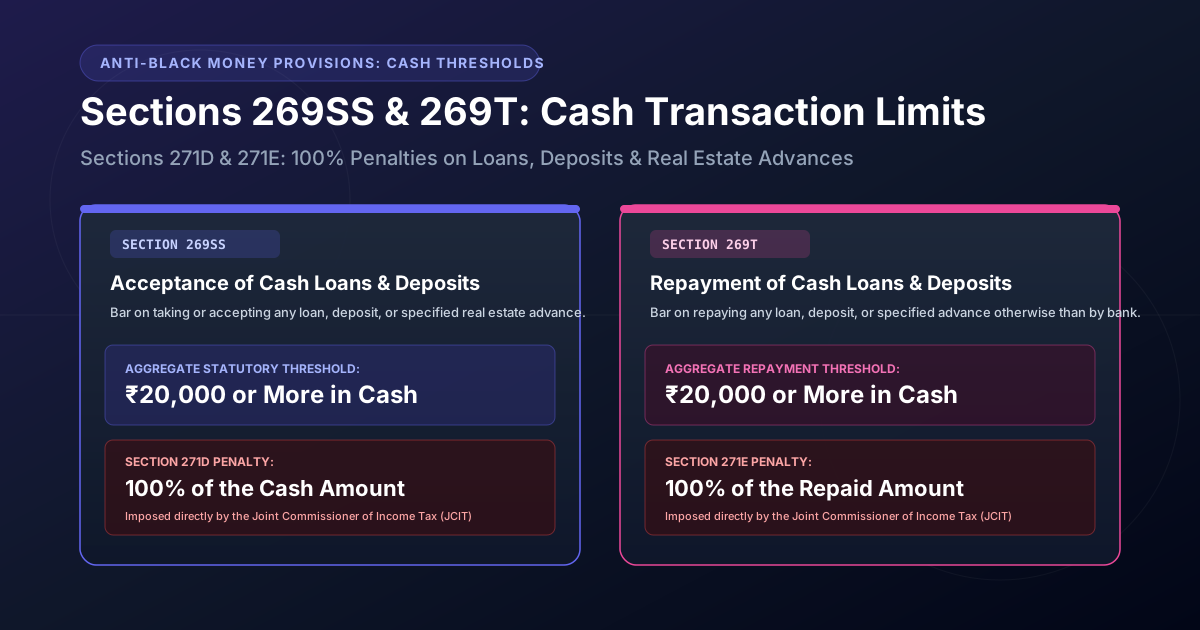
Table of Contents
- 1. Legislative Rationale: Curbing Unaccounted Cash Explanations
- 2. Section 269SS: Bar on Taking / Accepting Cash Loans, Deposits & Property Advances
- 3. Section 269T: Bar on Repaying Loans, Deposits & Advances in Cash
- 4. The Tripartite Aggregation Formula: How the ₹20,000 Limit is Triggered
- 5. 100% Penalties: Section 271D & Section 271E Mechanics & JCIT Jurisdiction
- 6. The 'Specified Sum' Danger: Real Estate Advances & Token Money (Biana)
- 7. Statutory Safe Harbors: Banking, Government & Agriculturist Exceptions
- 8. Judicial Carveouts: Journal Entries, Partner Transactions & Family Distress
- 9. The Section 273B Defense: Establishing "Reasonable Cause"
- 10. Section 269SS vs Section 269ST: Distinct Operational Thresholds
- 11. Standard Operating Procedure (SOP) for Answering a Section 271D/271E Notice
- 12. Frequently Asked Questions (FAQ Schema)
1. Legislative Rationale: Curbing Unaccounted Cash Explanations
In the 1970s and early 1980s, when the Income Tax Department conducted search operations or discovered unexplained cash credits during assessments, taxpayers routinely fabricated confirmatory letters from friends, relatives, or associates claiming that the cash was a temporary unsecured loan or deposit. Because oral loans and informal cash lending were common in Indian commerce, the department found it exceedingly difficult to establish tax evasion.
To strike at the root of this tax avoidance mechanism, Parliament enacted Section 269SS via the Finance Act, 1984, followed by Section 269T. These sections do not make the cash transaction void or illegal under general contract law; instead, they establish a strict regulatory mandate: transactions involving loans, deposits, and specified advances exceeding statutory thresholds must be executed exclusively through banking channels or prescribed electronic modes. Non-compliance triggers an automatic, draconian civil penalty equal to 100% of the entire transaction value.
2. Section 269SS: Bar on Taking / Accepting Cash Loans, Deposits & Property Advances
Section 269SS places an absolute statutory bar on the recipient of funds. Under Section 269SS, no person shall take or accept from any other person any loan or deposit or specified sum, otherwise than by:
- An Account Payee Cheque;
- An Account Payee Bank Draft;
- The use of an Electronic Clearing System (ECS) through a bank account; or
- Such other electronic modes as prescribed under Rule 6ABBA (including Credit Cards, Debit Cards, Net Banking, IMPS, UPI, RTGS, and NEFT).
Bearer Cheques and Crossed Cheques are Prohibited!
It is a widespread misconception that accepting a crossed cheque ("& Co.") or a bearer cheque complies with Section 269SS. The statute explicitly specifies an "account payee cheque" or "account payee draft". If a loan of ₹50,000 is accepted via a bearer cheque or a crossed cheque without the words "Account Payee", it is legally treated as cash, attracting a 100% penalty under Section 271D!
3. Section 269T: Bar on Repaying Loans, Deposits & Advances in Cash
While Section 269SS monitors the inflow of funds, Section 269T acts as the regulatory gatekeeper for fund outflows. Section 269T provides that no branch of a banking company, cooperative bank, firm, company, or other person shall repay any loan or deposit made with it, or any specified advance received by it, otherwise than by an account payee cheque, account payee draft, ECS, or prescribed electronic mode, if the repayment amount reaches the statutory threshold.
Crucially, Section 269T penalizes the payer / repaying party. If a borrower repays ₹1,00,000 of a genuine business loan in cash, the lender commits no offence under Section 269T, but the borrower is directly liable for a 100% penalty of ₹1,00,000 under Section 271E.

4. The Tripartite Aggregation Formula: How the ₹20,000 Limit is Triggered
The statutory threshold under both Section 269SS and Section 269T is ₹20,000. However, taxpayers frequently fall into the trap of assuming that individual cash transactions below ₹20,000 are completely safe. The statute contains three cumulative aggregation limbs designed to defeat transaction structuring:
The Three Statutory Aggregation Tests under Section 269SS:
Section 269SS is violated if on the date of accepting a cash loan, deposit, or specified sum:
- The amount of such loan or deposit or specified sum is ₹20,000 or more; OR
- The aggregate of the loan, deposit, and specified sum taken earlier from that person and remaining unpaid on that date is ₹20,000 or more; OR
- The aggregate of the amount being accepted, together with the unpaid earlier balance, equals or exceeds ₹20,000.
Numerical Demonstration: Structuring Pitfall
Suppose Mr. Sharma has an existing unpaid loan balance of ₹15,000 borrowed via cheque from his associate Mr. Verma. On 10th October, Sharma accepts an additional cash loan of ₹8,000 from Verma. While the new receipt of ₹8,000 is individually below ₹20,000, the aggregate outstanding balance becomes ₹23,000 (exceeding the ₹20,000 threshold). Sharma has violated Section 269SS and is liable for a penalty under Section 271D equal to the cash received (₹8,000).
5. 100% Penalties: Section 271D & Section 271E Mechanics & JCIT Jurisdiction
The statutory consequences of violating Section 269SS and Section 269T are among the most severe in the Income Tax Act:
Section 271D Penalty (Violation of 269SS)
Statutory Quantum: A sum equal to the amount of the loan or deposit or specified sum so accepted. (100% Penalty).
Levied Upon: The recipient of the cash loan or deposit.
Section 271E Penalty (Violation of 269T)
Statutory Quantum: A sum equal to the amount of the loan or deposit or specified advance so repaid. (100% Penalty).
Levied Upon: The person repaying the cash loan or deposit.
Exclusive Jurisdiction of the Joint Commissioner (JCIT)
A critical statutory check and balance is embedded in Section 271D(2) and Section 271E(2):
Statutory Jurisdictional Bar:
"Any penalty imposable under sub-section (1) shall be imposed by the Joint Commissioner."
This means the Assessing Officer (whether an Income Tax Officer, Assistant Commissioner, or Deputy Commissioner) has zero statutory power to pass an order imposing a penalty under Section 271D or 271E. The AO can merely refer the matter to the Joint Commissioner of Income Tax (JCIT) or Additional Commissioner (Addl. CIT). In numerous rulings—including the Karnataka High Court in CIT v. Sri Basaveshwara Sugar Co. Ltd.—courts have held that penalty orders passed by an Assessing Officer are null and void ab initio.
Statutory Limitation Period (Section 275(1)(c))
Under Section 275(1)(c), an order imposing penalty under Section 271D or 271E must be passed before the expiry of the financial year in which the proceedings are initiated, or within six months from the end of the month in which action for imposition of penalty is initiated, whichever period expires later. Orders passed after this limitation window are time-barred and unenforceable.
6. The 'Specified Sum' Danger: Real Estate Advances & Token Money (Biana)
Prior to Assessment Year 2016-17, Section 269SS applied exclusively to loans and deposits. In real estate transactions, sellers routinely accepted massive cash advances as "biana" or token advance, arguing that an advance for purchase of land or apartment is neither a loan nor a deposit. To eliminate this widespread cash laundering channel, Parliament amended Section 269SS and 269T via the Finance Act, 2015, inserting the term "specified sum".
Statutory Definition of 'Specified Sum':
"Specified sum means any sum of money undertaken to be agreed to be taken or accepted, whether as an advance or otherwise, in relation to transfer of an immovable property, whether or not the transfer takes place."
This statutory amendment creates three profound legal implications for real estate deals in India:
- Any Immovable Property: It applies to all immovable properties: agricultural land, residential plots, commercial shops, industrial sheds, and luxury apartments.
- Strict ₹20,000 Threshold: If a property seller accepts even ₹25,000 in cash as token money or earnest advance from a prospective buyer, the seller commits an offence under Section 269SS and faces a 100% penalty under Section 271D.
- Even if the Deal Collapses: The statute specifically says "whether or not the transfer takes place". Even if the buyer defaults and the seller forfeits the token advance, the 100% penalty under Section 271D remains fully imposable! Similarly, if the deal is cancelled and the seller refunds the cash advance to the buyer, the refund violates Section 269T, triggering an additional 100% penalty under Section 271E on the seller!

7. Statutory Safe Harbors: Banking, Government & Agriculturist Exceptions
Sections 269SS and 269T contain explicit statutory exceptions where the cash restrictions do not apply:
1. Institutional Exemptions (First Proviso)
No penalty applies where the loan, deposit, or specified advance is taken/accepted from, or repaid to:
- The Central Government or any State Government;
- Any banking company, post office savings bank, or cooperative bank;
- Any corporation established by a Central, State, or Provincial Act;
- Any Government company as defined in Section 2(45) of the Companies Act, 2013;
- Institutions, associations, or bodies notified by the Central Government in the Official Gazette.
2. The Pure Agriculturist Exemption (Second Proviso)
Under the second proviso to Section 269SS, the provisions shall not apply if:
- The person from whom the loan, deposit, or specified advance is taken or accepted; AND
- The person by whom the loan, deposit, or specified advance is taken or accepted,
are both persons having agricultural income, and neither of them has any other income chargeable to tax under the Income Tax Act. If even one party has taxable business, professional, or salary income exceeding the basic exemption limit, this safe harbor is instantly destroyed.
8. Judicial Carveouts: Journal Entries, Partner Transactions & Family Distress
Over four decades of appellate jurisprudence, the Supreme Court and High Courts have carved out vital commercial safe harbors protecting genuine commercial transactions from mechanical penalty imposition:
1. Book Entries / Journal Entries Between Group Entities
In corporate group management, parent and subsidiary entities routinely square off inter-company balances via journal entries without physical cash passing. The Delhi High Court in CIT v. Worldwide Township Projects Ltd. [2014] 367 ITR 433 (Delhi) and Bombay High Court in CIT v. Triumph International Finance Ltd. [2012] 345 ITR 270 (Bom) held that transactions executed through book adjustments or journal entries are not in violation of Section 269SS or 269T, as the legislative intent was to curb the physical introduction of unaccounted cash.
2. Transactions Between Partners and Partnership Firms
Under Indian partnership law, a firm is not a distinct legal person separate from its constituent partners. The Rajasthan High Court in CIT v. Lokhpat Film Exchange [2008] 304 ITR 172 (Raj) held that money introduced by a partner as capital into a firm, or withdrawn by a partner from the firm, does not partake of the character of a loan or deposit between two independent legal persons. Consequently, Sections 269SS, 269T, 271D, and 271E cannot be invoked on partner-firm transactions.
3. Transactions Between Close Family Members for Medical or Urgent Support
In cases involving cash assistance between spouses, parents, or siblings for medical treatment, hospital deposits, or urgent family maintenance, the Madras High Court in CIT v. M. Yesodha [2013] 351 ITR 265 (Mad) ruled that family transactions driven by natural love and affection without commercial borrowing intent cannot be subjected to 100% penal extraction.
9. The Section 273B Defense: Establishing "Reasonable Cause"
Even if an assessee has technically accepted or repaid a cash loan or deposit exceeding ₹20,000, they are not automatically doomed to pay the 100% penalty. Parliament incorporated a powerful statutory escape hatch under Section 273B:
Section 273B Statutory Immunity:
"Notwithstanding anything contained in the provisions of section 271D or section 271E... no penalty shall be imposable on the person or the assessee, as the case may be, for any failure referred to in the said provisions, if he proves that there was reasonable cause for the said failure."
Recognized Grounds of "Reasonable Cause":
- Banking Disruption: Continuous bank holidays, nationwide bank employee strikes, or banking server outages when immediate payments were legally mandatory.
- Commercial Emergency: Cash urgently required to avert auction of mortgaged assets, clear demurrage charges at ports to prevent cargo confiscation, or disburse statutory worker wages on festival eves.
- Medical Hospitalization: Unforeseen medical crisis where private hospitals refused admission or surgery without immediate upfront cash deposits.
- Remote Geography: Transactions taking place in remote rural or hilly areas where banking branches or operational ATMs do not exist within a reasonable radius.
10. Section 269SS vs Section 269ST: Distinct Operational Thresholds
Taxpayers and accounting professionals frequently confuse Section 269SS with Section 269ST (enacted by the Finance Act, 2017). They serve completely distinct purposes:
| Compliance Parameter | Section 269SS & 269T | Section 269ST |
|---|---|---|
| Statutory Scope | Loans, deposits, and specified immovable property advances. | General cash receipts for any transaction (sale of goods, services, jewelry, cars). |
| Statutory Monetary Limit | ₹20,000 (evaluated with outstanding unpaid balances). | ₹2,00,000 per person per day / per transaction / per event. |
| Penalty Provision | Section 271D (100% on receiver) & Section 271E (100% on payer). | Section 271DA (100% penalty on receiver of cash). |
| Applicability to Normal Sales | Does NOT apply to normal commercial sales of goods/services. | Directly applies to routine sales of merchandise, cars, machinery, etc. |
11. Standard Operating Procedure (SOP) for Answering a Section 271D/271E Notice
If you receive a Show Cause Notice from the Joint Commissioner of Income Tax proposing 100% penalties under Section 271D or 271E, execute this structured legal defense roadmap:
Phase 1: Jurisdictional & Limitation Audit (Days 1–7)
- Verify whether the notice is issued by the Joint Commissioner / Additional Commissioner. If issued by an ITO/ACIT, challenge it immediately as lacking statutory jurisdiction under Section 271D(2) / 271E(2).
- Calculate the limitation period under Section 275(1)(c). If more than six months have elapsed from the end of the month in which penalty proceedings were initiated, raise the bar of limitation.
Phase 2: Substantive Factual Re-Classification (Days 8–15)
- Examine ledger entries to determine if the transaction was a genuine loan or a trade advance / reimbursement / journal entry. Book adjustments do not attract Section 269SS/269T under the Worldwide Township doctrine.
- If between partners and firm, present the partnership deed and cite the Lokhpat Film Exchange precedent.
Phase 3: Invoke Section 273B Reasonable Cause (Days 16–30)
- Compile contemporaneous documentary evidence demonstrating commercial exigency: hospital admission receipts, port demurrage notices, bank strike circulars, or vendor demands.
- Submit an affidavit demonstrating that the transaction was genuine, the identity of the transacting party was proven, tax was not evaded, and the cash mode was necessitated by unavoidable emergencies under Section 273B.
12. Frequently Asked Questions (FAQ Schema)
Under Section 269SS, no person shall accept or take any loan, deposit, or specified sum (advance in relation to transfer of an immovable property) from another person in cash if the amount, or the aggregate of such amount and previous unpaid loans/deposits, is ₹20,000 or more. Any acceptance in cash equal to or exceeding ₹20,000 violates Section 269SS.
The penalty for accepting a cash loan or deposit in violation of Section 269SS is governed by Section 271D, which mandates a penalty equal to 100% of the loan or deposit accepted. Similarly, the penalty for repaying a loan or deposit in cash in violation of Section 269T is governed by Section 271E, which imposes a penalty equal to 100% of the amount repaid.
No. Under Section 271D(2) and Section 271E(2), any penalty under these sections can only be imposed by the Joint Commissioner of Income Tax (JCIT) or Additional Commissioner of Income Tax (Addl. CIT). Courts have repeatedly held that penalty orders passed by an Assessing Officer below the rank of JCIT are illegal and void ab initio due to lack of statutory jurisdiction.
No. Landmark judgments of the Delhi High Court (CIT v. Worldwide Township Projects) and Bombay HC (CIT v. Triumph International Finance) have settled that bona fide book adjustment entries or journal entries between group companies or sister concerns without physical passing of cash do not violate Section 269SS or Section 269T, and therefore no penalty under Section 271D or 271E can be levied.
No. High Courts including Rajasthan HC (CIT v. Lokhpat Film Exchange) have held that a partnership firm and its partners are not distinct legal entities under general law. The introduction of cash capital or current account deposits by a partner into the firm, or withdrawal by a partner, does not constitute a loan or deposit between two independent persons under Section 269SS or 269T.
Under Section 273B, no penalty under Section 271D or 271E shall be imposable if the assessee proves that there was a 'reasonable cause' for the failure. Recognized reasonable causes include: medical emergencies requiring immediate cash payments, commercial exigencies such as avoiding bank cheque bounce or port demurrage on bank holidays, transactions between close relatives for genuine support, and transactions in remote rural locations lacking banking facilities.