Section 271AAC Penalty & Section 115BBE 78% Tax: The Unexplained Cash Credits (Sections 68–69D) Guide
An exhaustive direct tax masterclass on the most punitive regime in the Indian Income Tax Act. Unpack the mechanics of Section 115BBE's 78% flat tax, the mandatory 10% penalty under Section 271AAC, the 3-fold evidentiary test for cash credits, the complete prohibition on loss set-off, and judicial strategies to defend against confiscatory additions.
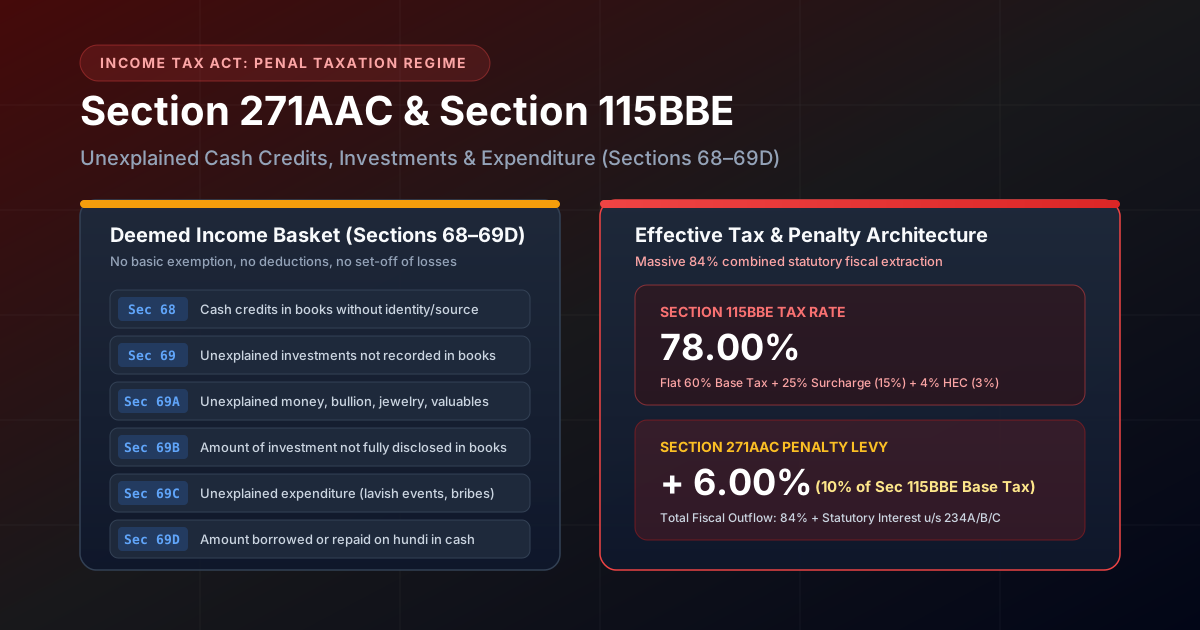
Table of Contents
- 1. Legislative Evolution: From Normal Slab Rates to Confiscatory 84% Extraction
- 2. The Deemed Income Basket: Dissecting Sections 68 through 69D
- 3. The Evidentiary Burden: The 3-Fold Test under Section 68 and the Source of Source
- 4. Section 115BBE Mathematical Breakdown: 60% Base + 25% Surcharge + 4% Cess = 78%
- 5. Section 271AAC Penalty Mechanics: The 10% Levy & Voluntary Filing Exception
- 6. Section 115BBE(2) Prohibition: Zero Expense Allowances & Zero Loss Set-Off
- 7. Judicial Battleground: Business Cash/Stock Found in Surveys vs Section 115BBE
- 8. Interplay Between Section 270A and Section 271AAC: Immunity from Double Jeopardy
- 9. Live Numerical Simulation: ₹50 Lakh Unexplained Credit Impact
- 10. Standard Operating Procedure (SOP) for Answering Section 68 / 115BBE Notices
- 11. Frequently Asked Questions (FAQ Schema)
1. Legislative Evolution: From Normal Slab Rates to Confiscatory 84% Extraction
In the original scheme of the Income Tax Act, 1961, any unexplained credit or undisclosed investment added by an Assessing Officer under Sections 68, 69, 69A, 69B, 69C, or 69D was simply aggregated into the assessee's total income. It was then taxed at regular graduated slab rates (or applicable corporate tax rates), with taxpayers routinely claiming deductions under Chapter VI-A and setting off substantial unabsorbed business losses or depreciation against these additions. Evasion was essentially treated as an interest-free loan from the government if caught.
To dismantle this lucrative loophole, Parliament introduced Section 115BBE via the Finance Act, 2012, imposing a flat tax rate of 30% on unexplained income. However, the watershed moment occurred during the November 2016 demonetization exercise. Fearing that massive unaccounted cash deposits would be laundered by declaring them as unexplained credits and paying a mere 30% tax, Parliament enacted the Taxation Laws (Second Amendment) Act, 2016. This amendment radically altered Section 115BBE and inserted Section 271AAC, establishing a truly confiscatory regime:
- Flat Base Tax Rate: Raised from 30% to 60%.
- Mandatory Surcharge: Imposed at a flat rate of 25% of the tax (which translates to 15% of the income).
- Health & Education Cess: Levied at 4% on the total tax plus surcharge (which equals 3% of the income).
- Effective Tax Rate: A punishing 78.00%.
- Penalty under Section 271AAC: An additional mandatory penalty equal to 10% of the base tax (which equals 6% of the income).
Consequently, any unexplained cash credit or undisclosed asset uncovered during assessment is subjected to a staggering 84.00% fiscal extraction, before adding statutory interest under Sections 234A, 234B, and 234C, leaving the assessee with virtually zero economic recovery.
2. The Deemed Income Basket: Dissecting Sections 68 through 69D
The penal rates under Section 115BBE and Section 271AAC do not apply to regular income additions or routine disallowances of expenditure under Sections 37, 40(a)(ia), or 43B. They apply exclusively to additions originating from the "deemed income basket" comprised of six statutory provisions:
| Section | Statutory Heading | Legal Trigger & Evidentiary Requirement |
|---|---|---|
| Section 68 | Cash Credits | Any sum found credited in the books of an assessee maintained for any previous year, where the assessee offers no explanation about its nature and source, or the explanation offered is not satisfactory to the Assessing Officer. |
| Section 69 | Unexplained Investments | Investments made by the assessee in the financial year which are not recorded in their books of account, and the assessee offers no explanation or an unsatisfactory explanation regarding the financial source. |
| Section 69A | Unexplained Money, Bullion, Jewelry, etc. | The assessee is found to be the owner of any money, bullion, jewelry, or other valuable article not recorded in their books of account, with no satisfactory explanation of acquisition. |
| Section 69B | Amount of Investments Not Fully Disclosed | The assessee has recorded an investment or acquisition in books, but the Assessing Officer finds that the actual expenditure incurred exceeds the recorded figure (e.g., on-money paid in property purchases). |
| Section 69C | Unexplained Expenditure | The assessee incurs expenditure in a financial year but offers no explanation or an unsatisfactory explanation about the source of money used to fund that expenditure (e.g., extravagant weddings, unrecorded foreign trips). |
| Section 69D | Amount Borrowed or Repaid on Hundi | Any amount borrowed on a hundi, or any amount due thereon repaid, otherwise than through an account payee cheque drawn on a bank. Both borrowing and repayment can be deemed as income. |
3. The Evidentiary Burden: The 3-Fold Test under Section 68 and the Source of Source
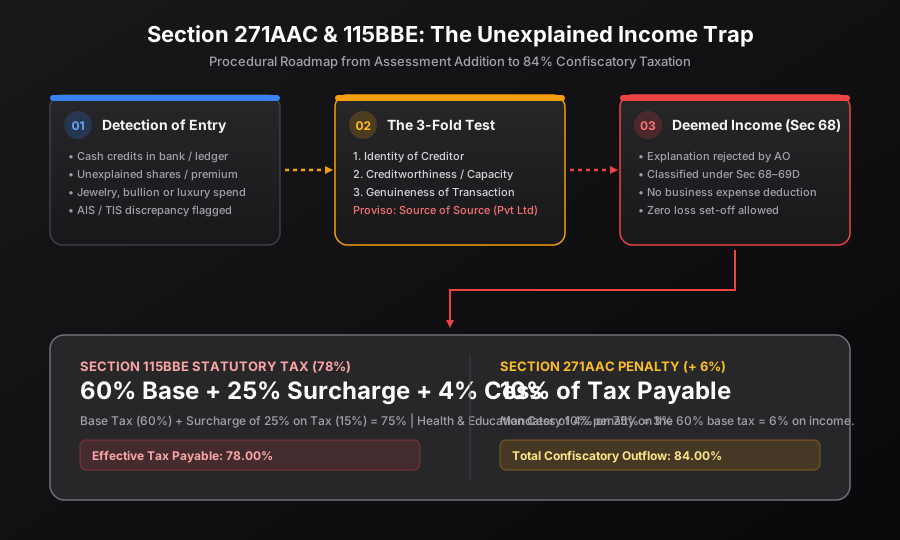
Section 68 is the most litigated anti-avoidance provision in Indian corporate tax law. Under Section 68, the initial legal burden of proof lies squarely on the assessee. Decades of Supreme Court and High Court jurisprudence—including the landmark rulings in Govindarajulu Mudaliar v. CIT [1958] 34 ITR 807 (SC) and Kale Khan Mohammad Hanif v. CIT [1963] 50 ITR 1 (SC)—have crystallized the mandatory Three-Fold Test that a taxpayer must successfully satisfy:
The Three Cumulative Pillars of Section 68
- Identity of the Creditor / Investor: The assessee must positively establish the legal existence and identity of the person or entity providing the funds. This is established by producing Permanent Account Numbers (PAN), Aadhaar, incorporation certificates, registered addresses, and active corporate status with the Ministry of Corporate Affairs (MCA).
- Creditworthiness / Financial Capacity: The taxpayer must establish that the creditor possessed the financial wherewithal to advance the loan, advance, or share application money. This cannot be proved by mere bank entries; it requires audited financial statements, income tax returns showing sufficient net worth, and proof that the creditor did not have an artificially bloated balance sheet funded by simultaneous cash deposits.
- Genuineness of the Transaction: The transaction must satisfy commercial reality. It must be executed through regular banking channels (NEFT/RTGS/Cheque), supported by formal loan agreements, board resolutions, promissory notes, and interest servicing where applicable. Mere routing of money through banking channels is not conclusive evidence of genuineness if the bank account was used as a conduit for round-tripping cash.
The Proviso to Section 68: The 'Source of Source' Doctrine
Historically, under the Supreme Court's ruling in CIT v. Lovely Exports Pvt. Ltd. [2008] 216 CTR 195 (SC), if a closely held company provided the names, PANs, and addresses of share applicants, it was deemed to have discharged its onus; the department could not add the share capital in the hands of the company, but had to pursue the individual investors. To overturn this ruling, Parliament inserted the first proviso to Section 68 via the Finance Act, 2012.
Under this proviso, where the assessee is a closely held company (a company in which the public are not substantially interested), and the sum credited consists of share application money, share capital, share premium, or any such amount, the explanation offered by the company shall NOT be deemed satisfactory unless:
- The resident shareholder also offers an explanation about the nature and source of such sum; and
- Such explanation is found satisfactory by the Assessing Officer.
This statutory amendment created the stringent "Source of Source" requirement. The Supreme Court in PCIT v. NRA Iron & Steel Pvt. Ltd. [2019] 412 ITR 161 (SC) forcefully reaffirmed that the Assessing Officer is duty-bound to pierce the corporate veil. If investor companies are found to be paper entities operating from tiny shared offices with nominal income yet investing crores at exorbitant share premiums, the addition under Section 68 will stand confirmed, subjecting the entire capital infusion to Section 115BBE's 78% tax rate.
4. Section 115BBE Mathematical Breakdown: 60% Base + 25% Surcharge + 4% Cess = 78%
Section 115BBE(1) establishes an extraordinary, non-standard tax formula. Let us analyze how the statutory components combine mathematically:
Component-by-Component Formula for Section 115BBE Tax:
Total Tax = Base Tax (60%) + Surcharge (25% of Base Tax) + Cess (4% of [Base Tax + Surcharge])
| Tax Component | Statutory Provision | Calculation Formula | Effective Rate on Contested Income |
|---|---|---|---|
| Base Tax | Section 115BBE(1)(i) | 60% of Deemed Income | 60.00% |
| Statutory Surcharge | Finance Act (Chapter II) | 25% of Base Tax (25% × 60%) | 15.00% |
| Sub-Total (Tax + Surcharge) | Statutory Liability | 60.00% + 15.00% | 75.00% |
| Health & Education Cess | Finance Act (Chapter II) | 4% of Sub-Total (4% × 75%) | 3.00% |
| Final Section 115BBE Tax Rate | Effective Gross Tax | 75.00% + 3.00% | 78.00% |
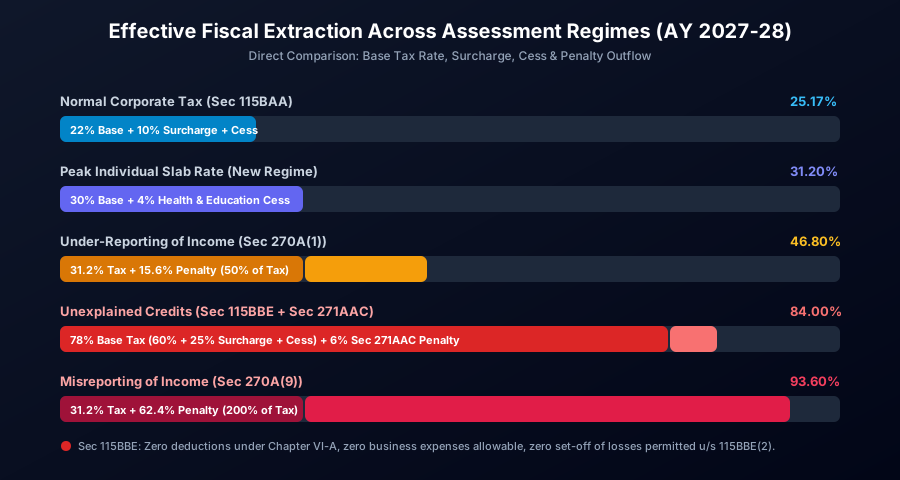
Crucially, this 78% tax rate applies uniformly across all taxpayer classes: individuals, HUFs, partnership firms, private limited companies, and public corporations. It completely bypasses personal slab rates, basic exemptions, and corporate concession schemes under Section 115BAA or 115BAB.
5. Section 271AAC Penalty Mechanics: The 10% Levy & Voluntary Filing Exception
In addition to the 78% tax mandated by Section 115BBE, Section 271AAC empowers the Assessing Officer to direct the payment of a penalty where any addition is made under Sections 68 through 69D:
Section 271AAC Penalty Formula:
Penalty = 10% of the Tax Payable under Section 115BBE(1)(i)
Because the base tax payable under Section 115BBE(1)(i) is 60% of the income, the penalty amount is computed as:
10% × 60% = 6.00% of the Unexplained Income
When this 6% penalty is added to the 78% tax, the total statutory recovery reaches 84.00%.
The Voluntary Disclosure Safe Harbor: The Proviso to Section 271AAC(1)
Parliament provided one critical exception where the 10% penalty under Section 271AAC shall NOT be levied. Under the proviso to Section 271AAC(1), no penalty is imposable if:
- The assessee has included such income in the return of income furnished under Section 139 for the relevant previous year; and
- The tax payable under Section 115BBE(1)(i) has been paid on or before the end of the relevant previous year (i.e., through advance tax installments before 31st March).
If an assessee realizes during the financial year that they have unrecorded cash or an unsubstantiated credit, they can voluntarily disclose it in their return of income and pay the 78% tax before 31st March. In doing so, they completely extinguish their liability to the Section 271AAC penalty (saving 6% of the amount) and protect themselves from criminal prosecution under Section 276C.
6. Section 115BBE(2) Prohibition: Zero Expense Allowances & Zero Loss Set-Off
Section 115BBE(2) acts as an impenetrable iron curtain around unexplained additions. It contains two sweeping statutory prohibitions:
1. Complete Disallowance of Expenses
Section 115BBE(2) Clause 1: Notwithstanding anything contained in this Act, no deduction in respect of any expenditure or allowance or set-off of any loss shall be allowed to the assessee under any provision of this Act in computing their total income referred to in Section 115BBE(1).
Impact: If ₹50 Lakhs of unexplained credit is added, the taxpayer cannot deduct brokerage, banking charges, consultancy fees, or commercial costs incurred in procuring those funds.
2. Absolute Prohibition of Loss Set-Off
Section 115BBE(2) Clause 2: Sub-section (2) was explicitly amended by Finance Act 2016 to insert the words "or set-off of any loss". This prevents taxpayers from neutralizing additions using brought forward business losses, current year operating losses, or unabsorbed depreciation.
Impact: Even if a company suffers a genuine operational loss of ₹1 Crore in the current year, an unexplained credit addition of ₹50 Lakhs cannot be set off against that loss. The company must pay 78% tax on the ₹50 Lakhs in cash.
7. Judicial Battleground: Business Cash/Stock Found in Surveys vs Section 115BBE
One of the most fiercely contested areas of modern direct tax litigation revolves around additions made during surveys under Section 133A or searches under Section 132. Tax authorities routinely attempt to classify any excess physical cash found in the business till, or excess stock uncovered in a factory warehouse, as "unexplained money" under Section 69A or "unexplained investment" under Section 69, triggering the 78% tax rate under Section 115BBE.
However, an extensive body of landmark judicial rulings has established a vital distinction between unexplained entries and undisclosed business assets:
The Principle of Business Origin vs Deemed Income
- Rajasthan High Court in Bajargan Traders [2017] 86 taxmann.com 295 (Raj): The High Court held that where excess stock is discovered during a survey in the business premises of a trader, and the assessee is engaged in no other activity except that business, such excess stock represents unrecorded business inventory funded out of accumulated business profits. It is chargeable as regular business income under Section 28, NOT as unexplained investment under Section 69. Consequently, Section 115BBE cannot be invoked.
- Gujarat High Court in Chokshi Hiralal Maganlal [2014] 363 ITR 677 (Guj): Excess cash found in the business cash register during normal trading hours represents unrecorded business turnover/receipts, which must be assessed under the head "Profits and Gains of Business or Profession" at standard rates, allowing normal business deductions.
- ITAT Special Bench and Coordinate Benches: Coordinate benches across Delhi, Mumbai, and Chandigarh have consistently held that the Assessing Officer cannot automatically invoke Sections 68–69D unless there is an absolute failure to explain the source. If the taxpayer demonstrates that the funds were generated from regular commercial business operations, the addition must be classified under Section 28, escaping the confiscatory 78% rate.
8. Interplay Between Section 270A and Section 271AAC: Immunity from Double Jeopardy
A crucial legal question arises during assessment: Can the Assessing Officer initiate penalty proceedings under both Section 270A (for misreporting of income at 200%) AND Section 271AAC (for unexplained cash credits at 10%) on the exact same addition?
The statute provides an unambiguous, definitive answer under Section 271AAC(2):
Section 271AAC(2) Statutory Bar:
"No penalty under the provisions of section 270A shall be imposed upon the assessee in respect of the income referred to in sub-section (1)."
This statutory bar completely shields taxpayers from double jeopardy. Once an addition is assessed under Section 115BBE, the penalty mechanism is restricted exclusively to Section 271AAC's 10% levy. The Assessing Officer is statutorily prohibited from invoking Section 270A's 200% misreporting penalty on that same sum. Any penalty order passed under Section 270A in respect of Section 115BBE additions is legally invalid and liable to be quashed on jurisdictional grounds.
9. Live Numerical Simulation: ₹50 Lakh Unexplained Credit Impact
To fully appreciate the catastrophic financial gravity of Section 115BBE and Section 271AAC, let us trace a live case simulation of a private limited company facing an addition of ₹50,00,000 for unexplained share capital under Section 68 during AY 2027-28:
| Liability Head | Calculation Formula | Amount in INR | Percentage of Contested Sum |
|---|---|---|---|
| Contested Addition u/s 68 | Unexplained Share Capital | ₹50,00,000 | 100.00% |
| Base Tax u/s 115BBE(1)(i) | 60% of ₹50,00,000 | ₹30,00,000 | 60.00% |
| Statutory Surcharge (25%) | 25% of ₹30,00,000 | ₹7,50,000 | 15.00% |
| Health & Education Cess (4%) | 4% of (₹30L + ₹7.5L) | ₹1,50,000 | 3.00% |
| Total Section 115BBE Tax | Base Tax + Surcharge + Cess | ₹39,00,000 | 78.00% |
| Section 271AAC Penalty | 10% of Base Tax (10% × ₹30L) | ₹3,00,000 | 6.00% |
| Section 234B Interest (approx. 24 mos) | 1% per month on unpaid tax (₹39L × 24%) | ₹9,36,000 | 18.72% |
| Section 234C Deferment Interest | Statutory advance tax default interest | ₹1,17,000 | 2.34% |
| Total Statutory Fiscal Outflow | Tax + Penalty + Mandatory Interest | ₹52,53,000 | 105.06% |
As demonstrated in this simulation, when statutory interest under Sections 234B and 234C is added to the 78% tax and 6% penalty, the total liability reaches ₹52,53,000 on an addition of ₹50,00,000—a devastating 105.06% total extraction! The taxpayer ends up paying more than the entire sum credited into their business.
10. Standard Operating Procedure (SOP) for Answering Section 68 / 115BBE Notices
When an inquiry notice under Section 142(1) or a Show Cause Notice under Section 144B proposes an addition under Sections 68 through 69D, immediate, disciplined procedural defense is required:
Phase 1: Compile the Tripartite Dossier (Days 1–10)
- Identity Documentation: Obtain certified copies of PAN cards, Aadhaar, Certificate of Incorporation, Memorandum and Articles of Association, and active CIN status from the MCA master data portal.
- Capacity Documentation: Procure audited balance sheets, profit and loss statements, and Income Tax Return Acknowledgments (ITR-V) of the creditor for the relevant assessment year and the immediately preceding two assessment years.
- Transaction Documentation: Obtain complete bank account statements of the creditor highlighting the debit entry, counterfoil bank statements of the assessee showing credit via RTGS/NEFT, loan agreement specifying repayment terms and interest rate, and relevant Board Resolutions.
Phase 2: Establish Commercial Linkage & Business Head (Days 11–20)
- If the addition relates to unrecorded cash or stock, submit documentary proof that the funds originated from normal commercial operations. Present sales registers, GST return reconciliations (GSTR-1 and GSTR-3B), and transport bilties to establish that the income belongs under Section 28, completely excluding Section 115BBE.
- Cite the jurisdictional High Court judgments (such as Bajargan Traders or Chokshi Hiralal Maganlal) establishing that business assets cannot be mechanically deemed as unexplained investments under Section 69.
Phase 3: Appellate Action & Stay of Demand (Post-Assessment)
- File an appeal in Form No. 35 before the CIT(Appeals) within 30 days of receiving the demand notice.
- Simultaneously file an application for stay of demand before the Assessing Officer and Principal CIT under Section 220(6), offering payment of 20% of the disputed tax demand under CBDT Office Memorandums, citing financial hardship where applicable.
- Ensure that no Section 270A penalty notice is entertained; challenge any Section 270A notice as statutorily barred under Section 271AAC(2).
11. Frequently Asked Questions (FAQ Schema)
Under Section 115BBE of the Income Tax Act, unexplained income under Sections 68, 69, 69A, 69B, 69C, and 69D is taxed at an effective rate of 78%. This is composed of a flat base tax rate of 60%, a mandatory surcharge of 25% on tax (which equals 15% of income), and a 4% Health and Education Cess on tax plus surcharge (which equals 3% of income), yielding exactly 78% before interest or penalties.
Section 271AAC levies a mandatory penalty equal to 10% of the tax payable under Section 115BBE(1)(i). Since the base tax is 60%, the 10% penalty equals 6% of the unexplained income amount. When combined with the 78% tax rate, the total fiscal extraction reaches 84% of the contested income, before calculating statutory interest under Sections 234A, 234B, and 234C.
Yes. Under the proviso to Section 271AAC(1), no penalty shall be imposed if the assessee includes the unexplained income in their return of income furnished under Section 139 and pays the full tax due under Section 115BBE (including advance tax) on or before the end of the relevant previous year. The penalty is triggered only when the income is determined or added by the Assessing Officer during assessment.
No. Section 115BBE(2) contains an absolute statutory bar prohibiting the set-off of any loss (whether current year business loss, unabsorbed depreciation, or brought forward capital loss) against income referred to in Sections 68, 69, 69A, 69B, 69C, or 69D. Furthermore, no deduction under Chapter VI-A or basic exemption limit is permissible against this income.
To prevent an addition under Section 68, the taxpayer must establish three cumulative elements: 1) Identity of the creditor (PAN, Aadhaar, ROC registration); 2) Creditworthiness and financial capacity of the creditor (bank statements, ITR acknowledgments, balance sheets); and 3) Genuineness of the transaction (banking channels, loan agreements, confirmation letters). For closely held companies issuing shares at a premium, the first proviso to Section 68 also requires explaining the source of funds in the hands of the investor.
No. Section 271AAC(2) explicitly provides that no penalty under Section 270A shall be imposed in respect of any income referred to in Section 115BBE. This statutory bar prevents double jeopardy and ensures that unexplained credits are governed exclusively by Section 271AAC.