Section 270A Penalty Guide: Under-Reporting vs Misreporting of Income, 50% vs 200% Levies, Section 270A(6) Safe Harbors & Form 68 Immunity u/s 270AA
An authoritative legal analysis of Section 270A statutory penalties for AY 2027-28. Master the computational formulas for under-reported income, dissect the six fatal statutory triggers of misreporting under Section 270A(9), invoke bona fide safe harbors under Section 270A(6), and execute total statutory immunity through Form 68 under Section 270AA.

Table of Contents
- 1. Legislative Shift: From Section 271(1)(c) to Section 270A Objective Penalties
- 2. What Constitutes Under-Reporting of Income? (Section 270A(2) & (3))
- 3. Mathematical Computation of Tax Payable on Under-Reported Income (Section 270A(10))
- 4. The 6 Deadly Sins of Misreporting under Section 270A(9) (200% Punitive Levy)
- 5. Section 270A(6) Safe Harbors: Exclusions from Under-Reporting
- 6. Section 270AA Immunity Mechanism: Form No. 68 & 30-Day Window
- 7. Under-Reporting vs Misreporting: Strategic Comparison Matrix
- 8. Practical Scenarios: Salaried Tech Worker vs Manufacturing Enterprise
- 9. Standard Operating Procedure (SOP) When Facing a Section 270A Show Cause Notice
- 10. Frequently Asked Questions (FAQ Schema)
1. Legislative Shift: From Section 271(1)(c) to Section 270A Objective Penalties
Prior to Assessment Year 2017-18, the imposition of penalties for tax evasion in India was governed by the infamous Section 271(1)(c) of the Income Tax Act, 1961. That legacy regime hinged on two subjective legal phrases: "concealment of particulars of income" or "furnishing inaccurate particulars of income". Because these concepts were inherently subjective, they spawned decades of protracted litigation. Taxpayers and the Revenue routinely fought multi-year battles up to the Supreme Court over whether an incorrect legal claim or an inadvertent omission constituted deliberate "concealment" (the celebrated ruling in CIT v. Reliance Petroproducts Pvt. Ltd. [2010] 322 ITR 158 (SC) established that merely making an unsustainable claim does not amount to furnishing inaccurate particulars).
To eliminate this pervasive ambiguity and usher in a predictable, objective penalty framework, Parliament enacted Section 270A via the Finance Act, 2016, effective from Assessment Year 2017-18 onwards. Section 270A completely discarded the concepts of "concealment" and "inaccurate particulars", replacing them with a bifurcated mathematical architecture:
Under-Reporting of Income (Section 270A(1))
Statutory Levy: 50% of the tax payable on under-reported income. Designed for additions arising from disallowances, mathematical reconciliations, routine audit disputes, or bona fide differences in statutory interpretations where no deliberate deceit is proven.
Misreporting of Income (Section 270A(8) & (9))
Statutory Levy: 200% of the tax payable on under-reported income. Strictly reserved for deliberate, egregious, and fraudulent acts of tax evasion explicitly itemized in the six statutory clauses of Section 270A(9).
Crucially, the Assessing Officer (AO), the Commissioner (Appeals), the Principal Commissioner, or the Commissioner has statutory discretion under Section 270A(1) to direct that any person who has under-reported their income shall be liable to pay a penalty. However, that discretion is strictly channeled through the statutory definitions of under-reporting and misreporting, backed by mandatory safe harbors and an express statutory immunity route under Section 270AA.
2. What Constitutes Under-Reporting of Income? (Section 270A(2) & (3))
Section 270A(2) establishes the exact statutory boundaries for when a person is considered to have under-reported their income. The statute bifurcates taxpayers into distinct categories depending on whether a return of income was originally furnished and whether the assessment is an initial assessment or a reassessment:
- Where Return Has Been Furnished: A person is considered to have under-reported income if the income assessed under Section 143(3) or Section 144 exceeds the income processed in the intimation under Section 143(1)(a).
- Where No Return Has Been Furnished: A person is deemed to have under-reported income if:
- In the case of an individual, HUF, AOP, or BOI, the assessed income exceeds the maximum amount not chargeable to tax (the basic exemption slab, e.g., ₹3,00,000 under New Tax Regime or ₹2,50,000 under Old Tax Regime for AY 2027-28); or
- In the case of any other assessee (such as a company or partnership firm where no basic exemption exists), the assessed income is greater than zero.
- In Cases of Reassessment (Section 147 / 148): The income reassessed under Section 147 exceeds the income assessed or reassessed immediately before such reassessment.
- Deemed Total Income under MAT / AMT (Section 115JB / 115JC): Where total income assessed or reassessed has the effect of reducing the loss or converting that loss into income, or where book profit assessed exceeds book profit processed under Section 143(1)(a).
Quantifying the Under-Reported Income (Section 270A(3))
Under Section 270A(3), the statutory quantum of under-reported income is calculated strictly according to statutory formulas:
| Assessment Scenario | Statutory Formula for Under-Reported Income | Baseline Comparison Point |
|---|---|---|
| Return Filed & Assessed for First Time | Assessed Income − Income processed u/s 143(1)(a) | Section 143(1) Intimation Total Income |
| No Return Filed (Individual / HUF) | Assessed Income − Maximum Amount Not Chargeable to Tax | Basic Exemption Limit (e.g., ₹3,00,000) |
| No Return Filed (Company / Firm) | Total Assessed Income | Nil (Every rupee of assessed income is under-reported) |
| Reassessment Proceedings (Section 147) | Reassessed Total Income − Immediately Preceding Assessed Income | Income determined in previous assessment order |
| Loss Return Assessed as Positive Income | Assessed Positive Income + Assessed Loss Processed u/s 143(1)(a) | Full swing from negative loss to positive income |

3. Mathematical Computation of Tax Payable on Under-Reported Income (Section 270A(10))
One of the most common errors made by both taxpayers and junior tax practitioners is calculating the 50% or 200% penalty directly on the under-reported income amount itself. The penalty under Section 270A is NOT levied on the income; it is levied on the tax payable on under-reported income calculated under Section 270A(10).
The Marginal Rate Mechanism
Under Section 270A(10), the tax payable on under-reported income is determined using a step-up marginal calculation:
Tax Payable on Under-Reported Income (T_URI) =
Tax on (Assessed Total Income) − Tax on (Assessed Total Income − Under-Reported Income)
This marginal formula ensures that the under-reported income is taxed at the assessee's highest marginal tax bracket (including applicable surcharge and 4% Health and Education Cess), rather than at the average tax rate or lower baseline slab rates.
Live Numerical Demonstration: Salaried Executive Addition
Consider Mr. Rajesh, a corporate VP who filed his return for AY 2027-28 showing a total income of ₹25,00,000 under the New Tax Regime. During scrutiny assessment under Section 143(3), the Assessing Officer makes an addition of ₹5,00,000 due to disallowed bogus deductions, taking the assessed income to ₹30,00,000. Let us trace the tax and penalty computation:
| Computational Step | Under-Reporting (50% Penalty) | Misreporting (200% Penalty) |
|---|---|---|
| Total Assessed Income | ₹30,00,000 | ₹30,00,000 |
| Processed Income u/s 143(1) | ₹25,00,000 | ₹25,00,000 |
| Under-Reported Income (URI) | ₹5,00,000 | ₹5,00,000 |
| Tax on Assessed Income (₹30 Lakhs) | ₹5,10,000 + 4% Cess = ₹5,30,400 | ₹5,10,000 + 4% Cess = ₹5,30,400 |
| Tax on Baseline Income (₹25 Lakhs) | ₹3,60,000 + 4% Cess = ₹3,74,400 | ₹3,60,000 + 4% Cess = ₹3,74,400 |
| Tax Payable on URI (Section 270A(10)) | ₹5,30,400 − ₹3,74,400 = ₹1,56,000 | ₹5,30,400 − ₹3,74,400 = ₹1,56,000 |
| Statutory Penalty Percentage | 50% of ₹1,56,000 | 200% of ₹1,56,000 |
| Total Penalty Levied u/s 270A | ₹78,000 | ₹3,12,000 |
| Total Fiscal Outflow (Tax + Penalty) | ₹1,56,000 + ₹78,000 = ₹2,34,000 | ₹1,56,000 + ₹3,12,000 = ₹4,68,000 |
Notice that in the case of misreporting, the total fiscal liability (tax + 200% penalty) reaches ₹4,68,000 on an addition of ₹5,00,000—an effective depletion rate of 93.6% of the added income, completely wiping out the contested funds even before statutory interest under Sections 234B and 234C is factored in!
4. The 6 Deadly Sins of Misreporting under Section 270A(9) (200% Punitive Levy)
The Assessing Officer does not possess unfettered discretion to invoke the 200% misreporting penalty. The statute creates a strict legal presumption: every addition is initially an under-reporting addition unless it falls squarely into one or more of the six exhaustive statutory conditions specified under Section 270A(9). If an addition does not satisfy these specific ingredients, an allegation of misreporting cannot survive judicial scrutiny:
The Six Statutory Clauses of Section 270A(9)
- Misrepresentation or Suppression of Facts (Clause a): Deliberately presenting distorted facts, submitting fabricated certificates, concealing bank accounts, or failing to disclose primary material facts that were within the exclusive knowledge of the assessee.
- Failure to Record Investments in Books of Account (Clause b): Unexplained purchase of immovable properties, benami holdings, unrecorded mutual fund portfolios, or jewelry acquisitions uncovered through AIS/TIS data matching or third-party verification.
- Claim of Expenditure Not Substantiated by Evidence (Clause c): Booking fictitious consultancy fees, bogus travel expenses, inflated subcontractor charges, or claiming HRA / 80G deductions using fabricated rent receipts or forged trust receipts without real transactions.
- Recording of False Entry in Books of Account (Clause d): Generating accommodation entries from shell companies, entry providers, or hawala operators, inflating purchases via fake invoices without physical receipt of goods, or booking dummy depreciation claims.
- Failure to Record Any Receipt in Books (Clause e): Diverting sales cash collections into personal promoter bank accounts, accepting unaccounted cash advances for real estate deals, or omitting professional fees received through UPI/cash.
- Failure to Report International Transactions (Clause f): Concealing specified domestic transactions or cross-border related-party arrangements under Chapter X without filing Form 3CEB or disclosing associated enterprise dealings.
In landmark decisions including Schneider Electric South East Asia HQ Pte Ltd v. ACIT (Delhi High Court), the courts have firmly established that the Assessing Officer must specify in the assessment order itself which specific sub-clause of Section 270A(9) is being triggered. A vague or composite notice stating "under-reporting or misreporting" without pinpointing the exact charge violates natural justice and is liable to be quashed.
5. Section 270A(6) Safe Harbors: Exclusions from Under-Reporting
Even when an assessment results in an addition to total income, Section 270A(6) provides powerful statutory shields. If a taxpayer can demonstrate that an addition falls within any of the following four safe harbors, the addition is legally excluded from the definition of under-reported income, completely shielding the taxpayer from both the 50% and 200% penalty:
1. The Bona Fide Explanation Shield (Section 270A(6)(a))
The taxpayer offers an explanation regarding the contested item, and the Assessing Officer, CIT(A), or ITAT is satisfied that:
- The explanation offered by the assessee is bona fide; and
- The assessee has disclosed all material facts necessary to substantiate the explanation offered.
Example: An enterprise claims depreciation on software at 40% based on established precedent, but the AO restricts it to 15%. Because the assessee disclosed the full purchase invoices, asset classification, and legal justification, the disallowance represents a debatable point of law rather than under-reporting. Penalty cannot be levied.
2. The Inherent Accounting Estimation Shield (Section 270A(6)(b))
The addition is based on an estimate made by the Assessing Officer because the accounts of the assessee were correct and complete to the satisfaction of the AO, but the method of accounting employed was such that the true income could not be properly deduced therefrom.
3. The Disclosed Self-Estimation Shield (Section 270A(6)(c))
The addition is made on the basis of an estimate where the assessee had themselves made an estimate on the identical item in their computation of income, fully disclosing the underlying scientific or accounting basis, but the AO estimated a higher figure.
4. The Transfer Pricing Documentation Shield (Section 270A(6)(d))
In cases of international transactions under Chapter X, the addition relates to an Arm's Length Price (ALP) adjustment, provided that the assessee maintained all mandatory transfer pricing documentation under Section 92D and disclosed all transactions honestly in Form 3CEB.
Search and Seizure Exclusion (Section 270A(6)(e))
Any undisclosed income discovered during search operations conducted under Section 132 is governed exclusively by the specialized search penalty regime under Section 271AAB and is statutorily excluded from Section 270A proceedings.
6. Section 270AA Immunity Mechanism: Form No. 68 & 30-Day Window
To reduce protracted litigation and provide an honorable exit route for taxpayers facing inadvertent additions, Parliament enacted Section 270AA alongside Section 270A. Under Section 270AA, an assessee has a statutory right to apply for total immunity from the imposition of Section 270A penalties as well as complete immunity from criminal prosecution under Section 276C (willful attempt to evade tax) and Section 276CC (failure to furnish returns).
The Three Non-Negotiable Conditions Precedent
To successfully obtain immunity under Section 270AA, the assessee must strictly fulfill three statutory conditions:
- Full Payment of Statutory Demand: The taxpayer must pay the entire tax demand and interest specified in the Section 156 notice within the 30-day period granted in the demand notice.
- Complete Forfeiture of Appellate Rights: The taxpayer must NOT file any appeal against the assessment order under Section 246A before the CIT(Appeals) or under Section 248. Paying the demand while simultaneously filing an appeal immediately disqualifies the applicant from Section 270AA immunity.
- Timely Submission of Form No. 68: The formal application must be submitted electronically in Form No. 68 within one month from the end of the month in which the assessment order was received.
| Statutory Parameter | Under-Reporting Addition | Misreporting Addition (Section 270A(9)) |
|---|---|---|
| Eligibility for Form 68 Immunity | Eligible Mandatory grant of immunity if tax is paid. | Statutorily Barred AO is barred from granting immunity. |
| Statutory Timeline for AO Order | Within 1 month from end of month of receiving Form 68. | Within 1 month (rejection order passed after giving SCN). |
| Prosecution Protection (Sec 276C/276CC) | Complete Immunity No criminal complaint can be filed. | No Protection Revenue retains full right to prosecute. |
| Legal Finality | The assessment order becomes final and conclusive. | Matter proceeds to appellate litigation or compounding. |
Judicial Safeguard: Arbitrary Allegations of Misreporting
Assessing Officers often mechanically check the box for "misreporting" in the assessment order simply to block the taxpayer from seeking Section 270AA immunity. The Delhi High Court in Prem Brothers Infrastructure LLP v. NFAC [2022] 142 taxmann.com 38 (Delhi) held that an Assessing Officer cannot deprive an assessee of Section 270AA immunity merely by labeling an addition as misreporting without showing how the case satisfies Section 270A(9). Where the addition is merely a disallowance of expenditure or depreciation, the High Court directed the AO to grant immunity under Form 68.
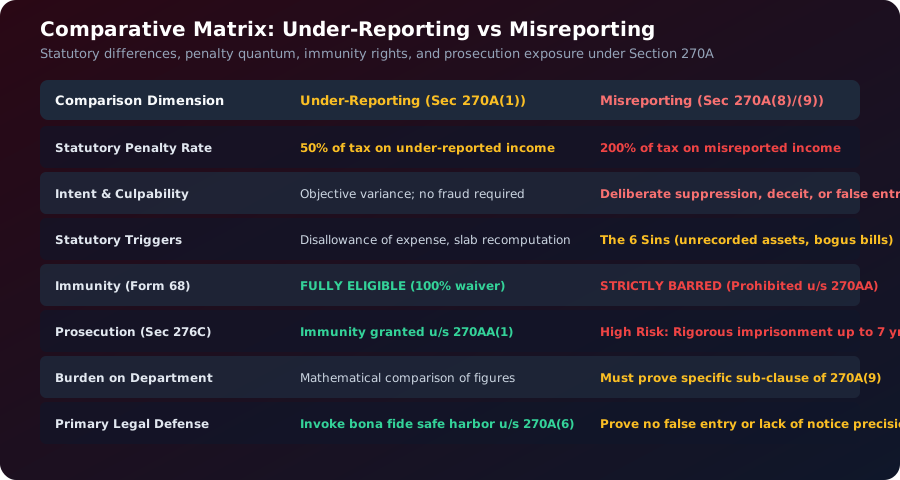
7. Under-Reporting vs Misreporting: Strategic Comparison Matrix
Understanding where a specific addition sits on the statutory spectrum is essential for formulating a defense strategy. The comparative analysis below contrasts the operational and legal distinctions:
| Parameter | Under-Reporting (Section 270A(1)) | Misreporting (Section 270A(8) & (9)) |
|---|---|---|
| Penalty Rate | 50% of tax payable on under-reported income. | 200% of tax payable on under-reported income. |
| Mental State (Mens Rea) | Strict liability; no proof of deliberate fraud or mens rea required. | Requires proof of willful deceit, fabrication, or deliberate suppression. |
| Statutory Scope | Residual and broad; covers any excess of assessed income over returned income. | Exhaustive and strictly confined to the six clauses of Section 270A(9). |
| Section 270AA Immunity | Fully Available via Form 68 within 30 days of month-end. | Statutorily Ineligible u/s 270AA(3). |
| Criminal Prosecution Risk | Negligible; administrative addition without criminal mens rea. | Severe; often triggers prosecution u/s 276C and 277. |
| Burden of Proof | Rests initially on the taxpayer to prove safe harbors u/s 270A(6). | Rests heavily on the Revenue to prove the specific ingredients of subsection (9). |
8. Practical Scenarios: Salaried Tech Worker vs Manufacturing Enterprise
Scenario A: Salaried Software Architect & Bogus 80G Donation Addition
The Incident: Vikram, a software architect earning ₹38 LPA, claimed a deduction of ₹2,00,000 under Section 80G for donations to an unrecognized political trust based on advice from an unregistered tax preparer. During faceless scrutiny under Section 144B, the Assessment Unit verified through the Insight Portal that the trust was a shell entity issuing bogus receipts in exchange for cash kickbacks. The AO disallowed the ₹2,00,000 deduction and initiated penalty proceedings under Section 270A for misreporting under Section 270A(9)(c) (claim of expenditure not substantiated by evidence).
The Legal Consequence: Because the deduction was substantiated by a fabricated receipt from an entry-providing trust, the addition qualifies as misreporting under Section 270A(9)(c). The penalty is levied at 200% of the tax payable on ₹2,00,000. At Vikram's 30% slab rate (+ 4% cess), the tax payable is ₹62,400. The 200% penalty amounts to ₹1,24,800, bringing the total fiscal payout to ₹1,87,200. Furthermore, because misreporting was invoked, Vikram cannot apply for immunity under Section 270AA.
Scenario B: Manufacturing Enterprise & Debatable Depreciation Claim
The Incident: Precision Auto Ltd. capitalized automated robotic welding equipment costing ₹1.5 Crores under the 40% depreciation block for pollution control and advanced machinery. The Assessing Officer held that the equipment falls under the general plant and machinery block eligible for only 15% depreciation, disallowing ₹37.5 Lakhs of excess depreciation claim. The AO added this to total income and initiated penalty proceedings under Section 270A.
The Strategic Defense: Precision Auto Ltd. filed a detailed reply demonstrating that: 1) Full technical specifications, manufacturer brochures, and purchase invoices were disclosed in the return and audit report; 2) The claim was based on expert opinion and judicial decisions supporting accelerated depreciation for robotic automation; 3) The explanation was completely bona fide and disclosed all material facts under Section 270A(6)(a).
The Legal Outcome: The CIT(Appeals) held that a difference of opinion on asset classification between two arguable rates does not constitute under-reporting when all material facts are honestly disclosed. The penalty proceedings under Section 270A were quashed in their entirety under the statutory safe harbor of Section 270A(6)(a).
9. Standard Operating Procedure (SOP) When Facing a Section 270A Show Cause Notice
Receiving an assessment order accompanied by a notice initiating penalty proceedings under Section 270A requires immediate, tactical evaluation. Follow this structured roadmap to protect your capital and legal standing:
Phase 1: Determine the Legal Classification (Days 1–7)
- Examine the operative part of the assessment order and the penalty show cause notice issued under Section 274 read with Section 270A.
- Verify whether the notice alleges under-reporting (50%) or misreporting (200%). If the notice vaguely mentions both without striking out the inapplicable clause, document this jurisdictional defect immediately.
- If the addition is an under-reporting addition, calculate whether the tax demand is worth litigating or whether paying and taking immunity under Section 270AA is the financially superior option.
Phase 2: The Fork in the Road: Litigate vs Settle (Days 8–20)
Route A: Opt for Form 68 Immunity (Recommended for routine disallowances):
- Pay the complete tax and interest demanded in the Section 156 notice within the 30-day window.
- Submit electronic Form No. 68 on the e-filing portal before the expiry of one month from the end of the month in which the assessment order was received.
- Attach the challan receipt and an undertaking that no appeal has been or will be filed under Section 246A.
- The AO is statutorily mandated under Section 270AA(4) to pass an order granting complete immunity within one month from the end of the month in which Form 68 was received.
Route B: Contest on Merits & Safe Harbors (For high-stakes or misreporting additions):
- File an appeal in Form No. 35 before the CIT(Appeals) within 30 days of receiving the assessment order.
- Submit a comprehensive written submission in response to the Section 270A notice invoking the relevant safe harbors under Section 270A(6).
- Request the Assessing Officer to keep penalty proceedings in abeyance under Section 275(1)(a) until the first appellate authority disposes of the quantum appeal.
10. Frequently Asked Questions (FAQ Schema)
Under Section 270A, under-reporting of income attracts a penalty equal to 50% of the tax payable on the under-reported income. It arises when assessed income exceeds processed or returned income due to additions or disallowances. Misreporting of income attracts a punitive penalty equal to 200% of the tax payable and is strictly restricted to the six specific mala fide acts defined under Section 270A(9), such as suppression of facts, false entries, or unrecorded investments.
Under Section 270A(9), misreporting occurs only if the under-reported income results from: 1) Misrepresentation or suppression of facts; 2) Failure to record investments in books of account; 3) Claim of expenditure not substantiated by any evidence; 4) Recording of false entries in books of account; 5) Failure to record any receipt in books of account having a bearing on total income; or 6) Failure to report any international transaction or deemed international transaction under Chapter X.
Section 270A(6) provides statutory safe harbors where under-reported income shall NOT include additions if: a) The taxpayer offers a bona fide explanation and discloses all material facts; b) The addition is based on an estimate where accounts were correct and complete but the method made direct determination impossible; c) An addition is made on estimate where the assessee estimated the amount themselves and disclosed all underlying basis; or d) Transfer pricing additions where documentation was maintained under Section 92D and disclosed in Form 3CEB.
Yes. Under Section 270AA, an assessee can apply in Form No. 68 to the Assessing Officer within one month from the end of the month in which the assessment order is received. To qualify, the assessee must pay the entire tax and statutory interest demanded under Section 156 within the specified 30-day period and must NOT file any appeal against the assessment order under Section 246A. Immunity is granted from Section 270A penalty and Section 276C/276CC criminal prosecution, provided the case does NOT involve misreporting under Section 270A(9).
No. Section 270AA(3) explicitly stipulates that the Assessing Officer shall not grant immunity if penalty proceedings have been initiated for misreporting of income under Section 270A(9). However, constitutional courts have held that the Assessing Officer cannot mechanically label an under-reporting addition as misreporting without establishing the specific ingredients of subsection (9); arbitrary reclassification can be challenged through an Article 226 writ petition.
Under Section 270A(10), tax payable on under-reported income is calculated by computing the tax on the total assessed income (including under-reported income) and subtracting the tax that would have been chargeable had the under-reported income been reduced from the assessed income. This marginal tax methodology ensures that under-reported income is taxed at the taxpayer's highest applicable slab rate plus applicable surcharge and 4% Health & Education Cess.