Faceless Assessment Scheme under Section 144B: Standard Operating Procedure, Legal Rights & Video Hearing Rules

Executive Summary: Navigating Faceless Tax Scrutiny
- Zero Physical Interface: Section 144B permanently eliminates physical interactions between assessees and Assessing Officers. All notices, submissions, evidence, and orders flow exclusively through the National Faceless Assessment Centre (NaFAC) portal.
- Team-Based Multi-Unit Framework: Assessments are decentralized across four independent units: Assessment Units (AU), Verification Units (VU), Technical Units (TU), and Review Units (RU), dynamically allocated across Indian cities via automated algorithms.
- Mandatory Show Cause Notice (SCN): Under Section 144B(1)(xii), the Assessment Unit cannot make any addition or variation prejudicial to the taxpayer without first serving a formal Show Cause Notice accompanied by a Draft Assessment Order (DAO).
- Statutory Right to Video Conference: If an adverse modification is proposed in an SCN, the taxpayer has a statutory right under Section 144B(6)(vii) to request an oral hearing through video conferencing. Denying this request invalidates the resulting assessment order.
- Mandatory Document Identification Number (DIN): Any order or notice issued without a verifiable DIN under CBDT Circular 19/2019 is non-est (legally non-existent).
1. Genesis of Section 144B: The Shift from Territorial to Dynamic Jurisdiction
For over seven decades, direct tax assessments in India operated on a territorial jurisdiction model. A taxpayer residing in Mumbai or operating a factory in Ahmedabad was assigned to a local Income Tax Officer (ITO) or Assistant Commissioner of Income Tax (ACIT) based on geographic pincodes and alphabetical surnames. This system suffered from endemic structural vulnerabilities: personal familiarity created opportunities for subjective discretionary power, harassment of honest assessees, opaque chamber hearings, and systemic delays.
To dismantle this archaic structure, the Prime Minister announced the "Transparent Taxation — Honoring the Honest" platform in August 2020. This administrative reform was codified into law through the enactment of Section 144B by the Taxation and Other Laws (Relaxation and Amendment of Certain Provisions) Act, 2020. Following widespread early litigation, Parliament comprehensively restructured Section 144B through the Finance Act, 2022 to provide an airtight, codified statutory framework.
Section 144B completely severed the territorial nexus between the taxpayer and the assessing officer. An individual living in Delhi might have their return audited by an Assessment Unit in Chennai, verified by a Verification Unit in Kolkata, technically evaluated by a Technical Unit in Mumbai, and peer-reviewed by a Review Unit in Bengaluru. Neither the taxpayer nor the officers know each other's identity, ensuring absolute institutional impartiality.
2. Institutional Architecture: NaFAC, AU, VU, TU & RU Multi-Unit Grid
The Faceless Assessment Scheme does not rely on an individual officer acting as an investigator, prosecutor, and judge. Instead, Section 144B(2) establishes a team-based, specialized division of labor composed of five distinct administrative organs:
1. National Faceless Assessment Centre (NaFAC)
Headquartered in New Delhi, NaFAC is the apex central command. It serves as the sole electronic interface between the taxpayer and the department. All notices, summonses, questionnaires, and assessment orders bear NaFAC's digital seal. NaFAC uses automated allocation algorithms to assign cases, route inquiries, and deliver communications.
2. Assessment Unit (AU)
The core adjudicating body. The AU examines the return of income, analyzes financial statements, formulates inquiries under Section 142(1), analyzes taxpayer responses, and prepares the initial Draft Assessment Order (DAO) determining total taxable income or loss.
3. Verification Unit (VU)
Responsible for factual field investigations. When an AU requires ground verification — such as verifying the existence of a vendor, inspecting physical factory premises, examining third-party books under Section 133(6), or recording witness statements under Section 131 — NaFAC assigns the task to a VU.
4. Technical Unit (TU)
Houses specialized domain experts. The TU provides formal technical opinions on complex Transfer Pricing (TP) benchmarking, Departmental Valuation Officer (DVO) real estate appraisals under Section 50C/56(2)(x), foreign law interpretations, and digital forensic analysis of confiscated electronic ledgers.
5. Review Unit (RU)
The internal quality audit wing. Before a Draft Assessment Order proposing substantial additions is finalized, NaFAC routes it to an RU located in a completely different city. The RU conducts a rigorous peer review to verify whether the proposed additions are supported by admissible evidence, mathematical accuracy, and binding judicial precedents from the High Court and Supreme Court.

Figure 1: Institutional workflow of the Faceless Assessment Scheme across NaFAC, AU, VU, TU, and Review Units.
3. The 10-Step Standard Operating Procedure (SOP) of a Faceless Assessment
Sub-section (1) of Section 144B lays down an exhaustive, sequential statutory procedure that every faceless assessment must rigorously adhere to:
- Selection & Notice Service (Clause i): Return selected under CASS. NaFAC serves notice under Section 143(2) specifying whether scrutiny is Limited or Complete.
- Taxpayer Response (Clause ii): The assessee files a response to the notice within the specified 15-day window through the e-filing portal.
- Assignment to Assessment Unit (Clause iii): NaFAC assigns the case to a specific Assessment Unit in an anonymous regional center through an automated allocation tool.
- Information Requests via Section 142(1) (Clause iv): The AU formulates detailed questions and requests books of accounts. NaFAC issues notice under Section 142(1) to the taxpayer.
- Request for Technical / Verification Support (Clause v): If needed, the AU requests NaFAC to obtain field verification from a VU or expert appraisal from a TU.
- Preparation of Draft Assessment Order (Clause vii): After considering the assessee's submissions, the AU prepares a Draft Assessment Order (DAO) accepting the return or proposing modifications.
- Risk Examination & Review Unit Referral (Clause ix): NaFAC subjects the DAO to automated risk algorithms. If flagged, it is routed to a Review Unit (RU) for peer review. The RU can either agree or suggest revisions.
- Mandatory Show Cause Notice if Addition Proposed (Clause xii): If the final DAO proposes any variation prejudicial to the assessee, NaFAC must serve a Show Cause Notice (SCN) with the draft order, giving the assessee an opportunity to respond.
- Assessee Response & Video Hearing (Clause xiv & vii): The assessee submits written objections and may request a personal hearing through video conferencing.
- Final Assessment Order (Clause xxii): The AU finalizes the order after considering the video hearing arguments and written objections. NaFAC signs the final order with a DIN and transmits it to the taxpayer along with a notice of demand under Section 156.
4. The Draft Assessment Order & Mandatory Show Cause Notice Requirement
One of the greatest safeguards introduced by Section 144B is the statutory prohibition against "surprise additions". In the pre-faceless era, taxpayers frequently submitted detailed explanations only to receive a final assessment order on March 31 with multi-crore additions that had never been discussed during hearings.
Under Section 144B(1)(xii), this practice is illegal. The statute states that where the Assessment Unit proposes to make any variation which is prejudicial to the assessee:
"…the National Faceless Assessment Centre shall serve a show-cause notice on the assessee, specifying the variations proposed to be made to the income of the assessee and the basis on which such variations are proposed, together with a draft order of assessment."
This statutory provision requires the department to share its complete reasoning, factual deductions, and legal calculations before passing a final order. If the tax department skips this step and issues a final order under Section 143(3) without serving a prior Show Cause Notice with the draft order, the assessment order is legally void and will be summarily set aside by appellate courts.
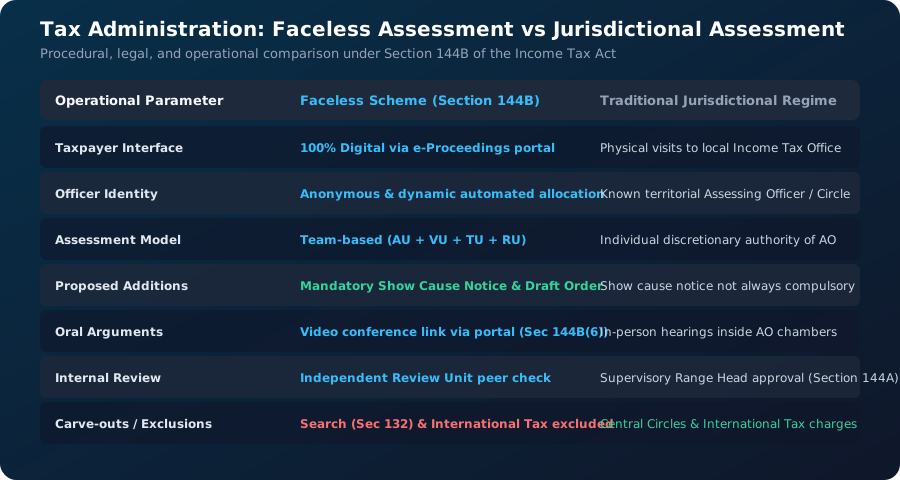
Figure 2: Comprehensive matrix comparing operational and legal parameters of Faceless Assessment vs Traditional Assessment.
5. Statutory Right to Video Conference Hearings: Section 144B(6)(vii) Jurisprudence
When the faceless scheme was first rolled out, tax officers routinely treated written PDF replies as sufficient compliance, rejecting taxpayer requests for oral hearings. This triggered an unprecedented wave of writ petitions before High Courts across the country.
To settle the controversy, Parliament amended Section 144B(6)(vii) and (viii). Under the current law:
Statutory Mandate: Section 144B(6)(vii)
Where a Show Cause Notice proposing an adverse modification has been served, the assessee or their authorized representative may request for a personal hearing so as to make oral submissions or present their case. Clause (viii) mandates that where such a request is received, the Principal Chief Commissioner or Director General of NaFAC shall allow the hearing through video conferencing or video telephony.
The legal force of this requirement has been upheld in dozens of authoritative judicial precedents:
- Delhi High Court in Bharat Aluminium Company Ltd. (BALCO) v. Union of India [2022] 442 ITR 386 (Del): The High Court held that the right to an oral hearing via video conference is not discretionary; it is a fundamental element of natural justice codified by Parliament. An assessment order passed in defiance of a video hearing request is an incurable nullity.
- Bombay High Court in Piramal Enterprises Ltd. v. Additional CIT [2021] 436 ITR 97 (Bom): The court set aside an assessment order where NaFAC failed to grant an oral hearing despite multiple written requests, declaring the order void ab initio.
- Calcutta High Court in Cheviot Company Ltd. v. CCIT [2022] 443 ITR 292 (Cal): Confirmed that even if written replies are comprehensive, the taxpayer cannot be deprived of the opportunity to orally explain accounting complexities before an adverse order is finalized.
6. Procedural Violations that Render an Assessment Order Void Ab Initio
Tax litigation practitioners must scrutinize the procedural trail of a faceless assessment. Because Section 144B is a strict code of procedure, any material deviation by NaFAC or the Assessment Unit invalidates the assessment. Key legal grounds for challenging faceless orders include:
| Procedural Defect by Tax Department | Governing Section / Circular | Legal Consequence & Judicial Remedy |
|---|---|---|
| Omission of Mandatory Show Cause Notice | Section 144B(1)(xii) | Order quashed by High Court under Article 226 for breach of statutory procedure. |
| Denial of Requested Video Conference Hearing | Section 144B(6)(vii) & (viii) | Flagrant natural justice violation; remanded back to SCN stage or quashed. |
| Missing Document Identification Number (DIN) | CBDT Circular 19/2019 | Order is deemed non-est (never existed in the eyes of law). |
| Passed by Territorial AO without Section 127 Transfer | Section 144B(1) read with Sec 120 | Total lack of jurisdiction; territorial officers have zero authority to pass scrutiny orders. |
| Expanding Limited Scrutiny without PCIT Approval | CBDT Instructions 20/2015 & 5/2016 | Additions made on unflagged issues declared ultra vires and deleted. |
7. Statutory Exclusions: What Cases Remain Outside the Faceless Scheme?
While over 95% of routine scrutiny assessments are conducted through the faceless mechanism, Section 144B(2) authorizes the Central Board of Direct Taxes (CBDT) to exclude specific classes of assessees or categories of cases requiring intensive physical investigation.
Under notifications issued by the CBDT, the following two broad categories are explicitly carved out from the Faceless Assessment Scheme:
- Central Charges (Search, Seizure & Surveys): Assessments initiated pursuant to search operations under Section 132, requisitions under Section 132A, or surveys under Section 133A are handled by specialized Central Circles headed by jurisdictional Additional Commissioners and Principal Commissioners. Because search assessments require handling seized physical cash, physical diaries, locker contents, and confidential forensic hard drives, these cases remain strictly non-faceless.
- International Taxation Charges: Assessments of non-resident individuals, foreign companies, cross-border digital economy taxation (equalization levy), and complex Transfer Pricing audits referred to Transfer Pricing Officers (TPOs) under Section 92CA are handled by dedicated International Taxation and Transfer Pricing Directorates.
8. Step-by-Step e-Proceedings Guide: Submissions, Adjournments & Evidence
Navigating an active faceless assessment requires adherence to precise digital protocols on the income tax e-filing portal (eportal.incometax.gov.in). Follow these verified steps:
- Monitoring e-Proceedings: Log in to your PAN account at least once a week during scrutiny season. Go to "Pending Actions" > "e-Proceedings". Ensure your primary email and mobile number are verified so automated SMS and email alerts are never missed.
- Viewing Active Notices: Click on the active proceeding. You will see notices listed in chronological order (Section 143(2), Section 142(1), Section 144B SCN). Download the notice PDF and verify the Document Identification Number (DIN).
- Seeking an Adjournment: If the 15-day notice deadline cannot be met due to unavoidable delays (e.g., awaiting bank audit reports, travel, illness), click on "Seek Adjournment". Choose a realistic extension date (usually 7 to 14 days) and upload an explanatory letter. Do not wait until the last day to request an adjournment!
- Drafting the Written Response: Compose a clean, numbered covering submission addressing every query in the Section 142(1) notice point-by-point. Include a summary index referencing attached exhibits.
- Uploading PDF Attachments: The portal enforces strict attachment constraints (maximum 5MB to 10MB per PDF file). Compress all PDF attachments, ensure scans are legible, and name each file clearly (e.g.,
Annexure-A-Bank-Statement-FY26-27.pdf). - Attending the Video Conference: If you requested a video hearing under Section 144B(6)(vii), NaFAC will generate an electronic hearing notice with a dedicated meeting link (typically Cisco Webex or Microsoft Teams) and time slot. Join promptly with your authorized Chartered Accountant or tax advocate, keep concise bullet-point notes ready, and ensure audio/video clarity.
Estimate Your Accurate Tax Liability with Confidence
Avoid computational discrepancies during scrutiny assessments by double-checking your calculations with our free, production-ready calculators:
9. Real-World Case Studies: Successful Defenses in Faceless Scrutiny
Case Study 1: Manufacturing Firm Facing Section 43B Disallowance Defended via Technical Unit
Background: Apex Precision Engineering had an active assessment under Section 144B. The AU in Bengaluru proposed to disallow ₹45,00,000 in employer EPF contributions under Section 43B, claiming the challans were paid after the due date under the EPF Act.
Defense Strategy & Outcome:
- Upon receiving the Section 144B Show Cause Notice with Draft Order, Apex's tax team distinguished between employee contributions (Section 36(1)(va)) and employer contributions (Section 43B).
- They cited Section 43B proviso, which explicitly allows deduction for employer contributions if paid on or before the due date of filing ITR under Section 139(1).
- They requested a video conference hearing and demonstrated the payment challans deposited in September prior to the October 31 audit ITR deadline.
- The Review Unit and AU concurred with the statutory position, completely dropping the ₹45 Lakh proposed addition in the final Section 143(3) order.
Case Study 2: Real Estate Investor Successfully Quashing Order for Video Hearing Denial
Background: Suresh received an SCN proposing an addition of ₹85,00,000 under Section 56(2)(x) for alleged stamp duty under-valuation on a commercial property purchase. He submitted written objections and specifically clicked the checkbox requesting a video hearing under Section 144B(6)(vii) to explain that the agreement value was fixed 3 years prior to registration (triggering the first proviso to Section 56(2)(x)).
Judicial Remedy:
- NaFAC failed to generate a video hearing link and passed the final assessment order confirming the ₹85 Lakh addition.
- Suresh immediately filed a writ petition under Article 226 before the High Court.
- The High Court relied on BALCO (Delhi HC) and Piramal Enterprises (Bombay HC), holding that denying an oral video hearing requested under Section 144B(6)(vii) is a fatal natural justice defect.
- The High Court quashed the assessment order and remanded the matter back to NaFAC with mandatory directions to convene a video hearing.
10. Frequently Asked Questions (Statutory Clarifications)
Q1: What is the role of NaFAC in the Faceless Assessment Scheme?
The National Faceless Assessment Centre (NaFAC), headquartered in New Delhi, serves as the central command and sole communication bridge between the Income Tax Department and the taxpayer under Section 144B. All notices, questionnaires, draft orders, show-cause notices, and final assessment orders are issued through NaFAC. The taxpayer has zero direct contact with the specific Assessment Unit (AU) or officers drafting the order, ensuring total anonymity and dynamic nationwide allocation.
Q2: Is it mandatory for the tax department to issue a Show Cause Notice before making additions under Section 144B?
Yes. Under Section 144B(1)(xii) of the Income Tax Act, where the Assessment Unit proposes to make any variation prejudicial to the assessee (such as adding income, disallowing deductions, or enhancing tax demand), NaFAC is legally mandated to issue a Show Cause Notice (SCN) accompanied by the Draft Assessment Order (DAO) stating the specific grounds for the proposed variation. Numerous High Courts have repeatedly held that passing an assessment order without issuing this mandatory SCN violates natural justice and renders the order void ab initio.
Q3: Can a taxpayer demand a personal hearing through video conference under Section 144B?
Yes. Under Section 144B(6)(vii) and Section 144B(6)(viii), where a Show Cause Notice proposing an adverse modification has been issued, the assessee (or their authorized representative) has a statutory right to request a personal hearing through video conferencing. The competent authority is legally obliged to facilitate this video hearing. Denying a timely request for a video conference hearing violates the principles of natural justice and provides immediate grounds for filing a writ petition before the High Court.
Q4: What are the four specialized units operating under Section 144B?
Section 144B(2) establishes four decentralized, specialized units to execute assessments: 1) Assessment Unit (AU) which examines returns, frames questions, and drafts assessment orders; 2) Verification Unit (VU) which conducts field inquiries, cross-checks third-party records, and examines witnesses; 3) Technical Unit (TU) which provides specialized expertise on Transfer Pricing, valuation of real estate, foreign law, and accounting standards; and 4) Review Unit (RU) which performs peer-review audits on draft orders to verify legal soundness.
Q5: What categories of tax assessments are excluded from the Faceless Assessment Scheme?
Under statutory notifications issued pursuant to Section 144B(2), the following assessments are explicitly excluded from the faceless regime and continue to be handled by territorial or specialized officers: 1) Search and seizure cases initiated under Section 132 or requisition cases under Section 132A (assigned to Central Circles); and 2) International taxation charges involving non-resident corporate entities, transfer pricing disputes handled by specialized TPO wings, and foreign tax treaty interpretations.
Q6: How does a taxpayer seek an extension of time (adjournment) during faceless assessment?
To request an adjournment, the taxpayer must log in to the e-filing portal (eportal.incometax.gov.in), navigate to 'Pending Actions' > 'e-Proceedings', select the relevant notice, click on 'Seek Adjournment', specify the reason for the extension (e.g., awaiting third-party bank statements, medical emergency, complex ledger reconciliation), and select the requested extension date (typically between 7 to 15 days). NaFAC's automated workflow evaluates the request and grants an updated deadline.