Section 143(1) Intimation vs Section 143(2) Scrutiny Notice: CASS Parameters, Prima Facie Adjustments & Compliance (FY 2026-27)

Executive Summary: Demystifying Income Tax Communications
- Section 143(1) is NOT a Scrutiny Notice: It is an automated summary processing intimation issued by CPC 2.0 Bengaluru. Every validly filed return generates an intimation under Section 143(1), reflecting either an accepted return, a refund determination, or a demand resulting from mathematical and reporting mismatches.
- Section 143(2) is a Statutory Scrutiny Notice: Issued when your return is algorithmically selected by Computer Aided Scrutiny Selection (CASS). It marks the commencement of formal, in-depth assessment proceedings conducted under the Faceless Assessment Scheme (Section 144B).
- Strict Limitation Clock: A Section 143(2) notice must be served within 3 months from the end of the financial year in which the return is furnished (by June 30 of the following year for returns filed within the financial year). A notice served beyond this deadline is legally void and incurable under Section 292BB.
- Proposed Adjustments under 143(1)(a): Before making adverse summary adjustments (such as disallowing PF contributions, rejecting late-filed losses, or adjusting mismatched income), CPC must provide a mandatory 30-day electronic opportunity to object.
- Mandatory DIN Verification: Under CBDT Circular 19/2019, any notice or intimation lacking a valid Document Identification Number (DIN) is null and void (non-est in the eyes of law).
1. The Core Legal Distinction: Summary Processing vs Detailed Scrutiny
In the Indian direct tax ecosystem, receiving an electronic communication from the Income Tax Department frequently induces acute anxiety among taxpayers. A significant portion of this panic stems from confusing a routine automated intimation with a punitive tax scrutiny notice. To navigate direct tax compliance effectively, every taxpayer and tax consultant must appreciate the categorical legal divide between an intimation generated under Section 143(1) and a notice issued under Section 143(2).
The legal character of Section 143(1) was definitively established by the Supreme Court of India in the landmark judgment of Assistant Commissioner of Income Tax v. Rajesh Jhaveri Stock Brokers Pvt. Ltd. [2008] 291 ITR 500 (SC). The apex court ruled that an intimation generated under Section 143(1) is merely an acknowledgment and summary processing statement; it does not constitute an "assessment" in the judicial sense. There is no assessment order passed, no hearing convened, and no quasi-judicial adjudication of contentious issues.
In stark contrast, a notice under Section 143(2) represents the formal invocation of the sovereign's investigatory powers. It vests the National Faceless Assessment Centre (NaFAC) and the Assessment Unit (AU) with statutory jurisdiction to examine books of accounts, interrogate third-party financial records, cross-examine counterparties, issue statutory questionnaires under Section 142(1), and ultimately pass a binding assessment order under Section 143(3).
2. Section 143(1) CPC Summary Processing & Prima Facie Adjustments
Upon the e-filing and electronic verification of an Income Tax Return (ITR), the file is ingested by the Centralized Processing Centre (CPC 2.0) located in Bengaluru. CPC does not assign human officers to read returns. Instead, automated processing software executes algorithms to compute the taxpayer's total income and tax liability after making specific, statutorily circumscribed adjustments.
Under Section 143(1)(a), CPC is legally empowered to make only the following six categories of prima facie adjustments:
- Arithmetical Errors: Straightforward computational mistakes, additions, subtractions, or incorrect percentage applications in the return itself.
- Incorrect Claims Apparent from the Return: Inconsistencies where information in one schedule directly contradicts an entry in another schedule, or where an exemption or deduction claimed exceeds statutory caps (e.g., claiming ₹2,00,000 under Section 80C when the statutory ceiling is ₹1,50,000).
- Disallowance of Carried-Forward Losses: Disallowance of carry-forward of business losses (Section 72), speculative losses (Section 73), or capital losses (Section 74) if the return of income for the year in which the loss occurred was furnished beyond the Section 139(1) statutory due date.
- Disallowance of Expenditure Indicated in Audit Report: Additions of expenditure disallowed by a Chartered Accountant in Form 3CD (Tax Audit Report) but erroneously deducted by the assessee in their ITR. Common triggers include:
- Unpaid statutory liabilities (GST, EPF, ESI) disallowed under Section 43B because payment was made after the ITR due date.
- Late employee contributions to EPF/ESIC disallowed under Section 36(1)(va) (Supreme Court ruling in Checkmate Services).
- Disallowances for non-deduction of TDS under Section 40(a)(ia).
- Disallowance of Profit-Linked Deductions for Late Filers: Disallowance of deductions claimed under Section 10AA or Chapter VI-A under the heading "C.—Deductions in respect of certain incomes" (Sections 80-IA, 80-IAB, 80-IB, 80-IC, 80-ID, 80-IE) if the return was filed after the Section 139(1) due date.
- Addition of Income Appearing in Form 26AS/AIS: Mismatches where income appearing in Form 26AS or the Annual Information Statement (AIS) was completely omitted from the ITR and no explanatory adjustment was provided.
Statutory Limitation for Section 143(1) Intimation
Under the second proviso to Section 143(1), no intimation shall be sent after the expiry of 9 months from the end of the financial year in which the return is furnished. For example, if you file your return on July 20, 2026 for AY 2027-28, the financial year in which the return was furnished is FY 2026-27 (ending March 31, 2027). The 9-month limitation period expires on December 31, 2027. If no intimation is dispatched by CPC before that date, the acknowledgment of the return is legally deemed to be the final intimation.

Figure 1: Statutory progression from return submission through Section 143(1) processing to Section 143(2) faceless scrutiny.
3. The 30-Day Window: Responding to Proposed Adjustments u/s 143(1)(a)
CPC 2.0 does not arbitrarily unilaterally reduce deductions or demand taxes without warning. The first proviso to Section 143(1)(a) establishes a mandatory principle of natural justice:
"Provided that no such adjustments shall be made unless an intimation is given to the assessee of such adjustments either in writing or in electronic mode, and the response received from the assessee, if any, is considered before making any adjustment."
When an algorithm detects an apparent variance, it generates an automated communication titled "Proposed Adjustment under Section 143(1)(a)" via email and SMS. The taxpayer is granted exactly 30 days from the date of issuance to respond on the portal.
During this critical 30-day window, the assessee has three procedural choices:
- Option A: Agree with the Adjustment: If the taxpayer acknowledges that an error occurred (e.g., duplicate deduction or forgotten interest income), they can select "Agree" on the portal. The system will process the return with the adjusted figures and calculate any resulting tax demand or reduced refund.
- Option B: Submit Written Disagreement with Proof: If the proposed adjustment is incorrect (e.g., CPC failed to read an annexure, or an employer entered an incorrect PAN in Form 16), the taxpayer selects "Disagree" and provides detailed text justifications along with supporting documents (reconciliation statements, challans, bank certificates).
- Option C: Furnish a Revised Return under Section 139(5): If the statutory deadline for revised returns has not passed (December 31 of the Assessment Year), the taxpayer can submit a revised return rectifying the discrepancy, which supersedes the earlier filing.
Critical Warning: If the taxpayer ignores the communication and fails to respond within 30 days, CPC's automated system executes the proposed adjustments by default, issues a final Section 143(1) intimation, and creates a formal tax demand under Section 156 with running interest under Section 220(2).
4. Section 143(2) Scrutiny Notices & CASS Risk Algorithms
Unlike Section 143(1) intimations, which are issued for virtually every e-filed return, a notice under Section 143(2) is issued to only a selective subset of taxpayers (historically between 0.25% and 0.5% of total filers).
Section 143(2) states that where a return has been furnished, if the Assessing Officer (or the automated system) considers it necessary or expedient to ensure that the assessee has not understated income, computed excessive loss, or underpaid tax in any manner, they shall serve on the assessee a notice requiring attendance or production of evidence.
In the modern era of tax administration, case selection is driven exclusively by CASS (Computer Aided Scrutiny Selection). CASS deploys machine learning and predictive data analytics across dozens of statutory data streams:
| CASS Risk Engine Stream | External Data Source Cross-Referenced | Typical Scrutiny Red Flags |
|---|---|---|
| Statement of Financial Transactions (SFT) | Banks, Registrar of Properties, Mutual Funds, Stock Exchanges | Cash deposits exceeding ₹10 Lakhs in savings account; property purchases over circle rate; unlisted equity sales. |
| GST vs ITR Revenue Discrepancies | GSTN Portal (GSTR-1, GSTR-3B, GSTR-9) | Turnover reported in ITR lower than gross taxable supplies reported in GST returns by > 5%. |
| Substantial Capital Gains Exemptions | Schedule CG & Sub-registrar registration deeds | Claims of multi-crore exemptions under Section 54, 54EC, or 54F without verifiable proof of construction or investment. |
| Unsecured Loans & Share Capital | Balance Sheet schedules & MCA portal filings | Introduction of substantial fresh unsecured loans or share premium from shell or loss-making entities (Section 68 risk). |
| High Ratio of Refunds vs Gross TDS | TRACES TDS database & salary schedules | Repeated claims of 90%+ TDS refunds supported by questionable donations (Section 80G) or fake rental receipts (HRA). |
5. Limited Scrutiny vs Complete Scrutiny: Jurisdictional Boundaries
When an assessee receives a notice under Section 143(2), the very first sentence of the notice text reveals its legal scope. The Central Board of Direct Taxes (CBDT) divides scrutiny cases into two distinct jurisdictional categories:
A. Limited Scrutiny Cases
In a Limited Scrutiny case, the notice explicitly enumerates the specific reasons for selection. For instance: "Issue 1: Large cash deposits in bank account; Issue 2: Deduction claimed under Section 54F."
CBDT has issued binding instructions (Instruction No. 20/2015 and Instruction No. 5/2016) governing Limited Scrutiny. Under these instructions, the Assessing Officer's jurisdiction is strictly confined to the flagged issues. The officer cannot embark on a fishing or roving inquiry, cannot demand books of accounts for unrelated matters, and cannot question routine business expenses.
If, during the inquiry, the officer discovers credible evidence of tax evasion exceeding ₹10 Lakhs (or ₹50 Lakhs in metro cities) on an unflagged issue, they cannot simply expand the scope on their own. They must submit a formal written proposal to the Principal Commissioner of Income Tax (PCIT). Only upon obtaining written administrative approval from the PCIT can the case be converted into Complete Scrutiny. Any addition made on an unflagged issue without PCIT conversion approval is jurisdictional ultra vires and liable to be quashed by appellate courts.
B. Complete Scrutiny Cases
In Complete Scrutiny, the notice states that the case has been selected for comprehensive assessment. Here, the Assessment Unit is legally empowered to examine every aspect of the return, including gross profit ratios, sundry creditors, depreciation schedules, valuation of closing stock, foreign assets reported in Schedule FA, and personal household withdrawals.
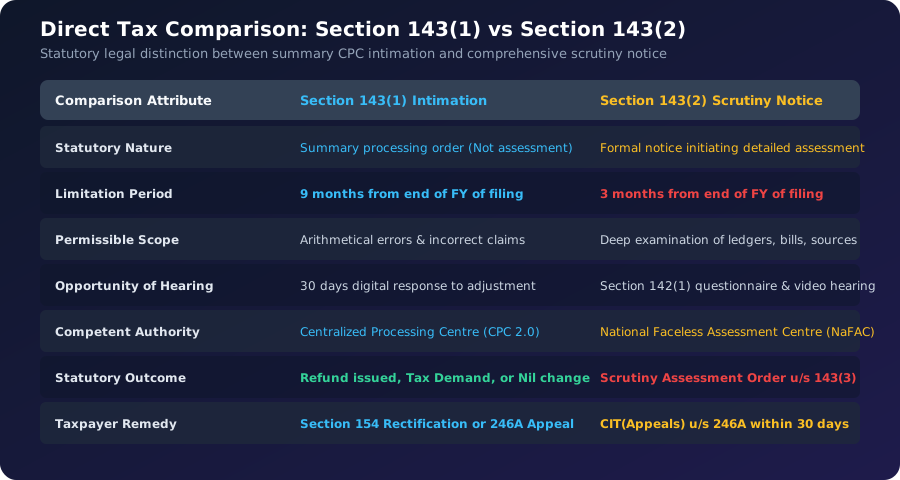
Figure 2: Direct statutory comparison between summary intimation and scrutiny notice under the Income Tax Act.
6. Statutory Limitation Periods & Jurisdictional Invalidation (Section 292BB)
Tax authorities do not possess indefinite time to initiate scrutiny. To provide finality to tax proceedings, Parliament enacted strict statutes of limitation under Section 143(2).
Under the proviso to Section 143(2), no notice shall be served on the assessee after the expiry of three months from the end of the financial year in which the return is furnished:
Mathematical Calculation of Limitation Deadline:
- Assessment Year: AY 2027-28 (Financial Year 2026-27).
- ITR Filing Date: July 28, 2026 (filed during FY 2026-27).
- End of Financial Year of Filing: March 31, 2027.
- Three Months from March 31, 2027: June 30, 2027.
Conclusion: The Section 143(2) notice must be served on or before June 30, 2027. If served on July 1, 2027, it is legally dead on arrival!
In the landmark constitutional bench ruling of Assistant Commissioner of Income Tax v. Hotel Blue Moon [2010] 321 ITR 362 (SC), the Supreme Court held that the service of a valid notice under Section 143(2) within the statutory limitation period is the foundation of jurisdiction. If this mandatory condition precedent is breached, the defect is not a mere procedural irregularity; it vitiates the entire assessment, rendering any subsequent order passed under Section 143(3) completely null and void.
The Section 292BB Trap: Taxpayers must be extremely cautious of Section 292BB. This deemed notice service provision states that if an assessee appears in any proceeding or cooperates in any inquiry without lodging an immediate formal protest regarding non-service or late service of notice, they are precluded from raising the objection before higher appellate authorities! Therefore, if a Section 143(2) notice is served beyond June 30, the taxpayer must submit an immediate written preliminary objection on the e-portal questioning jurisdiction before making any factual submissions.
7. Standard Operating Procedure (SOP) for e-Proceedings Compliance
All scrutiny assessments in India are executed under the Faceless Assessment Scheme (Section 144B) through the National Faceless Assessment Centre (NaFAC). There is zero physical interaction with local tax offices. Everything is handled digitally through your secure login on the income tax portal. Follow this structured SOP when managing scrutiny proceedings:
- Verify Document Identification Number (DIN): Open the notice PDF. Check that a valid 10-digit DIN appears on the top banner. Under CBDT Circular 19/2019, any communication issued without a DIN is invalid in law. Cross-verify the DIN on the portal's public verification page.
- Navigate to e-Proceedings Tab: Log in to
eportal.incometax.gov.in. Navigate to "Pending Actions" > "e-Proceedings". Locate the active proceeding under Section 143(2) and inspect the accompanying notice under Section 142(1) (which contains the specific factual questionnaire). - Prepare Indexed & Tabular Rebuttals: Never submit disorganized bundles of receipts. Structure your response into an executive covering submission accompanied by a numbered table. Cross-reference every query in the Section 142(1) questionnaire to an exact Annexure number.
- Format PDF Documentation Correctly: The portal enforces strict technical upload constraints (files must be PDF, max 5MB to 10MB per attachment, clear scanning at 200 DPI). Ensure bank account statements are highlighted with explanatory margin notes showing the specific sources of credited funds.
- Request Video Conference Hearing if Required: If the Faceless Assessment Unit issues a draft assessment order proposing an adverse addition, the assessee has a statutory right under Section 144B(6)(vii) to request an oral hearing via video conference to clarify complex business models or factual misinterpretations.
8. Appellate Remedies: Section 154 Rectification vs Section 246A Appeals
When an adverse order or intimation creates an unwarranted tax liability, taxpayers have two primary statutory avenues of redress:
A. Rectification Application under Section 154
Section 154 allows an income tax authority to amend any order or intimation to rectify any mistake apparent from the record. This is the fastest and most cost-effective remedy for routine Section 143(1) errors, such as:
- Failure of CPC to credit TDS or advance tax payments properly reflected in Form 26AS.
- Mathematical calculation errors in interest under Sections 234A, 234B, or 234C.
- Incorrect denial of standard deduction under Section 16(ia) or Section 87A rebate.
A Section 154 rectification request can be submitted directly online through the portal within 4 years from the end of the financial year in which the order was passed. CPC is statutorily mandated to dispose of the rectification within six months.
B. First Appeal before Commissioner (Appeals) under Section 246A
If the dispute involves a contested interpretation of law, disputed evidence, or a formal assessment order passed under Section 143(3), Section 154 cannot be used. The taxpayer must file an appeal in Form 35 before the Commissioner of Income Tax (Appeals) [CIT(A)] or the Joint Commissioner of Income Tax (Appeals) [JCIT(A)] under Section 246A.
The appeal must be submitted electronically within 30 days of the date of service of the assessment order and demand notice. Along with the appeal, the assessee typically files an application for stay of demand, seeking to deposit 20% of the disputed demand in terms of CBDT Office Memorandums while the appeal remains pending.
9. Practical Case Studies: Resolving 143(1) Demands & Scrutiny Inquiries
Case Study 1: Salaried Executive Hit by 143(1)(a) Disallowance of HRA
Situation: Rohit claimed ₹1,80,000 HRA exemption under Section 10(13A) in his ITR-1 under the Old Tax Regime. His employer had omitted HRA from Part B of Form 16 because Rohit submitted rent receipts late. CPC issued a proposed adjustment notice under Section 143(1)(a) stating that the exemption claimed was not reflected in Form 16, proposing to add ₹1,80,000 to his salary income and demanding ₹42,000 in tax.
Resolution Pathway:
- Rohit logged into the e-portal within the 30-day window and clicked "Disagree" on the proposed adjustment screen.
- Under the disagreement remarks, he cited judicial precedents confirming that employees can validly claim HRA in their ITR even if omitted from Form 16.
- He uploaded the registered rent agreement, rent payment bank statements, and landlord's PAN.
- CPC verified the documents, dropped the proposed adjustment, and issued a final Section 143(1) intimation accepting the return with zero demand.
Case Study 2: Property Seller Selected for CASS Limited Scrutiny u/s 143(2)
Situation: Ananya sold a residential apartment for ₹1.2 Crore and claimed full exemption under Section 54 by investing the capital gains in an under-construction apartment. CASS selected her return for "Limited Scrutiny" on the single issue: "Verification of deduction claimed under Section 54/54F".
Resolution Pathway:
- Ananya received a notice under Section 143(2) followed by a Section 142(1) questionnaire requesting purchase deeds, sale deeds, and bank transaction trails.
- She prepared a structured index showing: Sale deed of old asset (showing stamp duty value matches sale consideration u/s 50C), builder buyer agreement of new residential flat, construction milestone payment receipts, and bank statements confirming payment within statutory timelines.
- Because the inquiry was strictly confined to Limited Scrutiny, the Faceless Assessment Unit verified the Section 54 compliance and passed a "Nil Addition" assessment order under Section 143(3).
Accurately Verify Your Tax Slabs & Take-Home Salary
Discrepancies in CTC calculations and tax exemptions are the primary source of CPC adjustment notices. Check your numbers beforehand with our free tools:
10. Frequently Asked Questions (Statutory Clarifications)
Q1: Is an intimation received under Section 143(1) considered an assessment order?
No. The Hon'ble Supreme Court of India in the landmark ruling of Assistant Commissioner of Income Tax v. Rajesh Jhaveri Stock Brokers Pvt. Ltd. (2008) held that an intimation generated under Section 143(1) is merely a summary computer processing of the return of income and does not qualify as an 'assessment' in the true judicial sense. It involves no active adjudication or application of mind by an Assessing Officer, being confined purely to arithmetical corrections, internal inconsistencies, and automated cross-checks.
Q2: What is the statutory limitation period for serving a scrutiny notice under Section 143(2)?
Under the proviso to Section 143(2) of the Income Tax Act, 1961, a notice under Section 143(2) must be served on the assessee within three months from the end of the financial year in which the return of income is furnished. For example, if an assessee files their ITR on July 25, 2026 (during Financial Year 2026-27), the financial year ends on March 31, 2027. Three months from that date expires on June 30, 2027. Any Section 143(2) notice served on or after July 1, 2027 is barred by limitation and void ab initio.
Q3: What should a taxpayer do if CPC issues a proposed adjustment notice under Section 143(1)(a)?
When CPC 2.0 identifies a prima facie mismatch (such as disallowance of Section 80C, mismatch between Form 16 and ITR, or loss carry-forward disallowance), it issues an automated communication granting the taxpayer 30 days to respond. The taxpayer must log in to the e-filing portal, navigate to 'Pending Actions' > 'Response to Outstanding Demand / Worklist', and either accept the adjustment, submit a detailed written disagreement with supporting evidence, or furnish a revised return under Section 139(5) within the 30-day window.
Q4: What is the difference between Limited Scrutiny and Complete Scrutiny under CASS?
Under the Computer Aided Scrutiny Selection (CASS) framework, 'Limited Scrutiny' is initiated to verify one or two specific, predefined parameters flagged by automated algorithms (such as high cash deposits, large capital gain deductions under Section 54, or substantial foreign remittances). The Assessing Officer is strictly barred from examining unrelated issues without obtaining prior written approval from the Principal Commissioner of Income Tax (PCIT). In contrast, 'Complete Scrutiny' authorizes a comprehensive examination of the assessee's entire books of accounts, balance sheets, bank transactions, and revenue computations.
Q5: Can an Assessing Officer issue a Section 143(2) scrutiny notice if no return of income was filed?
No. A notice under Section 143(2) can legally be issued only where a return of income has been furnished under Section 139 or in response to a notice under Section 142(1). If an assessee has completely failed to furnish a return of income, the tax department cannot issue a notice under Section 143(2). Instead, the department must proceed under Section 144 (Best Judgment Assessment) or issue a reassessment notice under Section 148 / 148A.
Q6: How does a taxpayer verify the legal authenticity of an income tax notice?
Under CBDT Circular No. 19/2019, any notice, summons, letter, or order issued by the Income Tax Department without a computer-generated Document Identification Number (DIN) is non-est (invalid and legally void). Taxpayers can verify the authenticity of any communication by visiting the Income Tax Department's official portal (eportal.incometax.gov.in) under the 'Authenticate Notice / Order Issued by ITD' utility and entering the 10-digit alphanumeric DIN.