Section 144 Best Judgment Assessment: Ex-Parte Orders, Statutory Conditions & Legal Remedies (FY 2026-27)

Executive Summary: Surviving an Ex-Parte Tax Assessment
- Invoked Strictly on Four Statutory Defaults: Section 144 can be triggered only if an assessee fails to file an ITR u/s 139, fails to respond to a Section 142(1) inquiry, defaults on a Section 142(2A) special audit, or skips a Section 143(2) scrutiny hearing.
- Mandatory Show Cause Notice: Under the first proviso to Section 144(1), the officer must serve a Show Cause Notice proposing the basis of the best judgment before completing an ex-parte order. Omitting this notice vitiates the entire assessment.
- The Supreme Court Velukutty Doctrine: Best judgment assessment cannot be wild guesswork, capricious, vindictive, or punitive. It must be an honest, rational estimate based on tangible evidence on record.
- Confiscatory 78% Tax under Section 115BBE: Ex-parte orders frequently treat unverified bank deposits as unexplained credits under Sections 68-69A, taxing them at a flat 78% effective rate with zero deductions and zero threshold exemptions.
- Actionable Appellate Remedies: Taxpayers can appeal before the CIT(Appeals) under Section 246A, submit fresh evidence under Rule 46A by showing reasonable cause, seek a stay of demand, or file a writ petition under Article 226 before the High Court.
1. Statutory Foundation: The Four Default Triggers under Section 144(1)
In the Indian direct tax administration, a Best Judgment Assessment under Section 144 represents the sovereign's ultimate remedy when an assessee exhibits persistent non-cooperation or complete administrative default. An assessment completed under Section 144 is commonly referred to in legal parlance as an ex-parte assessment.
However, an Assessing Officer does not possess unfettered discretion to invoke Section 144 arbitrarily. The opening words of Section 144(1) establish that the power to make an assessment to the best of their judgment can be exercised only if the assessee commits one or more of the following four specific statutory defaults:
Default 1: Non-Filing of Return (Clause a)
The person fails to make the return required under sub-section (1) of Section 139, and has not made a belated return under sub-section (4) or a revised return under sub-section (5) of that section.
Default 2: Failure to Comply with Section 142(1) Notice (Clause b)
The person fails to comply with all the terms of a statutory inquiry notice issued under Section 142(1) (which may call for a return of income, production of accounts, balance sheets, or written information).
Default 3: Failure in Special Audit under Section 142(2A) (Clause c)
The person fails to comply with a direction issued under Section 142(2A) requiring them to get their accounts audited by a nominated Chartered Accountant and furnish the audit report within the prescribed timeline.
Default 4: Failure to Comply with Section 143(2) Scrutiny Notice (Clause d)
Having furnished a return of income, the person fails to comply with all the terms of a statutory scrutiny notice issued under Section 143(2) requiring attendance or production of supporting evidence.
If none of these four defaults has occurred, an Assessing Officer has zero statutory authority to invoke Section 144. An ex-parte order passed in the absence of an established statutory default is void ab initio.
2. The Mandatory Show Cause Notice Proviso & Natural Justice
Even when an assessee commits one of the four statutory defaults, the law does not permit the tax officer to proceed immediately to an ex-parte order in secrecy. Parliament codified an indispensable natural justice requirement under the first proviso to Section 144(1):
"Provided that such assessment shall be made after giving the assessee an opportunity of being heard, by serving a notice calling upon him to show cause, on a date and at a time to be specified in the notice, why the assessment should not be completed to the best of his judgment."
The Narrow Statutory Carve-Out: The second proviso to Section 144(1) states that such a show cause notice shall not be required where a notice under Section 142(1) was already issued prior to the making of an assessment under this section.
However, under the Faceless Assessment Scheme (Section 144B), the issuance of a Show Cause Notice proposing variations prejudicial to the assessee is mandatory across all cases under Section 144B(1)(xii). High Courts across the country have repeatedly held that completing an ex-parte best judgment assessment under Section 144 read with Section 144B without serving a specific Show Cause Notice with draft order is a fatal procedural violation that automatically quashes the assessment.

Figure 1: Statutory lifecycle of Section 144 Best Judgment Assessments and multi-channel appellate defense pathways.
3. The Judicial Standard of "Best Judgment": The Velukutty & Badridas Doctrine
What does the phrase "best judgment" actually mean in tax law? Does it empower an assessing officer to pull random revenue figures out of thin air to penalize an uncooperative taxpayer?
The legal doctrine governing Section 144 was laid down in two of the most celebrated decisions in Indian tax jurisprudence:
A. The Privy Council in CIT v. Laxminarayan Badridas [1937] 5 ITR 170 (PC)
The Judicial Committee of the Privy Council held that the officer exercising power under Section 144:
"…must not act dishonestly, or vindictively or capriciously because he must exercise judgment to the best of his ability. He must make what he honestly believes to be a fair estimate of the proper figure of assessment, and for this purpose he must take into consideration local knowledge and repute in regard to the assessee's circumstances, and other matters which he thinks will assist him in arriving at a fair and proper estimate."
B. The Supreme Court in State of Kerala v. C. Velukutty [1966] 60 ITR 239 (SC)
The Constitution Bench of the Supreme Court of India elevated this principle to an absolute constitutional standard:
The Velukutty Fair Estimate Rule
"The limits of the power are implicit in the expression 'best of his judgment'. Judgment is a faculty to decide matter with wisdom truly and legally. Judgment does not depend upon the arbitrary caprice of a judge, but on settled and invariable principles of justice. Though there is an element of guess-work in a 'best judgment' assessment, it shall not be a wild one, but shall have a reasonable nexus to the available material and the circumstances of each case."
Therefore, an Assessing Officer cannot simply take total bank credits and arbitrarily add 100% of it as net profit, nor can they arbitrarily adopt a 30% profit margin when industry standards under Section 44AD dictate 6% to 8%. Any estimate lacking rational nexus to evidence is liable to be set aside on appeal.
4. Punitive Consequences: 78% Tax under Section 115BBE & Disallowances
When an assessment lands in Section 144, the resulting tax demand is frequently devastating. Because the taxpayer failed to produce books and vouchers, the Assessing Officer operates under severe adverse legal presumptions:
- Disallowance of All Unverified Expenditures: Legitimate purchases, salary payments, contractor charges, and utility bills are routinely disallowed under Section 37(1) for want of documentary verification.
- Disallowance of Cost of Acquisition in Capital Gains: If a taxpayer sold property or shares and failed to respond to notices, the officer frequently computes capital gains by adopting the entire gross consideration as taxable gain, treating cost of acquisition as zero!
- Confiscatory 78% Taxation under Section 115BBE: The most catastrophic danger in a Section 144 order is the routine invocation of Sections 68 (unexplained cash credits), 69 (unexplained investments), or 69A (unexplained money). When bank statements reveal deposits that remain unexplained due to non-appearance, the entire credit is taxed under Section 115BBE:
- Base Tax Rate: 60%
- Surcharge under Section 115BBE: 25% of tax (15% of income)
- Health & Education Cess: 4% of tax and surcharge
- Effective Statutory Tax Rate: 77.84% (rounded to 78%)!
- Mandatory Penalty under Section 271AAC: Additional 6% of tax payable!
- Zero Deductions / Zero Threshold: Section 115BBE(2) explicitly prohibits basic exemption thresholds, Chapter VI-A deductions, or loss set-offs against such income.
- Penalty for Misreporting under Section 270A: Non-attendance is treated as willful suppression of facts, attracting a maximum 200% penalty on the tax payable.
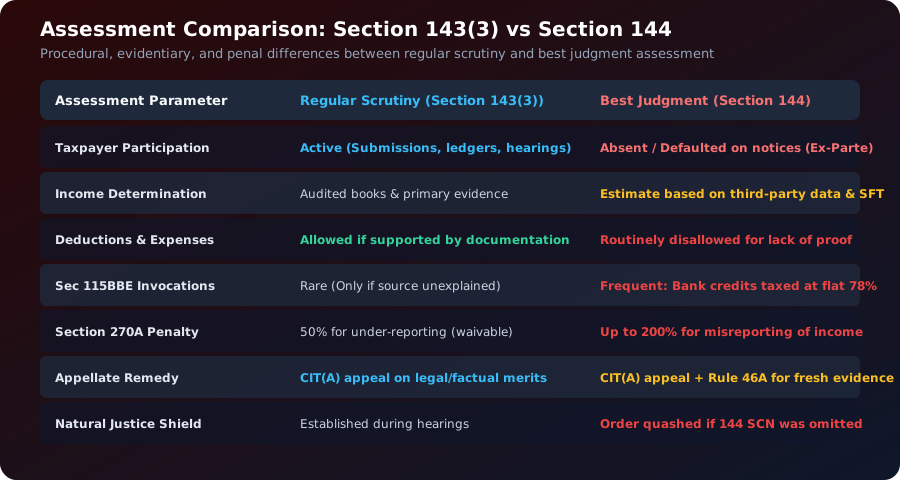
Figure 2: Procedural and penal differences between regular scrutiny under Section 143(3) and Best Judgment under Section 144.
5. First Appeal under Section 246A & Introducing Fresh Evidence under Rule 46A
The primary statutory remedy against an adverse Section 144 order is filing an electronic appeal in Form 35 before the Commissioner of Income Tax (Appeals) [CIT(A)] or Joint Commissioner (Appeals) under Section 246A within 30 days of receiving the demand notice.
In an appeal against a Section 144 assessment, the taxpayer must fight on two fronts:
- Challenging the Validity of Ex-Parte Proceedings: Proving that the Assessing Officer failed to establish one of the four statutory defaults, omitted the mandatory Show Cause Notice, or failed to properly serve notices (e.g., notices delivered to an outdated email address or inactive mobile number).
- Challenging the Quantum of Additions on Merits: Proving that the additions are arbitrary, violate the *Velukutty* fair estimate doctrine, or represent tax-paid capital transactions.
Introducing Fresh Evidence under Rule 46A
Normally, an appellate authority examines only the evidence that was produced before the Assessing Officer. However, in an ex-parte assessment, the taxpayer defaulted on producing evidence. How can you now submit your audited books, bank statements, and purchase bills?
The taxpayer must file a formal application under Rule 46A(1) of the Income Tax Rules, 1962, demonstrating that they fall under one of the four statutory exceptions:
- The Assessing Officer refused to admit evidence which ought to have been admitted (Clause a); or
- The appellant was prevented by sufficient cause from producing the evidence called for by the Assessing Officer (Clause b); or
- The appellant was prevented by sufficient cause from producing before the Assessing Officer any evidence which is relevant to any ground of appeal (Clause c); or
- The Assessing Officer made the assessment order without giving sufficient opportunity to the appellant to adduce evidence (Clause d).
Once the CIT(A) admits the additional evidence under Rule 46A, they forward the documents to the Assessing Officer for a formal Remand Report under Rule 46A(3). The taxpayer can then rebut the remand report, paving the way for the deletion of unwarranted additions.
6. Staying Demand Recovery: Navigating the 20% Pre-Deposit Rule
Filing an appeal before the CIT(Appeals) does not automatically stay the recovery of the tax demand. Under Section 220(1), the taxpayer must pay the demanded sum within 30 days of receiving the Section 156 notice of demand. If unpaid, the Tax Recovery Officer (TRO) can freeze the assessee's bank accounts under Section 226(3).
Under CBDT Office Memorandums (Instruction No. 1914 as amended by OM dated July 31, 2017), the Assessing Officer shall grant a stay of demand pending first appeal upon payment of a lump sum of 20% of the disputed demand.
Can the 20% Pre-Deposit be Waived or Reduced?
Yes! In the landmark ruling of Valvoline Cummins Ltd. v. DCIT [2008] 307 ITR 103 (Del) and confirmed in subsequent High Court decisions, the courts held that the 20% guideline is not an absolute, mechanical rule. The Principal Commissioner has inherent discretion to grant a stay on a lower deposit (e.g., 5% or 10%) or grant an absolute zero-deposit stay if:
- The assessment order is patently arbitrary, unreasonable, or high-pitched on its face;
- The addition made by the AO is contrary to binding judgments of the High Court or Supreme Court; or
- The demand is so massive that paying 20% would cause irreparable financial ruin, leading to insolvency or closure of ongoing business operations.
7. Administrative Revision under Section 264: When to Choose Over Appeal
In cases where an assessee missed the 30-day appeal deadline before the CIT(Appeals), or where the default was purely due to an innocent administrative oversight, Section 264 (Revision of Orders by Principal Commissioner) offers an alternative legal remedy.
Under Section 264, the Principal Commissioner of Income Tax (PCIT) possesses plenary powers to call for the record of any proceeding and pass an order prejudicial to the revenue, granting relief to the assessee.
Critical Caveat: The Doctrine of Merger
Under Section 264(4), the PCIT cannot revise an order if an appeal against that order is pending before the CIT(Appeals), or if the order has been made the subject of an appeal to the Appellate Tribunal. Therefore, Section 264 is mutually exclusive with Section 246A. You can invoke Section 264 only if you explicitly waive or surrender your right to appeal before the CIT(Appeals).
8. Invoking Article 226 Writ Jurisdiction against Illegal Ex-Parte Orders
While tax statutes generally require exhausting alternative remedies before approaching constitutional courts, the Supreme Court in Whirlpool Corporation v. Registrar of Trade Marks (1998) established three universal exceptions where a Writ Petition under Article 226 of the Constitution of India is directly maintainable before the High Court:
- Where the assessment order was passed in gross violation of the principles of natural justice;
- Where the order or notice is issued completely without statutory jurisdiction; or
- Where the fundamental constitutional rights of the petitioner have been infringed.
In modern faceless assessments under Section 144 read with Section 144B, High Courts routinely entertain writ petitions and quash Section 144 orders where:
- The department served notices on an old or deactivated email ID while ignoring the updated address on the PAN portal;
- The assessee submitted a formal adjournment request due to medical reasons, but NaFAC ignored the request and passed an ex-parte order on the same day; or
- The department failed to issue the mandatory Show Cause Notice under Section 144B(1)(xii) before finalizing adverse additions.
9. Practical Case Studies: Reversing Multi-Lakh Ex-Parte Tax Demands
Case Study 1: Freelance Software Engineer Hit by 78% Tax on Bank Inflows
Situation: Gaurav, an independent software developer, received ₹32 Lakhs in foreign client remittances into his savings account. He failed to check his registered tax portal email for eight months due to international travel. The AU passed an ex-parte Section 144 order treating the entire ₹32 Lakhs as unexplained cash credits under Section 68, levying 78% tax under Section 115BBE and creating a demand of ₹28,40,000!
Appellate Resolution Pathway:
- Gaurav filed an appeal before the CIT(Appeals) under Section 246A along with a condonation application explaining overseas travel.
- He filed an application under Rule 46A presenting client invoices, Foreign Inward Remittance Certificates (FIRC), and banking trails.
- He established that the receipts were professional freelance earnings eligible for 50% presumptive taxation under Section 44ADA, not unexplained cash credits under Section 68.
- The CIT(A) admitted the evidence under Rule 46A, directed assessment under Section 44ADA on taxable income of ₹16 Lakhs, and deleted the confiscatory Section 115BBE additions entirely.
Case Study 2: Trader Quashing Ex-Parte Order via High Court Writ for SCN Omission
Situation: M/s Radhe Trading defaulted on a Section 143(2) notice due to an accountant's sudden demise. The Faceless Assessment Unit immediately finalized a Section 144 ex-parte order estimating net profit at 25% of turnover without issuing a prior Show Cause Notice with draft order.
High Court Outcome:
- Radhe Trading filed a Writ Petition under Article 226 before the High Court.
- The High Court held that under Section 144(1) first proviso and Section 144B(1)(xii), issuing a Show Cause Notice proposing the basis of best judgment is a mandatory statutory condition precedent.
- The High Court quashed the assessment order and demand notice, remanding the matter back to NaFAC with directions to issue an SCN and allow 15 days to file complete audited ledgers.
Audit Your Tax Liabilities with Free Scientific Calculators
Ensure complete precision in your financial planning, salary structuring, and advance tax estimations with our suite of free calculators:
10. Frequently Asked Questions (Statutory Clarifications)
Q1: What are the four statutory defaults that trigger a Section 144 Best Judgment Assessment?
Under Section 144(1) of the Income Tax Act, 1961, the Assessing Officer is empowered to make a Best Judgment Assessment if the taxpayer commits any of the following four statutory defaults: 1) Failure to make a return of income under Section 139(1) and failure to file a belated return u/s 139(4) or revised return u/s 139(5); 2) Failure to comply with all terms of an inquiry notice issued under Section 142(1); 3) Failure to comply with a statutory direction issued under Section 142(2A) for a Special Audit by a nominated accountant; or 4) Failure to comply with all terms of a scrutiny notice issued under Section 143(2).
Q2: Is the tax department legally required to give a hearing opportunity before passing a Section 144 order?
Yes. Under the first proviso to Section 144(1), the Assessing Officer must give the assessee an opportunity of being heard by serving a notice to show cause why the assessment should not be completed to the best of their judgment. An exception applies only where a notice under Section 142(1) was already issued and remained uncomplied with. Courts have consistently held that passing an ex-parte Section 144 order without issuing this mandatory show cause notice violates natural justice and renders the order void.
Q3: What is the legal standard for a 'fair estimate' under Section 144 established by the Supreme Court?
In the landmark rulings of State of Kerala v. C. Velukutty (1966) and CIT v. Laxminarayan Badridas (1937), the Supreme Court and Privy Council held that while a Best Judgment Assessment inherently involves an element of guesswork, it must be an honest, rational guesswork based on some tangible material on record. The estimate cannot be wild, arbitrary, capricious, or vindictive, nor can it be used as a weapon to punish the taxpayer for procedural default.
Q4: Why are bank credit additions in a Section 144 order taxed at a punitive 78% rate?
In ex-parte Section 144 assessments, Assessing Officers routinely treat unverified bank deposits as unexplained cash credits or unexplained money under Sections 68, 69, or 69A. Such income is subject to special penal taxation under Section 115BBE: flat 60% base tax + 25% surcharge (15% on total income) + 4% cess, resulting in an effective tax rate of 77.84% (rounded to 78%). Furthermore, Section 115BBE strictly prohibits any basic exemption limit, deductions under Chapter VI-A, or set-off of current or past losses against this income.
Q5: Can a taxpayer introduce fresh evidence before the CIT(Appeals) against a Section 144 order?
Yes. Under Rule 46A(1) of the Income Tax Rules, 1962, a taxpayer appealing against an ex-parte Section 144 order can produce fresh documents, ledgers, and bank statements before the Commissioner (Appeals), provided they demonstrate that they were prevented by sufficient cause (such as medical hospitalization, natural disaster, or non-service of electronic notices due to technical glitches) from producing the evidence before the Assessing Officer.
Q6: What immediate step should a taxpayer take to prevent bank attachment after receiving a Section 144 order?
The taxpayer must immediately file an electronic appeal in Form 35 before the Commissioner (Appeals) under Section 246A within 30 days of receiving the demand notice. Simultaneously, the taxpayer must file a Stay of Demand application before the Assessing Officer and Principal Commissioner, demonstrating extreme financial hardship or patent arbitrariness in the assessment, requesting waiver or reduction of the standard 20% pre-deposit requirement in terms of CBDT guidelines.