Section 131 Summons & Section 133(6) Information Requests: Powers, Scope & Legal Defenses (FY 2026-27)

Executive Summary: Navigating Summons & Inquiries
- Section 131 Summons Vests Civil Court Powers: Income tax authorities possess the exact coercive powers of a Civil Court under the Code of Civil Procedure, 1908 (CPC), including enforcing physical attendance, examining witnesses on oath, and impounding books of accounts.
- 15-Day Book Impounding Ceiling: Under Section 131(3), an Assessing Officer cannot retain impounded books of accounts or documents for more than 15 days without obtaining prior written approval from the Principal Chief Commissioner or Commissioner.
- Section 133(6) Inquiries without Pending Proceedings: The department can requisition transaction records from banks, registrars, suppliers, or taxpayers even when no assessment is actively pending, provided prior administrative approval of the Director or Commissioner is obtained.
- Severe Non-Compliance Penalties: Disregarding a Section 131 summons attracts a flat penalty of ₹10,000 per default under Section 272A(1)(c). Failing to reply to Section 133(6) incurs a continuing penalty of ₹500 per day under Section 272A(2)(c).
- Constitutional & Judicial Safeguards: Statements extracted under threat or sleep deprivation can be validly retracted. Taxpayers have an unconditional right to cross-examine third parties whose statements are used against them.
1. The Coercive Spectrum: Routine Questionnaires vs Formal Investigative Summons
During the course of tax administration, an assessee or third-party entity may receive various forms of statutory communications. A fundamental error committed by taxpayers and corporate accounts teams is treating all income tax letters with the same casual approach. Under the Income Tax Act, 1961, statutory inquiries fall into a distinct hierarchy of coercive authority.
At the baseline level sits Section 142(1), which is a routine assessment questionnaire issued to an assessee whose return is currently under examination. While failure to comply with Section 142(1) can lead to an ex-parte Best Judgment Assessment under Section 144, it does not involve the exercise of judicial civil court powers.
In contrast, Section 131 and Section 133(6) represent the sharp investigatory teeth of the sovereign. Section 131 transforms the tax officer into a presiding judge of a Civil Court, armed with the power to compel personal attendance, record binding depositions under oath, and seize books of accounts. Section 133(6) serves as the department's institutional dragnet, compelling banks, registrars, stock depositories, and business counterparties to furnish granular financial intelligence.
2. Section 131: Civil Court Powers of Discovery, Production & Oath Examination
Section 131(1) of the Income Tax Act explicitly decrees that the Assessing Officer, Deputy Commissioner (Appeals), Joint Commissioner, Commissioner (Appeals), and Principal Chief Commissioner shall have the same powers as are vested in a Civil Court under the Code of Civil Procedure, 1908 (CPC) when trying a suit, in respect of the following matters:
- Discovery and Inspection (Order XI of CPC): The power to compel any person to disclose documents in their possession or answer written interrogatories under oath.
- Enforcing the Attendance of Any Person (Order XVI of CPC): The authority to issue a formal summons commanding any individual — including directors, accountants, bank managers, vendors, or family members — to appear physically before the officer and examine them on oath.
- Compelling Production of Books of Account (Order XIII of CPC): Ordering the physical production of general ledgers, cash books, digital hard drives, sales registers, and minute books.
- Issuing Commissions (Order XXVI of CPC): Appointing an advocate or department officer as a commissioner to examine witnesses who are medically unfit to travel or to inspect property located in other jurisdictions.
Deemed Judicial Proceeding: Under Section 136 of the Income Tax Act, any proceeding under Section 131 is legally deemed to be a judicial proceeding within the meaning of Sections 193 and 228 of the Indian Penal Code (IPC) / Sections 229 and 267 of the Bharatiya Nyaya Sanhita (BNS). Giving false evidence or fabricating documents in response to a Section 131 summons is a non-compoundable criminal offense punishable with imprisonment up to seven years!

Figure 1: Statutory progression from Section 133(6) data gathering to Section 131 civil court summons.
3. Section 131(1A): Special Powers of the Investigation Directorate
A classic jurisdictional defense frequently raised by taxpayers under Section 131(1) is that an Assessing Officer cannot issue a summons unless a formal assessment proceeding (such as a pending scrutiny under Section 143(3) or reassessment under Section 148) is actively pending on their file.
To empower the intelligence gathering apparatus, Parliament inserted Section 131(1A). This sub-section vests extraordinary powers in officers of the Investigation Directorate (Principal Director General, Director General, Principal Director, Additional Director, Joint Director, Deputy Director, or Assistant Director of Income Tax):
"…if the Principal Director General or Director General or Principal Director or Director or Joint Director or Assistant Director or Deputy Director… has reason to suspect that any income has been concealed, or is likely to be concealed, by any person or class of persons within his jurisdiction, then, for the purposes of making any inquiry or investigation relating thereto, it shall be competent for him to exercise the powers conferred under sub-section (1), notwithstanding that no proceedings with respect to such person or class of persons are pending before him or any other income-tax authority."
Under Section 131(1A), the Investigation Wing does not require a pending assessment to issue a summons. If the wing has a "reason to suspect" that income has been concealed (e.g., intelligence on suspicious hawala transactions, offshore crypto trades, or cash property purchases), they can issue a binding summons compelling attendance and evidence production.
4. Section 131(3) Book Impounding: The Strict 15-Day Statutory Limitation
One of the most drastic powers available under Section 131 is the power to impound and retain books of account and other documents produced before the tax officer under Section 131(3).
However, to prevent assessing officers from paralyzing a taxpayer's ongoing business operations by holding ledgers indefinitely, the legislature enacted an absolute statutory safeguard under the proviso to Section 131(3):
The Mandatory 15-Day Impounding Rule: Section 131(3) Proviso
An Assessing Officer or Assistant Commissioner shall not impound any books of account or other documents without recording their reasons for doing so. Furthermore, they shall not retain in their custody any such books or documents for a period exceeding fifteen days (exclusive of holidays) without obtaining the prior approval of the Principal Chief Commissioner or Chief Commissioner or Principal Director General or Director General or Principal Commissioner or Commissioner.
Judicial Consequence: In Kanodia Knits (Delhi High Court), the court held that retaining impounded books beyond 15 days without recording prior reasons and without obtaining written sanction from the Chief Commissioner is completely illegal. The department is legally bound to return the impounded records immediately upon the expiry of the 15th day.
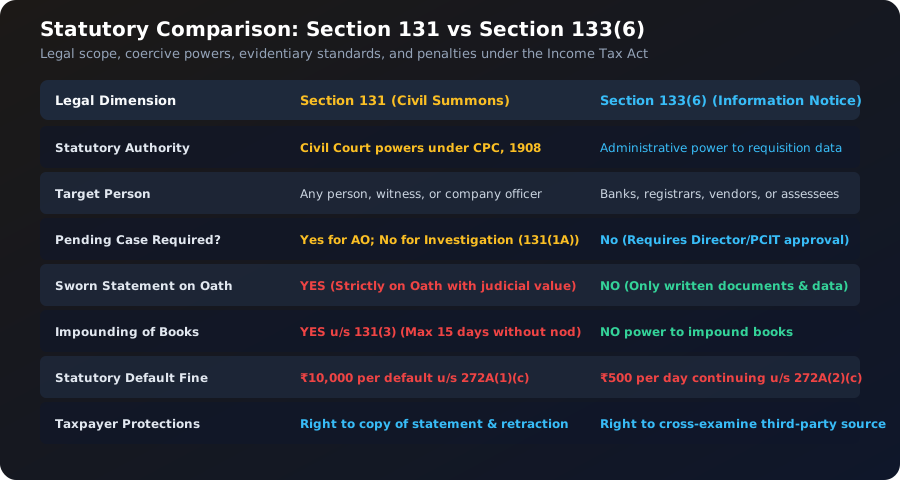
Figure 2: Statutory comparison between Section 131 Civil Summons and Section 133(6) Information Notices.
5. Section 133(6): Calling for Information When No Proceeding is Pending
While Section 131 is used primarily to summon persons and record sworn oral testimony, Section 133(6) is the workhorse of document and data collection. Under Section 133(6), the tax authority may require any person (whether an assessee or not):
"…to furnish information in relation to such points or matters, or to furnish statements of accounts and affairs verified in the manner specified by the Assessing Officer, Deputy Commissioner (Appeals), Joint Commissioner or the Commissioner (Appeals), giving information in relation to such points or matters as, in the opinion of the officer, will be useful for, or relevant to, any proceeding under this Act."
Can Section 133(6) be Issued When NO Proceeding is Pending? Prior to 1995, the Supreme Court in DB Sen held that Section 133(6) could be invoked only if a proceeding was actively pending against the target assessee. In response, Parliament amended the statute by inserting the words: "inquiry or" and adding the second proviso to Section 133(6).
Under the currently amended second proviso to Section 133(6), the power to call for information can be exercised even if no proceeding is pending. However, there is a crucial statutory check: an officer below the rank of Principal Director or Principal Commissioner cannot issue a notice where no proceeding is pending without obtaining the prior approval of the Principal Director or Director, or the Principal Commissioner or Commissioner. Any notice issued to a third party without such prior approval is ultra vires.
6. Statutory Penalties for Non-Compliance: Section 272A(1)(c) vs 272A(2)(c)
Ignoring an investigative notice or summons is extraordinarily dangerous. The Income Tax Act prescribes severe monetary penalties and criminal sanctions for non-attendance and non-furnishing of records:
| Statutory Default | Applicable Penalty Section | Quantum of Monetary Fine |
|---|---|---|
| Refusal to answer questions or sign statements on oath | Section 272A(1)(a) & (b) | Flat ₹10,000 for each default |
| Failure to attend or produce books in response to Section 131 summons | Section 272A(1)(c) | Flat ₹10,000 for each default |
| Failure to furnish information or statements under Section 133(6) | Section 272A(2)(c) | ₹500 for EVERY DAY of continuing failure |
| Intentional non-appearance or absconding from summons | Section 174 of IPC / Section 229 of BNS | Imprisonment up to 1 month and/or fine |
Notice of Section 273B Defense: Under Section 273B, no penalty shall be imposable under Section 272A if the assessee proves that there was reasonable cause for the failure. Genuine medical hospitalization, natural calamities, non-receipt of notice due to postal error, or death in the immediate family constitute established reasonable cause.
7. Evidentiary Weight of Sworn Statements & The Legal Doctrine of Retraction
During investigative inquiries under Section 131, taxpayers are frequently subjected to intense psychological pressure, overnight interrogations, and aggressive questioning by tax authorities. In moments of extreme fatigue, taxpayers occasionally make unverified confessional statements admitting to "undisclosed income" or agreeing to surrender deductions.
Is such an admission irreversible? Absolutely not.
In the historic ruling of Pullangode Rubber Produce Co. Ltd. v. State of Kerala [1973] 91 ITR 18 (SC), the Supreme Court established that:
"An admission is an extremely important piece of evidence, but it cannot be said that it is conclusive. It is open to the person who made the admission to show that it is incorrect or that it was made under a mistaken impression of facts or law."
Furthermore, the Central Board of Direct Taxes (CBDT) issued mandatory instructions — Instruction F.No. 286/2/2003-IT (Inv.) dated March 10, 2003 — explicitly directing tax officers to refrain from obtaining confessions of undisclosed income under coercion during search, survey, or summons proceedings. The CBDT reiterated that additions must be founded on tangible, corroborative financial evidence, not mere oral admissions.
How to Validly Retract a Statement: If a confessional statement was extracted under duress, the taxpayer must file a formal written retraction promptly (preferably within 24 to 72 hours). The retraction must be accompanied by an affidavit explaining the coercive circumstances, medical records (if sleep-deprived or ill), and rigorous documentary reconciliation proving that the admitted income is factually non-existent. Delayed retractions without documentary backing are routinely rejected by courts as afterthoughts.
8. The Constitutional Right to Cross-Examination (Kishinchand Chellaram Doctrine)
A common tactic deployed in accommodation entry and bogus purchase assessments is relying on statements recorded under Section 131 from third-party entry operators, dummy directors, or vendors who confess to providing accommodation bills.
Can the tax officer use such a statement against you without letting you question the witness?
The Supreme Court of India in Kishinchand Chellaram v. CIT [1980] 125 ITR 713 (SC) and Andaman Timber Industries v. Commissioner of Central Excise [2015] 281 CTR 241 (SC) established the bedrock principle of natural justice:
The Andaman Timber Doctrine
Not allowing the assessee to cross-examine witnesses whose statements are made the sole basis of an adverse addition is a serious flaw which makes the order a nullity. The opportunity to cross-examine is not an empty formality; it is a fundamental right. If the Assessing Officer denies cross-examination of the third party upon formal request, the third party's statement is rendered inadmissible, and the resulting tax addition must be quashed!
9. Real-World Case Studies: Resolving Summons & Third-Party Inquiries
Case Study 1: Managing Director Summoned u/s 131 on Unsecured Loans
Situation: The Investigation Wing issued a Section 131 summons to the Managing Director of an infrastructure firm, demanding physical appearance within 48 hours to explain ₹2.5 Crores in unsecured corporate loans received during the financial year.
Compliance & Resolution Pathway:
- The MD's counsel submitted an interim letter seeking a 7-day adjournment supported by board meeting commitments, thereby avoiding the Section 272A(1)(c) penalty.
- Before attending, the finance team compiled a comprehensive three-pillar file proving identity, creditworthiness, and genuineness under Section 68: PAN cards of lenders, audited balance sheets showing net worth > loan amount, bank statements showing banking channel fund transfers, and confirmation certificates.
- During the personal appearance, the MD gave clear, concise answers strictly based on the audited files and requested a signed copy of the recorded deposition on the spot.
- The Investigation Wing verified the documentation and closed the inquiry without issuing any adverse referral.
Case Study 2: Retailer Hit by Section 133(6) Notice on Vendor Payments
Situation: An electronics retail chain received a Section 133(6) notice from a Faceless Verification Unit requiring complete ledger accounts, transport bilty receipts, and bank payment trails for ₹1.8 Crores of inventory purchased from a specific distributor whose return was under scrutiny.
Resolution Pathway:
- The retailer verified the DIN on the portal to confirm authenticity.
- Within the 10-day notice window, they uploaded: GST invoices matching GSTR-2B, e-way bills generated during transport, stock register entries showing physical receipt into warehouse, and bank statements showing RTGS payments.
- By complying promptly, the retailer avoided the ₹500/day penalty under Section 272A(2)(c) and shielded themselves from being dragged into a third-party scrutiny.
Verify Your Financial Calculations with Confidence
Avoid discrepancies in your tax filings and salary declarations using our suite of 100% free client-side financial tools:
10. Frequently Asked Questions (Statutory Clarifications)
Q1: What Civil Court powers are vested in tax authorities under Section 131?
Under Section 131(1) of the Income Tax Act, 1961, income tax authorities (Assessing Officers, Joint Commissioners, CITs, and Investigation Directorate officials) are vested with the exact powers of a Civil Court trying a suit under the Code of Civil Procedure, 1908 (CPC). These powers include: 1) Discovery and inspection of documents; 2) Enforcing the physical attendance of any person, including bank officers, and examining them on oath; 3) Compelling the production of books of account and documents; and 4) Issuing commissions for local examination or witness depositions.
Q2: Can an Assessing Officer impound books of accounts indefinitely under Section 131(3)?
No. Under the proviso to Section 131(3), an Assessing Officer or Assistant Commissioner cannot impound and retain in their custody any books of account or other documents for a period exceeding 15 days without obtaining the prior written approval of the Principal Chief Commissioner, Chief Commissioner, Principal Director General, Director General, or Principal Commissioner. Retaining books beyond 15 days without recording reasons and securing higher administrative sanction is illegal.
Q3: Can the Income Tax Department issue a Section 133(6) notice if no assessment is pending?
Yes. Following legislative amendments to Section 133(6), the department can call for information or statements from any person (including banks, financial institutions, counterparties, or taxpayers) even when no assessment proceeding is actively pending against that person. However, under the second proviso to Section 133(6), if no proceeding is pending, an officer below the rank of Principal Director or Principal Commissioner must obtain the prior approval of the Director or Commissioner before issuing such a notice.
Q4: What are the penalties for failing to comply with a Section 131 summons or Section 133(6) notice?
Under Section 272A(1)(c), failure to attend in person, sign statements, or produce books of account in response to a summons under Section 131(1) attracts a flat penalty of ₹10,000 for each default. Under Section 272A(2)(c), failure to furnish information or statements called for under Section 133(6) attracts a continuing penalty of ₹500 for every day during which the failure continues.
Q5: Can a taxpayer retract an admission or confessional statement recorded under oath during a Section 131 summons?
Yes. While a statement recorded on oath under Section 131 carries strong evidentiary value in judicial proceedings (Section 136), the Supreme Court in Pullangode Rubber Produce Co. v. State of Kerala (1973) held that an admission is not conclusive and can be retracted if the assessee demonstrates that it was made under coercion, mental exhaustion, factual error, or duress. The retraction must be filed promptly through a sworn affidavit supported by documentary and financial evidence.
Q6: Does a taxpayer have the right to cross-examine third parties whose statements are used by the tax officer?
Yes. The Hon'ble Supreme Court of India in the landmark rulings of Kishinchand Chellaram v. CIT (1980) and Andaman Timber Industries v. CCE (2015) established that relying on third-party depositions or statements without granting the assessee an opportunity to cross-examine those witnesses is a fatal violation of natural justice. Any tax addition made on the basis of untested third-party statements is legally invalid and liable to be quashed.