CBDT Compounding Guidelines under Section 279(2): Tax Offences Settlement, Fee Formulas & Legal Immunity
The definitive direct tax guide to compounding criminal offences under Section 279(2) of the Income Tax Act for AY 2027-28. Dissect Category A vs Category B classification, master mathematical compounding fee calculations, navigate timeline condonations, and execute complete criminal court acquittals under Section 320 CrPC.
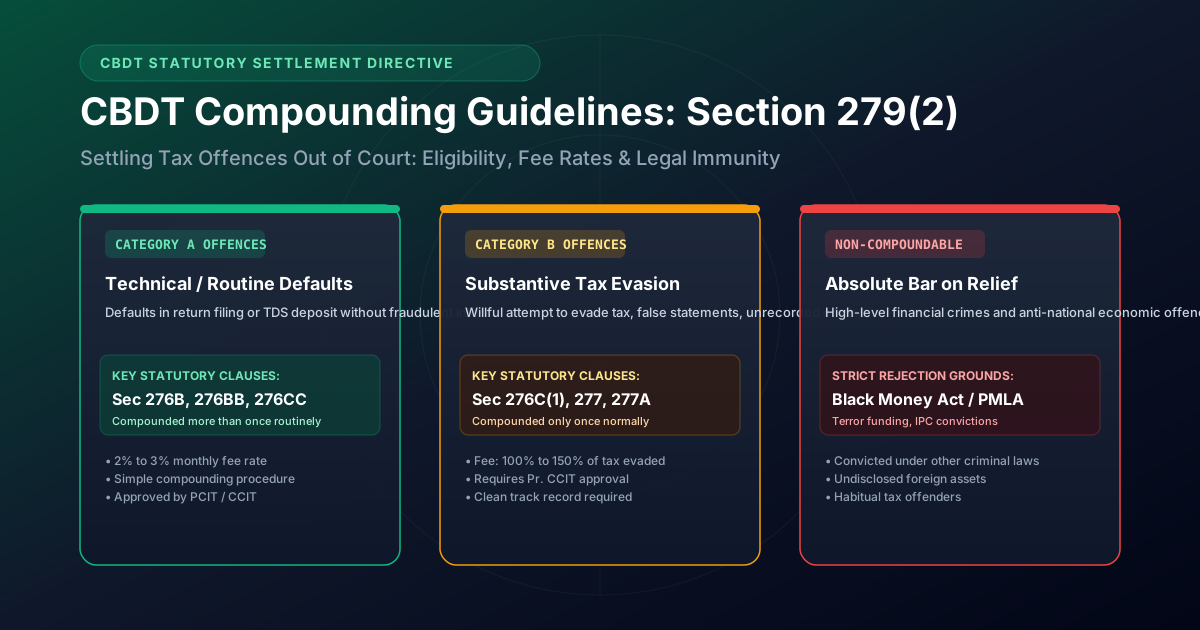
Table of Contents
- 1. Statutory Foundation of Compounding: Section 279(2) of the Income Tax Act
- 2. The Categorization Framework: Category A vs Category B Offences
- 3. Non-Compoundable Offences: The Absolute Exclusion List
- 4. Mathematical Fee Computation Formulas Across Common Offences
- 5. Ancillary Levies: Prosecution Establishment Charges & Litigation Expenses
- 6. The Step-by-Step Compounding Application Workflow
- 7. Statutory Timelines & Condonation of Delay by CBDT Authorities
- 8. Legal Effect of Compounding: Complete Acquittal under Section 320 CrPC
- 9. Live Case Simulation: Compounding a ₹20 Lakh TDS Default (Section 276B)
- 10. Standard Operating Procedure (SOP) for Filing a Compounding Petition
- 11. Frequently Asked Questions (FAQ Schema)
1. Statutory Foundation of Compounding: Section 279(2) of the Income Tax Act
While the Income Tax Act, 1961, empowers the Revenue to prosecute tax evaders with rigorous imprisonment up to seven years under Chapter XXII, Parliament recognized that the primary objective of direct tax administration is revenue collection rather than the mass incarceration of commercial taxpayers. To strike a pragmatic equilibrium between deterrence and dispute resolution, Parliament enacted Section 279(2):
Section 279(2) Statutory Mandate:
"Any offence under this Chapter may, either before or after the institution of proceedings, be compounded by the Principal Chief Commissioner or a Chief Commissioner or a Principal Director General or a Director General."
Compounding is a legally recognized compromise between the sovereign and the assessee. In exchange for the payment of outstanding taxes, statutory interest, administrative penalties, and prescribed compounding charges, the state agrees to drop criminal charges. Crucially, compounding is not an inherent constitutional right of the taxpayer; it is an administrative power exercised in accordance with standardized policy directives issued by the Central Board of Direct Taxes (CBDT) under Section 119.
2. The Categorization Framework: Category A vs Category B Offences
To eliminate arbitrary discretion and ensure uniform administration across all regional directorates, the CBDT issued exhaustive Compounding Guidelines that classify all compoundable direct tax offences into two distinct tiers:
Category A Offences: Technical & Operational Defaults
Category A covers procedural omissions, delay in statutory reporting, and withholding tax defaults where there is no primary intent to evade tax:
- Section 276B: Failure to pay to the credit of the Central Government tax deducted at source (TDS).
- Section 276BB: Failure to pay tax collected at source (TCS).
- Section 276CC: Failure to furnish return of income within statutory deadlines.
- Section 276DD / 276E: Legacy cash loan acceptance/repayment defaults.
Frequency Rule: Category A offences can be compounded multiple times across different assessment years, provided all financial dues are cleared.
Category B Offences: Substantive Tax Evasion
Category B covers deliberate, fraudulent acts aimed at fabricating accounts or evading assessment:
- Section 276C(1): Willful attempt in any manner to evade tax, penalty, or interest.
- Section 276C(2): Willful evasion of payment of tax demand.
- Section 277: False statement or false verification in any ITR or account.
- Section 277A: Falsification of books of account by advisors/facilitators.
- Section 278: Abetment of false return filing.
Frequency Rule: Category B offences are considered grave and are generally permitted to be compounded only once in a taxpayer's lifetime, requiring high-level approval from a Collegium of Chief Commissioners.
3. Non-Compoundable Offences: The Absolute Exclusion List
The CBDT Guidelines delineate specific red lines where compounding is strictly prohibited. The competent authority has zero discretion to entertain an application if the case involves any of the following statutory disqualifications:
Absolute Grounds of Rejection
- Offences under the Black Money Act, 2015: Any undisclosed foreign income, undeclared overseas bank accounts, or foreign immovable assets prosecuted under the Black Money (Undisclosed Foreign Income and Assets) and Imposition of Tax Act, 2015.
- Benami Property Transactions: Any case where prosecution is connected to the Prohibition of Benami Property Transactions Act, 1988.
- PMLA Prosecutions: Offences linked to ongoing money laundering investigations or charges framed under the Prevention of Money Laundering Act (PMLA), 2002.
- Crimes Against National Security: Any offence having a bearing on national security, narcotics trafficking, corruption under the Prevention of Corruption Act, or terrorist financing.
- Prior Court Conviction: Any assessee who has already been convicted by a court of competent jurisdiction under the Income Tax Act or any other economic criminal statute.
- Habitual Category B Evaders: An assessee who has already had a Category B offence compounded in a previous proceeding, unless exceptional mitigating circumstances are established before the CBDT Chairman.
4. Mathematical Fee Computation Formulas Across Common Offences
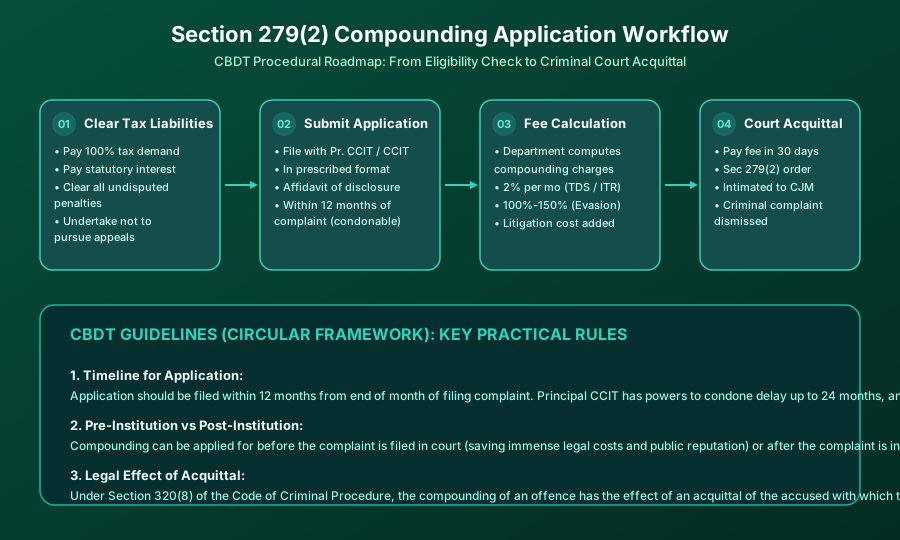
The CBDT Guidelines establish standardized mathematical formulas to compute the compounding fee for each specific statutory violation:
| Offence & Section | Prescribed Fee Formula | Computational Nuance & Multipliers |
|---|---|---|
| Failure to Pay TDS (Section 276B) | 2% per month (or part) of unpaid TDS for first 3 months; 3% per month for subsequent delay. | Calculated from the date tax was deductible/deducted till the actual date of deposit to the credit of the Government. |
| Failure to File ITR (Section 276CC) | 2% to 3% per month of the tax determined on assessed income, reduced by advance tax and TDS. | Calculated from the statutory due date under Section 139(1) till the date of filing return or completion of assessment. |
| Willful Tax Evasion (Section 276C(1)) | 100% of the tax sought to be evaded (1st application); 150% for any subsequent application. | Flat percentage calculated on the core tax evaded; in search/seizure cases, rates can reach 150%. |
| Evasion of Tax Payment (Section 276C(2)) | 3% per month (or part) of the unpaid tax liability during the period of default. | Calculated from the expiry of 30 days of Section 156 notice until the date of full payment of demand. |
| False Statement in Verification (Section 277) | Composite charge; covered under Section 276C(1) compounding fee. | If charged standalone without 276C, fee is calculated at 100% of the tax attributable to false entries. |
5. Ancillary Levies: Prosecution Establishment Charges & Litigation Expenses
Many applicants incorrectly budget only for the primary compounding fee. The CBDT Guidelines mandate that a complete compounding settlement requires the simultaneous payment of two additional statutory overheads:
1. Prosecution Establishment Charges
A mandatory surcharge equal to 10% of the gross compounding fee is levied to cover the department's internal administrative overheads. This charge is subject to a statutory minimum of ₹25,000 and a statutory ceiling of ₹50,00,000.
2. Departmental Litigation Expenses
If the criminal complaint has already been instituted in the Court of the Chief Judicial Magistrate, the applicant must reimburse the entire legal fee paid by the Income Tax Department to its Special Public Prosecutors and Standing Counsels, as certified by the jurisdictional PCIT.
6. The Step-by-Step Compounding Application Workflow
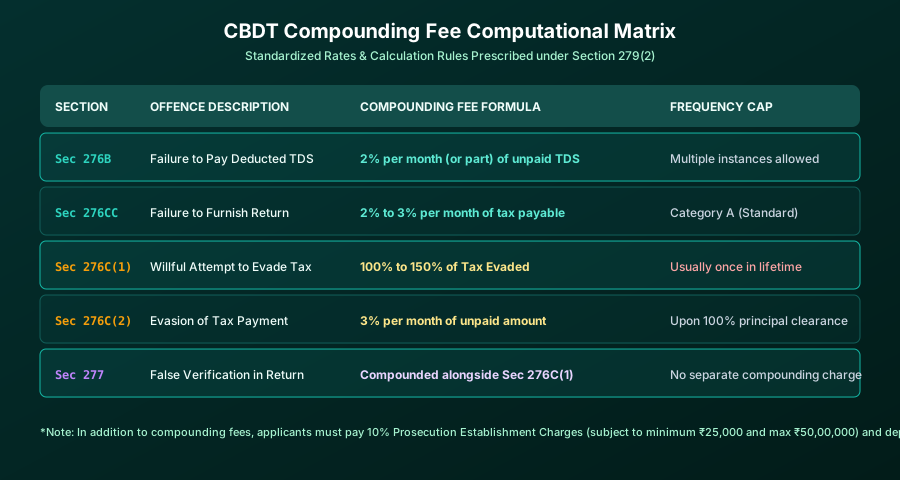
Executing a successful compounding settlement involves disciplined coordination between the assessee, the tax authorities, and the criminal court:
The 5 Core Procedural Milestones:
- Stage 1: Pre-requisite Financial Rectification: Before filing the application, the applicant must pay 100% of the outstanding tax demand, statutory interest under Section 220(2), and all undisputed administrative penalties.
- Stage 2: Formal Application Submission: The application must be submitted in the standardized CBDT format to the jurisdictional Principal Chief Commissioner / Chief Commissioner (CCIT). It must include an affidavit verifying that all material facts are disclosed, accompanied by proof of tax payments and withdrawal of pending appeals.
- Stage 3: Verification & Committee Scrutiny: The application is forwarded to the Assessing Officer and Verification Unit for factual verification. For Category B offences or cases involving tax evasion exceeding ₹1 Crore, a regional Collegium comprising three senior Chief Commissioners reviews the application.
- Stage 4: Intimation of Compounding Charges: Once approved in principle, the competent authority issues a formal letter intimating the exact compounding fee, establishment charges, and litigation costs. The applicant is granted 30 calendar days to deposit the entire amount.
- Stage 5: Final Order & Court Discharge: Upon verification of challan deposits, the competent authority passes a formal order under Section 279(2). A certified copy is submitted by the Special Public Prosecutor to the CJM Court, whereupon the Magistrate drops the proceedings and discharges the accused.
7. Statutory Timelines & Condonation of Delay by CBDT Authorities
Under the revised CBDT Guidelines, an application for compounding must ordinarily be submitted within 12 months from the end of the month in which the criminal complaint was filed in court. However, recognizing that trial proceedings often drag on for years before the realization of settlement occurs, extensive condonation powers are provided:
- Delay up to 24 Months: The jurisdictional Principal Chief Commissioner or Chief Commissioner has statutory authority to condone delays up to 24 months upon being satisfied that genuine hardship or reasonable cause existed.
- Delay Beyond 24 Months: Where the application is filed after 24 months, the application can only be entertained with the prior written concurrence of the Chairman, Central Board of Direct Taxes (CBDT). Recent circulars have liberalized this power, encouraging one-time settlement windows to clear clogged economic court dockets across India.
8. Legal Effect of Compounding: Complete Acquittal under Section 320 CrPC
The single most powerful advantage of Section 279(2) compounding is its profound criminal law impact. Under Section 320(8) of the Code of Criminal Procedure, 1973 (and corresponding provisions of the Bharatiya Nagarik Suraksha Sanhita):
Statutory Effect of Acquittal:
"The compounding of an offence under this section shall have the effect of an acquittal of the accused with whom the offence has been compounded."
This means the legal effect of a Section 279(2) order is NOT a conditional discharge, pardon, or probation; it is an absolute acquittal. The criminal complaint is permanently dismissed. The individual maintains a clean police verification record, suffers no disqualification under Section 164 of the Companies Act, 2013 from holding corporate directorships, and faces zero passport or immigration travel impediments.
9. Live Case Simulation: Compounding a ₹20 Lakh TDS Default (Section 276B)
Let us examine a real-world scenario involving Apex Infra Solutions Pvt. Ltd., which deducted ₹20,00,000 of contractor TDS under Section 194C during FY 2024-25 but failed to deposit it into the Central Government account due to cash-flow shortages. The department initiated prosecution under Section 276B in the CJM Court. The company subsequently cleared the ₹20 Lakh TDS principal with Section 201(1A) interest after a delay of 10 months and applied for compounding under Section 279(2):
| Cost Component | Statutory Formula / Rate | Payable Amount (INR) |
|---|---|---|
| Unpaid TDS Principal (Pre-paid) | Core statutory deduction | ₹20,00,000 (Already Deposited) |
| Section 201(1A) Interest (Pre-paid) | 1.5% per month for 10 months | ₹3,00,000 (Already Deposited) |
| Compounding Fee (1st to 3rd Month) | 2% per month × 3 months on ₹20L | ₹1,20,000 |
| Compounding Fee (4th to 10th Month) | 3% per month × 7 months on ₹20L | ₹4,20,000 |
| Total Core Compounding Fee | ₹1,20,000 + ₹4,20,000 | ₹5,40,000 |
| Prosecution Establishment Charges | 10% of Core Compounding Fee | ₹54,000 |
| Departmental Litigation Counsel Cost | Special Prosecutor appearance fees | ₹35,000 |
| Total Settlement Payout | Fee + Charges + Counsel Cost | ₹6,29,000 |
By paying ₹6,29,000 in compounding charges, the directors of Apex Infra Solutions permanently extinguished their prosecution under Section 276B, avoiding a potential 3-month to 7-year prison sentence and achieving a complete legal acquittal.
10. Standard Operating Procedure (SOP) for Filing a Compounding Petition
Execute this disciplined roadmap to successfully compound a direct tax criminal offence:
Phase 1: Financial & Appellate Clearance (Days 1–15)
- Deposit 100% of the disputed tax demand and interest under Section 156 / Section 201(1A) via electronic challans.
- File formal withdrawal applications before the CIT(Appeals) or ITAT for any pending appeals relating to the prosecuted addition. Obtain certified proof of withdrawal.
Phase 2: Drafting & Submission of Petition (Days 16–30)
- Draft the petition in Annexure-I format prescribed by the CBDT Compounding Guidelines.
- Execute a notarized affidavit affirming that: 1) No foreign assets under Black Money Act are involved; 2) The applicant has not been convicted by a court under IPC/BNS; 3) All facts are truthfully disclosed.
- Submit the dossier to the Principal Chief Commissioner of Income Tax (Pr. CCIT) having jurisdiction over the case.
Phase 3: Charge Payment & Court Disposal (Post-Sanction)
- Upon receiving the demand intimation letter, remit the compounding fee and establishment charges within 30 calendar days. (Request CCIT for extension if liquidity is constrained).
- Obtain the signed Section 279(2) Compounding Order from the Pr. CCIT.
- File a certified copy of the order before the Chief Judicial Magistrate Court under Section 320 CrPC, obtaining a formal decree of acquittal and discharge of bail bonds.
11. Frequently Asked Questions (FAQ Schema)
Compounding under Section 279(2) is a statutory mechanism that allows an assessee accused of direct tax criminal offences (such as tax evasion, non-filing of returns, or failure to deposit TDS) to settle the case with the Income Tax Department out of court. Upon payment of prescribed compounding fees, establishment charges, and outstanding tax liabilities, criminal proceedings are permanently withdrawn, and the accused is acquitted.
Category A offences represent technical or routine defaults such as failure to deposit TDS (Section 276B/276BB) or failure to furnish returns (Section 276CC). These can be compounded multiple times upon payment of standard monthly fee rates. Category B offences represent substantive tax evasion or fraudulent conduct such as willful tax evasion (Section 276C(1)) and false verification (Section 277). Category B offences are strictly scrutinized and normally allowed to be compounded only once in a lifetime.
Under CBDT Guidelines, the compounding fee for Section 276B defaults is calculated at 2% to 3% per month (or part of a month) of the unpaid TDS amount for the period of delay. In addition, the applicant must pay Prosecution Establishment Charges equal to 10% of the compounding fee (minimum ₹25,000) and the department's litigation counsel fees.
Under Section 320(8) of the Code of Criminal Procedure (CrPC), compounding of an offence operates as a complete legal acquittal of the accused. The criminal trial before the Chief Judicial Magistrate is dismissed, the charges are quashed, no criminal conviction is recorded, and the individual suffers no legal disqualification for corporate directorships or visa travel.
Under CBDT Guidelines, offences cannot be compounded if they involve: 1) Undisclosed foreign assets or accounts prosecuted under the Black Money Act, 2015; 2) Offences connected to the Prevention of Money Laundering Act (PMLA), 2002; 3) Benami property transactions; 4) Offences enabling terrorism or organized crime; or 5) Where the accused has already been convicted by a court under the Indian Penal Code or any economic statute.
Yes. Section 279(2) explicitly provides that compounding can take place 'either before or after the institution of proceedings'. Therefore, an assessee can apply for compounding even when a criminal trial is actively pending before the Special Economic Offences Magistrate or Chief Judicial Magistrate.