Criminal Prosecution under Income Tax Act: Sections 276C, 276CC & 277: Rigorous Imprisonment, Mens Rea & Bail Rules
An exhaustive criminal defense treatise on Chapter XXII of the Income Tax Act, 1961. Navigate rigorous imprisonment sentences up to 7 years, master the reverse burden of proof under Section 278E, dissect Special Magistrate trial procedures, secure regular bail, and invoke Supreme Court quashing precedents under Section 482 CrPC.

Table of Contents
- 1. The Direct Tax Divide: Civil Adjudication vs Criminal Prosecution
- 2. Section 276C: Willful Attempt to Evade Tax, Penalty, or Payment
- 3. Section 276CC: Failure to Furnish Return of Income & ₹10,000 Safe Harbor
- 4. Sections 277 & 277A: False Verification & Falsification of Books (Advisor Liability)
- 5. The Section 278E Legal Quagmire: Presumption of Culpable Mental State
- 6. Criminal Trial Mechanics: Section 279(1) Sanction, CJM Complaint & Bail Rules
- 7. Direct Tax Criminal Offences: Sentence, Threshold & Compounding Matrix
- 8. The Landmark Defense: The K.C. Builders Doctrine & Section 482 CrPC Quashing
- 9. Section 279(2) Compounding: Commercial Settlement as a Complete Defense
- 10. Standard Operating Procedure (SOP) When Served with a Prosecution Show Cause Notice
- 11. Frequently Asked Questions (FAQ Schema)
1. The Direct Tax Divide: Civil Adjudication vs Criminal Prosecution
In Indian taxation law, tax evasion operates along two parallel yet distinct legal tracks: civil administrative adjudication and criminal prosecution. Civil assessment proceedings conducted under Sections 143(3), 144, or 147 determine the quantum of escaped income and impose monetary levies such as statutory interest (Sections 234A/B/C) and administrative penalties (Section 270A or 271AAC). These civil proceedings are adjudicated on the legal standard of the preponderance of probabilities, where even an honest difference of legal opinion can result in an addition to income.
In contrast, criminal prosecution governed by Chapter XXII (Sections 275A to 280D) of the Income Tax Act, 1961, targets personal liberty. A prosecution proceeding is not intended to collect revenue; it is designed to punish fraudulent conduct with rigorous imprisonment (hard labor in prison) and criminal fines. Because personal freedom is at stake, criminal jurisprudence historically demands proof beyond reasonable doubt. Understanding the threshold between a routine tax adjustment and a criminal indictment is essential for every corporate director, high-net-worth investor, and tax practitioner in India.
2. Section 276C: Willful Attempt to Evade Tax, Penalty, or Payment
Section 276C is the primary criminal weapon utilized by the Central Board of Direct Taxes (CBDT) against serious tax evasion. The statute creates two distinct offences under sub-sections (1) and (2):
Section 276C(1): Evasion of Assessment / Tax Liability
If a person willfully attempts in any manner whatsoever to evade any tax, penalty, or interest chargeable or imposable under the Act, they commit an offence under Section 276C(1). The statutory sentence is bifurcated based on the quantum of tax evaded:
High-Value Evasion (> ₹25 Lakhs)
Section 276C(1)(i): Where the amount sought to be evaded exceeds ₹25,00,000, the offence is punishable with:
- Rigorous Imprisonment: Minimum 6 months extending up to 7 years.
- Mandatory Fine: Discretionary monetary fine imposed alongside imprisonment.
Standard Evasion (≤ ₹25 Lakhs)
Section 276C(1)(ii): In any other case where the amount sought to be evaded does not exceed ₹25,00,000:
- Rigorous Imprisonment: Minimum 3 months extending up to 2 years.
- Mandatory Fine: Discretionary monetary fine imposed alongside imprisonment.
Section 276C(2): Evasion of Payment of Tax
Section 276C(2) addresses an entirely different mischief: where an assessment order has been passed, the tax liability is determined, but the assessee willfully attempts to evade the payment of that tax (for instance, by liquidating bank accounts, transferring real estate to benamidars, or funneling cash overseas to frustrate recovery officers). Punishable with rigorous imprisonment for a minimum term of 3 months extending up to 2 years plus fine.
The Core Ingredient: "Willfulness"
The operative statutory word in Section 276C is "willful". The Supreme Court in Prem Dass v. ITO [1999] 236 ITR 18 (SC) held that willful attempt implies an intentional, conscious act with a bad motive or purpose. Mere failure to pay tax due to severe financial distress or bankruptcy does not constitute a willful attempt to evade payment.
3. Section 276CC: Failure to Furnish Return of Income & ₹10,000 Safe Harbor
Section 276CC penalizes the willful failure to furnish returns of income. It is invoked when an assessee fails to submit their return within statutory deadlines in response to:
- The general filing deadline under Section 139(1);
- A statutory inquiry notice under Section 142(1)(i);
- A reassessment notice under Section 148; or
- A search assessment notice under Section 153A.
Punishment Structure
Similar to Section 276C, if the tax that would have been evaded had the failure not been detected exceeds ₹25,00,000, the sentence is rigorous imprisonment from 6 months to 7 years plus fine. In other cases, the term is 3 months to 2 years plus fine.
The Crucial Statutory Safe Harbor: Proviso to Section 276CC
Many taxpayers mistakenly believe that missing the ITR deadline automatically exposes them to criminal prosecution. Parliament incorporated a vital statutory safe harbor under the proviso to Section 276CC:
Section 276CC Statutory Proviso Shield:
A person shall NOT be proceeded against under Section 276CC for failure to furnish a return under Section 139(1) if:
- The return is furnished by them before the expiry of the assessment year; OR
- The tax payable by such person, not being a company, on the total income determined on regular assessment, as reduced by advance tax paid and tax deducted at source (TDS), does NOT exceed ₹10,000.
This means if a salaried employee or individual investor earned ₹50 Lakhs but their employer deducted the entire tax liability via TDS, resulting in a net tax payable of less than ₹10,000 upon assessment, criminal prosecution under Section 276CC is statutorily barred, even if the individual failed to file an ITR!
4. Sections 277 & 277A: False Verification & Falsification of Books (Advisor Liability)
Every Income Tax Return contains a solemn statutory verification signed by the taxpayer (or verified via Aadhaar OTP/Digital Signature) certifying that the information given in the return is correct, complete, and truly stated.
Section 277: False Statement in Verification
If a person makes a statement in any verification, return, account, or statement under the Act that they know to be false, or does not believe to be true, they are guilty under Section 277. The punishment mirrors Section 276C: 6 months to 7 years RI if the tax impact exceeds ₹25 Lakhs, and 3 months to 2 years in other cases.
Section 277A: Falsification of Books & Professional Culpability
Inserted to target aggressive entry providers, chartered accountants, tax consultants, and hawala operators, Section 277A penalizes any person who willfully and knowingly enables another person to evade tax by making false entries, fabricating invoices, or omitting relevant transactions in books of account. Crucially, Section 277A operates independently of whether the primary taxpayer is convicted, exposing unscrupulous tax professionals to direct rigorous imprisonment for up to 2 years plus fine.
5. The Section 278E Legal Quagmire: Presumption of Culpable Mental State
Under conventional criminal law in India (governed by the Bharatiya Nyaya Sanhita / Indian Penal Code), the golden rule of justice is that the accused is presumed innocent until proven guilty, and the prosecution must prove mens rea beyond reasonable doubt. However, Section 278E completely turns this sacred constitutional principle upside down in direct tax prosecutions:
Statutory Presumption under Section 278E(1):
"In any prosecution for any offence under this Act which requires a culpable mental state on the part of the accused, the court shall presume the existence of such mental state..."
Under Section 278E, the moment the tax department proves the physical act (the actus reus—such as the omission of income in the return or unrecorded cash in a bank account), the Special Court is legally bound to presume that the taxpayer committed the act with criminal intention, fraudulent motive, and willful intent. Furthermore, under Section 278E(2), the accused can rebut this presumption only by proving the absence of a culpable mental state beyond reasonable doubt, not merely on a balance of probabilities. This makes direct tax trials exceptionally perilous for unprepared defendants.
6. Criminal Trial Mechanics: Section 279(1) Sanction, CJM Complaint & Bail Rules
Direct tax criminal prosecutions follow a rigorous statutory procedure governed by the Code of Criminal Procedure (now BNSS):
1. Mandatory Prior Sanction under Section 279(1)
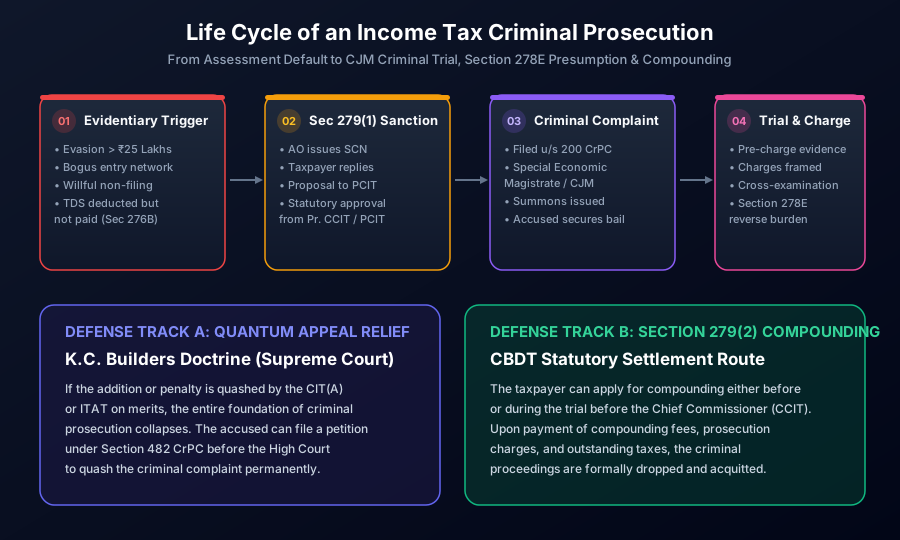
No criminal prosecution under Chapter XXII can be instituted without the prior statutory sanction of the Principal Chief Commissioner, Chief Commissioner, Principal Director General, Director General, or Principal Commissioner. The Assessing Officer cannot file a complaint on their own initiative. Prior to granting sanction, administrative circulars mandate issuing a Show Cause Notice (SCN) giving the taxpayer an opportunity to explain why prosecution should not be sanctioned.
2. Non-Cognizable Nature & Complaint Procedure (Section 279A)
Under Section 279A, all offences under Chapter XXII are statutorily declared to be non-cognizable. This means:
- The local police have no power to register an FIR, conduct an investigation, or arrest the taxpayer.
- Proceedings commence strictly via a formal criminal complaint filed under Section 200 CrPC by an authorized Income Tax Officer before the Court of the Special Judge for Economic Offences or the Chief Judicial Magistrate (CJM) / Additional Chief Metropolitan Magistrate (ACMM).
3. Bail Rules & First Appearance
Upon receiving the complaint, the Magistrate examines the complaint and issues summons to the accused. When the accused appears before the Magistrate in response to summons, they must immediately apply for regular bail. Because tax offences are economic offences not punishable with life imprisonment or death, and because the assessee is appearing voluntarily in response to summons, bail is routinely granted upon furnishing personal bonds and local solvent sureties.

7. Direct Tax Criminal Offences: Sentence, Threshold & Compounding Matrix
The comparative matrix below details the statutory penalty architecture across all major direct tax criminal provisions:
| Section | Nature of Default | Monetary Threshold | Mandatory Sentence | CBDT Compounding Status |
|---|---|---|---|---|
| Section 276C(1) | Willful Tax Evasion | Tax Evaded > ₹25 Lakhs | 6 Months to 7 Years RI + Fine | Category B (Permitted under CCIT approval) |
| Section 276C(1) | Willful Tax Evasion | Tax Evaded ≤ ₹25 Lakhs | 3 Months to 2 Years RI + Fine | Category B (Permitted under CCIT approval) |
| Section 276C(2) | Willful Evasion of Payment | Any unpaid demanded sum | 3 Months to 2 Years RI + Fine | Category B (Permitted upon tax clearance) |
| Section 276CC | Failure to Furnish ITR | Net Tax > ₹25 Lakhs | 6 Months to 7 Years RI + Fine | Category A (Routinely compounded) |
| Section 276CC | Failure to Furnish ITR | Net Tax > ₹10,000 up to ₹25L | 3 Months to 2 Years RI + Fine | Category A (Routinely compounded) |
| Section 277 | False Statement in Verification | Tax Impact > ₹25 Lakhs | 6 Months to 7 Years RI + Fine | Category B (Permitted with 276C compounding) |
| Section 276B | Failure to Deposit TDS | Deducted but unpaid TDS | 3 Months to 7 Years RI + Fine | Category A (Routinely compounded upon deposit) |
8. The Landmark Defense: The K.C. Builders Doctrine & Section 482 CrPC Quashing
The most powerful legal shield available to a taxpayer facing criminal prosecution is the doctrine of appellate exoneration on merits, articulated by the Supreme Court of India in the landmark decision of K.C. Builders v. ACIT [2004] 265 ITR 562 (SC).
The K.C. Builders Principle:
In K.C. Builders, the Supreme Court ruled that where additions made in the assessment order or administrative penalties levied under the Act are cancelled or set aside on merits by appellate authorities (such as the CIT(Appeals) or the Income Tax Appellate Tribunal), the criminal prosecution initiated for the very same additions cannot survive. The Supreme Court observed that when the statutory basis of the addition is found to be unsustainable in civil adjudication, continuing criminal prosecution on the exact same facts constitutes an abuse of the judicial process.
This principle was further solidified by a Constitution Bench in Radheshyam Kejriwal v. State of West Bengal [2011] 333 ITR 58 (SC), which laid down five definitive guidelines:
- Adjudication proceedings and criminal proceedings are independent and can proceed concurrently.
- The findings in adjudication proceedings are not binding on criminal courts, but exoneration in adjudication on merits obliterates the criminal charge.
- If the exoneration in civil adjudication is on technical grounds (e.g., limitation period), criminal prosecution may still proceed if criminal elements are established.
- Where the assessee is completely exonerated on merits—meaning the appellate authority finds no undisclosed income or falsification—criminal prosecution must be dropped.
Remedy under Section 482 CrPC: Armed with an ITAT order deleting the disputed addition, the taxpayer can immediately file a criminal miscellaneous petition under Section 482 of the CrPC before the High Court praying for quashing of the criminal complaint and discharge from the proceedings.
9. Section 279(2) Compounding: Commercial Settlement as a Complete Defense
Even where an assessee has committed a statutory default and the addition cannot be successfully overturned on merits, the law provides an extraordinary settlement mechanism: Compounding of Offences under Section 279(2).
Under Section 279(2), the tax department is statutorily authorized to compromise criminal offences. Upon payment of the prescribed compounding fee, establishment charges, and all outstanding taxes and interest, the criminal proceedings are formally withdrawn. The trial court passes an order of acquittal under Section 320 CrPC, completely erasing the criminal charge and preventing imprisonment or a criminal record. (A comprehensive deep dive into CBDT Compounding Guidelines, fee formulas, and application workflows is provided in our dedicated guide).
10. Standard Operating Procedure (SOP) When Served with a Prosecution Show Cause Notice
If you or your company receives a Show Cause Notice proposing criminal prosecution under Chapter XXII, execute this tactical response checklist immediately:
Phase 1: Intercept Sanction Proceedings (Days 1–15)
- Examine the SCN to identify the exact section invoked (276C(1), 276CC, or 277) and the specific assessment year involved.
- Verify whether the disputed addition is currently under challenge before the CIT(Appeals) or ITAT. Draft a formal submission requesting the Principal CIT to keep sanction proceedings in abeyance pending disposal of the quantum appeal.
- Demonstrate absence of mens rea: present documentary evidence showing that the default was caused by reasonable cause, system glitches, illness, banking failure, or genuine accounting ambiguity.
Phase 2: Magistrate Court Defense & Bail (Upon Complaint Filing)
- Engage an experienced criminal defense counsel specializing in economic offences to inspect the complaint filed in the CJM / ACMM Court.
- Ensure the accused appears on the first date of hearing with solvent sureties to obtain regular bail immediately upon summons.
- Submit an application before the Magistrate informing the court of the pending quantum appeal or pending compounding application.
Phase 3: Invoke High Court Quashing / Compounding
- If the ITAT deletes the additions on merits, file a petition under Section 482 CrPC before the High Court citing K.C. Builders to quash the criminal complaint.
- If merits are weak, immediately file a compounding petition under Section 279(2) before the Principal CCIT, pay the compounding fee, and secure a complete discharge.
11. Frequently Asked Questions (FAQ Schema)
Under Section 276C(1), if the amount sought to be evaded exceeds ₹25,00,000, the offence is punishable with rigorous imprisonment for a minimum term of 6 months extending up to 7 years, along with a mandatory monetary fine. Where the tax evasion is ₹25,00,000 or less, the sentence is rigorous imprisonment for a minimum of 3 months extending up to 2 years, along with a fine.
No. Under the proviso to Section 276CC, an individual is protected from prosecution for failure to file a return under Section 139(1) if the net tax payable on regular assessment, after deducting advance tax paid and TDS, does not exceed ₹10,000. Prosecution is typically initiated only where the tax evasion exceeds statutory thresholds and the failure is proven to be willful.
Section 278E creates a statutory presumption of culpable mental state (mens rea) against the accused in any prosecution under the Income Tax Act. The court must presume that the taxpayer acted with intention, motive, or knowledge. The burden of proof shifts entirely onto the accused taxpayer to establish beyond reasonable doubt that they had no culpable mental state.
No. Under Section 279A, all offences under Chapter XXII of the Income Tax Act are non-cognizable. The local police have no jurisdiction to register an FIR or make an arrest. Prosecution can be initiated only by way of a formal criminal complaint filed by an authorized Income Tax Officer (not below the rank of ITO) before the Special Economic Offences Magistrate or Chief Judicial Magistrate (CJM).
Under the landmark Supreme Court ruling in K.C. Builders v. ACIT [2004] 265 ITR 562 (SC) and Radheshyam Kejriwal v. State of West Bengal [2011] 333 ITR 58 (SC), when the addition or penalty is cancelled on merits by the appellate authority (CIT(A) or ITAT), the very substratum of the prosecution disappears. The taxpayer can file a petition under Section 482 of the Code of Criminal Procedure (CrPC) before the High Court to have the criminal complaint quashed.
Yes. Under Section 279(2), any offence under Chapter XXII may, either before or after the institution of proceedings, be compounded by the Principal Chief Commissioner, Chief Commissioner, or Principal Director General. Upon payment of compounding fees, prosecution establishment charges, and outstanding tax demands, the criminal trial is terminated, and the accused stands acquitted.