
1. The Global Indian Dilemma in FY 2026-27
In direct tax jurisprudence, few legal distinctions carry consequences as profound as an individual's Residential Status. Under Indian direct tax laws, your tax liability is determined not by your passport, nationality, or citizenship, but strictly by where you physically spend your days during the financial year (April 1 to March 31).
If you are classified as a Non-Resident Indian (NRI), the Indian government exercises strictly territorial tax jurisdiction: you pay income tax only on income that is earned, accrued, or received within the geographical boundaries of India (such as rental income from a Bengaluru apartment or dividends from Indian shares). Your foreign salary, offshore RSUs, and overseas business revenues remain 100% immune from Indian taxation.
However, if your physical stay crosses statutory tripwires, you can be classified as a Resident and Ordinarily Resident (ROR). The moment this happens, your entire worldwide income is dragged into the Indian tax net. You are taxed in India on your foreign bank interest, global salary, and overseas stock sales, and face severe reporting requirements under Schedule FA (Foreign Assets) with draconian ₹10 Lakh penalties under the Black Money Act.
2. FEMA vs Income Tax: Two Different Legal Universes
A pervasive source of confusion among non-residents is conflating residency under the Foreign Exchange Management Act (FEMA), 1999 with residency under the Income-tax Act, 1961. They are administered by two different regulators (Reserve Bank of India vs Central Board of Direct Taxes) and serve entirely different legal purposes:
| Statutory Parameter | FEMA, 1999 (Governed by RBI) | Income-tax Act, 1961 (Governed by CBDT) |
|---|---|---|
| Governing Section | Section 2(v) and Section 2(w) | Section 6 |
| Core Benchmark | Intention: Going abroad for employment, business, or indefinite stay. | Physical Presence: Mathematical count of days spent on Indian soil. |
| Day Count Period | Previous financial year (> 182 days) + ongoing intention. | Current financial year (April 1 to March 31). |
| Primary Impact | Legality of holding bank accounts (NRE/NRO), buying agricultural land, and outward remittance. | Scope of taxable income (territorial vs worldwide income) and tax slab rates. |
The Classic Contrast: An engineer who relocates from Hyderabad to California on May 15 on an H-1B visa immediately becomes a "Person Resident Outside India" under FEMA from the day they board the flight (enabling them to open NRE/NRO accounts). However, for income tax purposes, because they were physically present in India for 45 days in the current year and 365+ days in earlier years, their income tax residency depends strictly on Section 6 day-count formulas!
3. Basic Residency Conditions under Section 6(1)
Under Section 6(1) of the Income-tax Act, an individual is classified as a Resident of India in any previous year if they satisfy either of the following two basic statutory conditions:
$$\text{Condition 1: Physical stay in India } \ge 182 \text{ days in the relevant Financial Year}$$
-- OR --
$$\text{Condition 2: Physical stay } \ge 60 \text{ days in FY} \quad \text{AND} \quad \ge 365 \text{ days in 4 preceding FYs}$$
If an individual satisfies neither of these conditions, they are classified as a Non-Resident (NRI) for that financial year.
How Days Are Legally Counted
- Arrival and Departure Days: Under established judicial precedents (including rulings by the Supreme Court and Armed Forces Tribunal), both the day of arrival and the day of departure are counted as full days spent in India, regardless of the flight landing or take-off time.
- Continuous vs Fragmented Stay: The stay in India does not need to be continuous. All visits across the 365 days of the financial year are aggregated.
- Passport Stamping: Immigration departure and arrival stamps in your passport, along with airline boarding passes and e-visa records, serve as legal evidence during tax assessments.
4. Concessions for Leaving India for Employment
To protect Indian citizens who secure international jobs from being penalized by the 60-day rule, Parliament enacted Explanation 1(a) to Section 6(1):
This means that if you are an Indian citizen leaving India for a permanent or contractual foreign assignment, you will remain a Non-Resident for that financial year provided you leave India on or before September 28 (spending 181 days or fewer in India). If you leave on October 1, you spend 184 days in India, triggering Indian residency!
5. The 120-Day Rule for Visiting HNIs (> ₹15L Income)
Prior to April 1, 2020, Indian citizens and Persons of Indian Origin (PIOs) residing abroad who visited India enjoyed a blanket exception: they could spend up to 181 days in India every year without becoming tax residents. Many high-net-worth individuals structured their travel schedules to spend 180 days in India running domestic businesses while claiming full NRI tax immunity.
The Finance Act fundamentally restructured this exception by introducing a dual-tier threshold:
| Category of Visiting NRI / PIO | Total Indian-Sourced Income in FY | Physical Stay in India to Trigger Residency | Statutory Classification |
|---|---|---|---|
| Standard Visiting NRI / PIO | Up to ₹15,00,000 (₹15 Lakh) | 182 days or more (60 days remains 182 days) | Non-Resident (if < 182 days) |
| High-Net-Worth Visiting NRI / PIO | Exceeding ₹15,00,000 (₹15 Lakh) | 120 days or more (and ≥ 365 days in 4 prior years) | Resident (RNOR) |
6. Section 6(1A) Deemed Residency: Stateless Expats
To tackle "tax nomads"—individuals who renounce Indian tax residency but live in zero-tax jurisdictions like Dubai, Monaco, or the Cayman Islands without paying income tax anywhere—Parliament enacted Section 6(1A):
Statutory Text of Section 6(1A)
Notwithstanding anything contained in clause (1), an individual, being a citizen of India, having total income, other than the income from foreign sources, exceeding fifteen lakh rupees during the previous year shall be deemed to be resident in India in that previous year, if he is not liable to tax in any other country or territory by reason of his domicile or residence or any other criteria of similar nature.
The Three Cumulative Triggers of Section 6(1A)
- The individual must be an Indian citizen (foreign citizens and OCI cardholders are exempt).
- Their Indian-sourced taxable income must exceed ₹15,00,000 during the financial year.
- They must not be liable to tax in any other foreign country by reason of domicile, residence, or similar criteria.
The Relief: To protect genuine Gulf-based workers from double taxation, the statute explicitly mandates that any person deemed to be a resident under Section 6(1A) is automatically classified as a Resident but Not Ordinarily Resident (RNOR). Therefore, their foreign earnings in the UAE or Saudi Arabia remain 100% tax-free!
7. Residential Status Determination Flowchart
The decision tree below maps out every statutory gate under Section 6, guiding taxpayers from basic day counts to final classification:

Figure 1: Statutory decision flowchart for assessing Indian residency, 120-day visits, Section 6(1A) deemed residency, and RNOR transitions.
8. ROR vs RNOR: The Golden 1-to-3 Year Tax Shield
Once an individual is determined to be a Resident under Section 6(1) or Section 6(1A), the next critical inquiry is whether they are Resident and Ordinarily Resident (ROR) or Resident but Not Ordinarily Resident (RNOR).
The RNOR Qualification Tests (Section 6(6))
An individual qualifies as an RNOR if they satisfy any one of the following conditions:
- Test A: They have been a Non-Resident in 9 out of the 10 previous years preceding the relevant financial year; OR
- Test B: They have been in India for a period of 729 days or less during the 7 previous years preceding the relevant financial year; OR
- Test C: They are an Indian citizen / PIO visiting India whose Indian income > ₹15 Lakhs and whose stay in India is between 120 and 181 days; OR
- Test D: They are a deemed resident under Section 6(1A).
9. Scope of Total Income: Section 5 Analysis
The table and analytical matrix below summarize how your taxability alters depending on your final classification:
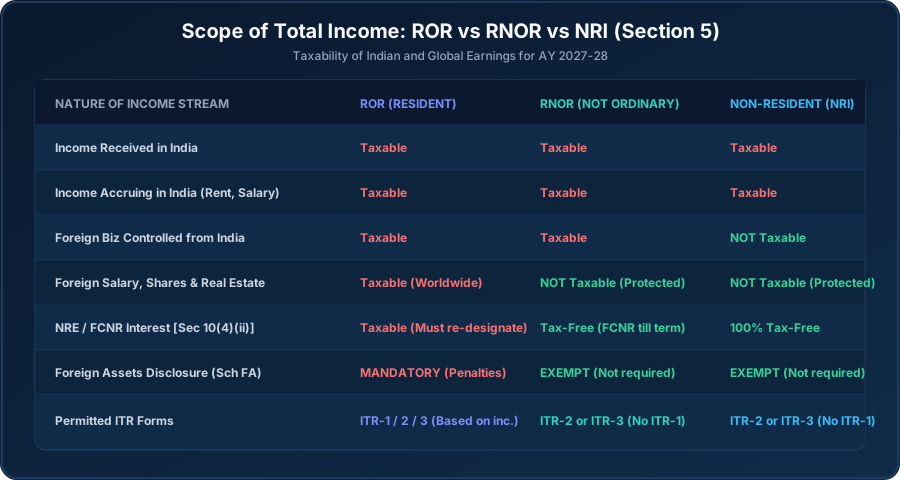
Figure 2: Scope of taxable income under Section 5 comparing Ordinary Residents, Not Ordinarily Residents, and Non-Residents.
Key operational insights from Section 5:
- Indian Salary Received Abroad: If you work in India for an Indian employer, but your salary is credited into an overseas bank account, it is still taxable in India because it accrued from services rendered on Indian soil.
- Foreign Salary Received in India: If you work abroad for an overseas employer, but you instruct them to credit your monthly paycheck directly into a domestic Indian bank account (resident or NRO), it becomes taxable in India because it was received in India under Section 5(2)(a). Always have foreign earnings credited into your offshore foreign bank account or NRE account first!
10. NRE, NRO & FCNR Re-designation Obligations
When an individual transitions between resident and non-resident status, their banking obligations under FEMA change instantly:
- Designation as Non-Resident: As soon as you qualify as a non-resident under FEMA, you must formally intimate your Indian banks. All existing resident savings bank accounts must be designated as NRO (Non-Resident Ordinary) accounts. You can also open NRE (Non-Resident External) and FCNR (Foreign Currency Non-Resident) deposit accounts. Holding an ordinary resident savings account while being an NRI is a civil contravention under Section 13 of FEMA.
- Returning to India (Change to Resident): When an NRI relocates to India with the intention of permanent stay, they must notify their banks to convert NRE accounts into regular resident accounts or transfer the balances into a Resident Foreign Currency (RFC) Account. RFC accounts allow returning NRIs to maintain foreign currencies (USD, GBP, EUR) tax-free during their RNOR phase.
11. Real-World Computational Case Studies
Case Study 1: Dubai Professional Visiting India for 140 Days
Tariq is an Indian citizen residing in Dubai for the last 8 years. He earns a tax-free salary of AED 400,000 (approx. ₹90 Lakhs). In India, he owns two commercial properties in Mumbai that generate rental income of ₹24,00,000 (₹24 Lakhs) per year. In FY 2026-27, Tariq visits his parents in India and stays for 145 days.
- Test 1: Stay in India ≥ 182 days? No (145 days < 182 days).
- Test 2: Tariq is an Indian citizen visiting India, but his Indian-sourced income (₹24 Lakhs) exceeds the ₹15 Lakh threshold! Therefore, the relaxed benchmark is 120 days.
- Because Tariq stayed 145 days (> 120 days) and was in India for ≥ 365 days across the last 4 years, he is classified as a Resident.
- RNOR Test: Under Section 6(6)(c), any visiting citizen becoming resident under the 120-day rule is automatically an RNOR.
- Tax Liability: Tariq's Dubai salary of ₹90 Lakhs remains 100% tax-free in India. Only his Mumbai rental income of ₹24 Lakhs is taxed in his Indian ITR.
Case Study 2: Software Engineer Relocating Abroad for Employment
Ananya secures a job with a tech firm in London. She resides in Pune until August 25, 2026, when she moves to the UK on a Tier 2 Skilled Worker visa. She does not return to India during the remainder of FY 2026-27.
- Ananya's physical stay in India: April 1, 2026 to August 25, 2026 = 147 days.
- Because Ananya is an Indian citizen leaving India for the purpose of employment outside India, Explanation 1(a) applies: the 60-day rule is extended to 182 days.
- Since 147 days is less than 182 days, Ananya is classified as a Non-Resident (NRI) for FY 2026-27.
- Her UK salary earned from September 2026 to March 2027 is completely exempt from Indian taxation. Only her Indian salary earned from April to August 2026 is taxable in India.
12. Frequently Asked Questions (FAQs)
Can an NRI choose between the Old and New Tax Regimes?
Yes. Under Section 115BAC, Non-Resident Indians have the exact same right as resident individuals to choose between the New Tax Regime (default) and the Old Tax Regime. If an NRI has no business or professional income in India, they can choose the regime every year while filing their ITR-2.
Does an NRI get the benefit of the basic exemption limit?
Yes. Non-resident individuals are entitled to the standard basic exemption limit (₹3,00,000 under the New Tax Regime and ₹2,50,000 under the Old Regime). However, the higher senior citizen exemption limits (₹3 Lakh and ₹5 Lakh) are available strictly to resident senior citizens, not non-residents.
Can an NRI claim Section 87A tax rebate?
No. Section 87A explicitly restricts the tax rebate to an "individual resident in India". Non-residents cannot claim the Section 87A rebate even if their taxable Indian income is under ₹7 Lakh or ₹12 Lakh.
Is an NRI required to report foreign bank accounts in their Indian ITR?
No. Non-Residents (NRIs) and Resident but Not Ordinarily Residents (RNORs) are completely exempt from filling Schedule FA (Foreign Assets) and Schedule FSI (Foreign Source Income). Schedule FA is mandatory strictly for Resident and Ordinarily Resident (ROR) taxpayers.
What if a flight transits through an Indian airport?
If an NRI transits through an Indian airport without passing through immigration (staying within the international transit lounge), that day is not counted as a stay in India. However, if they clear immigration and exit the airport, that day is counted as a day spent on Indian soil.