
1. The High Stakes of NRI Property Disposals
When a Non-Resident Indian decides to liquidate an immovable property in India—whether an ancestral home in Delhi, an investment apartment in Bengaluru, or inherited agricultural land—the transaction is frequently jeopardized by severe tax withholding rules.
In transactions between resident Indians, the tax system is relatively benign: under Section 194-IA, the buyer simply withholds 1% of the property value, files an online challan (Form 26QB) using their PAN, and remits the remaining 99% to the seller.
However, the moment the seller is a Non-Resident Indian under Section 6 of the Income-tax Act, Section 194-IA ceases to apply. The transaction is immediately thrown under the jurisdiction of Section 195—a stringent anti-avoidance provision designed to ensure that foreign payees cannot repatriate capital outside India without discharging their full tax obligations.
2. Section 194-IA vs Section 195: The Big Divide
Many real estate brokers, buyers, and even bank loan officers mistakenly assume that the 1% TDS rule applies universally across all property transactions in India. This misunderstanding leads to catastrophic tax notices for unsuspecting buyers:
| Statutory Parameter | Seller is Resident Indian (Section 194-IA) | Seller is Non-Resident Indian (Section 195) |
|---|---|---|
| Statutory Section | Section 194-IA | Section 195 |
| Monetary Threshold | Applies only if value ≥ ₹50,00,000 | No threshold! Applies from Rupee 1. |
| TDS Rate | Flat 1.00% | 12.5% to 20% (LTCG) / 30% (STCG) + Surcharge & Cess |
| Base for Deduction | Higher of agreed price or circle rate | Entire Gross Sale Consideration (unless Form 13 obtained) |
| Buyer TAN Requirement | No TAN required (Only Buyer & Seller PAN) | Mandatory TAN under Section 203A |
| Compliance Form | Form 26QB (Challan-cum-statement) | Challan ITNS 281 + Quarterly Form 27Q |
| TDS Certificate | Form 16B (from TRACES) | Form 16A (from TRACES) |
3. The "Gross Sale Consideration" Withholding Trap
The most dangerous legal trap in Section 195 is the base on which the buyer must calculate tax.
Under the law, a regular individual buyer is not a tax assessment authority. The buyer has no statutory power to determine how much the NRI originally paid for the property, whether the construction bills are authentic, or whether the seller is entitled to Section 54 reinvestment relief.
Consequently, the Supreme Court of India held in Transmission Corporation of AP Ltd vs CIT and reaffirmed in subsequent rulings that:
The Real-World Nightmare: If an NRI sells an apartment for ₹3,00,00,000 (₹3 Crore) that was purchased a few years earlier for ₹2,70,00,000 (actual capital gain: ₹30 Lakh), the buyer must withhold up to 23.92% on the full ₹3,00,00,000—deducting over ₹71.7 Lakhs in TDS! The NRI receives less than ₹2.28 Crore, effectively locking up more than double their actual profit in government coffers for 12 to 18 months until an ITR refund is processed.
4. Statutory Rates, Surcharges & Health Cess
Unlike resident TDS (which is a flat 1%), Section 195 withholding requires compounding the base tax rate with applicable surcharges and the mandatory 4% Health and Education Cess.
Base Tax Rates for FY 2026-27 (AY 2027-28)
- Long-Term Capital Assets (Transferred post July 23, 2024): Base rate is 12.5% without indexation.
- Long-Term Capital Assets (Acquired prior to July 23, 2024): Under grandfathering provisions, resident individuals can elect 20% with indexation. For NRIs, tax authorities typically enforce withholding at 12.5% or 20% depending on the title date.
- Short-Term Capital Assets (Held ≤ 24 months): Base rate is 30%.
Surcharge Matrix for Non-Resident Individuals
Surcharge is levied on the base tax rate based on the total capital gain / transaction value:
| Capital Gain / Income Threshold | Surcharge Rate | Effective Rate on 12.5% Base (+ 4% Cess) | Effective Rate on 20% Base (+ 4% Cess) |
|---|---|---|---|
| Up to ₹50,00,000 (₹50 Lakh) | 0% | 13.00% | 20.80% |
| ₹50,00,001 to ₹1,00,00,000 (₹1 Cr) | 10% | 14.30% | 22.88% |
| Exceeding ₹1,00,00,000 (₹1 Cr) | 15% (Capped for LTCG) | 14.95% | 23.92% |
5. Form 13 & Section 197 Lower TDS Certificate
To eliminate the gross consideration trap, the Income-tax Act provides an indispensable statutory remedy under Section 197.
An NRI seller has the legal right to apply online for a Certificate for Lower or Nil Deduction of Tax by submitting Form 13 to their jurisdictional Assessing Officer (International Taxation).
How the Certificate Operates
- The Assessing Officer evaluates the NRI's estimated total income, the actual purchase price of the property, indexed cost of acquisition (if applicable), and any rollover tax exemptions claimed under Section 54, Section 54EC, or Section 54F.
- The AO determines the actual estimated tax liability on the capital gain.
- The AO issues a formal digitally signed certificate under Section 197 stating the exact effective percentage of TDS the buyer is authorized to deduct (e.g., 1.5%, 2.8%, or 0.0% on the gross sale value).
- Once the buyer receives this certificate, the buyer is legally protected from any short-deduction notices and withholds only the certified amount!
6. Form 13 Application & Issuance Lifecycle
The infographic below illustrates the six sequential phases of securing and executing a Form 13 Lower TDS Certificate:
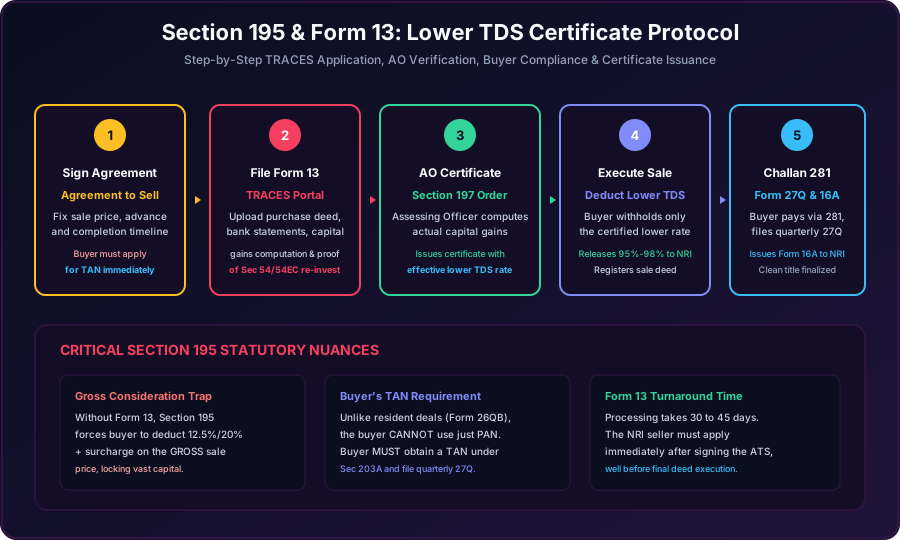
Figure 1: Complete procedural lifecycle of Form 13 from agreement execution to TRACES certificate download and Form 27Q filing.
7. Essential Supporting Documentation Checklist
To ensure speedy approval from the International Taxation ward within the standard 30 to 45 day window, the NRI must assemble an exhaustive documentation docket:
Required Document Docket
- Executed Agreement to Sell (ATS): Duly stamped or notarized, clearly specifying the full sale consideration, token advance received, and scheduled registration date.
- Original Purchase Conveyance Deed: Registered deed showing the date and acquisition price when the NRI originally bought or inherited the property.
- Bank Statement Trail: Bank statements proving the outward remittances or cheques paid during the original purchase.
- Circle Rate / Stamp Duty Valuation Proof: Ready reckoner or circle rate valuation certificate issued by local sub-registrar authorities for both the purchase year and sale year.
- Renovation & Improvement Invoices: Authentic bills, architect certificates, and bank payment receipts if claiming deductions for cost of improvements under Section 48.
- Proof of Reinvestment: If claiming rollover exemption under Section 54 or Section 54EC, provide builder booking agreements, construction payment receipts, or bond subscription receipts.
- Passport & Travel History: Complete copy of all passport pages showing immigration arrival and departure stamps to verify residential status.
- Buyer's TAN Details: Formal letter or copy of the buyer's 10-digit Tax Deduction Account Number (TAN) allotment.
8. Buyer's Legal Mandate: TAN, Challan 281 & Form 27Q
Buying property from an NRI imposes substantial administrative responsibilities on the buyer that do not exist in resident transactions:
Step 1: Obtain a TAN (Section 203A)
The buyer cannot use Form 26QB. The buyer must apply for a Tax Deduction Account Number (TAN) using Form 49B online on the Protean / NSDL portal. A TAN is typically allotted within 3 to 5 business days.
Step 2: Deposit TDS via Challan ITNS 281
When payment is released to the NRI seller (or at the time of deed registration), the buyer withholds the applicable TDS and deposits it into the Central Government account using Challan ITNS 281 (Major Head 0020 / Minor Head 200). The deposit must be completed within 7 days from the end of the month in which the deduction was made.
Step 3: File Quarterly TDS Return in Form 27Q
The buyer must file a formal quarterly withholding tax return in Form 27Q detailing the NRI's PAN, certificate number, gross consideration, and tax deposited.
Step 4: Issue Form 16A Certificate
Once Form 27Q is processed, the buyer logs into the TRACES portal, downloads the digitally signed Form 16A TDS Certificate, and furnishes it to the NRI seller within 15 days of filing Form 27Q.
9. Buyer Default: "Assessee in Default" Penalties
What happens if a buyer mistakenly treats an NRI seller as a resident Indian and deducts only 1% TDS under Section 194-IA?
This is one of the most financially catastrophic mistakes a homebuyer can make:
- Assessee in Default (Section 201(1)): The buyer is declared an "assessee in default". The Income Tax Department issues a demand notice recovering the short-deducted tax (the remaining 19% to 22.92%) directly from the buyer!
- Compounding Interest (Section 201(1A)): Mandatory interest of 1.0% per month for failure to deduct, and 1.5% per month for failure to pay, calculated from the date of the sale deed.
- Disallowance & Penalties: Penalties equal to 100% of the short-deducted tax under Section 271C. The fact that the seller has left the country is no defense—the buyer remains legally liable!
10. Comparative Financial Impact Analysis
The matrix below illustrates the dramatic difference in cash liquidity between selling with vs without a Form 13 certificate:
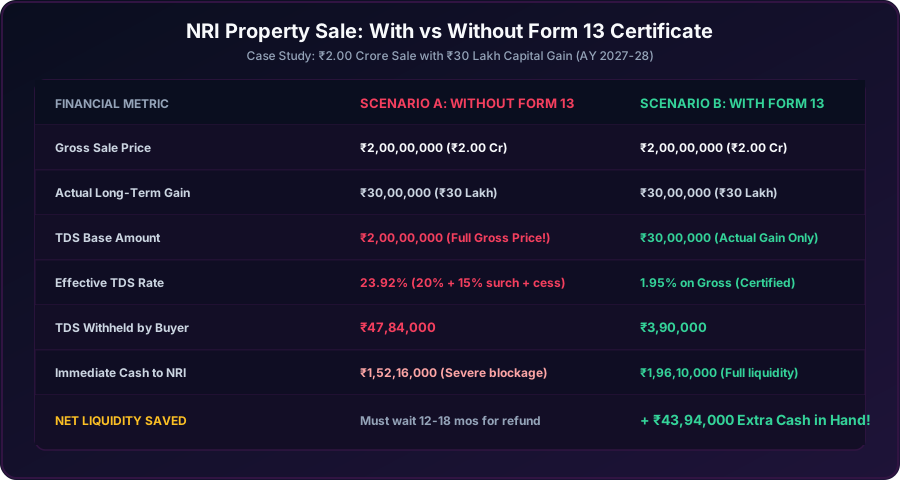
Figure 2: Financial impact analysis illustrating how Form 13 unlocks ₹43.94 Lakhs of immediate in-hand cash liquidity on a ₹2 Crore transaction.
11. Real-World Computational Case Studies
Case Study 1: Complete Tax Shelter via Section 54 Reinvestment
Karthik, an NRI residing in Singapore, sells his inherited villa in Hyderabad for ₹2,50,00,000 (₹2.50 Cr) in October 2026. His indexed capital gain is ₹90,00,000. Karthik plans to reinvest the entire capital gain into another residential house in Pune under Section 54.
- Without Form 13, the buyer would have withheld 23.92% on ₹2.50 Crore = ₹59,80,000.
- Karthik files Form 13 on TRACES, submitting the sale agreement, purchase deed, and proof of booking the new Pune flat with builder payment receipts.
- The Assessing Officer verifies the Section 54 exemption and issues a NIL Deduction Certificate (0% TDS) under Section 197.
- The buyer withholds ₹0. Karthik receives the full ₹2.50 Crore gross consideration and seamlessly completes his purchase in Pune.
Case Study 2: The Buyer Who Deducted Only 1%
Vikas (resident buyer) bought a luxury apartment in Mumbai for ₹1,80,00,000 from Reema, who had relocated to London 4 years ago. Unaware of the NRI rules, Vikas filed Form 26QB and deducted only 1% TDS (₹1,80,000).
- During automated verification with immigration records, the CPC detected that Reema was an NRI during the transfer year.
- The Assessing Officer issued a demand notice to Vikas under Section 201 for short deduction: $$\text{Short Deduction} = (20\% + 10\% \text{ surcharge} + 4\% \text{ cess}) \times ₹1.80 \text{ Cr} - ₹1,80,000 = ₹41,18,400 - ₹1,80,000 = \mathbf{₹39,38,400}$$
- Vikas was forced to pay ₹39.38 Lakhs plus 18 months of interest out of his own pocket, while Reema had already repatriated the full sale proceeds to the UK!
12. Frequently Asked Questions (FAQs)
How long does it take to get a Form 13 Lower TDS Certificate?
By law, the Income Tax Department's citizen charter prescribes a turnaround time of 30 to 45 days from the date of a complete application. To avoid delaying property registration, the NRI seller should apply for Form 13 immediately upon signing the Agreement to Sell.
Can a Power of Attorney (PoA) holder apply for Form 13 on behalf of the NRI?
Yes. A registered Power of Attorney holder residing in India can execute the transaction, sign documents, and engage a Chartered Accountant to submit Form 13 on TRACES on behalf of the non-resident owner.
Can the buyer register the property before Form 13 is issued?
If the registration occurs before Form 13 is issued, the buyer is legally obligated to deduct the full 12.5% to 20% (+ surcharge and cess) on the gross price. The certificate cannot be applied retroactively to payments already credited or made to the seller.
What if the property is co-owned by an NRI and a resident Indian?
If a property is held jointly (e.g., 50% by an NRI sibling and 50% by a resident sibling), the buyer must split the consideration: deduct 1% TDS on the resident's share under Section 194-IA (using Form 26QB), and deduct Section 195 TDS (or Form 13 certified rate) on the NRI's share (using TAN and Form 27Q).
Is a Lower TDS Certificate valid for multiple properties?
No. A certificate issued under Section 197 is specific to a single transaction, a specific buyer's TAN, and a specific financial year. It cannot be used for any other asset transfer.