
1. The Double Taxation Dilemma
In global commerce and personal finance, income frequently transcends geographic borders. An Indian software engineer residing in San Jose earns interest on an NRO fixed deposit in Mumbai. A resident consultant in Bengaluru receives fees for technical services from a German manufacturing client. An Indian resident executive liquidates vested stock options (RSUs) in a US-headquartered corporation.
Without bilateral agreements, such transactions would be decimated by Juridical Double Taxation: the source state asserts territorial jurisdiction to tax the income because it was generated within its borders, while the residence state asserts worldwide jurisdiction to tax the same income because the recipient is a resident. If India levies 30% and the United States levies 35%, over 65% of the taxpayer's earnings would be consumed by taxes!
To neutralize this destructive friction, countries enter into bilateral Double Taxation Avoidance Agreements (DTAAs). India has executed comprehensive tax treaties with over 85 sovereign jurisdictions, including the United States, United Kingdom, Canada, Singapore, United Arab Emirates, Germany, and Australia.
2. Section 90 & The "More Beneficial" Doctrine
The constitutional authority enabling the Central Government to enter into international tax treaties is enshrined in Section 90 of the Income-tax Act, 1961.
The cornerstone of treaty interpretation in India is contained in sub-section (2):
The Supremacy Doctrine: Section 90(2)
"Where the Central Government has entered into an agreement with the Government of any country outside India or specified territory outside India under sub-section (1) for granting relief of tax, or as the case may be, avoidance of double taxation, then, in relation to the assessee to whom such agreement applies, the provisions of this Act shall apply to the extent they are more beneficial to that assessee."
In landmark judgments, including the Supreme Court's constitution bench ruling in Union of India vs Azadi Bachao Andolan, Indian courts have affirmed:
- DTAA provisions override the domestic Income-tax Act whenever the treaty is more favorable to the taxpayer.
- A tax treaty can only grant relief or reduce tax; it cannot create a new tax liability that does not exist under domestic law.
- The taxpayer has the absolute legal prerogative to choose between the domestic Income-tax Act and the DTAA, selecting the provision that minimizes their tax liability.
3. Unilateral Relief under Section 91 (Non-DTAA)
What happens if an Indian resident earns income in a foreign nation with which India has no DTAA treaty (such as certain Latin American or African states)?
To prevent unfair hardship, Parliament enacted Section 91, providing Unilateral Tax Relief:
- If a resident individual proves that they have paid tax in a non-treaty country on foreign-sourced income, they are entitled to a deduction from their Indian income tax.
- The relief equals the tax calculated on such doubly taxed income at the Indian tax rate or the foreign tax rate, whichever is lower.
4. The Tax Residency Certificate (TRC) Mandate
You cannot simply present an overseas driver's license or passport and demand treaty tax rates. In the Finance Act, 2012, Parliament introduced Section 90(4) to combat treaty shopping and sham offshore entities.
How to Obtain a TRC in Key NRI Hubs
- United States: File Form 8802 with the Internal Revenue Service (IRS) to obtain Form 6166 (Certification of U.S. Tax Residency).
- United Kingdom: Apply online through your HMRC Government Gateway account for a Certificate of Residence (CoR).
- United Arab Emirates: Apply on the UAE Federal Tax Authority (FTA) portal for an electronic Tax Residency Certificate.
- Singapore: Request a Certificate of Residence from the Inland Revenue Authority of Singapore (IRAS) via myTax Portal.
5. Electronic Form 10F: Portal Filing Protocol
Under Rule 21AB of the Income-tax Rules, a TRC must contain six statutory particulars: Name, Status, Nationality, Tax Identification Number (TIN), Country of Residence, and Period of Validity.
Many foreign tax authorities (including the US IRS and UK HMRC) issue standardized TRCs that do not mention the individual's residential address or father's name. Under Section 90(5), if the TRC lacks any of the prescribed details, the non-resident must furnish Form 10F.
The Electronic Mandate
Historically, taxpayers submitted physical, signed copies of Form 10F. The Directorate of Income Tax (Systems) discontinued physical submissions, mandating that Form 10F must be furnished electronically via the e-filing portal (incometax.gov.in).
Filing Steps for NRIs
- Log in to the e-filing portal using your PAN. (If you do not possess an Indian PAN, use the specialized "Non-resident without PAN" registration category).
- Navigate to e-File > Income Tax Forms > File Income Tax Forms and select Form 10F.
- Select the relevant Assessment Year, enter your foreign residential address, Country of Origin, Tax Identification Number in the foreign state, and upload the digital copy of your foreign TRC.
- Verify the form using an electronic Digital Signature Certificate (DSC) or Electronic Verification Code (EVC via registered email/mobile).
- Download the generated Form 10F PDF and Acknowledgement Slip to submit to your Indian bank or payer.
6. DTAA Relief Claim Execution Flowchart
The infographic below illustrates the complete operational workflow of claiming DTAA withholding benefits and filing for foreign tax credits:
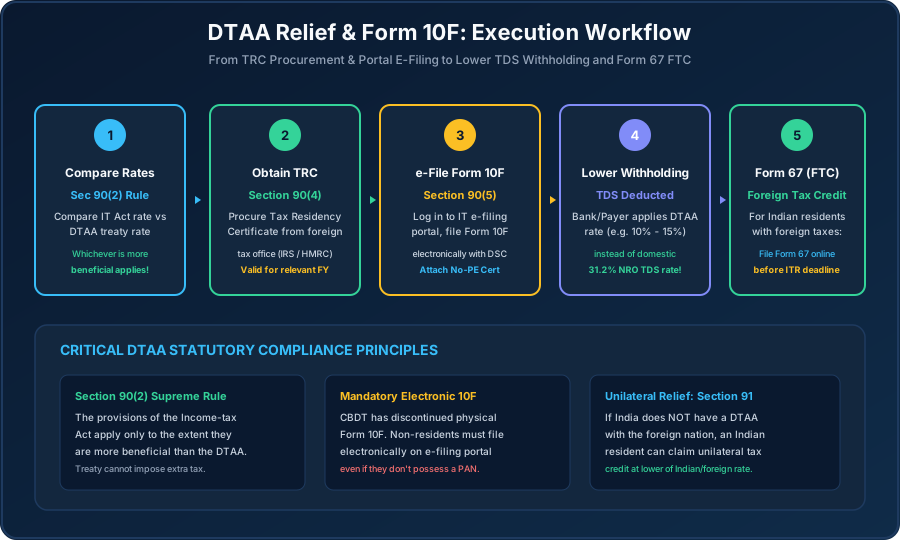
Figure 1: Step-by-step procedural workflow for establishing treaty residency, submitting electronic Form 10F, and obtaining lower TDS.
7. Slashing NRO Withholding from 31.2% to 15%
For Non-Resident Indians, the most frequent practical application of DTAA is reducing the punitive 31.2% domestic TDS deducted on NRO savings accounts and NRO fixed deposits.
How the Saving Works
Under domestic Section 195, Indian banks automatically deduct 30% tax + 4% cess = 31.2% on all NRO interest. However, under Article 11 (Interest) of most Indian tax treaties:
- US-India DTAA (Article 11): Caps withholding tax on bank interest at 15.00%.
- UK-India DTAA (Article 12): Caps withholding tax on bank interest at 15.00%.
- Singapore-India DTAA (Article 11): Caps withholding tax on bank interest at 10.00% to 15.00%.
- UAE-India DTAA (Article 11): Caps withholding tax on bank interest at 12.50%.
- Germany-India DTAA (Article 11): Caps withholding tax on bank interest at 10.00%.
• Without DTAA: The bank deducts 31.2% = ₹3,12,000 in TDS.
• With DTAA (TRC + Form 10F submitted): The bank deducts only 15% = ₹1,50,000.
• Immediate Cash Saved: ₹1,62,000 without waiting a full year for an ITR refund!
8. Dividends, Royalties & FTS Treaty Rates
Beyond bank interest, DTAAs provide massive relief across corporate and professional income streams:
- Dividend Income: Under domestic law (Section 195/115A), foreign shareholders face 20% + surcharge + cess (up to 23.92%) on dividends from Indian companies. Most treaties cap dividend withholding at 10% to 15%.
- Royalties and Fees for Technical Services (FTS): The domestic tax rate on royalties and FTS under Section 115A is 20% + cess. Tax treaties with the US, UK, and Singapore reduce this to 10% to 15%, protecting cross-border software developers, consultants, and IP licensors.
- Real Estate Capital Gains: Most DTAAs follow Article 6 and Article 13 of the UN/OECD Model Conventions, allocating the primary right to tax immovable property gains to the source country where the property is located. Hence, sale of real estate in India remains taxable in India under domestic capital gains rates (12.5% / 20%).
9. Form 67 & Foreign Tax Credit (FTC) for Residents
While NRIs use DTAAs to reduce Indian TDS, Resident Indians (ROR) use DTAAs to prevent paying double tax on foreign earnings.
If a resident individual in India earns foreign income (such as US consulting fees, dividends on Apple shares, or foreign rental income) that suffered withholding tax overseas, they can claim a Foreign Tax Credit (FTC) under Section 90/91 and Rule 128.
Mandatory Filing of Form 67
To claim FTC, the taxpayer must furnish Form 67 electronically on the income tax portal:
Documents attached to Form 67 include: statement of foreign income and tax withheld (e.g., US Form 1042-S / W-2), and proof of tax payment/deduction issued by the foreign revenue authority.
10. DTAA Withholding Tax Matrix (Key Countries)
The comparative matrix below outlines concessional treaty withholding rates across India's largest trading and diaspora partner nations:
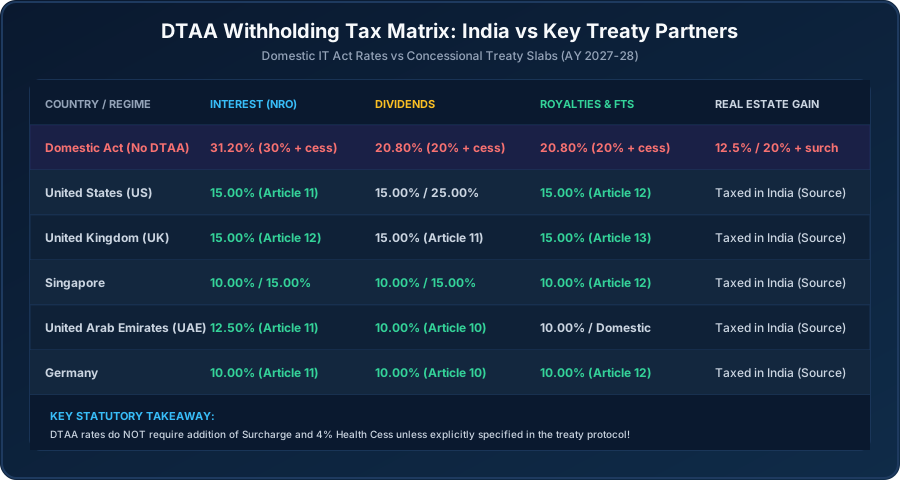
Figure 2: Concessional treaty withholding rates under bilateral DTAAs compared against Indian domestic Income-tax Act baselines.
11. Surcharge & Cess Treaty Exemption Precedents
A major point of direct tax litigation in India was whether the Income Tax Department could add Surcharge and 4% Health and Education Cess on top of the capped DTAA tax rate.
For example, if the US-India DTAA caps interest withholding at 15%, could the assessing officer demand 15% + 4% cess = 15.60%?
The Judicial Special Bench Verdict
In a watershed ruling by the Special Bench of the ITAT Mumbai in DCIT vs Concentrix Services India Pvt Ltd and subsequent High Court judgments:
- Under international tax law, taxes covered by the treaty encompass "income-tax including any surcharge thereon".
- The tax rate specified in a DTAA is a maximum all-inclusive ceiling.
- The Indian revenue authorities have no legal authority to enhance the treaty rate by adding domestic surcharges or education cesses unless the bilateral treaty protocol explicitly permits such enhancement.
- Therefore, when you claim 15% or 10% under DTAA, the payer deducts exactly 15.00% or 10.00% flat!
12. Real-World Computational Case Studies
Case Study 1: Silicon Valley Software Engineer Slashing NRO TDS
Aditya works in San Francisco on an H-1B visa and maintains an NRO fixed deposit of ₹50,00,000 (₹50 Lakh) with ICICI Bank, generating ₹3,50,000 annual interest.
- Without DTAA: ICICI Bank deducts domestic TDS @ 31.2% = ₹1,09,200. Net interest credited: ₹2,40,800.
- Aditya files Form 8802 with the US IRS, obtains Form 6166 (US TRC), and files Form 10F online on the Indian e-filing portal. He submits both forms along with a No-PE declaration to ICICI Bank.
- With DTAA (Article 11): The bank applies the treaty rate of 15% flat = ₹52,500. Net interest credited: ₹2,97,500.
- Annual Cash Savings: ₹56,700 credited directly to Aditya's bank account every year!
Case Study 2: Resident Indian Claiming FTC on US Stock Dividends
Sanjana, a Resident and Ordinarily Resident (ROR) in Bengaluru, holds shares in Microsoft and Nvidia. In FY 2026-27, she receives gross dividends of \$4,000 (approx. ₹3,36,000). The US broker withholds 25% US tax under the US-India treaty = \$1,000 (₹84,000), remitting \$3,000 net.
- Because Sanjana is an Indian resident, her worldwide income is taxable in India. Her marginal Indian tax slab is 30% (+ 4% cess = 31.2%).
- Indian tax liability on ₹3,36,000 dividend = ₹1,04,832.
- Sanjana files Form 67 on the e-filing portal before July 31, 2027, attaching her US Form 1042-S dividend statement.
- In her ITR-2, under Schedule FSI and Schedule TR, she claims Foreign Tax Credit (FTC) of ₹84,000 under Section 90.
- Net tax payable in India: ₹1,04,832 - ₹84,000 = ₹20,832. Total double taxation is completely avoided!
13. Frequently Asked Questions (FAQs)
Can an NRI claim DTAA relief if they do not have an Indian PAN?
Yes. Under Section 206AA(7) and Rule 37BC, a non-resident payee who does not possess a PAN is not subject to higher 20% TDS, provided they furnish their Name, Email ID, Contact Number, Foreign Address, Tax Residency Certificate (TRC), and Tax Identification Number in their home country. Furthermore, the CBDT has enabled non-residents without a PAN to register on the e-filing portal to submit electronic Form 10F.
How long is a Tax Residency Certificate (TRC) valid?
A TRC is issued for a specific tax year or calendar year. It is generally valid for one financial year. To maintain concessional DTAA withholding on NRO deposits, the non-resident must submit a renewed TRC and fresh Form 10F to their Indian bank at the start of every financial year.
Can a Non-Resident Indian claim DTAA benefits while filing their ITR?
Yes. Even if the bank or payer deducted tax at the full domestic rate of 31.2% because TRC was not submitted in time, the NRI can still claim treaty benefits at the time of filing their annual Income Tax Return (ITR-2) by reporting the lower treaty rate in Schedule FSI and Schedule TR, and claiming a refund of the excess tax deducted.
What is a "Permanent Establishment" (PE) and why is a No-PE declaration required?
A Permanent Establishment refers to a fixed place of business (such as a branch office, factory, or project site) through which the business of an enterprise is wholly or partly carried on in India. If an NRI or foreign entity has a PE in India, the concessional treaty rates on business profits, royalties, or technical fees are forfeited, and the income is taxed as domestic business profits under Section 44DA. A No-PE declaration certifies that no such establishment exists.
Does DTAA apply to capital gains on Indian mutual funds?
Under modern amended DTAAs (including treaties with Singapore, Mauritius, and Cyprus), capital gains arising from the sale of Indian shares and mutual funds are taxable in India in accordance with domestic capital gains tax rates (12.5% for LTCG post-Budget). Primary taxing rights on securities rest with the source state.