
1. Banking Architecture for the Global Diaspora
Every year, millions of Non-Resident Indians (NRIs), Persons of Indian Origin (PIOs), and Overseas Citizens of India (OCIs) remit over \$125 Billion into India, making India the largest recipient of cross-border remittances in the world. Whether these remittances are destined for family maintenance in Kerala, real estate acquisitions in Gurugram, or fixed deposits with Indian banks, the legal conduit through which these funds flow determines your tax exposure.
Under the Foreign Exchange Management Act (FEMA), 1999, it is illegal for a non-resident to operate an ordinary domestic resident savings account in India. To accommodate non-resident capital while protecting domestic monetary stability, the Reserve Bank of India (RBI) created three specialized account structures:
- NRE (Non-Resident External) Account: Designed for parking foreign earnings in Indian Rupees with 100% tax-free interest and unrestricted outward repatriation.
- NRO (Non-Resident Ordinary) Account: Designed for collecting and managing legitimate domestic earnings generated on Indian soil (such as rent, dividends, and asset sales), subject to Indian income tax and regulated outward remittance.
- FCNR(B) (Foreign Currency Non-Resident) Account: Designed for holding term deposits directly in major global currencies (USD, GBP, EUR), eliminating rupee depreciation risk while retaining tax-free status.
2. FEMA Regulations & RBI Master Directions
The opening, maintenance, and operation of NRI bank accounts are governed by the Foreign Exchange Management (Deposit) Regulations, 2016 (Notification No. FEMA 5(R)/2016-RB) issued by the Reserve Bank of India.
The fundamental statutory principle is segregation:
3. NRE Account: Tax-Free Yields & Free Repatriation
The Non-Resident External (NRE) account is the preferred savings and investment vehicle for overseas Indians sending earnings back home.
Key Legal Characteristics
- Rupee Denomination: While funds must originate in foreign currency (via wire transfer, SWIFT, foreign currency cash, or traveler's cheques), the funds are automatically converted into Indian Rupees (INR) at the prevailing exchange rate upon credit.
- Complete Tax Exemption under Section 10(4)(ii): Under Section 10(4)(ii) of the Income-tax Act, 1961, any income by way of interest earned on an NRE account by a person resident outside India under FEMA is completely exempt from income tax in India.
- Zero TDS: Authorized dealers (banks) do not deduct any Tax Deducted at Source (TDS) on interest paid on NRE savings accounts or NRE fixed deposits.
- Unrestricted Repatriability: Both the principal deposit and all accumulated interest are freely repatriable back to your overseas bank account at any time, with zero monetary caps and zero regulatory approvals. You do not need a Chartered Accountant's certificate to wire NRE funds abroad.
- Account Types: Available as Savings Bank accounts, Current accounts, Recurring Deposits (RD), and Fixed Term Deposits (FD).
4. NRO Account: Managing Indian Incomes & 30% TDS
When an Indian citizen relocates overseas, they rarely sever all financial ties with India. They may retain an ancestral flat that yields monthly rental income, hold dividend-paying shares in Indian companies, or receive state pensions. An NRE account cannot accept these funds. You must open a Non-Resident Ordinary (NRO) Account.
Key Legal Characteristics
- Rupee Denomination: NRO accounts are maintained in Indian Rupees.
- Permissible Credits: Accepts all legitimate rupee earnings originating in India: rental income, corporate dividends, pension credits, sale proceeds of immovable property, interest on domestic investments, and mutual fund redemptions. Inward remittances from abroad can also be credited to NRO accounts.
- Taxability of Interest: Interest earned on NRO savings balances and NRO fixed deposits is 100% taxable in India at your applicable income tax slab rates.
- Mandatory 30% TDS under Section 195: Banks are statutorily mandated to deduct TDS at the flat rate of 30% plus 4% Health and Education Cess = 31.2% on every rupee of interest paid on an NRO account, regardless of your total income. If your total Indian taxable income is below the basic exemption limit (₹3 Lakh), you must file an ITR to claim a refund of this deducted tax.
- Controlled Repatriation: Outward remittance from an NRO account to an overseas bank account is capped at USD 1,00,000 (USD 1 Million) per financial year and requires strict tax clearance via Form 15CA and Form 15CB.
5. FCNR(B) Account: Foreign Currency Shield
While NRE deposits offer attractive Indian interest rates (typically 6.5% to 7.5%), they expose overseas investors to Currency Depreciation Risk. If the Indian Rupee depreciates against the US Dollar by 3% to 4% annually, a significant portion of your nominal interest gains is wiped out when converted back into dollars.
To provide a risk-free foreign exchange alternative, the RBI introduced the Foreign Currency Non-Resident (Bank) [FCNR(B)] scheme.
Key Legal Characteristics
- Maintained in Foreign FX: The account is maintained entirely in designated freely convertible foreign currencies: USD, GBP, EUR, JPY, AUD, and CAD. Both principal and interest are denominated in that foreign currency.
- Zero Currency Risk: If you deposit \$100,000 in an FCNR deposit, your balance remains in US Dollars. You are 100% insulated from rupee fluctuations.
- Term Deposit Format Only: FCNR accounts can only be opened as Fixed Term Deposits for tenures ranging from 1 year to 5 years. Savings or checking accounts are not permitted.
- 100% Tax-Free under Section 10(15)(iv)(fa): Interest earned on FCNR deposits is completely exempt from income tax in India as long as the depositor maintains Non-Resident or RNOR status. Zero TDS is deducted by the bank.
- Freely Repatriable: On maturity, the principal and interest can be wired directly to any foreign bank account in the designated currency without regulatory restrictions.
6. Fund Flow & Repatriation Lifecycle Flowchart
The infographic below outlines the distinct inflow pathways, internal transfer rules, and outward cross-border repatriation conduits for NRE, NRO, and FCNR accounts:

Figure 1: Operational fund flow architecture illustrating sources of credit, tax withholding, and cross-border repatriation mechanisms.
7. The USD 1 Million Repatriation Protocol
Under RBI's Master Direction on Remittance Facilities (Section B of Master Direction No. 13/2015-16), NRIs and PIOs are permitted to remit through authorized dealer banks an aggregate amount up to USD 1,000,000 (USD 1 Million) per financial year (April to March) out of balances held in their NRO account.
Eligible Sources for the $1M Quota
- Net sale proceeds of immovable property (residential, commercial, or agricultural land) held in India.
- Inheritance or legacy distributions from parents or relatives.
- Accumulated rental incomes, dividends, and interest balances.
- Proceeds from liquidation of domestic mutual funds, shares, and insurance policies.
Inter-Account Transfer: You can transfer funds directly from your NRO account into your NRE account within this same USD 1 Million annual quota, provided applicable income taxes have been discharged. Once funds move into your NRE account, they become 100% tax-free and freely repatriable in all future years!
8. Form 15CA & Form 15CB CA Certification Guide
Before any bank can execute an outward wire transfer from an NRO account or transfer funds from NRO to NRE, the Income Tax Department mandates electronic verification to guarantee that no tax has been evaded. This is executed through Form 15CA and Form 15CB under Section 195(6) and Rule 37BB.
The Two-Step Compliance Architecture
- Form 15CB (Chartered Accountant Certificate): A practicing Indian Chartered Accountant examines the origin of the funds (e.g., registered sale deed, capital gains computation, tax payment challans) and certifies that all applicable income taxes have been paid or deducted at source. The CA uploads and digitally signs Form 15CB on the income tax portal.
- Form 15CA (Taxpayer Undertaking): Once Form 15CB is filed and its Acknowledgement Number is generated, the NRI logs into their e-filing portal and completes Form 15CA (Part C), cross-referencing the CA certificate.
- Bank Submission: The NRI submits the generated Form 15CA acknowledgement, Form 15CB copy, and FEMA A2 remittance application to the bank's foreign exchange desk. The bank verifies the documents and executes the outward wire remittance.
9. Lowering NRO TDS via DTAA & Form 10F
Suffering a flat 31.2% TDS deduction on NRO fixed deposits can significantly damage an investor's yield. However, if the NRI is a tax resident of a country with which India has signed a comprehensive Double Taxation Avoidance Agreement (DTAA), they can invoke treaty benefits to drastically reduce this withholding rate.
| NRI Country of Tax Residence | Domestic Section 195 TDS Rate | DTAA Concessional Interest Rate | Net Tax Savings on Interest |
|---|---|---|---|
| United States (US) | 31.20% (30% + cess) | 15.00% (Article 11) | 16.20% lower withholding |
| United Kingdom (UK) | 31.20% (30% + cess) | 15.00% (Article 12) | 16.20% lower withholding |
| Singapore | 31.20% (30% + cess) | 10.00% / 15.00% (Article 11) | Up to 21.20% lower withholding |
| United Arab Emirates (UAE) | 31.20% (30% + cess) | 12.50% (Article 11) | 18.70% lower withholding |
| Canada | 31.20% (30% + cess) | 15.00% (Article 11) | 16.20% lower withholding |
Mandatory Documentation for DTAA Relief
- Tax Residency Certificate (TRC): Obtained from the tax revenue authority of your country of residence (e.g., Form 6166 from US IRS, HMRC certificate from UK, FTA tax residency certificate from UAE).
- Electronic Form 10F: Filed online on the Indian Income Tax e-filing portal under Section 90(5).
- No PE Declaration: A formal self-declaration confirming that the NRI has no permanent establishment or fixed place of business in India.
10. NRE vs NRO vs FCNR Comparative Feature Matrix
The comparison table below provides a quick side-by-side reference across all legal, operational, and taxation parameters:
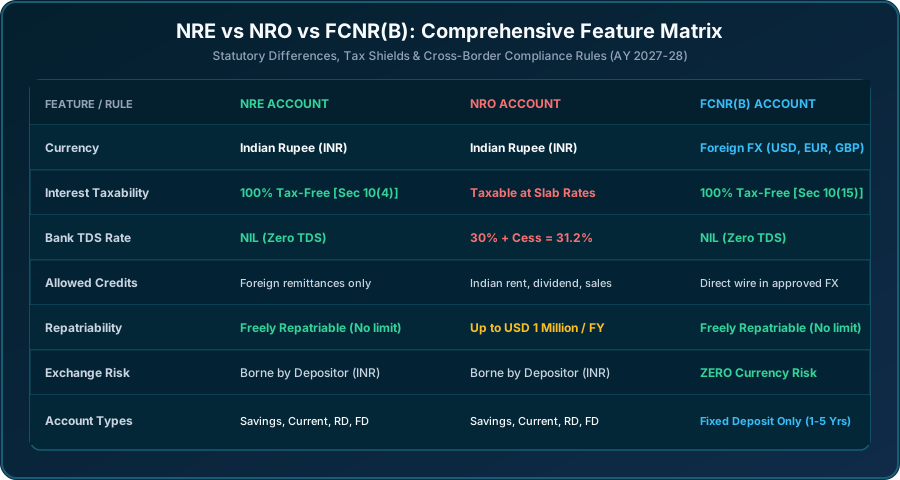
Figure 2: Comprehensive matrix comparing operational features, tax rates, and regulatory restrictions across NRE, NRO, and FCNR(B) accounts.
11. Joint Accounts with Resident Relatives
Many overseas Indians want their aging parents or resident spouse in India to operate their bank accounts for domestic household bills, medical emergencies, or real estate maintenance.
FEMA Joint Holding Protocols
- NRE Accounts: An NRI can open an NRE account jointly with an Indian resident close relative (as defined under Section 2(77) of the Companies Act, 2013: spouse, parents, children, siblings). However, the account must operate on a 'Former or Survivor' basis. The resident relative can only operate the account under a registered Power of Attorney (PoA) during the NRI's lifetime or become the sole owner upon the demise of the NRI.
- NRO Accounts: An NRO account can be held jointly with a resident Indian relative on a 'Former or Survivor' or 'Either or Survivor' basis, allowing the resident relative full convenience in issuing domestic cheques.
- PoA Mandate Restrictions: A resident PoA holder cannot gift funds from an NRE/NRO account, transfer funds to their own personal account, or remit funds abroad to third parties.
12. Returning to India: RFC Accounts & Re-designation
When an NRI returns to India permanently with the intention to reside indefinitely, their status under FEMA shifts from Non-Resident to Person Resident in India.
Mandatory Banking Re-designations
- Notify Banks Immediately: The returning NRI must formally inform all banking branches of their change in residential status.
- NRO Accounts: Automatically re-designated as standard domestic resident savings accounts.
- NRE Accounts: Must either be converted into resident savings accounts or transferred into a Resident Foreign Currency (RFC) Account.
- FCNR Deposits: Can be held until their contracted maturity date at the agreed foreign interest rate. On maturity, the proceeds must be converted to an RFC account or resident rupee deposit.
- The RFC Advantage: RFC accounts allow returning NRIs to maintain foreign currency balances (USD, GBP, EUR) indefinitely. During their RNOR status phase (1 to 3 years), interest earned on RFC accounts is completely tax-free under Section 10(15)(iv)(fa)!
13. Real-World Computational Case Studies
Case Study 1: Monetizing Ancestral Property and Repatriating Funds
Sundeep, a US citizen and OCI living in Chicago, sells his inherited residential flat in Chennai for ₹2,40,00,000 (approx. \$288,000). After paying capital gains tax under Section 195, the net post-tax balance of ₹2,10,00,000 is credited into his NRO account.
- Because the total sum is well within the annual USD 1,00,000 (USD 1 Million) quota, Sundeep is eligible to repatriate the entire ₹2.10 Crore to his Chase Bank account in the US.
- Sundeep engages an Indian CA who verifies the sale deed, capital gains tax challans, and computes tax compliance, generating Form 15CB.
- Sundeep files Form 15CA (Part C) on the e-filing portal and submits both forms to SBI Foreign Exchange branch.
- The bank executes the wire transfer. Sundeep receives \$252,000 in Chicago seamlessly without foreign exchange delays.
Case Study 2: Protecting Against Rupee Depreciation via FCNR
Pooja works as an investment banker in London. She has £50,000 of surplus savings to park for 3 years.
- Option A (NRE Rupee FD): Convert £50,000 to INR at ₹108/£ = ₹54,00,000 @ 7.0% p.a. tax-free. If the Rupee depreciates to ₹120/£ at Year 3, her terminal wealth in GBP is: ₹66,15,000 / 120 = £55,125 (Effective GBP CAGR: ~3.3%).
- Option B (FCNR Deposit in GBP): Invest £50,000 directly in a GBP FCNR term deposit @ 5.0% p.a. tax-free. Her terminal wealth at Year 3 is: £50,000 × (1.05)3 = £57,881.
- Outcome: By choosing the FCNR route, Pooja completely eliminates currency depreciation risk and earns £2,756 higher net wealth in her home currency!
14. Frequently Asked Questions (FAQs)
Can I transfer money from my NRE account to my NRO account?
Yes. Transfer of funds from an NRE account to an NRO account is freely permitted without any limit or regulatory clearance. However, moving money from an NRO account to an NRE account is treated as an outward remittance and requires Form 15CA and Form 15CB certification within the USD 1 Million annual quota.
What happens if I forget to convert my resident account to NRO after becoming an NRI?
Operating a resident savings account while being a non-resident violates Section 10(6) of FEMA, 1999. In case of scrutiny, the RBI can impose a compounding penalty up to three times the amount involved or ₹2,00,000 where the amount is not quantifiable. You should immediately write to your bank branch requesting designation to an NRO account.
Are cash deposits allowed in NRE and NRO accounts?
In NRE accounts, cash deposits are permitted only if they are in foreign currency physically brought into India by the account holder during travel and declared under a Currency Declaration Form (CDF) if exceeding \$5,000 in cash or \$10,000 total. In NRO accounts, domestic INR cash deposits are permitted subject to standard bank AML thresholds.
Can an NRI invest in Indian mutual funds and stocks through NRE/NRO accounts?
Yes. NRIs can invest in Indian equities and mutual funds on a repatriable basis using an NRE account (through a Portfolio Investment Scheme - PINS or Non-PINS demat account), or on a non-repatriable basis using an NRO account. Redemptions from NRE investments are credited to NRE and remain freely repatriable.
Is an NRI required to file an ITR in India if they only have an NRE account?
No. If an NRI's only income in India is interest from NRE or FCNR accounts, they are not required to file an Indian Income Tax Return (ITR), because this interest is 100% exempt from income tax under Section 10(4)(ii). An ITR is mandatory only if their taxable Indian-sourced income (from NRO interest, rent, capital gains, etc.) exceeds the basic exemption limit.