Returning NRIs (RNOR Status): Section 6(6) Tax Holidays, Global Income Exemption & Cross-Border Wealth Structuring (FY 2026-27)

Executive Strategic Overview
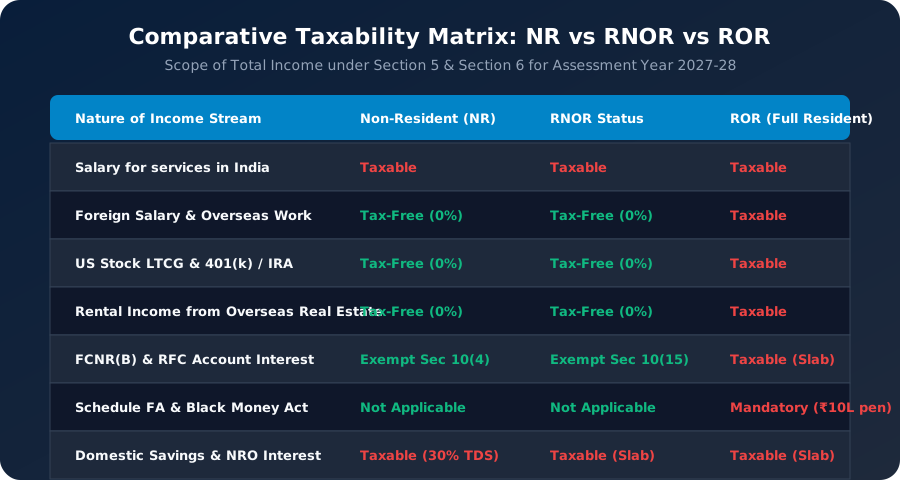
Relocating permanently to India after years of working in the United States, United Kingdom, Middle East, or Singapore triggers a seismic shift in tax liability. While Indian tax residents are subject to worldwide taxation on global income, the Indian Parliament codified an indispensable transition shelter known as Resident but Not Ordinarily Resident (RNOR) status under Section 6(6) of the Income Tax Act, 1961. For a period of one to three financial years, an RNOR taxpayer is treated virtually as a Non-Resident for foreign income purposes: overseas rental receipts, foreign stock dividends, capital gains from selling US/EU equities, and foreign pension withdrawals (such as 401(k) or IRA) remain 100% exempt from Indian income tax. Furthermore, RNORs are completely excused from filing the dreaded Schedule FA (Foreign Assets) under the Black Money Act. This comprehensive guide dissects the exact mathematical tests under Section 6(6), the scope of total income under Section 5(1), FCNR(B) and RFC account tax exemptions, and optimal asset liquidations before transitioning to full residency.
Table of Contents
- The Three-Tier Tax Residency Framework under Section 6
- Step 1: The Basic Residency Test under Section 6(1)
- Step 2: The RNOR Statutory Qualification Tests under Section 6(6)
- Special Deemed Residency & 120-Day Rule RNOR Provisions (Finance Act 2020 Amendments)
- Scope of Total Income under Section 5(1): The Proviso Shield
- Banking Privileges: Section 10(15)(iv)(fa) FCNR(B) & RFC Account Interest
- Immunity from Schedule FA & Black Money Act Disclosures
- Strategic Wealth Restructuring: US 401(k), IRAs, RSUs & Foreign Portfolios
- Common Traps: NRO Accounts, Remittance Timing & Business Ties
- The Cliff Edge: Transitioning into Full Resident (ROR) Status
- Frequently Asked Questions (FAQ)
1. The Three-Tier Tax Residency Framework under Section 6
Unlike the United States, which taxes citizens on worldwide income irrespective of where they live (citizenship-based taxation), India enforces a strictly physical residency-based tax regime under Section 6 of the Income Tax Act, 1961. For direct tax purposes, individual taxpayers are classified into three distinct categories every financial year:
- Non-Resident (NR): Taxed solely on income received, accruing, or arising within India. Foreign income is 100% tax-free.
- Resident but Not Ordinarily Resident (RNOR): A hybrid transitional status. Taxed on Indian-sourced income, but foreign-sourced income remains completely immune from Indian direct tax (subject to a narrow exception for Indian-controlled businesses).
- Resident and Ordinarily Resident (ROR): Fully exposed to Indian tax jurisdiction. Worldwide global income—from Tokyo to Toronto—is taxed at progressive Indian slab rates, and all global assets must be meticulously disclosed in the annual tax return.
The RNOR category is a deliberate statutory buffer designed to give returning expatriates adequate breathing room to organize their global financial affairs, close overseas accounts, or repatriate assets before entering the worldwide tax net of ROR.
2. Step 1: The Basic Residency Test under Section 6(1)
Before examining whether an individual is "Not Ordinarily Resident", one must first establish whether they are a Resident under Section 6(1). An individual is an Indian tax resident in FY 2026-27 if they satisfy either of the following two basic conditions:
- Condition A (182-Day Rule): The individual is physically present in India for an aggregate period of 182 days or more during the financial year (1 April 2026 to 31 March 2027); OR
- Condition B (60-Day + 365-Day Rule): The individual is in India for 60 days or more during the financial year, AND has been in India for 365 days or more during the 4 preceding financial years.
3. Step 2: The RNOR Statutory Qualification Tests under Section 6(6)
Once an individual crosses the residency threshold under Section 6(1), they are evaluated against the statutory filters of Section 6(6) to determine whether they are "Not Ordinarily Resident". Under Section 6(6)(a), a resident individual becomes an RNOR if they satisfy EITHER of the following dual historical conditions:
Condition 1: The 9-out-of-10 Years Non-Resident Test
The individual has been a Non-Resident in India in at least 9 out of the 10 financial years preceding the current financial year.
Practical Application: If a software architect worked in California from 2015 to 2025 (qualifying as a Non-Resident for all 10 years) and returns to Bengaluru in July 2026, they satisfy this condition effortlessly because they were a non-resident in 10 out of the 10 preceding years. They immediately qualify as an RNOR.
Condition 2: The 729-Day Physical Presence Test
The individual has been physically present in India for an aggregate period of 729 days or less during the 7 financial years preceding the current financial year.
Practical Application: Even if an individual was technically a resident in 2 out of the past 10 years (for example, during an earlier temporary sabbatical in India), but their total cumulative stay in India across the preceding 7 years was only 450 days (less than or equal to 729 days), they still qualify as an RNOR. Meeting either Condition 1 or Condition 2 is sufficient.
How Long Does the RNOR Tax Holiday Last?
For an expatriate who has lived outside India for 8 to 10 continuous years, RNOR status typically lasts for two to three consecutive assessment years:
- Year of Return (FY 1): The individual returns mid-year (e.g., September). They are resident under the 182-day or 60+365 day rule, but RNOR because they were NR in 9 of past 10 years and stayed ≤ 729 days. (RNOR Status: Yes).
- First Full Year in India (FY 2): The individual resides in India for the full 365 days. In the preceding 10 years, they were still NR in 8 or 9 years, and their stay in the preceding 7 years was around 200–365 days (well below 729 days). (RNOR Status: Yes).
- Second Full Year in India (FY 3): In the preceding 7 years, their cumulative stay now includes 365 days from FY 2 plus days from FY 1. Depending on the exact arrival date, cumulative stay may remain ≤ 729 days. (RNOR Status: Often Yes).
- Third Full Year in India (FY 4): Cumulative days in preceding 7 years now exceed 729 days, and the individual was a resident in more than 1 of the past 10 years. (Status: Turns ROR).

4. Special Deemed Residency & 120-Day Rule RNOR Provisions (Finance Act 2020 Amendments)
Parliament introduced significant anti-abuse amendments via the Finance Act, 2020 to prevent high-net-worth "tax nomads" from arranging their travel to avoid tax in all jurisdictions. These provisions created two new pathways into RNOR status:
A. The 120-to-181 Days Rule (Section 6(6)(c))
Under the amended explanation to Section 6(1)(b), if an Indian citizen or PIO residing abroad visits India and has total Indian-sourced income (other than foreign source income) exceeding ₹15 Lakh during the financial year, the period of 182 days is reduced to 120 days.
If such an individual stays in India for 120 days or more but less than 182 days (and has stayed 365 days in the 4 preceding years), they are deemed to be a resident. However, by virtue of Section 6(6)(c), they are automatically classified as an RNOR. Their foreign income remains completely safe from Indian taxation!
B. Deemed Residency under Section 6(1A) & Section 6(6)(d)
Under Section 6(1A), an individual who is an Indian citizen shall be deemed to be an Indian resident if:
- Their total Indian-sourced income (excluding foreign sources) exceeds ₹15 Lakh; AND
- They are not liable to tax in any other country or territory by reason of their domicile, residence, or any other criteria of similar nature (e.g., NRIs residing in zero-tax jurisdictions like Dubai, Qatar, Kuwait, or Oman).
Crucially, under Section 6(6)(d), any individual who becomes a deemed resident solely by virtue of Section 6(1A) is statutorily categorized as an RNOR. Consequently, the Indian government cannot tax their UAE salary, Gulf business profits, or international investment portfolio. Only their income earned inside India (such as Indian rental income, domestic mutual fund gains, or Indian bank interest) is taxed.
5. Scope of Total Income under Section 5(1): The Proviso Shield
The true financial power of RNOR status is enshrined in Section 5(1) of the Income Tax Act. Section 5 defines the scope of total income for resident individuals. While Section 5(1)(c) provides that a resident is taxable on income that accrues or arises outside India, it contains a historic legislative proviso:
This single statutory sentence creates a comprehensive tax shelter for returning NRIs. During your RNOR tenure:
- Overseas Salary: Salary received in an overseas bank account for employment exercised outside India prior to relocating is 0% taxable in India.
- Foreign Capital Gains: Gains realized from selling shares on the NASDAQ, NYSE, London Stock Exchange, or selling real estate in Singapore or Dubai are 0% taxable in India.
- Foreign Dividends & Interest: Dividends received from foreign corporations and interest earned in US, UK, or Swiss bank accounts are 0% taxable in India.
- Overseas Pension / Social Security: US Social Security benefits or foreign corporate pension distributions are 0% taxable in India.
The Lone Exception: If an RNOR owns an overseas company or consulting firm, and the effective control and management of that overseas business is exercised from their desk in Bengaluru or Mumbai, the profits of that foreign entity become taxable in India.
6. Banking Privileges: Section 10(15)(iv)(fa) FCNR(B) & RFC Account Interest
Under FEMA guidelines issued by the Reserve Bank of India, once an NRI returns to India with the intention of staying indefinitely, they can no longer maintain Non-Resident External (NRE) accounts or Foreign Currency Non-Resident (Bank) [FCNR(B)] deposits. These accounts must be designated as resident accounts or transferred into a Resident Foreign Currency (RFC) Account.
However, the Income Tax Act provides special statutory tax exemptions for these funds during the RNOR period:
1. FCNR(B) Deposit Interest Tax Exemption
Under Section 10(15)(iv)(fa) of the Income Tax Act, interest on deposits held by an individual who is a "Resident but Not Ordinarily Resident" in an authorized bank is completely exempt from Indian income tax. Even though you are physically living in India, the interest earned on your multi-year foreign currency fixed deposits remains 100% tax-free until the deposit matures or until your RNOR status expires.
2. Resident Foreign Currency (RFC) Account Benefits
Returning NRIs are permitted under FEMA to open and maintain RFC accounts denominated in foreign currencies (USD, GBP, EUR, AUD). Funds in RFC accounts can be freely repatriated abroad without any RBI approval. Under Section 10(15)(iv)(fa), the interest earned on RFC accounts is 100% tax-free as long as you maintain RNOR status. This eliminates foreign exchange conversion risk and shields high-yielding dollar deposits from Indian slab rates.
7. Immunity from Schedule FA & Black Money Act Disclosures
One of the most intimidating compliance minefields in the Indian Income Tax Return (ITR-2 or ITR-3) is Schedule FA (Foreign Assets). Under the Black Money (Undisclosed Foreign Income and Assets) and Imposition of Tax Act, 2015, any resident taxpayer who fails to report foreign bank accounts, shares, retirement accounts, or property in Schedule FA is subject to a flat ₹10,00,000 penalty per assessment year under Section 43, alongside potential criminal prosecution under Section 50.
The RNOR Statutory Exemption: The CBDT e-filing portal and the statutory rules governing Schedule FA explicitly restrict foreign asset disclosure mandates to individuals who are "Resident and Ordinarily Resident" (ROR).
8. Strategic Wealth Restructuring: US 401(k), IRAs, RSUs & Foreign Portfolios
Savvy cross-border wealth planners treat the RNOR window as a non-renewable "golden tax corridor". Once your RNOR status lapses into ROR, every dollar earned or realized overseas will be added to your Indian taxable income and taxed at up to 39% under the Old Tax Regime or 30% + surcharge under the New Tax Regime.
Here is how to strategically structure your foreign balance sheet during your RNOR years:
A. Rebalancing US Equities & Stepping Up Cost Basis
If you hold appreciated tech stocks (Apple, Microsoft, Nvidia, Google) in a US brokerage account, selling them after turning ROR triggers Indian capital gains tax (20% or 12.5% depending on holding period) plus US non-resident tax. During your RNOR period, selling these shares triggers zero Indian income tax under Section 5(1). You can realize long-term gains, pay the applicable US federal tax (or zero if you are an NRA for US tax purposes with no US-source capital gains), and immediately repurchase them, thereby stepping up your cost basis to current market prices.
B. 401(k) and Traditional IRA Distributions
When you withdraw from a US 401(k) or traditional IRA as an Indian ROR, the gross distribution is fully taxed in India as salary/pension income at your marginal slab rate. During the RNOR window, foreign retirement withdrawals are completely non-taxable in India. If you anticipate needing liquidity, taking planned distributions during RNOR ensures you pay only the US mandatory 30% withholding (or treaty rate), completely eliminating the top-up Indian tax.
C. Section 89A Relief for Retirement Accounts
If you choose not to liquidate your 401(k) or IRA during RNOR, ensure that you invoke Section 89A and Rule 21AAA by filing Form 10-EE on the Indian tax portal in the year you transition to ROR. This defers Indian tax on retirement fund earnings until the year of actual withdrawal, avoiding annual phantom taxation on undistributed retirement dividends.
D. Repatriating Capital into RFC Accounts
Instead of converting foreign exchange into Indian Rupees immediately, repatriate your liquidated foreign capital into a US Dollar or Euro-denominated RFC Account in India. This allows you to earn tax-free interest under Section 10(15)(iv)(fa) while protecting your capital against rupee depreciation.
9. Common Traps: NRO Accounts, Remittance Timing & Business Ties
Despite the immense benefits of RNOR status, returning NRIs frequently blunder into severe tax liabilities through procedural oversights:
- The Direct Remittance Mistake (Section 5(1)(a)): Income is taxable in India if it is received in India. If your overseas client, employer, or tenant wires foreign salary or foreign rent directly into your bank account in Mumbai, the income is legally received in India upon its first arrival, rendering it fully taxable in India, even for an RNOR! Always ensure that foreign income is first credited into an overseas bank account (e.g., Chase, HSBC UK, DBS Singapore) and subsequently transferred to India as an internal capital transfer.
- Failure to Redesignate Bank Accounts: Under Section 10(4) of the Income Tax Act, interest on NRE accounts is exempt only for persons resident outside India under FEMA. Under FEMA Section 2(v), once you return to India with the intention of permanent stay, you become a resident on Day 1 under FEMA (even while remaining an RNOR under income tax). You must instruct your bank to convert NRE accounts to RFC or resident savings accounts. Holding onto NRE accounts illegally invites FEMA Section 13 penalties (up to 3x the funds).
- Ignoring Indian Sourced Income: Remember that RNOR protects only foreign-sourced income. Your domestic Indian income (rental from properties in Delhi, dividends from domestic shares, Indian bank interest) is fully taxable at regular Indian slab rates. You must file an Indian ITR if your Indian income exceeds the basic exemption limit.
10. The Cliff Edge: Transitioning into Full Resident (ROR) Status
In your third or fourth financial year in India, the RNOR shield will inevitably expire. You will be categorized as Resident and Ordinarily Resident (ROR). As an ROR:
- Worldwide Tax Exposure: Every dollar of global income must be aggregated into your Indian ITR under Section 5(1).
- Mandatory Schedule FA Filing: Every foreign bank account, overseas demat account, ESOP/RSU vesting, insurance policy, and foreign immovable property must be disclosed with peak balances and closing values converted to INR at SBI TT buying rates.
- DTAA Foreign Tax Credit (FTC): To avoid double taxation on foreign income that faced withholding in the US or UK, you must file Form 67 on or before the due date under Section 139(1) to claim tax relief under Section 90.
11. Frequently Asked Questions (FAQ)
What are the statutory tests to qualify for RNOR status under Section 6(6)?
An individual who has become a resident in India will qualify as a 'Resident but Not Ordinarily Resident' (RNOR) under Section 6(6) if they satisfy either of two conditions: (1) they were a Non-Resident in India in 9 out of the 10 financial years preceding the relevant year, OR (2) their physical presence in India was 729 days or less during the 7 financial years preceding the relevant year.
How is an RNOR taxed on overseas income under Section 5(1)?
Under the proviso to Section 5(1)(c) of the Income Tax Act, an RNOR is NOT liable to Indian income tax on income that accrues or arises outside India, unless that income is derived from a business controlled in or a profession set up in India. Foreign salaries, overseas rental income, US stock dividends, and overseas capital gains are 100% tax-free in India during the RNOR period.
How long does the RNOR tax holiday typically last for a returning NRI?
For an NRI who has lived overseas for a decade or more and returns permanently to India, the RNOR status typically lasts for 2 to 3 consecutive assessment years, depending on the exact date of return and the cumulative physical day-count in the preceding 7 years.
Is an RNOR required to report foreign assets in Schedule FA of the ITR?
No. The mandatory reporting of foreign assets, foreign bank accounts, and foreign trust interests in Schedule FA (Foreign Assets) of the ITR under the Black Money Act applies strictly to 'Residents and Ordinarily Residents' (ROR). RNORs and Non-Residents are legally exempt from filing Schedule FA.
Is interest earned on FCNR(B) and RFC accounts tax-free for an RNOR?
Yes. Under Section 10(15)(iv)(fa) of the Income Tax Act, interest on Foreign Currency Non-Resident (FCNR(B)) deposits and Resident Foreign Currency (RFC) accounts held with an authorized bank in India is completely exempt from Indian income tax for individuals enjoying RNOR status.
How should a returning NRI handle their US 401(k) or IRA during the RNOR window?
Because foreign-source retirement withdrawals are completely tax-free in India during the RNOR status, returning techies often utilize this window to take strategic distributions or convert traditional 401(k)/IRAs to Roth IRAs, paying only US federal tax while avoiding future 30%+ Indian slab taxation once they turn ROR.
Explore Related NRI & Tax Planning Calculators
Optimize your salary, simulate take-home pay, and model tax burdens across Old and New Regimes:
Expat & Cross-Border Wealth Desk
Authored by international direct tax attorneys and cross-border chartered accountants at PercentageCalculatorTool. All legal citations reflect the Income Tax Act, 1961, Finance Acts up to 2026, and RBI FEMA guidelines for Assessment Year 2027-28.