Schedule FA (Foreign Assets Reporting) in ITR: Comprehensive Rules, Table A1–G Guide, US Stock RSUs/ESOPs, and Black Money Act ₹10 Lakh Penalties

Executive Compliance Snapshot: Schedule FA (AY 2027-28)
If you are a Resident and Ordinarily Resident (ROR) in India and own even a single share of a foreign MNC (like Google, Microsoft, Apple, or Meta via employee stock plans), hold a checking account from a prior overseas stint, or trade on global brokerages (Schwab, E*TRADE, Interactive Brokers), filling Schedule FA (Foreign Assets) in ITR-2 or ITR-3 is non-negotiable. Omission can trigger a crippling ₹10,00,000 penalty under Section 43 of the Black Money (Undisclosed Foreign Income and Assets) and Imposition of Tax Act, 2015—even if all your capital gains were already reported and tax was paid!
Table of Contents
- 1. Applicability: Who Must Report and Who is Exempt?
- 2. The Draconian Black Money Act, 2015: Section 42 & 43 Penalties
- 3. Budget 2024 ₹20 Lakh Safe Harbour De-Minimis Relief
- 4. The Calendar Year Trajectory: Why Jan-Dec Governs Schedule FA
- 5. Detailed Table-by-Table Reporting Guide (Tables A1 to G)
- 6. Tech Professionals Special: How to Report US RSUs, ESPPs, and Vested Shares
- 7. Currency Conversion Rules: SBI TT Buying Rate Standards
- 8. Interplay Between Schedule FA, Schedule FSI, and Schedule TR (Form 67)
- 9. Frequently Asked Questions (FAQs)
1. Applicability: Who Must Report and Who is Exempt?
The Income Tax Department of India requires complete transparency regarding assets and income situated outside India. However, the mandate to disclose foreign holdings is strictly tied to your residential status under Section 6 of the Income-tax Act, 1961.
The reporting obligation in Schedule FA applies exclusively to:
- Resident and Ordinarily Resident (ROR) Individuals: Any individual who satisfies the basic stay conditions (182 days in India, or 60 days plus 365 days over the preceding 4 years) and fulfills both resident tests under Section 6(6).
- Hindu Undivided Families (HUFs), Firms, and Domestic Companies that qualify as resident entities in India during the relevant financial year.
If your tax status is Non-Resident Indian (NRI) or Resident but Not Ordinarily Resident (RNOR), you are 100% exempt from disclosing your foreign assets or accounts in Schedule FA. Even if an RNOR earns substantial global dividends or holds extensive real estate in the US, UK, or UAE, Indian law does not compel disclosure in Schedule FA. Only global income that accrues or arises directly in India is taxable for NRIs and RNORs.
Furthermore, taxpayers who hold foreign assets are disqualified from filing simplified forms such as ITR-1 (Sahaj) or ITR-4 (Sugam). If you own any foreign asset, share, or bank account, you must mandatorily file either ITR-2 (for salaried individuals and capital gains earners) or ITR-3 (for business and professional income earners), regardless of how modest your annual total income may be.
2. The Draconian Black Money Act, 2015: Section 42 & 43 Penalties
Many software engineers and corporate executives in technology hubs like Bengaluru, Hyderabad, Gurugram, and Pune assume that if tax on their foreign employee stock purchase plan (ESPP) or restricted stock units (RSUs) has already been deducted at source by their Indian employer under Section 192 (as perquisite tax in Form 16), they do not need to report the underlying foreign brokerage account. This misunderstanding carries devastating financial and legal consequences.
Foreign asset non-disclosure is governed not by ordinary Income-tax Act penalty provisions, but by the far harsher Black Money (Undisclosed Foreign Income and Assets) and Imposition of Tax Act, 2015.
| Black Money Act Provision | Trigger Event | Statutory Penalty / Liability |
|---|---|---|
| Section 42 | Failure to file ITR or failure to disclose foreign assets in Schedule FA | Flat penalty of ₹10,00,000 per assessment year |
| Section 43 | Furnishing inaccurate particulars or incomplete disclosure in Schedule FA | Flat penalty of ₹10,00,000 per assessment year |
| Section 41 & Section 50 | Willful evasion of tax or undisclosed foreign income/assets | Tax @ 30% + Penalty @ 90% (Total 120%) + Rigorous Imprisonment (3 to 10 Years) |
Crucially, appellate tribunals and High Courts have repeatedly upheld that the penalty under Section 43 is attracted by the mere failure to report the asset, regardless of whether any taxable income was generated or concealed. The automated exchange of information (AEOI) under FATCA and the OECD Common Reporting Standard (CRS) provides the Central Board of Direct Taxes (CBDT) with direct electronic data feeds from over 100 foreign tax jurisdictions, enabling algorithmic matching of foreign accounts against Indian ITRs.

Figure 1: Systematic workflow for identifying foreign holdings, selecting the correct Schedule FA sub-table, and validating compliance against Black Money Act standards.
3. Budget 2024 ₹20 Lakh Safe Harbour De-Minimis Relief
Recognizing the unintended harassment caused to mid-level technology professionals, returning students, and salaried employees holding modest foreign stock plans or dormant student checking accounts abroad, the Finance Act, 2024 introduced a long-overdue humane amendment to Sections 42 and 43 of the Black Money Act.
With effect from October 1, 2024 (and fully operational for Assessment Year 2027-28), no penalty of ₹10 Lakh shall be leviable under Section 42 or Section 43 if the foreign asset (other than immovable real estate) consists of one or more bank accounts or equity investments where the aggregate peak balance or investment value did not exceed ₹20,00,000 (Twenty Lakh Rupees) at any time during the relevant accounting period.
While this amendment saves innocent salaried professionals from draconian ₹10 Lakh fines for forgetting a \$50 dormant Wells Fargo checking account or a fractional RSU grant, taxpayers must understand that disclosure itself remains mandatory. The ₹20 Lakh threshold is an immunity from the automated ₹10 Lakh penalty; it does not exempt an ROR from the statutory duty to file Schedule FA under Section 139(1) of the Income-tax Act.
4. The Calendar Year Trajectory: Why Jan–Dec Governs Schedule FA
One of the most perplexing traps in the entire Indian tax return filing process is the mismatch in accounting periods between the domestic tax schedules and Schedule FA.
While your salary, domestic capital gains, and business turnover are calculated according to the Indian Financial Year (1st April to 31st March), Schedule FA strictly follows the "Relevant Accounting Period" recognized by the foreign jurisdiction. In the vast majority of international financial centers—including the United States, the United Kingdom, Canada, Singapore, and European Union member states—the financial accounting cycle coincides with the standard Calendar Year (1st January to 31st December).
| Filing Parameter | Standard ITR Schedules (Salary, CG, Other Sources) | Schedule FA (Foreign Assets Reporting) |
|---|---|---|
| Governing Accounting Period | Financial Year: 1-Apr-2026 to 31-Mar-2027 | Calendar Year: 1-Jan-2026 to 31-Dec-2026 |
| Peak Value Window | Highest balance between April 2026 and March 2027 | Highest balance between 1-Jan-2026 and 31-Dec-2026 |
| Closing Balance Date | Value as of 31st March 2027 | Value as of 31st December 2026 |
| Dividend & Interest Timing | Received between 1-Apr-2026 and 31-Mar-2027 | Gross credited between 1-Jan-2026 and 31-Dec-2026 |
For example, if you acquired US tech shares via an employee stock purchase plan in February 2027, those shares do NOT belong in Schedule FA for Assessment Year 2027-28 (which covers the 2026 calendar year). They will be disclosed in Schedule FA for Assessment Year 2028-29 (covering the 2027 calendar year). Conversely, any foreign asset you held or acquired during calendar year 2026 must be reported, even if you liquidated it completely before March 31, 2027.
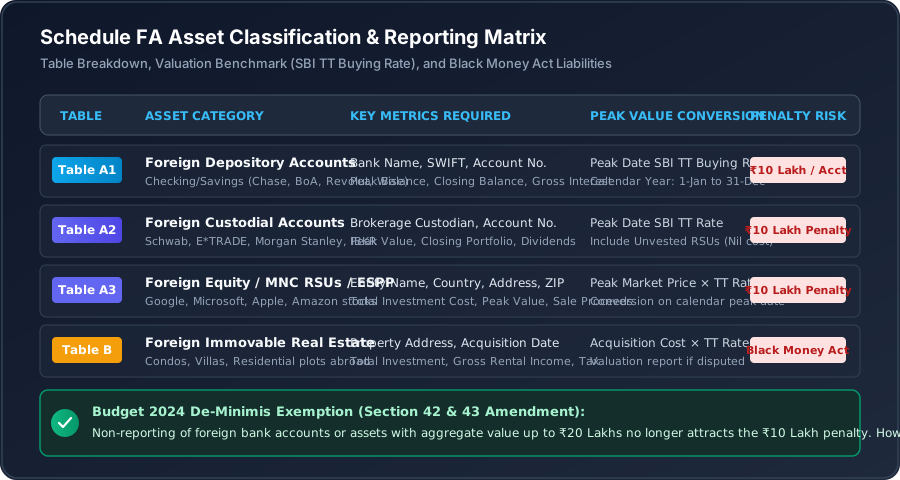
Figure 2: Classification matrix across Tables A1 through B, valuation standards, conversion benchmarks, and Black Money Act statutory penalty exposure.
5. Detailed Table-by-Table Reporting Guide (Tables A1 to G)
Schedule FA is divided into multiple distinct sub-tables. Correct classification is essential to ensure that automated CBDT parsing algorithms do not flag your return for scrutiny.
Table A1: Foreign Depository Accounts
This table captures foreign bank checking accounts, savings deposits, certificates of deposit, and digital foreign payment wallets (such as Revolut or Wise multicurrency balances). You must furnish:
- Country code and name of the banking institution.
- Address of the bank branch, ZIP code, and SWIFT/BIC code.
- Account number and date of opening.
- Peak balance during the calendar year (converted to INR at the SBI TT buying rate on the peak date).
- Closing balance as of December 31.
- Gross interest earned during the calendar year and whether it is offered to tax in Schedule OS (Income from Other Sources).
Table A2: Foreign Custodial Accounts
This table is designed for overseas brokerage accounts that hold equities, mutual funds, or debt securities on your behalf (such as Charles Schwab, Morgan Stanley Smith Barney, E*TRADE, Fidelity, or Interactive Brokers LLC). The fields mirror Table A1, requiring the custodian name, depository account number, peak portfolio market value, closing balance, and gross dividend or capital distributions received.
Table A3: Foreign Equity and Debt Interests
This table is where tech workers report their direct shareholdings in foreign parent corporations (e.g., Apple Inc., Microsoft Corporation, Alphabet Inc., Amazon.com Inc.). Crucially, each company’s shares must be entered as a distinct line item. Required details include:
- Entity name, registered address, and jurisdiction.
- Initial cost of investment (in INR at historical conversion rate).
- Peak value of the investment during the calendar year.
- Closing fair market value as of December 31.
- Total gross proceeds from any shares sold during the calendar year.
Table A4: Foreign Cash Value Insurance or Annuity Contracts
Captures overseas life insurance policies or annuity contracts having cash surrender value or maturity proceeds held with non-resident insurance corporations.
Table B: Financial Interest in Any Foreign Entity
Applies to taxpayers who hold an ownership interest, partnership stake, or directorship in an overseas startup, LLC, private limited entity, or joint venture abroad.
Table C & D: Immovable Real Estate & Other Capital Assets
Covers residential apartments, holiday homes, commercial land, yachts, physical bullion, or intellectual property held outside India.
Table E, F & G: Signing Authority, Trusts, and Other Sources
Table E captures bank accounts where you have signing power (e.g., as an authorized corporate signatory for an overseas subsidiary) without having beneficial ownership. Table F covers foreign trusts (where you are a settlor, trustee, or beneficiary), and Table G captures any other foreign source income not covered in Tables A through F.
6. Tech Professionals Special: How to Report US RSUs, ESPPs, and Vested Shares
The vast majority of compliance notices issued under the Black Money Act target salaried Indian software engineers who failed to report US employee stock incentives. Here is the exact operational checklist to report employee equity flawlessly:
The Golden Rule of Vesting
Unvested RSUs represent a contingent promise and do not constitute an existing legal asset under Indian property law. Therefore, strictly unvested RSUs do not need to be reported in Table A3. However, the moment your RSUs vest, they convert into actual legal equity shares deposited into your US custodial brokerage account.
Whenever you hold vested US shares, you must disclose them in TWO separate tables in Schedule FA:
- Table A2 (Custodial Account): Disclose your overall brokerage account with Charles Schwab, Morgan Stanley, or Fidelity, capturing the peak aggregate cash/portfolio value and closing balance.
- Table A3 (Equity Interest): Disclose the specific corporate shares (e.g., 200 shares of Microsoft Corp) detailing the acquisition cost, peak valuation, and calendar year closing market value.
Sell-to-Cover Traps and Cost of Acquisition
When RSUs vest, US brokerages typically execute an automatic "sell-to-cover" transaction to withhold estimated federal and state taxes (often 30% to 35.82%) on behalf of your Indian employer. The remaining net shares are deposited into your account. The cost of acquisition of these vested shares is the Fair Market Value (FMV) on the vesting date—which is the exact perquisite value added to your taxable salary under Section 17(2) and taxed in Form 16.
When completing Table A3, your total investment cost is the number of vested shares multiplied by the vesting FMV converted to INR using the SBI TT buying rate on the respective vesting dates. If you later sold any shares during the calendar year, the gross sale proceeds must be declared in Column 9 of Table A3, and the resulting capital gain must be cross-reported in Schedule CG.
7. Currency Conversion Rules: SBI TT Buying Rate Standards
Rule 115 of the Income-tax Rules, 1962 mandates the standard mechanism for converting foreign currency values into Indian Rupees. For Schedule FA, taxpayers must strictly utilize the State Bank of India (SBI) Telegraphic Transfer (TT) Buying Rate.
Common mistakes in currency conversion include using commercial credit card rates, Google search spot rates, or RBI reference rates. Only SBI TT Buying Rates are legally sanctioned for tax filings.
| Schedule FA Metric | Valuation / Event Date | Mandated SBI Conversion Rate Benchmark |
|---|---|---|
| Peak Value (Tables A1, A2, A3) | Specific calendar date on which the peak balance occurred | SBI TT Buying Rate on that exact peak date |
| Closing Balance (Tables A1, A2, A3) | 31st December of the relevant calendar year | SBI TT Buying Rate on 31st December (or preceding working day) |
| Initial Investment Cost | Date of share purchase, allotment, or RSU vesting | Historical SBI TT Buying Rate on the acquisition date |
| Gross Sale Proceeds | Date of share sale or transaction settlement | SBI TT Buying Rate on the transaction date |
| Foreign Dividend Income | Last day of the month preceding the month of dividend receipt | SBI TT Buying Rate as per Rule 115(2) |
Taxpayers should download and preserve the official SBI TT Buying Rate sheets for each relevant transaction date in their personal tax records. In the event of computerized scrutiny or compliance verification, providing these certified rate cards will immediately resolve valuation discrepancies.
8. Interplay Between Schedule FA, Schedule FSI, and Schedule TR (Form 67)
Schedule FA is an asset-disclosure schedule; it does not calculate your tax liability. To ensure complete tax compliance without double taxation, Schedule FA must operate in perfect harmony with three other vital components of your tax return:
- Schedule FSI (Foreign Source Income): Every rupee of interest, dividend, or capital gain earned on foreign assets reported in Schedule FA must be declared in Schedule FSI, categorizing the income under its appropriate head (Salary, Capital Gains, or Other Sources) and referencing the applicable Double Taxation Avoidance Agreement (DTAA) country code.
- Schedule TR (Tax Relief): Reflects the foreign tax deducted abroad (such as 25% US withholding tax on dividends under the US-India DTAA) for which you are claiming Foreign Tax Credit (FTC) under Section 90 or 91.
- Form 67 Mandatory Electronic Filing: To claim credit for taxes paid overseas, you must electronically submit Form 67 on the income tax e-filing portal on or before the due date for filing your ITR under Section 139(1). Failure to file Form 67 can result in the summary disallowance of your Foreign Tax Credit.
Use our client-side, verified Income Tax Calculator to estimate your slab tax liability under the New and Old Tax Regimes, and our In-Hand Salary CTC Calculator to track domestic perquisites against global equity gains.
9. Frequently Asked Questions (FAQs)
Q1: Who is legally mandated to fill Schedule FA in Indian Income Tax Returns?
Only individuals who qualify as Resident and Ordinarily Resident (ROR) under Section 6 of the Income-tax Act, 1961 are mandated to complete Schedule FA if they hold foreign assets, beneficial interest, or financial accounts abroad. Non-Residents (NRIs) and Residents but Not Ordinarily Residents (RNORs) are completely exempt from Schedule FA disclosures.
Q2: What is the penalty for omitting foreign RSUs, ESPPs, or foreign bank accounts from Schedule FA?
Under Section 43 of the Black Money (Undisclosed Foreign Income and Assets) and Imposition of Tax Act, 2015, the tax department can levy a flat statutory penalty of ₹10 Lakh per assessment year for failure to furnish information or furnishing inaccurate particulars in Schedule FA. This penalty applies regardless of whether the asset generated taxable income or if taxes were already paid via Indian employer TDS.
Q3: What is the Budget 2024 amendment regarding the ₹20 Lakh penalty relief in Schedule FA?
The Finance Act, 2024 amended Sections 42 and 43 of the Black Money Act to provide that the ₹10 Lakh penalty will not apply if the undisclosed foreign asset (other than immovable property) consists of one or more bank accounts or equity investments whose aggregate peak value did not exceed ₹20 Lakhs during the relevant period. However, reporting in Schedule FA remains legally compulsory.
Q4: Why does Schedule FA follow the Calendar Year rather than the Indian Financial Year?
Schedule FA adheres to the internationally recognized Common Reporting Standard (CRS) and FATCA reporting cycle, which operates on a calendar year basis (1st January to 31st December). For Assessment Year 2027-28 (Financial Year 2026-27), the relevant accounting period for Schedule FA is generally 1st January 2026 to 31st December 2026.
Q5: Which foreign exchange rate must be used to convert USD stock and bank balances into INR for Schedule FA?
Taxpayers must strictly adopt the State Bank of India (SBI) Telegraphic Transfer (TT) Buying Rate as of the specific valuation date. For peak balances, use the SBI TT Buying Rate on the date of the peak balance. For closing balances, use the SBI TT Buying Rate on the final day of the relevant accounting period (e.g., December 31).