Section 115A & Chapter XII-A NRI Special Tax Regime: Rules, Concessional Rates, Asset Structuring & Return Filing Immunity (FY 2026-27)

Executive Legislative Overview
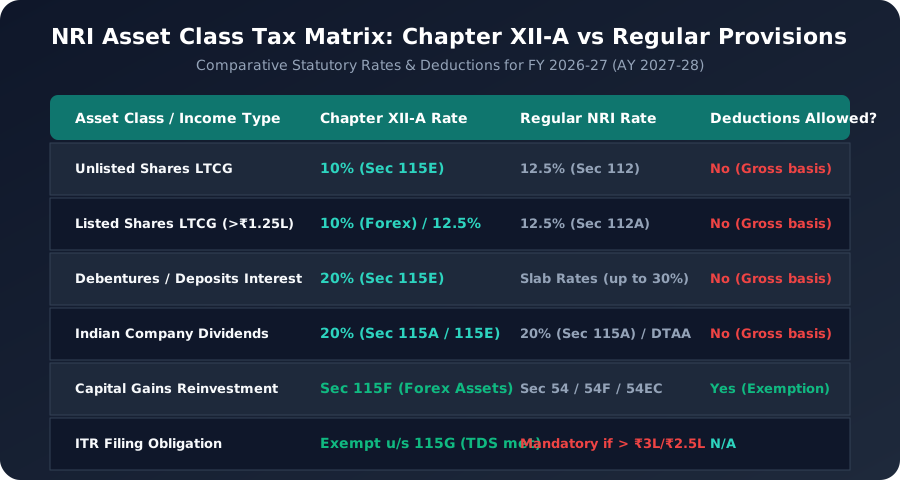
Under the Indian Income Tax Act, 1961, Non-Resident Indians (NRIs) who invest foreign currency into domestic Indian capital markets and institutional securities enjoy a distinct, simplified, and concessional statutory code known as Chapter XII-A (Sections 115C through 115-I), alongside the special provisions of Section 115A. When assets are acquired using convertible foreign exchange, investment income is taxed at a flat 20% and Long-Term Capital Gains (LTCG) at a reduced 10%, without indexation or currency fluctuation adjustments. Crucially, under Section 115G, NRIs whose assessable domestic income is confined to these assets and has faced statutory withholding (TDS) enjoy complete legal immunity from filing an Indian Income Tax Return (ITR). This guide dissects every clause of Chapter XII-A, operational mechanics, Section 115F reinvestment rollovers, Section 115H retention rules upon returning to India, and the tactical choice between Chapter XII-A and normal tax provisions for FY 2026-27 (AY 2027-28).
Table of Contents
- Statutory Foundation: Why Chapter XII-A Was Enacted
- Core Definitions: Who Qualifies & What Is a "Foreign Exchange Asset"?
- Section 115E Concessional Tax Rates: Investment Income vs Capital Gains
- Section 115D Grossing-Up: Total Denial of Chapter VI-A & Section 57 Deductions
- Section 115F Capital Gains Reinvestment Exemption (The 6-Month Rollover)
- Section 115G Exemption from Filing Income Tax Returns
- Section 115H Continuation of Benefits for Returning NRIs
- Interplay Between Section 115A, Chapter XII-A & DTAA Treaty Relief
- Section 115-I: When Should an NRI Formally Opt Out of Chapter XII-A?
- Step-by-Step Compliance, TDS Reconciliation & Audit Safeguards
- Frequently Asked Questions (FAQ)
1. Statutory Foundation: Why Chapter XII-A Was Enacted
Historically, cross-border remittances by the Indian diaspora faced severe procedural friction. Non-Resident Indians seeking to deploy hard currency savings into Indian securities were subjected to convoluted bookkeeping mandates, uncertain income characterization, complex capital gains deductions, and an onerous annual obligation to file Indian income tax returns under Section 139(1). To dismantle these operational bottlenecks, Parliament introduced Chapter XII-A (comprising Sections 115C to 115-I) via the Finance Act, 1983.
The legislative purpose of Chapter XII-A is threefold:
- Incentivize Inward Hard Currency Flow: By guaranteeing preferential tax rates to investments purchased strictly in freely convertible foreign exchange remitted from legitimate overseas sources.
- Eliminate Accounting & Dispute Friction: By substituting complex net income computations with gross flat-rate taxation, eliminating arguments over allowable expenditure under Section 57.
- Exempt NRIs from Compliance Burden: By granting full statutory exemption from filing an Indian tax return under Section 115G, provided exact withholding tax (TDS) has been deducted by the deductor under Section 195.
In parallel, Section 115A operates as a general sovereign tax framework prescribing gross withholding tax rates on dividends, interest, royalties, and technical service fees earned by all non-residents (both NRIs and foreign corporate entities). While Section 115A applies across the board to passive incomes, Chapter XII-A represents a specialized statutory charter reserved strictly for individual Non-Resident Indians who purchase qualifying Indian assets with foreign exchange.
2. Core Definitions: Who Qualifies & What Is a "Foreign Exchange Asset"?
To unlock the benefits of Chapter XII-A, an assessee must satisfy strict definitions codified under Section 115C of the Act:
A. Non-Resident Indian (Section 115C(e))
An assessee qualifies as a "Non-Resident Indian" under Chapter XII-A if they are an individual who is either:
- A citizen of India residing overseas; or
- A Person of Indian Origin (PIO). A person is deemed to be of Indian origin if they, or either of their parents, or any of their grandparents, were born in undivided India (as defined in the Government of India Act, 1935).
Note: Hindu Undivided Families (HUFs), Association of Persons (AOPs), Body of Individuals (BOIs), and foreign corporate entities are strictly disqualified from Chapter XII-A benefits. It is an individual-only tax shelter.
B. Specified Assets (Section 115C(f))
The concessional rates do not apply to every asset in India. Under Section 115C(f), only the following five categories of capital assets qualify:
- Shares in an Indian Company: Equity shares or preference shares in a domestic public or private company.
- Debentures of an Indian Public Company: Debentures issued by an Indian company that is not a private company.
- Deposits with an Indian Public Company: Fixed deposits or recurring deposits placed with an Indian public company (including commercial scheduled banks).
- Central Government Securities: Any security issued by the Central Government of India as defined in Section 2(2) of the Public Debt Act, 1944.
- Other Notified Assets: Any other asset that the Central Government may notify in the Official Gazette for this purpose.
C. Foreign Exchange Asset (Section 115C(b))
A "foreign exchange asset" means any specified asset acquired, purchased, or subscribed to by an NRI using convertible foreign exchange. Under Section 115C(a), convertible foreign exchange is foreign exchange which is treated as such by the Reserve Bank of India (RBI) under the Foreign Exchange Management Act (FEMA), 1999.

3. Section 115E Concessional Tax Rates: Investment Income vs Capital Gains
Where the total income of an NRI includes income from foreign exchange assets, Section 115E mandates an autonomous, two-tier flat tax structure:
Tier 1: Investment Income (Section 115E(a)) — Flat 20%
"Investment income" means any income derived from a foreign exchange asset, other than dividends referred to in Section 115-O (which is now obsolete following the abolition of DDT) or long-term capital gains. In contemporary practice, this primarily includes:
- Interest earned on debentures issued by Indian public companies.
- Interest earned on deposits with Indian public companies.
- Dividends distributed by Indian domestic companies on equity shares acquired with convertible foreign currency.
The statutory tax rate on such investment income is fixed at 20% (increased by the applicable surcharge and a 4% Health & Education Cess).
Tier 2: Long-Term Capital Gains (Section 115E(b)) — Flat 10%
When an NRI sells or transfers a foreign exchange asset held for the requisite statutory holding period (exceeding 12 months for listed equity shares, or exceeding 24 months for unlisted shares and debentures), the resulting gain is characterized as a long-term capital gain. Under Section 115E(b), this LTCG is taxed at a special rate of 10% (plus surcharge and cess).
Absence of Indexation & First Proviso to Section 48: Because Section 115E provides a heavily discounted 10% rate, the second proviso to Section 48 (cost inflation indexation) is explicitly inapplicable. Furthermore, under the first proviso to Section 48, capital gains arising to non-residents from the transfer of shares or debentures are computed by converting the purchase price, sale proceeds, and transfer expenses into the original foreign currency, calculating the gain in forex, and reconverting it into Indian Rupees. Under Section 115D, the computation under Chapter XII-A overrides general mechanisms, providing a clean 10% tax on the computed gain.
4. Section 115D Grossing-Up: Total Denial of Chapter VI-A & Section 57 Deductions
The most critical operational trap for tax professionals advising NRIs is Section 115D, which governs the computation of total income under Chapter XII-A. Section 115D contains sweeping statutory prohibitions:
- Denial of Section 57 Deductions: In computing investment income derived from a foreign exchange asset, no deduction in respect of any expenditure or allowance shall be allowed under any provision of the Act. For instance, if an NRI took an overseas personal loan to buy debentures in India, the interest paid on that loan cannot be deducted against the debenture interest. Tax is levied on the gross amount credited or received.
- Denial of Chapter VI-A Deductions: Section 115D(2)(a) explicitly mandates that where the gross total income consists solely of investment income or long-term capital gains from foreign exchange assets, no deduction shall be allowed to the NRI under Chapter VI-A. This means deductions under Section 80C (life insurance, PPF, tax-saver bonds), Section 80D (health insurance premiums), Section 80G (charitable donations), or Section 80TTA/80TTB (savings interest) are legally barred against Chapter XII-A income.
- No Basic Exemption Limit Benefit: Unlike resident taxpayers who can adjust their basic exemption limit (₹3,00,000 under the Old Regime or ₹4,00,000 under the New Regime for FY 2026-27) against unexhausted capital gains, an NRI cannot offset their basic exemption limit against Section 115E income. Every single rupee of investment income is taxed at 20%, and LTCG is taxed at 10%, starting from rupee one.
5. Section 115F Capital Gains Reinvestment Exemption (The 6-Month Rollover)
To encourage NRIs to retain their capital within the Indian economic ecosystem upon selling an asset, Parliament enacted Section 115F. This is the NRI equivalent of Section 54F, but tailored specifically to foreign currency investors.
Statutory Conditions for Exemption under Section 115F:
- Transfer of Foreign Exchange Asset: The capital gain must arise from the transfer of a long-term foreign exchange capital asset.
- 6-Month Reinvestment Window: The NRI must, within a period of six months from the date of the transfer, reinvest the net sale proceeds into any of the following "new assets":
- Shares in an Indian company.
- Debentures of an Indian public company.
- Deposits with an Indian public company.
- Central Government securities.
- Notified National Savings Certificates or specified infrastructure bonds.
- Proportional Exemption Formula:
Exempt LTCG = Capital Gain × [Cost of New Asset / Net Consideration]If the cost of the newly acquired foreign asset is equal to or greater than the net consideration received from the sale, the entire long-term capital gain is 100% tax-free. If only a portion of the net proceeds is reinvested, the exemption is granted on a proportionate basis.
The 3-Year Lock-In Debarment (Section 115F(2)):
If the NRI transfers or converts (otherwise than by transfer) the newly acquired asset into money within a period of three years from the date of its acquisition, the capital gain originally exempted under Section 115F is deemed to be long-term capital gains of the financial year in which the new asset is transferred or converted, and will be taxed at 10% in that year.
6. Section 115G Exemption from Filing Income Tax Returns
One of the greatest administrative reliefs in the Indian direct tax code is Section 115G. It frees qualifying NRIs from the procedural burden of retaining an Indian chartered accountant to file annual returns of income under Section 139(1).
Twin Cumulative Conditions for Filing Immunity:
An NRI is legally excused from furnishing an Indian return of income if:
- Exclusivity of Income: The total income of the NRI during the previous year consisted solely of "investment income" and/or "long-term capital gains" governed by Chapter XII-A; AND
- Full Tax Withholding: The tax deductible at source (TDS) under the provisions of Chapter XVII-B has been correctly and fully deducted from such income.
Outcome: Under Section 115G, the NRI is 100% exempt from filing an ITR in India. The Income Tax Department cannot issue a Section 148 or 142(1) notice for non-filing, because the withholding tax fully satisfied the sovereign tax liability at the Chapter XII-A rate.
7. Section 115H Continuation of Benefits for Returning NRIs
When an NRI relocates permanently back to India, their residency status transitions from Non-Resident (NR) to Resident but Not Ordinarily Resident (RNOR), and eventually to Resident and Ordinarily Resident (ROR). Ordinarily, upon becoming a tax resident, foreign concessions lapse, and global income becomes taxable at progressive slab rates (up to 39% under the Old Regime or 30% + surcharge under the New Regime).
To safeguard returning expatriates who brought foreign exchange into India, Parliament introduced Section 115H.
Statutory Mechanics of Section 115H:
- Who Can Benefit: A person who was an NRI in earlier years and becomes assessable as an Indian tax resident in any subsequent financial year.
- Eligible Assets: Foreign exchange assets acquired before returning, excluding equity shares in an Indian company. The continuation benefit applies specifically to:
- Debentures of an Indian public company.
- Deposits with an Indian public company.
- Central Government securities.
- Mandatory Written Election: The assessee must furnish a formal written declaration along with their return of income under Section 139 for that assessment year, declaring that the provisions of Chapter XII-A shall continue to apply to them in relation to the investment income derived from those specified assets.
- Perpetual Benefit Until Liquidation: Once this declaration is filed, the returning resident continues to pay a flat 20% tax on the interest income from those assets in all subsequent years until those assets are redeemed, transferred, or converted into money.
8. Interplay Between Section 115A, Chapter XII-A & DTAA Treaty Relief
Taxpayers frequently conflate Section 115A with Chapter XII-A. Understanding their structural differences is imperative for accurate cross-border tax filing:
| Parameter | Section 115A | Chapter XII-A (Sec 115C–115-I) |
|---|---|---|
| Applicability | All Non-Residents (NRIs, foreign companies, foreign funds). | Only Individual NRIs and Persons of Indian Origin (PIO). |
| Fund Source | Any source (forex or Indian Rupees). | Strictly convertible foreign exchange remitted from abroad. |
| Covered Incomes | Dividends, interest, royalties, fees for technical services (FTS). | Investment income (interest/dividend) AND Long-Term Capital Gains (LTCG). |
| LTCG Concession | No capital gains provisions (covered under Sec 112/112A). | Special 10% LTCG rate under Section 115E(b). |
| Reinvestment Relief | No rollover provisions. | Full/Proportionate exemption under Section 115F. |
| Return Filing Immunity | Available under Sec 115A(5) if only dividend/interest & TDS met. | Available under Section 115G for both investment income and LTCG. |
Double Taxation Avoidance Agreement (DTAA) Interaction (Section 90):
Under Section 90(2) of the Act, an NRI has the legal right to apply either the provisions of the domestic Income Tax Act or the relevant bilateral tax treaty (DTAA) with their country of residence, whichever is more beneficial. For example, under the India-USA or India-Singapore DTAA, dividend withholding tax may be capped at 10% to 15% (subject to obtaining a valid Tax Residency Certificate (TRC) and Form 10F), which is lower than the 20% domestic rate under Section 115A or Section 115E. However, treaty rates cannot be used to escape domestic reporting if the NRI seeks a refund of excess TDS.
9. Section 115-I: When Should an NRI Formally Opt Out of Chapter XII-A?
While Chapter XII-A provides simplified compliance and lower rates, it is not always the most tax-efficient regime. Recognizing this, Parliament inserted Section 115-I, granting NRIs the autonomy to opt out of the special regime.
Section 115-I states: "A non-resident Indian may elect not to be governed by the provisions of this Chapter for any assessment year by furnishing his return of income for that assessment year under section 139 declaring therein that the provisions of this Chapter shall not apply to him for that assessment year."
When Opting Out Is Financially Beneficial:
- Low Total Income: If an NRI's total Indian income is below the basic exemption threshold (e.g., ₹2,50,000 / ₹3,00,000 under Old Regime, or ₹4,00,000 under New Regime for FY 2026-27), opting out allows the NRI to claim a 100% refund of all TDS withheld. Under Chapter XII-A, basic exemption absorption is prohibited.
- Substantial Deductions Available: If the NRI has incurred substantial deductions under Section 80C (life insurance in India), Section 80D (mediclaim for elderly parents in India), or Section 80G, opting out allows these deductions to be set off against regular income under the Old Tax Regime.
- Capital Losses to Set Off: If the NRI has incurred short-term or long-term capital losses on other Indian assets, opting out enables them to utilize normal intra-head and inter-head set-off rules under Sections 70 and 71.
10. Step-by-Step Compliance, TDS Reconciliation & Audit Safeguards
To maintain ironclad compliance and avoid unexpected reassessment notices under Section 148, NRIs and their tax advisors should adhere to this operational checklist:
- Maintain Foreign Inward Remittance Certificates (FIRC): Ensure that your Authorised Dealer (AD Category-I) bank issues FIRCs or bank debit certificates confirming that investments in Indian equities, debentures, or deposits were debited from an NRE/FCNR account or received via direct foreign wire.
- Verify AIS / TIS & Form 26AS: Prior to July 31 of each assessment year, review the Annual Information Statement (AIS) and Form 26AS on the income tax e-filing portal. Confirm that the deductor classified the TDS under Section 195 at the correct Chapter XII-A rate.
- Ensure PAN-Aadhaar Exemption Flag: Ensure your PAN is designated as "Non-Resident" on the e-filing portal so that it is exempt from the mandatory PAN-Aadhaar linking requirement under Rule 114AAA, preventing your PAN from becoming inoperative.
- Elect Section 115H Upon Return: If you relocate to India, prepare the written declaration under Section 115H well before filing your first resident tax return to lock in the 20% concessional rate on pre-existing foreign debentures and deposits.
11. Frequently Asked Questions (FAQ)
What constitutes a 'foreign exchange asset' under Section 115C?
Under Section 115C(b) and (f), a foreign exchange asset is any specified asset (shares of an Indian company, debentures of a public company, deposits with a public company, or Central Government securities) acquired, purchased, or subscribed to by an individual NRI using convertible foreign exchange remitted from abroad via legal banking channels (such as an NRE account or international wire).
What are the concessional tax rates under Section 115E?
Under Section 115E, investment income (such as debenture interest, deposit interest, and dividends) derived from foreign exchange assets is taxed at a flat rate of 20% (plus surcharge and 4% cess). Long-term capital gains (LTCG) from the sale of such assets are taxed at a concessional rate of 10% (plus surcharge and cess).
Can an NRI claim Section 80C or 80D deductions against Chapter XII-A income?
No. Section 115D(2) strictly prohibits any deductions under Chapter VI-A (such as Section 80C, 80D, 80G, or 80TTA) or under Section 57 against investment income or long-term capital gains computed under Chapter XII-A. The tax applies strictly on the gross receipt without basic exemption threshold absorption.
How does Section 115F reinvestment exemption operate?
Under Section 115F, if an NRI transfers a long-term foreign exchange capital asset and reinvests the whole or any part of the net sale consideration into specified assets or notified central government securities within 6 months of the transfer date, the LTCG is exempt from tax either fully (if entire proceeds are reinvested) or proportionately. A 3-year lock-in period applies to the newly acquired asset.
When is an NRI exempt from filing an Income Tax Return under Section 115G?
Under Section 115G, an NRI is completely exempt from filing an Indian Income Tax Return (ITR) if their total assessable income during the financial year consists only of investment income and/or long-term capital gains governed by Chapter XII-A, and the appropriate tax deductible at source (TDS) has been fully withheld under Chapter XVII-B.
What is the Section 115H benefit for returning NRIs?
Under Section 115H, when an NRI becomes an Indian tax resident in any subsequent financial year, they may furnish a written declaration along with their ITR electing to continue the concessional 20% tax regime on investment income derived from foreign exchange assets (other than shares) until those assets are redeemed, transferred, or converted into money.
Explore Related NRI & Direct Tax Calculators
Optimize your cross-border tax liabilities, compute capital gains, and model tax liabilities under both regimes:
Direct Tax & Cross-Border Wealth Desk
Authored by certified direct tax practitioners and international tax researchers at PercentageCalculatorTool. All legal citations reflect the Income Tax Act, 1961, Finance Acts up to 2026, and applicable CBDT circulars for Assessment Year 2027-28.