Mutual Fund Taxation FY 2026-27: Equity, Debt, Hybrid & Arbitrage Tax Slabs (AY 2027-28 Guide)

Executive Summary: Post-Budget 2024 Mutual Fund Tax Landscape
The taxation of mutual funds in India underwent substantial rationalization following the Finance Act, 2024, fully operational for Financial Year 2026-27 (Assessment Year 2027-28). Equity mutual fund LTCG is now taxed at 12.5% (up from 10%) on gains exceeding the enhanced annual exemption threshold of ₹1,25,000, while STCG stands increased to 20% (up from 15%). Pure debt funds continue under the strict Section 50AA slab taxation regime without indexation. Meanwhile, hybrid funds and international funds occupy specialized 24-month holding tiers. Navigating these rules is essential to maximize your net post-tax portfolio returns.
Table of Contents
- 1. The Reformed Landscape: Budget 2024 Tax Rationalization
- 2. Equity-Oriented Mutual Funds (>65% Equity): Holding Periods & Rates
- 3. Pure Debt Mutual Funds (≤35% Equity): Section 50AA Slab Rules
- 4. Hybrid & Specified Mutual Funds (35% to 65% Equity): The 24-Month Rule
- 5. Arbitrage Funds: The Low-Risk Tax Shield for High-Slab Earners
- 6. Systematic Investment Plan (SIP) Taxation & FIFO Principles
- 7. Growth Option vs. IDCW (Dividend) Option: Section 194K TDS Impact
- 8. Systematic Withdrawal Plan (SWP) vs. Fixed Deposit Tax Efficiency
- 9. Frequently Asked Questions (FAQs)
1. The Reformed Landscape: Budget 2024 Tax Rationalization
Prior to the historic direct tax overhaul introduced in July 2024, mutual fund taxation in India was fragmented across disparate holding periods, conflicting indexation provisions, and divergent asset thresholds. The Finance (No. 2) Act, 2024 simplified capital asset categories into two streamlined holding periods (12 months for listed equities/equity funds, and 24 months for other assets) while establishing a single uniform long-term rate of 12.5%.
For investors navigating Financial Year 2026-27 (Assessment Year 2027-28), mutual funds are broadly categorized into three distinct tax buckets based on their underlying portfolio asset allocation:
- Equity-Oriented Funds: Investing 65% or more of their total proceeds in domestic equity shares.
- Pure Debt / Specified Mutual Funds: Investing not more than 35% in domestic equity shares (governed by Section 50AA).
- Hybrid / Intermediate Schemes: Investing more than 35% but less than 65% in domestic equities.
Understanding these thresholds is critical because a fund’s commercial name or marketing label (e.g., "Dynamic Asset Allocation" or "Multi-Asset Advantage") does not determine its tax status. The tax authorities look strictly at the statutory monthly average asset allocation filed with SEBI.
2. Equity-Oriented Mutual Funds (>65% Equity): Holding Periods & Rates
An equity-oriented mutual fund is defined under Section 112A of the Income-tax Act, 1961 as a scheme where more than 65% of the investible corpus is allocated to equity shares of domestic listed companies. This category encompasses Large Cap, Mid Cap, Small Cap, Flexi Cap, Multi Cap, Focused, Sectoral/Thematic funds, Equity Linked Savings Schemes (ELSS), and Arbitrage funds.
Holding Period Threshold
The statutory holding period to qualify as a long-term capital asset is more than 12 months (1 Year) from the date of allotment of units.
Long-Term Capital Gains (LTCG) under Section 112A
If you hold your equity fund units for more than 12 months before redeeming them:
- Tax Rate: 12.5% (plus applicable surcharge and 4% Health and Education Cess).
- Annual Exemption Threshold: ₹1,25,000 per financial year across all equity shares and equity mutual funds combined. If your aggregate long-term capital gains in FY 2026-27 are ₹1,80,000, tax at 12.5% applies only to the surplus ₹55,000 (i.e., ₹1,80,000 − ₹1,25,000).
- No Indexation Benefit: Indexation is completely unavailable on equity funds.
Short-Term Capital Gains (STCG) under Section 111A
If you redeem equity mutual fund units within 12 months or less of purchase, the resulting profit is classified as short-term capital gain.
- Tax Rate: Flat 20% under Section 111A (plus applicable surcharge and 4% cess).
- No Exemption: Unlike LTCG, there is zero basic exemption on STCG. Every rupee of gain is taxed at 20%, irrespective of your general income slab, although resident individuals can adjust unexhausted basic exemption limits under Section 111A(1).
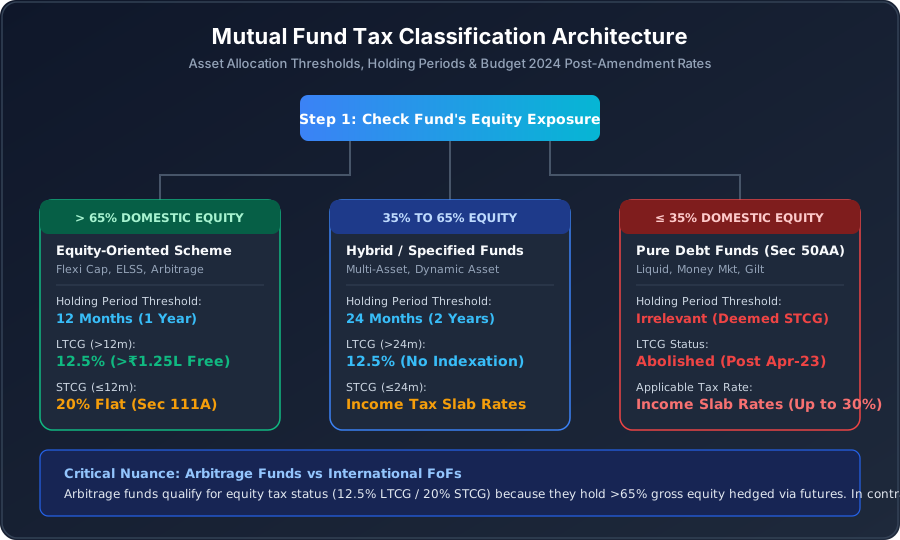
Figure 1: Decision architecture for determining mutual fund tax status based on equity allocation percentages and redemption time horizons.
3. Pure Debt Mutual Funds (≤35% Equity): Section 50AA Slab Rules
The taxation of debt mutual funds experienced a permanent tectonic shift when the Finance Act, 2023 inserted Section 50AA into the Income-tax Act. This provision stripped debt funds of their multi-decade advantage over bank fixed deposits.
What Constitutes a Section 50AA Specified Mutual Fund?
Any mutual fund scheme where the investment in domestic equity shares does not exceed 35% of the total proceeds of the scheme, acquired on or after 1st April 2023, is classified as a Specified Mutual Fund under Section 50AA. This encompasses:
- Liquid Funds and Overnight Funds
- Ultra Short Duration, Low Duration, and Money Market Funds
- Short Duration, Medium Duration, and Long Duration Debt Funds
- Corporate Bond Funds, Banking & PSU Debt Funds, and Gilt Funds
- Fund of Funds investing primarily in debt or overseas equity (where domestic equity ≤35%)
Under Section 50AA, all capital gains arising from the transfer, redemption, or maturity of Specified Mutual Fund units are deemed to be short-term capital gains, regardless of how long the investor holds them. Whether you hold the fund for 15 days or 15 years, the entire net gain is added to your total income and taxed at your applicable personal income tax slab rate (up to 30% plus surcharge and cess).
Grandfathering Clause for Pre-April 2023 Debt Units
Debt mutual fund units purchased on or before 31st March 2023 enjoy grandfathered tax status. If such pre-2023 units are held for more than 36 months, they qualify for long-term capital gains. Following Budget 2024, these grandfathered units are taxed at 12.5% without indexation upon redemption in FY 2026-27, providing substantial relief compared to regular slab taxation.
4. Hybrid & Specified Mutual Funds (35% to 65% Equity): The 24-Month Rule
Investors seeking a middle ground between pure equity volatility and pure debt slab taxation frequently utilize hybrid mutual funds. These funds allocate between 35% and 65% of their portfolio to domestic equity, with the remainder spread across corporate debt, government bonds, and gold.
Schemes falling into this intermediate bracket include Conservative Hybrid Funds, Multi-Asset Allocation Funds (with 35% to 65% equity), Dynamic Asset Allocation / Balanced Advantage Funds (where equity falls below 65%), and certain domestic Funds of Funds.
| Holding Period | Classification | FY 2026-27 Tax Treatment |
|---|---|---|
| 24 Months or Less (≤ 2 Years) | Short-Term Capital Asset | Gains added to total income; taxed at applicable income tax slab rates (up to 30%). |
| More than 24 Months (> 2 Years) | Long-Term Capital Asset | Taxed at flat 12.5% without indexation. Note: The ₹1.25 Lakh exemption applies ONLY to equity-oriented funds (>65%), not hybrid funds! |
Because LTCG is capped at 12.5% after 2 years, holding intermediate hybrid funds for at least 24 months offers a compelling tax arbitrage for investors in the 30% tax bracket compared to fixed deposits or pure debt funds.
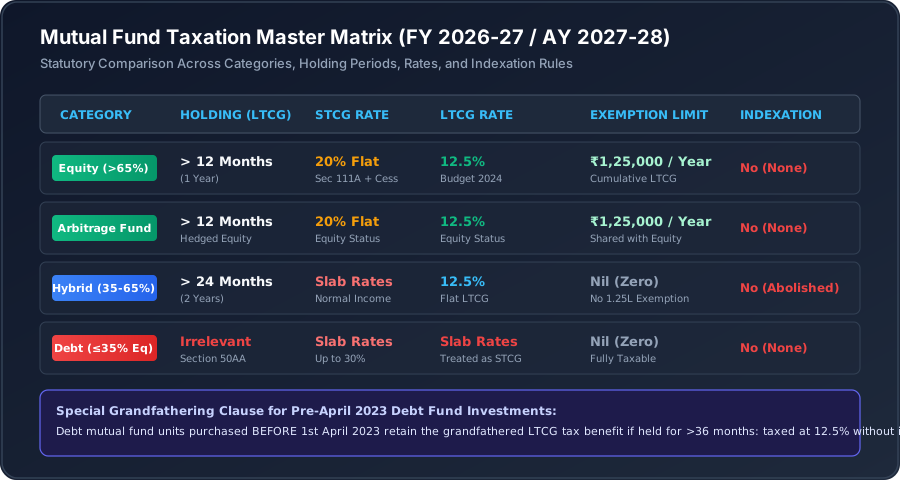
Figure 2: Comprehensive statutory tax matrix contrasting holding periods, STCG/LTCG rates, annual exemptions, and indexation rules across all mutual fund categories.
5. Arbitrage Funds: The Low-Risk Tax Shield for High-Slab Earners
Arbitrage funds occupy a unique statutory sweet spot in Indian tax law. These schemes exploit price differentials between the spot cash market and the futures derivative market. For instance, an arbitrage fund buys Reliance Industries shares in the cash market at ₹2,900 and simultaneously sells an equal quantity of Reliance futures in the derivative segment at ₹2,920, locking in a risk-free annualized spread of 6.5% to 7.5%.
Because the fund maintains a gross allocation of 65% or more in domestic equities (even though fully hedged with offsetting futures contracts), SEBI and the Income Tax Department classify Arbitrage Funds as equity-oriented mutual funds.
- Risk Profile: Similar to a 91-day Treasury Bill or Ultra Short Duration debt fund (virtually zero equity market risk).
- Tax Profile: 100% Equity Taxation! Gains held beyond 12 months are taxed at just 12.5% (with access to the ₹1.25 Lakh tax-free bracket). Gains redeemed within 12 months are taxed at a flat 20%.
- Net Savings: An investor in the 30% tax slab paying 31.2% (including cess) on liquid funds pays only 20% on short-term arbitrage gains and 12.5% on long-term gains, generating over 150 to 200 basis points of extra post-tax alpha!
6. Systematic Investment Plan (SIP) Taxation & FIFO Principles
A widespread misconception among retail investors is that when they start an SIP, the "holding period" is measured from the date of the first SIP instalment. Under Indian direct tax law, this assumption is completely incorrect.
Section 45 of the Income-tax Act dictates that every single SIP instalment constitutes an independent, distinct acquisition of mutual fund units. When an investor initiates a partial or full redemption, the tax engine applies the First-In-First-Out (FIFO) accounting method.
Numerical SIP Case Study
Assume an investor starts a monthly SIP of ₹25,000 in a Flexi Cap equity fund on 1st January 2025. On 15th February 2026 (after 14 months), the investor redeems the entire accumulated portfolio:
| Instalment Date | Purchase Date | Redemption Date | Holding Period | Tax Category | Tax Rate Applicable |
|---|---|---|---|---|---|
| Month 1 (Jan 2025) | 01-Jan-2025 | 15-Feb-2026 | 13.5 Months | Long-Term Capital Gain | 12.5% (Above ₹1.25L Exemption) |
| Month 2 (Feb 2025) | 01-Feb-2025 | 15-Feb-2026 | 12.5 Months | Long-Term Capital Gain | 12.5% (Above ₹1.25L Exemption) |
| Months 3 to 14 (Mar 2025 to Feb 2026) | 01-Mar-2025 onwards | 15-Feb-2026 | Under 12 Months | Short-Term Capital Gain | Flat 20% under Section 111A |
As demonstrated, only units purchased in January and February 2025 qualify for LTCG. The remaining 12 instalments (purchased between March 2025 and February 2026) have not completed 12 full months of holding and are strictly taxed as STCG at 20%.
7. Growth Option vs. IDCW (Dividend) Option: Section 194K TDS Impact
Following the abolition of the Dividend Distribution Tax (DDT) by the Finance Act, 2020, mutual fund dividends—now officially designated as Income Distribution cum Capital Withdrawal (IDCW)—are taxed directly in the hands of the unit holder under "Income from Other Sources".
| Feature | Growth Option | IDCW (Dividend Payout / Reinvestment) |
|---|---|---|
| Tax Timing | Taxed ONLY upon redemption of units. Zero tax during compounding phase. | Taxed annually whenever dividend is declared/paid out. |
| Applicable Rate | 12.5% LTCG (beyond ₹1.25L) or 20% STCG for equity funds. | Added to total income; taxed at marginal slab rates (up to 30%). |
| TDS Deducted | Nil (No TDS on redemption of mutual fund units for resident individuals). | 10% TDS under Section 194K if dividend exceeds ₹5,000 in a financial year. |
| Wealth Compounding | Maximum: Full pre-tax corpus compounds uninterrupted. | Sub-optimal: Annual tax leakage depletes compounding base. |
For virtually all wealth accumulators, the Growth option is demonstrably superior to IDCW. By choosing Growth, you exercise complete control over your tax event, deferring tax until you actively choose to liquidate your units.
8. Systematic Withdrawal Plan (SWP) vs. Fixed Deposit Tax Efficiency
For retirees and financial independence seekers requiring regular cash flow, a Systematic Withdrawal Plan (SWP) from an equity or conservative hybrid mutual fund is substantially more tax-efficient than conventional bank fixed deposit (FD) interest payouts.
When you withdraw ₹50,000 per month from a fixed deposit, the entire ₹50,000 represents interest income, taxable at your highest slab rate (up to 30% plus cess). However, when you withdraw ₹50,000 via an SWP from a mutual fund, each redemption consists of two parts:
- Return of Principal Capital: 100% Tax-Free.
- Capital Gain Component: Only the embedded capital gain is subject to tax (at 12.5% if units are older than 12/24 months, with an annual ₹1.25L exemption on equity gains).
In the initial years of an SWP, capital gains typically represent only 20% to 30% of the withdrawn amount, reducing your effective tax incidence to less than 2% to 3% of cash flow received, compared to 31.2% on bank interest. To calculate your personalized take-home and tax obligations, explore our client-side SIP Calculator and Income Tax Calculator.
9. Frequently Asked Questions (FAQs)
Q1: What are the new capital gains tax rates on equity mutual funds for FY 2026-27?
For equity-oriented mutual funds (>65% domestic equity exposure), long-term capital gains (LTCG) on units held for more than 12 months are taxed at 12.5% on gains exceeding the aggregate ₹1,25,000 annual exemption limit. Short-term capital gains (STCG) on units held for 12 months or less are taxed at a flat rate of 20% under Section 111A, plus applicable surcharge and 4% cess.
Q2: How are pure debt mutual funds taxed under Section 50AA?
Under Section 50AA of the Income-tax Act, all debt mutual funds having not more than 35% invested in domestic equities and acquired on or after April 1, 2023, are classified as Specified Mutual Funds. All capital gains arising from their redemption are deemed to be short-term capital gains and taxed at the investor's applicable income tax slab rates, irrespective of whether they are held for 1 month or 10 years.
Q3: How are hybrid mutual funds with 35% to 65% equity exposure taxed?
Hybrid funds holding between 35% and 65% in domestic equities require a holding period of more than 24 months to qualify for long-term capital gains (LTCG). Long-term gains are taxed at 12.5% without indexation benefits and without the ₹1.25 Lakh exemption. Short-term capital gains (held for 24 months or less) are added to total income and taxed at normal slab rates.
Q4: Why are Arbitrage Funds considered superior to Liquid Funds for high earners?
Arbitrage funds invest at least 65% of their corpus in equities while simultaneously hedging the exposure with stock futures, eliminating market directional risk. Because their gross equity holding exceeds 65%, they qualify for equity taxation (20% STCG and 12.5% LTCG above ₹1.25L). For investors in the 30% tax slab, arbitrage funds deliver significantly higher post-tax yields than pure liquid or overnight debt funds taxed at slab rates.
Q5: How is tax computed on Systematic Investment Plan (SIP) redemptions?
Tax on SIP redemptions follows the First-In-First-Out (FIFO) method. Every monthly SIP instalment is treated as an independent purchase with its own acquisition date and NAV. When you redeem units, the oldest units purchased are deemed to be sold first. Only units that have completed 12 months (for equity) or 24 months (for hybrid) qualify for LTCG; newer instalments are taxed as STCG.