Remittance of Inherited Property Sale Proceeds by NRIs: Form 15CA, Form 15CB, Section 197 LDC & $1M RBI Quota (FY 2026-27)

Executive Transactional Overview
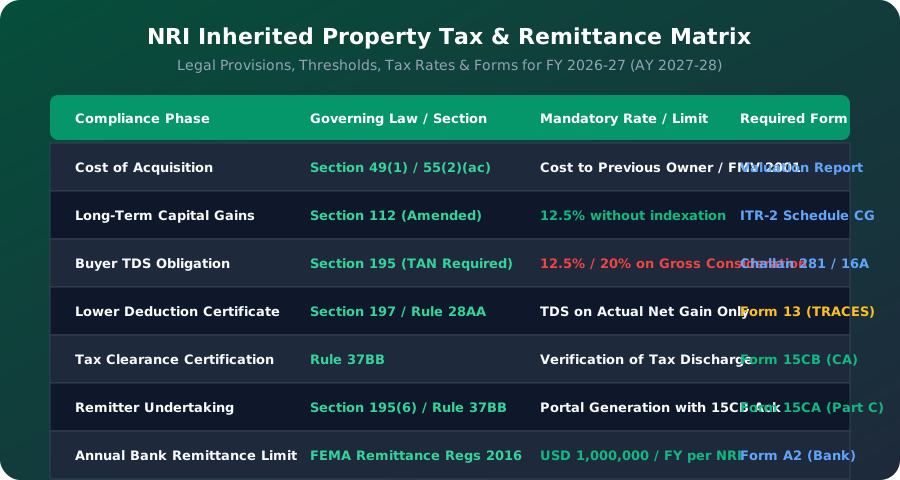
Liquidating inherited real estate in India and repatriating the proceeds to an overseas bank account in North America, Europe, or the Gulf is one of the most intricate cross-border transactions an NRI can undertake. The process involves multiple legal and statutory layers: establishing clear succession title via probate or legal heir certificates, calculating capital gains under Section 49(1) with ancestor holding period tacking under Section 2(42A), managing aggressive Section 195 buyer TDS through a Section 197 Lower Deduction Certificate (LDC) in Form 13, and complying with the Reserve Bank of India (RBI) USD 1,000,000 annual remittance quota from Non-Resident Ordinary (NRO) accounts under the FEMA Remittance of Assets Regulations, 2016. Every rupee remitted must be verified by a Chartered Accountant via Form 15CB and reported electronically on the income tax portal via Form 15CA (Part C). This guide walks you through every statutory calculation, tax filing, and banking protocol for FY 2026-27 (AY 2027-28).
Table of Contents
- Phase 1: Legal Succession, Probate & Title Mutation
- Phase 2: Computing Capital Gains on Inherited Property (Sec 49 & 55)
- Section 2(42A) Holding Period Tacking & 12.5% LTCG Tax Rate
- The Buyer TDS Trap: Section 195 Mandates on Real Estate Purchases
- Section 197 Lower Deduction Certificate (Form 13 Application)
- Capital Gains Tax Exemptions: Section 54 & Section 54EC Bonds
- FEMA Regulatory Framework: The USD 1 Million Annual NRO Quota
- Form 15CB & Form 15CA: Step-by-Step E-Filing Procedure
- Authorised Dealer (AD Bank) Documentation Checklist
- Frequently Asked Questions (FAQ)
1. Phase 1: Legal Succession, Probate & Title Mutation
Before an NRI can enter into an Agreement to Sell or receive any sale consideration, they must establish incontrovertible legal title over the inherited property. Indian municipal authorities and prospective buyers' legal counsel will strictly reject transactions without proper succession documentation.
Key Succession Instruments:
- Registered Will: If the deceased owner left a Will, it must specify the exact bequest of the immovable asset. In testamentary matters arising in the presidency towns of Kolkata, Mumbai, and Chennai, obtaining a Probate of the Will from a competent Civil Court is mandatory under Section 213 of the Indian Succession Act, 1925.
- Intestate Succession (No Will): If the deceased ancestor died without executing a Will (intestate), title passes to Class-I legal heirs under the Hindu Succession Act, 1956 (or applicable personal laws). A Legal Heir Certificate issued by the Tahsildar/Revenue Authority or a Succession Certificate issued by a District Court is essential.
- Relinquishment Deed / Release Deed: Where multiple siblings or legal heirs inherit a property jointly, co-heirs wishing to forfeit their rights in favor of the NRI must execute and register a formal Release Deed on proper non-judicial stamp paper.
- Revenue Mutation (Khata / Patta Transfer): The registered Will or Legal Heir Certificate must be submitted to the local municipal corporation (e.g., BBMP in Bengaluru, BMC in Mumbai, MCD in Delhi) to mutate the property title and update the official property tax register into the NRI's name.
2. Phase 2: Computing Capital Gains on Inherited Property (Sec 49 & 55)
Inheriting real estate in India does NOT trigger any immediate income tax liability. Under Section 47(iii) of the Income Tax Act, any transfer of a capital asset under a gift or will or an irrevocable trust is not regarded as a transfer for tax purposes. India does not levy inheritance tax or estate duty.
However, tax liability arises when the NRI heir subsequent sells the inherited asset.
1. Cost of Acquisition (Section 49(1))
Because the NRI heir acquired the property without paying any monetary consideration, Section 49(1) provides a statutory "look-through" rule:
2. Properties Acquired Prior to April 1, 2001 (Section 55(2)(ac))
If the deceased ancestor purchased the property prior to April 1, 2001, the NRI seller has the statutory right to substitute the Fair Market Value (FMV) as of April 1, 2001 as the deemed cost of acquisition.
The Stamp Duty Cap: Under the proviso to Section 55(2)(ac), the FMV as of April 1, 2001 cannot exceed the Stamp Duty Value (Circle Rate) of the property as on April 1, 2001. A formal valuation report from a Government-Registered Valuer establishing the historical circle rate as of 01.04.2001 is mandatory.
3. Cost of Improvements (Section 55(1)(b))
Any capital expenditure incurred on renovation, structural additions, or legal defense of title incurred by the deceased owner or the NRI heir after April 1, 2001 can be claimed as a deductible cost of improvement.
3. Section 2(42A) Holding Period Tacking & 12.5% LTCG Tax Rate
Under Section 2(42A), unlisted immovable property (land or building) qualifies as a long-term capital asset if it is held for more than 24 months.
The Holding Period Tacking Principle (Explanation 1(b) to Section 2(42A))
In computing the period of holding of an inherited asset, the law commands that the period for which the property was held by the previous deceased owner must be tacked on (added) to the period held by the NRI.
Example: If an NRI inherits an apartment in January 2026 that was originally purchased by their father in 1995, and sells it in December 2026 (holding it personally for only 11 months), the asset is nevertheless classified as a Long-Term Capital Asset because the father's 31-year holding period is legally aggregated.
The 12.5% LTCG Tax Regime (Finance Act, 2024 Amendments)
Under the revised direct tax framework applicable for FY 2026-27 (AY 2027-28), Long-Term Capital Gains on unlisted immovable property for non-resident assessees are taxed under Section 112 at a flat rate of 12.5% without indexation.
Net Capital Gain = Full Value of Consideration (or Circle Rate u/s 50C) − Cost of Acquisition (Ancestor's purchase price or 2001 FMV) − Cost of Improvement − Transfer Expenses (Brokerage, Legal Fees)Total Tax Due:
Net Capital Gain × 12.5% + Applicable Surcharge (up to 15%) + 4% Health & Education Cess.

4. The Buyer TDS Trap: Section 195 Mandates on Real Estate Purchases
When an Indian resident buys property from another resident seller, the transaction is governed by Section 194-IA (where the buyer deducts a nominal 1% TDS on consideration exceeding ₹50 Lakh).
However, when the seller is a Non-Resident Indian, Section 194-IA does NOT apply. The transaction falls strictly under the aggressive jurisdiction of Section 195 of the Income Tax Act.
The Mechanics of Section 195 Withholding:
- Mandatory TAN Requirement: The buyer cannot deduct TDS using their personal PAN. They must obtain a Tax Deduction and Collection Account Number (TAN) under Section 203A prior to executing the transaction.
- Gross Value Deductions: In the absence of a specific certificate from the tax department, Section 195 mandates the buyer to deduct TDS at the highest applicable rate (12.5% or 20% plus surcharge and cess, effectively 14.5% to 23.9%) on the ENTIRE GROSS SALE CONSIDERATION, not just on the capital gains!
5. Section 197 Lower Deduction Certificate (Form 13 Application)
To prevent the crushing cash-flow lockup described above, Parliament provided a statutory remedy under Section 197.
The Form 13 Procedure on the TRACES Portal:
- Online Application: As soon as the Agreement to Sell is signed, the NRI seller submits an online application in Form 13 on the TRACES portal requesting the jurisdictional International Taxation Assessing Officer (AO) to issue a Certificate for Lower / Nil Deduction of Tax.
- Required Documentation: The application must be backed by:
- Executed Agreement to Sell / Memorandum of Understanding.
- Proof of inheritance (Registered Will, Probate, Legal Heir Certificate).
- Original purchase deed of the deceased ancestor.
- Valuation report as of 01.04.2001 (if applicable).
- Detailed capital gains computation showing allowable deductions and exemptions (Sec 54 / 54EC).
- Bank statements of the seller's NRO account.
- Issuance of Certificate: The AO reviews the computation and issues a formal Section 197 Certificate prescribing the exact reduced rate of TDS (often between 1% and 3% of the sale value, or strictly 12.5% of the computed gain).
- Buyer Compliance: The buyer quotes this certificate number in their TDS return (Form 27Q) and deducts only the specific certified sum, releasing the vast balance of sale proceeds directly to the NRI seller.
6. Capital Gains Tax Exemptions: Section 54 & Section 54EC Bonds
An NRI selling inherited residential property in India can wipe out their capital gains tax liability using two primary statutory shelters:
1. Section 54: Reinvestment in Residential Property
- Condition: The NRI must purchase another residential house in India within 1 year before or 2 years after the date of transfer, or construct a residential house within 3 years.
- Cap: Section 54 exemption is capped at a maximum of ₹10 Crore.
- Two Residential Properties Exception: If the capital gain does not exceed ₹2 Crore, the NRI can exercise a once-in-a-lifetime option to invest in two residential properties in India.
2. Section 54EC: Capital Gains Infrastructure Bonds
- Condition: The NRI must invest the capital gains within 6 months from the date of the sale deed into specified notified bonds: National Highways Authority of India (NHAI), Rural Electrification Corporation (REC), Power Finance Corporation (PFC), or Indian Railway Finance Corporation (IRFC).
- Limit: Maximum statutory investment limit of ₹50,00,000 (₹50 Lakh) per financial year.
- Lock-In Period: The bonds have a mandatory 5-year lock-in period and carry a fixed interest rate (typically 5.25% p.a.), which is taxable in India.
7. FEMA Regulatory Framework: The USD 1 Million Annual NRO Quota
Once capital gains taxes are discharged and the net sale consideration is credited to the NRI seller's Non-Resident Ordinary (NRO) bank account, the funds are subject to the foreign exchange controls of the Reserve Bank of India.
The $1 Million Automatic Remittance Scheme
Under the Foreign Exchange Management (Remittance of Assets) Regulations, 2016 (Notification No. FEMA 13(R)/2016-RB), Authorised Dealer Category-I (AD-I) banks are permitted to remit up to USD 1,000,000 (One Million US Dollars) per financial year (April 1 to March 31) out of balances held in an NRO account representing:
- Sale proceeds of assets acquired through inheritance or deed of settlement;
- Sale proceeds of immovable property acquired out of rupee resources or foreign exchange;
- Domestic savings, pensions, and capital gains from Indian investments.
Key Remittance Rules for Real Estate:
- No Limit on Inherited Properties: While foreign currency purchases of residential property are restricted to repatriation of proceeds from up to two properties, inherited properties carry no such property-count limitation. An NRI can liquidate three or four inherited properties across different years, provided total remittances in any single financial year do not exceed USD 1 Million.
- Excess Above $1 Million: If the net sale proceeds of a prime inheritance in Mumbai or Delhi exceed USD 1,000,000, the excess balance can either be staggered across subsequent financial years (remitting $1M each FY) or remitted in a single tranche after obtaining prior approval from the Reserve Bank of India through the AD Bank.
8. Form 15CB & Form 15CA: Step-by-Step E-Filing Procedure
Under Section 195(6) of the Income Tax Act read with Rule 37BB, no bank in India can execute a foreign wire transfer from an NRO account without electronic tax compliance clearance. This is achieved through the dual filing of Form 15CB and Form 15CA.
Step 1: CA Verification & Form 15CB Issuance
Form 15CB is an official certificate issued by a practicing Chartered Accountant. The CA meticulously reviews:
- The ancestral chain of title and inheritance legitimacy.
- The registered sale deed and receipt of consideration in the NRO account.
- The computation of capital gains and statutory deductions claimed.
- Verification of tax payment (TDS deposited by buyer via Challan 281 or advance tax paid by seller).
- Applicability of the relevant Double Taxation Avoidance Agreement (DTAA).
The CA uploads Form 15CB using their digital signature certificate (DSC) on the income tax e-filing portal, generating an official 15CB Acknowledgment Number.
Step 2: Electronic Filing of Form 15CA (Part C)
Once Form 15CB is registered, the NRI remitter logs into their income tax portal account and accesses Form 15CA.
- Select Part C: Because the remittance exceeds ₹5,00,000 and requires a CA certificate, the remitter selects Part C.
- Link Form 15CB: The remitter inputs the CA's Form 15CB acknowledgment number and date. The portal auto-populates the tax determination fields.
- Verify Remittance Details: Enter the beneficiary foreign bank name, SWIFT code, IBAN/account number, and country of remittance.
- Submit & Print: The remitter submits Form 15CA electronically and prints the generated acknowledgment containing the unique transaction identifier.
9. Authorised Dealer (AD Bank) Documentation Checklist
With Form 15CA and 15CB in hand, the NRI submits the final remittance dossier to their AD Category-I bank (e.g., HDFC, ICICI, SBI, Axis, Citibank). Ensure you have original copies of:
- Form A2: The standard FEMA application form for purchase of foreign exchange.
- Form 15CA & Form 15CB: Signed printouts of the electronic e-filing acknowledgments.
- Succession Documents: Certified copy of the registered Will / Probate / Legal Heir Certificate.
- Death Certificate: Original or notarized copy of the death certificate of the deceased property owner.
- Registered Sale Deed: Certified copy of the conveyance deed registered with the Sub-Registrar of Assurances.
- TDS Proof: Form 16A issued by the buyer and Form 26AS/AIS reflecting the TDS credit under Section 195.
- NRO Bank Statement: Highlighting the credit of the sale proceeds and deduction of banking charges.
- FEMA Declaration: Formal undertaking that total remittances from all bank accounts across India during the current financial year do not exceed USD 1,000,000.
Upon verification, the AD Bank executes the foreign exchange conversion at the prevailing card rate and dispatches the wire via SWIFT to your overseas account.
10. Frequently Asked Questions (FAQ)
How is the cost of acquisition calculated for inherited property under Section 49(1)?
Under Section 49(1) of the Income Tax Act, where a capital asset becomes the property of the assessee under a gift, will, or inheritance, the cost of acquisition is deemed to be the cost for which the previous owner who acquired it by purchase or construction acquired it. If the ancestor acquired it before April 1, 2001, the assessee may opt for the Fair Market Value (FMV) as of April 1, 2001 (not exceeding the stamp duty value).
How is the holding period determined for inherited real estate?
Under Explanation 1(b) to Section 2(42A), in determining the holding period of an inherited asset, the period for which the property was held by the previous deceased owner is aggregated with the period held by the heir. If the combined holding period exceeds 24 months, the gain is classified as a Long-Term Capital Gain (LTCG).
What is the capital gains tax rate on inherited property sold by an NRI in FY 2026-27?
Following the direct tax amendments under Finance Act, 2024 (effective for AY 2027-28), Long-Term Capital Gains (LTCG) arising from the transfer of unlisted immovable property by non-residents are taxed at a flat rate of 12.5% without indexation (plus applicable surcharge and 4% cess).
Why is Section 197 Lower Deduction Certificate (Form 13) essential when selling NRI property?
Under Section 195, the buyer is legally obligated to deduct TDS at the full tax rate (12.5% or 20% plus surcharge/cess) on the ENTIRE gross sale consideration, not on the net capital gain. Obtaining a Section 197 certificate (LDC) from the Assessing Officer in Form 13 directs the buyer to deduct TDS only on the actual net capital gain, preserving the seller's liquidity.
What is the RBI remittance limit for inherited property sale proceeds under FEMA?
Under the FEMA (Remittance of Assets) Regulations, 2016, an NRI or PIO is permitted to remit up to USD 1,000,000 (US Dollars One Million) per financial year (April 1 to March 31) from balances held in their NRO bank account, representing the sale proceeds of inherited or self-acquired domestic immovable property.
What are Form 15CA and Form 15CB?
Form 15CB is a statutory certification issued by a practicing Chartered Accountant confirming that the remittance is in accordance with the Income Tax Act and applicable DTAA provisions, and that all taxes have been properly paid or deducted. Form 15CA is an online declaration filed by the remitter on the e-filing portal based on Form 15CB.
Explore Related Cross-Border & Property Calculators
Plan your property capital gains, compute monthly EMI schedules, and model tax rates:
- Home Loan EMI Calculator: Monthly Amortization & Interest
- Income Tax Calculator: Old vs New Regime Comparison (FY 2026-27)
- FEMA vs Income Tax Residential Status Conflicts & Bank Rules
- Section 115A & Chapter XII-A NRI Special Tax Regime Guide
- Returning NRIs RNOR Status Tax Benefits & Exemptions Guide
Cross-Border Real Estate & Tax Desk
Authored by senior cross-border real estate attorneys and international tax chartered accountants at PercentageCalculatorTool. Citations reflect FEMA 13(R) regulations, RBI Remittance of Assets Master Directions, and the Income Tax Act, 1961 for Assessment Year 2027-28.