FEMA vs Income Tax Act: Residential Status Conflicts, NRE/NRO Bank Accounts & Section 13 Penalties (FY 2026-27)

Executive Legal Overview
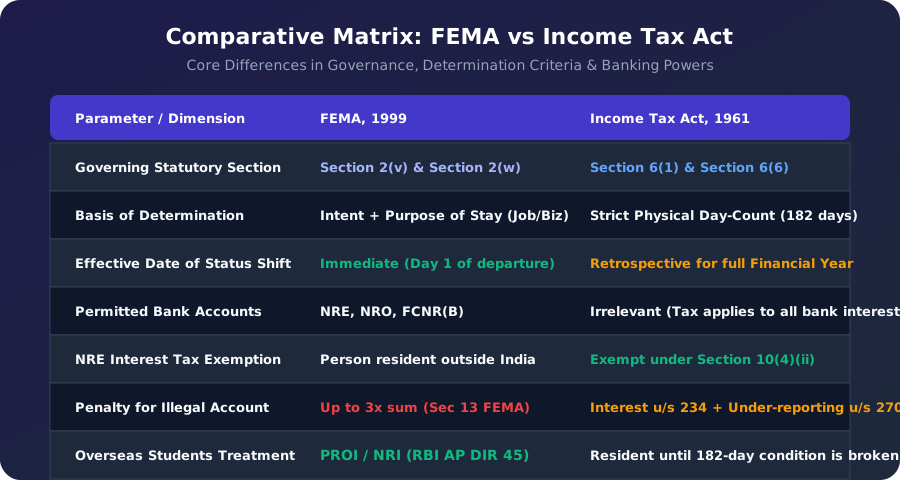
One of the most dangerous and widely misunderstood legal paradoxes facing Indian expatriates, cross-border tech professionals, and overseas students is the sharp statutory divide between FEMA, 1999 (governed by the Reserve Bank of India) and the Income Tax Act, 1961 (administered by the CBDT). In the eyes of the law, an individual can be a Non-Resident on Day 1 under FEMA while remaining a Resident under the Income Tax Act for the entire financial year. Operating under the mistaken assumption that tax residency dictates banking rights leads thousands of NRIs to unlawfully retain domestic resident savings accounts, exposing their accounts to Section 13 FEMA penalties of up to 300% of the account balance. This exhaustive guide provides an authoritative legal analysis of Section 2(v) of FEMA versus Section 6 of the Income Tax Act, NRE versus NRO bank accounts, Section 10(4) tax exemptions, 30% TDS under Section 195, and the RBI compounding mechanism to regularize inadvertent banking defaults.
Table of Contents
- The Fundamental Dichotomy: Purpose vs Day-Count
- Residential Status under FEMA: Section 2(v) Intent-Based Test
- Residential Status under Income Tax Act: Section 6 Day-Count Test
- Classic Real-World Conflict Scenarios
- The Statutory Banking Framework: NRE, NRO & FCNR(B) Accounts
- Direct Tax Implications: Section 10(4) vs Section 195 TDS on Bank Interest
- The Section 13 Penalty Trap: Holding Resident Accounts as an NRI
- Curing Inadvertent Defaults: The RBI Compounding Procedure
- Expatriate Action Plan: Bank Conversions Upon Moving Abroad & Returning
- Frequently Asked Questions (FAQ)
1. The Fundamental Dichotomy: Purpose vs Day-Count
In Indian jurisprudence, cross-border financial transactions are governed by two distinct sovereign statutes with completely separate legislative objectives:
- The Foreign Exchange Management Act (FEMA), 1999: Enacted to facilitate external trade and payments and promote the orderly development of the foreign exchange market in India. FEMA governs what you can legally do with money (opening bank accounts, remitting funds, holding foreign assets, and acquiring Indian immovable property). Under FEMA, residency is prospective and intention-driven.
- The Income Tax Act, 1961: Enacted to levy direct tax on income earned by assessees. The Income Tax Act governs how much tax you owe the government on your domestic and global earnings. Under direct tax laws, residency is retrospective and mathematical, determined solely by the number of days you spent on Indian soil between April 1 and March 31.
Because these two statutes operate independently, your residency status under the Income Tax Act has ZERO bearing on your status under FEMA, and vice versa. An assessee who qualifies as a "Non-Resident" for tax purposes might be a "Resident" under FEMA, and an assessee who is a "Person Resident Outside India" under FEMA may be assessed as a full "Resident" under the Income Tax Act.
2. Residential Status under FEMA: Section 2(v) Intent-Based Test
Under Section 2(v) of FEMA, 1999, a "Person Resident in India" (PRI) is defined through a two-step statutory test:
Step 1: The 182-Day Baseline in the Preceding Year
The individual must have resided in India for more than 182 days during the course of the preceding financial year.
Step 2: The Three Negative Intent Exceptions
Even if an individual resided in India for more than 182 days in the preceding year, they are statutorily excluded from being a Person Resident in India (and automatically become a Person Resident Outside India (PROI)) if they go out of India or stay outside India:
- For or on taking up employment outside India; OR
- For carrying on outside India a business or vocation; OR
- For any other purpose, in such circumstances as would indicate their intention to stay outside India for an uncertain period.
Special Status for Overseas Students:
Historically, students going abroad were considered residents because education was viewed as having a certain duration. However, the Reserve Bank of India resolved this ambiguity through A.P. (DIR Series) Circular No. 45 dated December 8, 2003. The RBI formally clarified that Indian students studying abroad are deemed to be Persons Resident Outside India (PROI) from the day they depart India, granting them the legal right to open NRE/NRO accounts and receive foreign remittances.
3. Residential Status under Income Tax Act: Section 6 Day-Count Test
The direct tax determination under Section 6(1) of the Income Tax Act, 1961 is strictly mathematical. An individual is a Resident if they meet either:
- Condition 1: Physical presence in India ≥ 182 days during the current financial year; OR
- Condition 2: Physical presence ≥ 60 days in the current financial year + ≥ 365 days across the 4 preceding financial years.
Special Relief for Leaving for Employment: Under Explanation 1(a) to Section 6(1), if an Indian citizen leaves India during any financial year for the purpose of employment outside India, the 60-day threshold in Condition 2 is extended to 182 days.
However, notice the critical structural trap: If an employee leaves India after having spent 183 days in India during that financial year (e.g., departure on October 3), they have already crossed the 182-day threshold of Condition 1! Consequently, under the Income Tax Act, they are a Resident for the entire financial year (April 1 to March 31).

4. Classic Real-World Conflict Scenarios
To understand how these dual statutes collide in practice, consider these three widespread scenarios:
Scenario A: The Mid-Year Relocating Professional
- Facts: Rohan, an Indian software engineer, works in Pune until October 15, 2026 (spending 198 days in India in FY 2026-27). On October 16, he relocates to London on a Tier-2 skilled worker visa to join a UK company.
- FEMA Status: On October 16, Rohan leaves India for employment with an indefinite stay intention. Under Section 2(v), he becomes a Person Resident Outside India (PROI) on October 16. He is legally prohibited from operating his resident savings accounts and must convert them to NRO.
- Income Tax Status: Having spent 198 days in India (exceeding 182 days), Rohan is an Indian Tax Resident for the entire FY 2026-27 under Section 6(1). If he does not qualify as an RNOR under Section 6(6), his global salary earned in London between October 16 and March 31 is taxable in India (subject to DTAA foreign tax credits under Section 90).
Scenario B: The Student Going Abroad
- Facts: Ananya leaves India on August 15, 2026 to pursue a 2-year Master's degree at Stanford University. She spent 137 days in India between April 1 and August 15. In the 4 preceding years, she lived entirely in India (>365 days).
- FEMA Status: Under RBI Circular No. 45, Ananya is treated as a PROI (NRI) from August 15. She can open an NRE account and execute foreign exchange transactions under FEMA.
- Income Tax Status: Because Ananya left for education and NOT for "employment abroad", the relaxed 182-day rule of Explanation 1(a) does not apply. She falls under Condition 2 (spent >60 days in FY 2026-27 and >365 days in past 4 years). Consequently, she remains an Indian Tax Resident for FY 2026-27! Any US graduate research stipend received before March 31 may be subject to Indian tax scrutiny.
Scenario C: The Returning Expatriate
- Facts: Vikram returns to India permanently on December 1, 2026 after working 12 years in Dubai. He spends 121 days in India in FY 2026-27.
- FEMA Status: Vikram returns with the intention to reside indefinitely. Under FEMA Section 2(v), he becomes a Person Resident in India on December 1. He must immediately inform his bank to convert his NRE accounts to resident accounts or open a Resident Foreign Currency (RFC) account.
- Income Tax Status: Having spent only 121 days in India in FY 2026-27 (and zero days in preceding years), Vikram does not satisfy the 182-day test or the 60+365 day test. For income tax purposes, he remains a Non-Resident (NR) for FY 2026-27! In FY 2027-28, he will transition to RNOR status.
5. The Statutory Banking Framework: NRE, NRO & FCNR(B) Accounts
The regulation of bank accounts maintained by non-residents is codified under the Foreign Exchange Management (Deposit) Regulations, 2016. Once an individual becomes a Person Resident Outside India under FEMA, they are entitled to hold three distinct bank accounts in India:
1. Non-Resident External (NRE) Account
- Currency: Denominated in Indian Rupees (INR).
- Permitted Credits: Fresh inward remittances from abroad in convertible foreign exchange through normal banking channels, transfers from other NRE/FCNR accounts, or interest accruing on the account. Local rupee cash or domestic income cannot be deposited into an NRE account.
- Repatriability: 100% freely repatriable abroad without any monetary ceiling or RBI approval.
- Tax Status: Interest earned is completely tax-free in India under Section 10(4)(ii) of the Income Tax Act.
2. Non-Resident Ordinary (NRO) Account
- Currency: Denominated in Indian Rupees (INR).
- Permitted Credits: Domestic Indian earnings including rental income, dividends, pensions, sale proceeds of domestic assets, interest, and legitimate rupees earned prior to departure.
- Repatriability: Restricted to USD 1,000,000 (One Million US Dollars) per financial year under the FEMA Remittance of Assets Regulations, subject to submission of Form 15CA and Form 15CB CA certification.
- Tax Status: Interest earned is fully taxable in India at applicable slab rates, and banks are statutorily mandated to deduct 30% TDS (plus surcharge and cess) under Section 195.
3. Foreign Currency Non-Resident (Bank) [FCNR(B)] Deposit
- Currency: Maintained in designated foreign currencies (USD, GBP, EUR, JPY, AUD, CAD).
- Nature: Fixed-term deposits with tenures ranging from 1 to 5 years.
- Advantage: Eliminates foreign currency exchange risk. The deposit and interest are paid in foreign currency.
- Tax Status: 100% exempt from Indian income tax under Section 10(4)(ii).
6. Direct Tax Implications: Section 10(4) vs Section 195 TDS on Bank Interest
The intersection of FEMA status and direct tax rules creates critical compliance obligations for bank interest:
The Section 10(4)(ii) Legal Prerequisite
Section 10(4)(ii) of the Income Tax Act states that interest on NRE accounts is exempt from income tax in the case of an individual who is a "person resident outside India as defined in clause (w) of section 2 of the Foreign Exchange Management Act, 1999".
Crucial Insight: The tax exemption on NRE interest is tied to your status under FEMA, not the Income Tax Act! If you return to India permanently and become a resident under FEMA on December 1, your right to claim Section 10(4)(ii) tax exemption on NRE interest ceases on December 1, even if you remain a Non-Resident for income tax purposes for that entire financial year. Any NRE interest earned after December 1 becomes taxable income in India!
Section 195 Withholding on NRO Accounts
Unlike resident accounts where TDS is deducted at 10% under Section 194A (with a ₹40,000 threshold), NRO account interest is subject to withholding under Section 195 at 30% plus cess (effective 31.2%) starting from Rupee one. If your total taxable Indian income is below the basic exemption limit (₹2,50,000 / ₹3,00,000 under Old Regime or ₹4,00,000 under New Regime for FY 2026-27), the only way to recover this excess tax is by filing an Indian Income Tax Return (ITR-2) to claim a full refund.
7. The Section 13 Penalty Trap: Holding Resident Accounts as an NRI
The single most widespread compliance failure among non-resident Indians is continuing to operate ordinary domestic resident savings accounts, fixed deposits, and demat accounts after moving abroad.
The Statutory Prohibition
Regulation 3 of the Foreign Exchange Management (Deposit) Regulations, 2016 explicitly prohibits a Person Resident Outside India from maintaining a domestic resident savings account. A resident savings account can be held only by a Person Resident in India under FEMA. Upon becoming a PROI, the individual is legally mandated to notify the bank and convert the account to an NRO account.
Penalties under Section 13 of FEMA
Under Section 13(1) of FEMA, 1999, any person who contravenes any provision of the Act, rule, regulation, notification, direction or order issued thereunder is liable to:
- Where the amount is quantifiable: A penalty of up to three times (300%) the sum involved in the contravention. (For example, if an NRI maintained a resident savings account with a balance or transactions of ₹20,00,000, the potential penalty can reach ₹60,00,000!).
- Where the amount is not quantifiable: A penalty of up to ₹2,00,000.
- Continuing Default: Where the contravention is a continuing one, a further penalty of up to ₹5,00,000 per day for every day during which the contravention continues after the first day.
Furthermore, under Section 13(2), any currency, security, or money in respect of which the contravention has taken place is liable to confiscation to the Central Government.
8. Curing Inadvertent Defaults: The RBI Compounding Procedure
If an NRI discovers that they have inadvertently maintained a resident savings account for years while living in the US, UK, or Gulf, they must NOT ignore the infraction. Under Section 15 of FEMA, 1999, the Reserve Bank of India has the power to "compound" contraventions.
What Is Compounding?
Compounding is a voluntary settlement mechanism wherein the contravener admits to the procedural contravention, submits full documentation to the RBI Foreign Exchange Department, and pays a nominal compounding fee determined under the Foreign Exchange (Compounding Proceedings) Rules, 2000. Once compounded, the contravention is legally erased, and no further penalty or prosecution under Section 13 can be initiated.
Step-by-Step Compounding Process:
- Rectify the Contravention: Instruct your bank immediately to convert the resident account to an NRO account or close it. The RBI will not accept a compounding application until the contravention has ceased.
- Prepare the Compounding Application: Complete the standardized application form along with an affidavit detailing the background, departure date, account statement copies, and the total quantum of transactions during the non-resident period.
- Pay the Application Fee: Enclose a demand draft of ₹5,000 in favor of the Reserve Bank of India.
- RBI Hearing & Order: The RBI Compounding Authority examines the records and issues a Compounding Order within 180 days, prescribing a nominal compounding fee (typically 1% to 2% of the transaction volume, rather than the 300% statutory penalty).
- Payment & Closure: Pay the compounded sum within 15 days of the order to receive an official Certificate of Compounding.
9. Expatriate Action Plan: Bank Conversions Upon Moving Abroad & Returning
To maintain seamless legal compliance and avoid regulatory scrutiny, follow this operational roadmap:
When Moving Abroad:
- Notify Your Banker: Within 30 to 60 days of arriving in your host country, submit your passport copy, visa/work permit, and overseas proof of address to your Indian bank.
- Convert to NRO: Request re-designation of existing domestic savings accounts to NRO savings accounts. Existing account numbers, debit cards, and UPI mandates can usually be preserved.
- Open NRE & PIS Demat Accounts: Open an NRE account for international remittances. If you trade Indian equities, convert your resident demat account to an NRE Portfolio Investment Scheme (PIS) or Non-PIS NRO Demat account.
- Update Tax Portal: Change your residential status from "Resident" to "Non-Resident" in your profile on the Income Tax e-filing portal.
When Returning Permanently to India:
- Re-designate NRO to Resident: Notify your bank to re-convert NRO accounts back to standard resident savings accounts.
- Transfer NRE to RFC: Transfer funds lying in NRE accounts into a Resident Foreign Currency (RFC) Account to lock in tax-free foreign currency interest under Section 10(15)(iv)(fa) during your RNOR years.
- Re-designate Demat: Convert non-resident demat accounts back to regular domestic resident demat accounts.
10. Frequently Asked Questions (FAQ)
How does residential status differ between FEMA and the Income Tax Act?
Under FEMA Section 2(v), residential status is determined by intention and purpose of travel (e.g., leaving India for employment, business, or indefinite stay makes an individual a non-resident immediately on Day 1 of departure). Under the Income Tax Act Section 6, residential status is determined mathematically by the number of physical days spent in India during the financial year (e.g., 182-day rule) retrospectively.
Can an individual be a Non-Resident under FEMA but a Resident under Income Tax simultaneously?
Yes. This dual status frequently occurs when a person leaves India for employment mid-year (e.g., in September or October). Under FEMA, they become a Person Resident Outside India (PROI) on the exact date of departure. However, having spent over 182 days in India during that financial year, they remain a Resident for Indian income tax purposes.
What happens if an NRI fails to convert their resident savings account to an NRO account?
Maintaining a domestic resident savings account after becoming a non-resident under FEMA is a direct statutory contravention of the Foreign Exchange Management (Deposit) Regulations, 2016. Under Section 13 of FEMA, the Directorate of Enforcement (ED) or RBI can levy a penalty of up to three times (300%) the sum involved in the account, or up to ₹2,00,000 where the amount is unquantifiable, plus ₹5,000 per day for continuing contravention.
What is the tax treatment of interest on NRE vs NRO accounts?
Under Section 10(4)(ii) of the Income Tax Act, interest earned on Non-Resident External (NRE) accounts and FCNR deposits is 100% exempt from Indian income tax for individuals resident outside India under FEMA. In contrast, interest earned on Non-Resident Ordinary (NRO) accounts is fully taxable at regular slab rates and is subject to mandatory 30% TDS (plus surcharge and cess) under Section 195.
Are Indian students studying abroad considered NRIs under FEMA?
Yes. Pursuant to RBI A.P. (DIR Series) Circular No. 45 dated December 8, 2003, Indian students who go abroad to study are treated as 'Persons Resident Outside India' (PROI) under FEMA from the day of their departure. They are entitled to open and operate NRE and NRO bank accounts and receive foreign exchange remittances under FEMA.
How can an NRI rectify an existing illegal resident savings account?
The NRI must immediately submit an application to their bank to redesignate the account as an NRO savings account or close it. For past contraventions, the NRI can file a compounding application with the Reserve Bank of India (Foreign Exchange Department) under Section 15 of FEMA to settle the contravention by paying a nominal compounding fee rather than facing full Section 13 adjudication.
Explore Related Cross-Border & Tax Planning Calculators
Calculate tax liabilities on domestic versus foreign income streams:
FEMA & Cross-Border Regulatory Desk
Authored by certified foreign exchange legal counsel and cross-border chartered accountants at PercentageCalculatorTool. All citations reflect FEMA 1999 regulations, RBI master directions, and the Income Tax Act, 1961 for Assessment Year 2027-28.