Section 44ADA Presumptive Tax for Professionals & Freelancers: 50% Rule & ₹75 Lakh Limit (FY 2026-27)

Statutory Summary: The Freelancer's Greatest Direct Tax Shield
Inserted into the Income-tax Act, 1961 via the Finance Act 2016, Section 44ADA is one of the most generous and financially transformative tax provisions available to Indian knowledge workers. For Assessment Year 2027-28 (Financial Year 2026-27), resident professionals—including software consultants, doctors, lawyers, Chartered Accountants, architects, and creative artists—with gross annual receipts up to ₹50 Lakhs (or up to ₹75 Lakhs if cash receipts do not exceed 5%) can declare a deemed net profit of exactly 50% of their gross receipts. The remaining 50% is automatically allowed as an unvouched business expense cushion. The scheme eliminates bookkeeping under Section 44AA, requires no tax audit under Section 44AB, mandates a single advance tax payment on 15 March, and enjoys complete immunity from the 5-year lock-in rule that burdens small businesses under Section 44AD.
Table of Contents
- 1. Legislative Background & Philosophy of Section 44ADA
- 2. Scope of "Specified Professions" Under Section 44AA(1)
- 3. Gross Receipt Ceilings: ₹50 Lakh Base vs. ₹75 Lakh Digital Threshold
- 4. The 50% Deemed Profit Rule & Automatic Expense Allowance
- 5. Operational Infographic: Section 44ADA Compliance Lifecycle
- 6. Analytical Matrix: Salaried CTC vs. Section 44ADA Freelancing
- 7. The Zero Lock-In Advantage: Freedom from Section 44AD(4)
- 8. Single Advance Tax Installment & GST LUT Compliance for Exports
- 9. Step-by-Step Reporting in ITR-4 (Sugam) on the e-Filing Portal
- 10. Comprehensive Real-World Numerical Case Studies
- 11. Frequently Asked Questions (FAQ)
1. Legislative Background & Philosophy of Section 44ADA
Prior to 2016, the presumptive taxation benefits of Section 44AD were restricted exclusively to commercial trading and manufacturing enterprises. Individual professionals, freelancers, software architects, and medical practitioners were compelled to maintain detailed double-entry books of accounts under Section 44AA—including cash books, day books, ledgers, original expense bills, client retainership agreements, and travel vouchers—even when their annual billings were modest.
Recognizing the explosive growth of India's knowledge economy and global IT outsourcing, Parliament enacted Section 44ADA with a sweeping non-obstante clause:
"Notwithstanding anything contained in sections 28 to 43C, in the case of an assessee, being an individual or a partnership firm, but not including a limited liability partnership firm as defined in clause (n) of sub-section (1) of section 2 of the Limited Liability Partnership Act, 2008, who is a resident in India, and is engaged in a profession referred to in sub-section (1) of section 44AA and whose total gross receipts do not exceed fifty lakh rupees in a previous year, a sum equal to fifty per cent of the total gross receipts of the assessee in the previous year on account of such profession, or, as the case may be, a sum higher than the aforesaid sum claimed to have been earned by the assessee, shall be deemed to be the profits and gains of such profession chargeable to tax under the head 'Profits and gains of business or profession'."
The core philosophy of Section 44ADA is simple: the government acknowledges that professional services have high intellectual value and relatively low physical overheads. By establishing a statutory presumption that 50% of gross receipts represent operational expenses, the state eliminates the need for tax officers to audit expense vouchers, verify software subscription bills, or inspect home-office depreciation schedules.
2. Scope of "Specified Professions" Under Section 44AA(1)
Unlike Section 44AD which applies broadly to any business activity (with a few exclusions), Section 44ADA is strictly restricted to assessees engaged in a "profession referred to in sub-section (1) of section 44AA". If your professional calling does not fall squarely within this statutory list or its subsequent CBDT notifications, you cannot lawfully invoke Section 44ADA.
Statutorily Specified Professions
| Professional Category | Statutory Reference | Typical Real-World Roles Covered |
|---|---|---|
| Technical Consultancy | CBDT Notification No. SO 890(E)/2001 | Software engineers, full-stack developers, cloud architects, DevOps consultants, cybersecurity analysts, data scientists, UI/UX designers, management consultants |
| Medical | Section 44AA(1) | Allopathic doctors, surgeons, dentists, pediatricians, Ayurvedic/Homeopathic practitioners, radiologists, clinical consultants |
| Legal | Section 44AA(1) | Advocates, legal consultants, corporate counsels, solicitors, patent attorneys, arbitrating counsel |
| Accountancy | Section 44AA(1) | Chartered Accountants in practice, Cost & Management Accountants (CMA), certified tax auditors |
| Engineering | Section 44AA(1) | Civil engineers, structural consultants, electrical engineering consultants, industrial design engineers |
| Architectural | Section 44AA(1) | Licensed architects, landscape designers, town planning consultants |
| Interior Decoration | Section 44AA(1) | Interior designers, commercial office spatial planners, exhibition designers |
| Authorized Representative | CBDT Notification No. SO 17(E)/1977 | Tax practitioners, legal representatives appearing before tribunals or statutory authorities |
| Film Artists | CBDT Notification No. SO 17(E)/1977 | Actors, directors, producers, cinematographers, music directors, art directors, dance directors, editors, lyricists, screen-play writers, dress designers |
Are Digital Creators & YouTubers Eligible?
Recreational content creators, lifestyle vloggers, and social media influencers earning primarily through YouTube AdSense, Instagram brand sponsorships, or affiliate commissions do not automatically qualify under "film artists" or "technical consultancy". Unless an influencer provides specialized technical consulting, scriptwriting, or video editing services falling within Notification No. SO 17(E), tax authorities may reclassify their income as business revenue governed under Section 44AD rather than Section 44ADA.
3. Gross Receipt Ceilings: ₹50 Lakh Base vs. ₹75 Lakh Digital Threshold
To support India's booming freelancing ecosystem and promote digital transactions, Parliament enhanced the gross receipts ceiling under Section 44ADA through an explicit proviso inserted in sub-section (1).
The Baseline ₹50 Lakh Ceiling
The default ceiling for claiming Section 44ADA is ₹50,00,000 (₹50 Lakhs) during the financial year. If a professional accepts more than 5% of their total fees in physical cash (such as a private doctor running a cash-based clinic), their gross receipts cannot exceed ₹50 Lakhs to remain within the presumptive scheme.
The Enhanced ₹75 Lakh Threshold for Digital Professionals
The first proviso to Section 44ADA(1) provides:
"Provided that where the amount or aggregate of the amounts received during the previous year, in cash, does not exceed five per cent of the total gross receipts of such previous year, this sub-section shall have effect as if for the words 'fifty lakh rupees', the words 'seventy-five lakh rupees' had been substituted."
Under this proviso, if cash collections do not exceed 5% of gross professional receipts, the ceiling expands to ₹75,00,000 (₹75 Lakhs). Furthermore, the second proviso clarifies that payments or receipts through non-account payee cheques or drafts are deemed to be cash.
Foreign Remittances Count as 100% Digital Receipts
For independent software developers, UI/UX designers, and tech consultants working remotely for clients in the United States, Europe, Singapore, or the UAE, payments are almost universally received via wire transfer (SWIFT), Stripe, Payoneer, or Wise into an Indian bank account. Because 100% of these inflows arrive via electronic banking channels, foreign freelance professionals automatically qualify for the higher ₹75 Lakh threshold!
4. The 50% Deemed Profit Rule & Automatic Expense Allowance
Under Section 44ADA(1), taxable professional income is computed as exactly 50% of total gross receipts. The remaining 50% is statutorily presumed to represent operational business expenditure incurred in the course of earning that professional income.
Deemed Absorption of All Deductions under Sections 30 to 38
Under Section 44ADA(2), every deduction allowable under the provisions of Sections 30 to 38 shall be deemed to have been already given full effect to, and no further deduction under those sections shall be allowed. This 50% deemed expense blanket automatically covers:
- Office & Coworking Space: Rent paid for commercial office space, coworking desks (WeWork, Awfis), or home-office allocations under Section 30.
- Depreciation on Assets (Section 32): High-end MacBook Pros, monitors, smartphones, server hardware, office furniture, and air conditioners. Under Section 44ADA(3), the written down value (WDV) of these assets is deemed to have been depreciated at standard income tax rates each year.
- Software Subscriptions & Cloud Hosting: AWS/Google Cloud hosting, GitHub, Jira, Figma, Adobe Creative Cloud, JetBrains, and Zoom licenses.
- Communication & Utilities: Broadband internet, mobile phone bills, and electricity.
- Travel & Client Entertainment: Local commuting, air travel for client meetings, hotel accommodation, and professional conference registrations.
- Subcontracting & Freelance Assistance: Payments made to junior coders, copywriters, or graphic designers.
The Ultimate Accounting Benefit: You do not need to collect, preserve, or reconcile a single tax invoice, GST bill, or payment voucher for any of these expenses. Even if your real out-of-pocket expenses for the entire year were only ₹3 Lakhs (e.g., 5% of receipts), the law legally grants you a full 50% deduction (₹37.5 Lakhs on ₹75 Lakh receipts)!
Voluntary Declaration of Higher Profit
Section 44ADA permits assessees to declare a higher profit percentage. If an IT consultant earns ₹60 Lakhs and incurs virtually zero overheads, they can voluntarily report 65% or 75% profit in ITR-4 to reflect higher declared income, bolstering their eligibility for personal mortgage loans or high-value credit underwriting.
5. Operational Infographic: Section 44ADA Compliance Lifecycle
The operational diagram below traces the end-to-end workflow of a freelancer or consultant operating under Section 44ADA, from receipt verification to single advance tax payment and ITR-4 submission.

As outlined in the compliance lifecycle above:
- Receipt Gatekeeper: Bank statements are audited to ensure cash collections remain at or below 5%, unlocking the ₹75 Lakh ceiling.
- Deemed Split: Half of gross collections are designated as taxable net profit; the remaining half is tax-exempt capital recovery.
- Zero Friction Filing: Tax is remitted in a single installment on 15 March, followed by simplified ITR-4 filing without CA audit involvement.
6. Analytical Matrix: Salaried CTC vs. Section 44ADA Freelancing
To demonstrate the immense fiscal power of Section 44ADA, let us analyze a direct mathematical comparison between a salaried software architect earning a CTC of ₹50,00,000 versus an independent tech consultant billing ₹50,00,000 under Section 44ADA for FY 2026-27 (New Tax Regime).
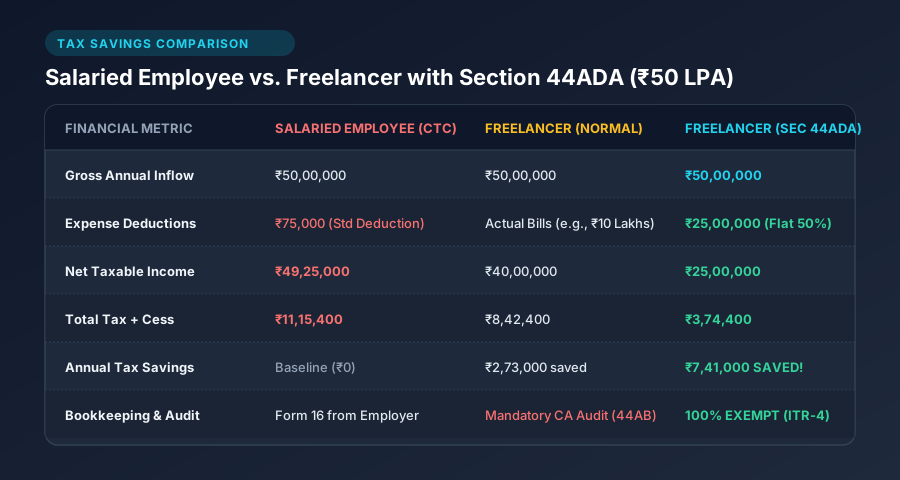
| Tax Parameter | Salaried Employee (₹50 LPA CTC) | Freelancer under Section 44ADA (₹50 LPA) | Fiscal Difference |
|---|---|---|---|
| Gross Annual Inflow | ₹50,00,000 | ₹50,00,000 | Nil (Identical gross) |
| Permissible Deductions | Standard Deduction: ₹75,000 | 50% Deemed Deduction: ₹25,00,000 | +₹24,25,000 extra deduction! |
| Net Taxable Income | ₹49,25,000 | ₹25,00,000 | Income halved by law |
| Base Income Tax (New Regime) | ₹10,72,500 | ₹3,60,000 | ₹7,12,500 lower base tax |
| Health & Education Cess (4%) | ₹42,900 | ₹14,400 | ₹28,500 lower cess |
| Total Income Tax Payable | ₹11,15,400 | ₹3,74,400 | ₹7,41,000 IN TAX SAVINGS! |
| Effective Tax Rate on Gross | 22.31% | 7.49% | 14.82% lower effective tax! |
The financial impact is staggering: an independent professional operating under Section 44ADA retains ₹7,41,000 more in post-tax cash flow every single year compared to a salaried employee earning the identical gross figure from an employer!
7. The Zero Lock-In Advantage: Freedom from Section 44AD(4)
Many tax practitioners and consultants mistakenly conflate Section 44AD and Section 44ADA, warning professionals about the dreaded "5-year lock-in rule". It is critical to recognize the vital statutory distinction between the two sections.
The Absence of Sub-Section (4) in Section 44ADA
As analyzed under our Section 44AD Small Business Guide, Section 44AD(4) contains an aggressive anti-abuse provision: if a trader opts out of Section 44AD in any year, they are barred from returning to Section 44AD for the next 5 assessment years. Crucially, no such provision exists in Section 44ADA!
Parliament deliberately excluded the lock-in restriction from Section 44ADA. This grants professionals complete annual fluidity:
- Year 1 (High Profit): Earn ₹60 Lakhs, incur ₹5 Lakhs expenses. Opt for Section 44ADA, declare 50% profit (₹30 Lakhs), pay tax on ₹30 Lakhs.
- Year 2 (Heavy Capital Investment): Earn ₹60 Lakhs, but purchase ₹40 Lakhs of high-end specialized surgical or rendering equipment and incur large travel costs (actual profit only 20% = ₹12 Lakhs). The professional can opt out of Section 44ADA, maintain books under Section 44AA, undergo a CA audit under Section 44AB(d), and pay tax on only ₹12 Lakhs!
- Year 3 (Return to 44ADA): Expenses normalize. The professional can immediately return to Section 44ADA without any waiting period or penalty!
8. Single Advance Tax Installment & GST LUT Compliance for Exports
Navigating indirect taxes and statutory advance tax timelines is essential for freelancers to avoid interest penalties.
Single Advance Tax Installment on 15th March
Under Section 211(1)(b) of the Income-tax Act, an assessee declaring income under Section 44ADA is exempt from the four quarterly advance tax deadlines (15 June, 15 September, 15 December). Instead, they are required to pay 100% of their advance tax in a single payment on or before 15th March of the financial year. If the total tax liability is paid in full on or before 15th March, zero interest under Section 234C is charged.
GST Obligations: The ₹20 Lakh Threshold & Letter of Undertaking (LUT)
While Section 44ADA provides an exemption from income tax bookkeeping, it does not grant exemption from Goods and Services Tax (GST):
- Mandatory Registration Threshold: Under Section 22 of the CGST Act, service providers whose aggregate turnover exceeds ₹20 Lakhs (or ₹10 Lakhs in special category states) must compulsorily obtain a GST registration.
- Domestic Indian Clients: Must issue a GST invoice charging 18% GST (SAC code 9983 for Information Technology and professional services).
- Foreign Export Clients (Zero-Rated Supply): If you provide services to clients located outside India and receive payment in convertible foreign exchange, the transaction qualifies as an "Export of Services" under Section 2(6) of the IGST Act.
- Exports are treated as zero-rated supplies (0% GST) under Section 16 of the IGST Act.
- To export services without paying 18% IGST upfront, the freelancer must file a Letter of Undertaking (Form GST RFD-11 / LUT) online on the GST portal at the beginning of each financial year.
- Always secure a Foreign Inward Remittance Certificate (FIRC) or Bank Realization Certificate (BRC) from your bank as proof that funds arrived in foreign currency.
9. Step-by-Step Reporting in ITR-4 (Sugam) on the e-Filing Portal
Eligible professionals claiming Section 44ADA file their returns using ITR-4 (Sugam). Below is the exact step-by-step reporting protocol on the official e-Filing portal (eportal.incometax.gov.in):
- Select Assessment Year: Choose AY 2027-28 (Financial Year 2026-27) and select form ITR-4.
- Navigate to Schedule BP (Business & Profession):
- Select "Income from Profession (Presumptive basis u/s 44ADA)".
- Select the appropriate Nature of Business/Profession Code (e.g., Code 14001 for Software Development/Technical Consultancy; Code 14002 for Web & UI Design; Code 16001 for Legal Services; Code 16002 for Medical Services; Code 16003 for Engineering/Architectural).
- Enter the Trade Name (your personal name or freelance agency name).
- Enter Gross Receipts Split:
- Enter total receipts received via banking/electronic modes (NEFT, UPI, SWIFT wire transfers).
- Enter total receipts received in physical cash (must not exceed 5% to claim the ₹75 Lakh ceiling).
- The portal auto-sums total gross receipts.
- Declare Presumptive Income:
- Enter your presumptive net profit. The portal enforces a mathematical validation rule requiring the declared income to be ≥ 50% of total gross receipts.
- Furnish Mandatory Financial Position Metrics:
- Sundry Debtors (unpaid client invoices as of 31 March).
- Sundry Creditors (unpaid expenses/vendor dues as of 31 March).
- Stock-in-trade (enter ₹0.00 for pure service professionals).
- Cash Balance (cash in hand as of 31 March).
- Bank Balance (closing balance of bank accounts as of 31 March).
- Verify AIS/TIS & 26AS: Ensure all client TDS deducted under Section 194J (10% or 2%) reflects in Schedule TDS-2 to claim 100% tax credit.
10. Comprehensive Real-World Numerical Case Studies
Case Study A: Remote Tech Consultant with US Remittances
Professional Profile: Siddharth is an independent cloud architect based in Bengaluru who contracts for two US technology startups. During FY 2026-27, he receives $78,000 in monthly wire transfers, converted by his bank into Indian Rupees totaling ₹66,00,000. He has zero cash receipts. He incurred ₹6,00,000 in real out-of-pocket expenses (laptop, home internet, SaaS tools, and coworking space).
Tax & Presumptive Assessment:
- Eligibility Check: Siddharth is a resident individual providing technical consultancy under Notification No. SO 890(E). His cash receipts are 0% (≤ 5%), qualifying him for the enhanced ₹75 Lakh ceiling. His ₹66 Lakh receipts fall comfortably within the threshold.
- Gross Receipts: ₹66,00,000.
- Deemed Business Expenses (50%): ₹33,00,000 (even though his actual expenses were only ₹6,00,000!).
- Taxable Professional Income (50%): ₹33,00,000.
- Tax Liability under New Tax Regime (FY 2026-27):
- ₹0 to ₹4,00,000: NIL
- ₹4,00,001 to ₹8,00,000 @ 5%: ₹20,000
- ₹8,00,001 to ₹12,00,000 @ 10%: ₹40,000
- ₹12,00,001 to ₹16,00,000 @ 15%: ₹60,000
- ₹16,00,001 to ₹20,00,000 @ 20%: ₹80,000
- ₹20,00,001 to ₹24,00,000 @ 25%: ₹1,00,000
- Above ₹24,00,000 (₹9,00,000) @ 30%: ₹2,70,000
- Total Base Income Tax: ₹5,70,000
- Health and Education Cess (4%): ₹22,800
- Total Final Tax Liability: ₹5,92,800
- Outcome: Siddharth pays an effective tax rate of only 8.98% on his gross ₹66 Lakh revenue, maintains zero books, and remits the full ₹5,92,800 via advance tax on 15 March 2027.
Case Study B: Senior Consultant Doctor with Hospital Retainership
Background: Dr. Meenakshi is a practicing surgeon who earns retainership fees from two private hospitals and consults patients at her clinic. For FY 2026-27, her gross receipts are:
- Hospital retainership fees (bank transfer via Sec 194J): ₹42,00,000 (TDS deducted @ 10% = ₹4,20,000).
- Clinic consultation fees via UPI/Card: ₹6,00,000.
- Clinic consultation fees in Cash: ₹1,50,000.
- Total Gross Professional Receipts: ₹49,50,000.
- Cash percentage: $₹1,50,000 / ₹49,50,000 = \mathbf{3.03\%}$ (≤ 5%).
Tax Computation:
- Gross Receipts of ₹49.5 Lakhs fall within both the base ₹50L and enhanced ₹75L limits.
- Presumptive Net Profit under Section 44ADA (50%): $50\% \times ₹49,50,000 = \mathbf{₹24,75,000}$.
- Total Tax under New Regime on ₹24,75,000 = ₹3,45,000 + 4% cess (₹13,800) = ₹3,58,800.
- TDS already deducted by hospitals and reflected in Form 26AS = ₹4,20,000.
- Tax Refund Claimed: Since TDS deducted (₹4,20,000) exceeds computed tax (₹3,58,800), Dr. Meenakshi receives an income tax refund of ₹61,200 credited directly to her bank account with interest under Section 244A!
11. Frequently Asked Questions (FAQ)
What is the gross receipts limit for Section 44ADA in FY 2026-27?
The baseline gross receipts ceiling under Section 44ADA is ₹50 Lakhs. However, an enhanced ceiling of ₹75 Lakhs applies if the aggregate cash receipts during the financial year do not exceed 5% of total gross receipts. Almost all technology freelancers and digital consultants operating via bank transfers or foreign wire remittances qualify for the ₹75 Lakh threshold.
Which professions are eligible to claim Section 44ADA?
Section 44ADA applies exclusively to "specified professions" notified under Section 44AA(1). These include legal, medical, engineering, architectural, accountancy, technical consultancy (including software developers, IT architects, and systems analysts), interior decoration, authorized representatives, and film artists (actors, directors, editors, lyricists, writers).
Does Section 44ADA have a 5-year lock-in rule like Section 44AD?
No! This is the single biggest statutory advantage of Section 44ADA over Section 44AD. The 5-year lock-out penalty under Section 44AD(4) applies strictly to business assessees under Section 44AD. Professionals under Section 44ADA can freely opt into presumptive taxation in one year, claim actual expenses via audit in the next year, and switch back to Section 44ADA in subsequent years without any penalty.
Can a professional declare more than 50% profit under Section 44ADA?
Yes. Section 44ADA(1) mandates a minimum profit of 50% or "a sum higher than the aforesaid sum claimed to have been earned". If your actual expenses are very low and you wish to declare 60%, 70%, or 80% net profit to build a stronger financial profile for home loans or visa processing, you can voluntarily report the higher percentage in ITR-4.
Are foreign freelance remittances eligible for Section 44ADA?
Yes. Foreign inward remittances received in convertible foreign exchange (e.g., USD, EUR, GBP) via authorized banking channels (SWIFT wire transfer, Stripe, Payoneer, or Wise) directly qualify as digital receipts under Section 44ADA, provided you obtain a Foreign Inward Remittance Certificate (FIRC) or BRC from your bank.
Are Hindu Undivided Families (HUFs) or LLPs eligible for Section 44ADA?
No. Under Section 44ADA(1), eligible assessees are strictly restricted to Resident Individuals and Resident Partnership Firms. HUFs and Limited Liability Partnerships (LLPs) are statutorily ineligible for Section 44ADA.