Section 44AD Presumptive Taxation Scheme: 6% vs 8% Rules, Limits & 5-Year Lock-In (FY 2026-27)

Statutory Summary: The Small Business Presumptive Safe Harbor
Enacted under Chapter IV-D of the Income-tax Act, 1961, Section 44AD provides a simplified, non-adversarial taxation framework for resident small traders, retail shopkeepers, wholesale distributors, contractors, and manufacturers in India. For Assessment Year 2027-28 (Financial Year 2026-27), eligible businesses with total turnover up to ₹2 Crore (or up to ₹3 Crore if cash receipts do not exceed 5%) can declare a deemed net profit of 6% on digital turnover and 8% on cash turnover. Opting for Section 44AD exempts businesses from maintaining books of accounts under Section 44AA and undergoing a tax audit under Section 44AB, but binds them to a strict 5-year lock-in rule under Section 44AD(4).
Table of Contents
- 1. Legislative Objective & Statutory Architecture of Section 44AD
- 2. Eligible Assessees & Ineligible Business Exclusions
- 3. Turnover Thresholds: ₹2 Crore Base vs. ₹3 Crore Digital Limit
- 4. Profit Computation: 6% Digital vs. 8% Cash Receipts
- 5. Operational Infographic: Section 44AD Decision Engine
- 6. Analytical Matrix: Normal Accounting vs. Section 44AD vs. Section 44ADA
- 7. The 5-Year Lock-In Trap Under Section 44AD(4) & (5)
- 8. Advance Tax Relaxation & Exemption from Sections 30 to 38
- 9. Reporting in ITR-4 (Sugam): Required Financial Disclosures
- 10. Comprehensive Real-World Numerical Case Studies
- 11. Frequently Asked Questions (FAQ)
1. Legislative Objective & Statutory Architecture of Section 44AD
Small proprietary businesses and retail enterprises in India often face overwhelming administrative burdens when compelled to adhere to conventional commercial accounting standards. Preparing double-entry ledgers, recording day-to-day vouchers, conducting periodic physical stock inventories, computing depreciation schedules under Section 32, and engaging Chartered Accountants for annual statutory audits impose disproportionate compliance overheads on micro-entrepreneurs.
To establish a friction-free tax environment, Parliament introduced Section 44AD with a non-obstante clause:
"Notwithstanding anything to the contrary contained in sections 28 to 43C, in the case of an eligible assessee engaged in an eligible business, a sum equal to eight per cent of the total turnover or gross receipts of the assessee in the previous year on account of such business, or, as the case may be, a sum higher than the aforesaid sum claimed to have been earned by the assessee, shall be deemed to be the profits and gains of such business chargeable to tax under the head 'Profits and gains of business or profession'."
The overriding language ("Notwithstanding anything to the contrary contained in sections 28 to 43C") means that once an assessee opts for Section 44AD, the standard statutory machinery for computing business income is suspended. The assessee is not required to prove their actual profit margins or substantiate operational expenditures; the statutory formula creates a legal presumption of income that the Assessing Officer cannot arbitrarily disturb.
2. Eligible Assessees & Ineligible Business Exclusions
Section 44AD does not apply universally across the entire corporate or commercial landscape. The statute enforces strict qualitative criteria regarding who can use the scheme and what business activities are statutorily barred.
Who Qualifies as an "Eligible Assessee" u/s 44AD(1)?
An eligible assessee must satisfy all three of the following statutory conditions:
- Entity Status: Must be a Resident Individual, a Resident Hindu Undivided Family (HUF), or a Resident Partnership Firm.
- Explicit Exclusion of LLPs: Explanation (a) specifically provides that an eligible assessee does not include a limited liability partnership firm registered under the LLP Act, 2008. Companies (Private or Public Limited) and Trusts/AOPs are also entirely ineligible.
- No Section 10A / Chapter VI-A Deductions: The assessee must not have claimed any profit-linked tax holidays under Section 10A, 10AA, 10B, 10BA or Chapter VI-A Part C (such as Sections 80-IA, 80-IAB, 80-IB, 80-IC, 80-ID, 80-IE, 80JJA, etc.) during the relevant assessment year.
Statutorily Excluded Businesses u/s 44AD(6)
Under sub-section (6), Section 44AD cannot be invoked by any taxpayer engaged in the following activities:
| Excluded Activity | Statutory Reason for Exclusion | Applicable Alternative Section |
|---|---|---|
| Specified Professions | Professions governed under Section 44AA(1) (Legal, Medical, Engineering, CA, Architecture, Interior Decorators, Tech Consultants) | Governed under Section 44ADA (50% presumptive profit rule) |
| Commission or Brokerage | Real estate agents, insurance brokers, stockbrokers, sub-brokers receiving commissions | Normal Accounting under Section 28 (Books u/s 44AA & Audit u/s 44AB) |
| Agency Businesses | Clearing & forwarding agents, consignment sales agents, advertising space agencies | Normal Accounting under Section 28 |
| Goods Carriage Transporters | Plying, hiring, or leasing goods transport carriages (trucks, lorries) | Governed under Section 44AE (Per-vehicle deemed slab rate) |
3. Turnover Thresholds: ₹2 Crore Base vs. ₹3 Crore Digital Limit
One of the most consequential amendments to Section 44AD in recent years was the enhancement of turnover thresholds to incentivize digital transaction adoption across Indian MSMEs.
The Baseline ₹2 Crore Ceiling
Historically, Section 44AD applied only to small businesses whose total turnover or gross receipts in the previous year did not exceed ₹2,00,00,000 (₹2 Crore). If a retail shopkeeper conducted business with a mix of cash and bank receipts and their annual turnover reached ₹2.05 Crore, they were immediately thrown out of Section 44AD and required to maintain books of accounts and undergo a CA audit.
The Enhanced ₹3 Crore Threshold for Digital Businesses
To accelerate the formalization of the commercial economy, the first proviso to Section 44AD(1) provides an enhanced threshold of ₹3,00,00,000 (₹3 Crore), subject to a strict 5% cash restriction:
"Provided that where the amount or aggregate of the amounts received during the previous year, in cash, does not exceed five per cent of the total turnover or gross receipts of such previous year, this sub-section shall have effect as if for the words 'two crore rupees', the words 'three crore rupees' had been substituted."
Under this proviso, if cash collections do not exceed 5% of gross turnover, the business can operate under Section 44AD all the way up to ₹3 Crore turnover. Furthermore, the second proviso clarifies that payments or receipts through non-account payee cheques or non-account payee drafts are treated as cash for the purpose of the 5% calculation.
4. Profit Computation: 6% Digital vs. 8% Cash Receipts
The substantive calculation of taxable business income under Section 44AD bifurcates total annual turnover into two statutory streams:
The 6% Concessional Rate on Digital Turnover
Under the proviso to Section 44AD(1), the deemed profit rate is slashed from 8% to 6% on that portion of turnover or gross receipts which is received:
- By an account payee cheque drawn on a bank;
- By an account payee bank draft;
- Through an electronic clearing system (ECS) through a bank account; or
- Through other prescribed electronic payment modes—including UPI, Credit Cards, Debit Cards, Net Banking, IMPS, NEFT, and RTGS.
Timing Rule: The digital receipts must be realized in the taxpayer's bank account during the financial year or before the statutory due date for filing the income tax return under Section 139(1) (typically 31st July of the assessment year). Digital turnover realized after the return filing due date defaults to the higher 8% rate.
The Standard 8% Rate on Cash Turnover
Any turnover received in physical cash, bearer cheques, or crossed (non-account payee) cheques is assessed at the standard deemed profit rate of 8%.
The Freedom to Declare Higher Profits
The statute explicitly allows an assessee to declare "a sum higher than the aforesaid sum claimed to have been earned". If a high-margin enterprise realizes an actual net profit of 12% or 15% on its turnover, the proprietor can voluntarily report 12% or 15% in ITR-4. Declaring higher profits enhances creditworthiness for bank loan sanctions and CC limit enhancements without sacrificing the procedural protections of Section 44AD.
5. Operational Infographic: Section 44AD Decision Engine
The operational flowchart below illustrates the exact statutory sequence an Indian business must navigate to determine eligibility, turnover thresholds, deemed profit splits, and compliance exemptions.

As visualized in the decision engine above:
- Threshold Gatekeeper: If cash receipts exceed 5%, turnover is strictly capped at ₹2 Crore. If cash is 5% or less, the business operates under the enhanced ₹3 Crore umbrella.
- Split Profit Formula: Turnover is divided between digital channels (taxed at 6%) and cash channels (taxed at 8%).
- Compliance Exemption Shield: Businesses qualifying under Section 44AD bypass complex Section 44AA bookkeeping and Section 44AB audits entirely.
6. Analytical Matrix: Normal Accounting vs. Section 44AD vs. Section 44ADA
To understand the structural advantages and limitations of Section 44AD, the comparison table and chart below contrast it against normal corporate accounting and the professional presumptive regime.
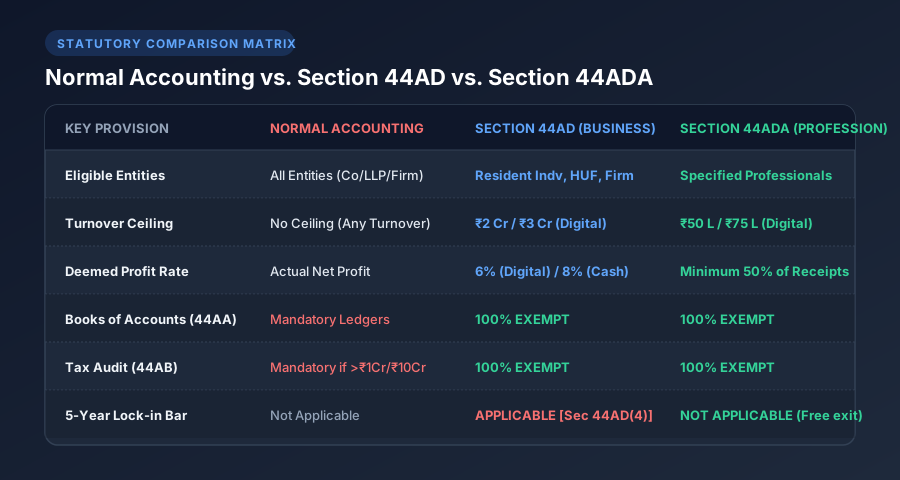
| Compliance Parameter | Normal Accounting (Sec 28) | Section 44AD (Businesses) | Section 44ADA (Professionals) |
|---|---|---|---|
| Eligible Assessees | All entities (Pvt Ltd, Public, LLP, Firm, Indv) | Resident Individuals, HUFs, Partnership Firms | Resident Individuals & Partnership Firms |
| Turnover Ceiling | Unlimited | ₹2 Crore / ₹3 Crore (Digital) | ₹50 Lakh / ₹75 Lakh (Digital) |
| Deemed Profit Rate | Actual net book profit | 6% (Digital) / 8% (Cash) | Minimum 50% of Gross Receipts |
| Books of Accounts (44AA) | Mandatory Ledgers & Journals | 100% Exempt | 100% Exempt |
| Tax Audit (44AB) | Mandatory if >₹1Cr / ₹10Cr | 100% Exempt | 100% Exempt |
| Advance Tax Schedule | 4 quarterly tranches (15 Jun/Sep/Dec/Mar) | 100% on or before 15th March | 100% on or before 15th March |
| Lock-in Penalty Rule | Not applicable | 5-Year Lock-Out [Sec 44AD(4)] | Zero Lock-in (Free annual exit) |
7. The 5-Year Lock-In Trap Under Section 44AD(4) & (5)
While Section 44AD provides tremendous relief, it contains a potent anti-abuse provision inserted via the Finance Act 2016 designed to prevent businesses from opportunistically hopping in and out of the scheme based on annual profitability.
The Statutory Mechanics of Section 44AD(4)
Under Section 44AD(4):
"Where an eligible assessee declares profit for any previous year in accordance with the provisions of this section and he declares profit for any of the five assessment years relevant to the previous year succeeding such previous year not in accordance with the provisions of sub-section (1), he shall not be eligible to claim the benefit of the provisions of this section for five assessment years subsequent to the assessment year in which the profit has not been declared in accordance with the provisions of sub-section (1)."
The Punitive Consequences of Section 44AD(5)
If an assessee triggers the lock-out under sub-section (4) by declaring profit lower than the mandated 6%/8% rate:
- 5-Year Debarment: The assessee is completely barred from using Section 44AD for the next 5 consecutive assessment years.
- Mandatory Books of Accounts: Under Section 44AD(5), the assessee must compulsorily maintain, retain, and furnish detailed books of accounts and documents as prescribed under Section 44AA.
- Compulsory Tax Audit: The assessee must get their accounts audited by a practicing Chartered Accountant and furnish an audit report under Section 44AB(e), provided their total taxable income exceeds the basic exemption limit (₹4,00,000 under the New Tax Regime for FY 2026-27).
Strategic Warning for Small Businesses
Never opt out of Section 44AD lightly. If your trading turnover is ₹1.5 Crore and your actual profit drops to 4% in a bad year, declaring 4% under normal accounting forces you into mandatory Chartered Accountant audits, complete voucher bookkeeping, and a 5-year exile from presumptive taxation. Often, it is mathematically more economical to voluntarily declare the deemed 6% profit and pay marginal tax rather than incur the recurring costs of accounting and audit fees for the next five years!
8. Advance Tax Relaxation & Exemption from Sections 30 to 38
Section 44AD carries critical ancillary advantages that eliminate cash-flow friction and accounting complexities throughout the operational year.
Single Advance Tax Installment on 15th March
Standard business entities governed under normal accounting must remit advance tax in four structured installments:
- 15% on or before 15th June
- 45% on or before 15th September
- 75% on or before 15th December
- 100% on or before 15th March
Failing to meet these quarterly targets triggers mandatory penal interest under Section 234C at 1% per month. However, under Section 211(1)(b), businesses declaring income under Section 44AD are 100% exempt from the June, September, and December installments. They are required to pay 100% of their advance tax in a single tranche on or before 15th March of the financial year. No Section 234C interest is levied if full payment is made by 15th March.
Deemed Allowance of Deductions & Asset Depreciation
Under Section 44AD(2), every deduction allowable under the provisions of Sections 30 to 38 shall, for the purposes of sub-section (1), be deemed to have been already given full effect to, and no further deduction under those sections shall be allowed.
- No Expense Claims: You cannot separately claim shop rent, employee wages, electricity, interest on bank OD loans, bad debts, or packing expenses. All expenses are presumed to be absorbed within the 92% or 94% cost cushion.
- Written Down Value (WDV) Depreciation Adjustment: Under sub-section (3), the written down value of any commercial asset used in the business shall be calculated as if the assessee had claimed and been actually allowed depreciation for each of the relevant assessment years. You cannot artificially freeze the WDV of your delivery vans or machinery during presumptive years.
- Partnership Salary and Interest: Following the Finance Act 2016 amendment, partnership firms opting for Section 44AD cannot deduct partner salary or partner interest under Section 40(b) from the deemed 6%/8% profit. The 6%/8% figure represents the firm's final net taxable profit before tax.
9. Reporting in ITR-4 (Sugam): Required Financial Disclosures
Eligible taxpayers utilizing Section 44AD file their returns using the simplified ITR-4 (Sugam) return form on the Income Tax e-Filing portal.
Mandatory Balance Sheet Disclosures in ITR-4
Although Section 44AD exempts businesses from maintaining full double-entry balance sheets, the Central Board of Direct Taxes mandates the disclosure of four specific financial metrics in ITR-4 as of 31st March of the financial year:
| Disclosure Field | Financial Definition | Reconciliation Source |
|---|---|---|
| Amount of Sundry Debtors | Total trade receivables outstanding from customers as of 31st March | Unpaid sales invoices / Customer ledger |
| Amount of Sundry Creditors | Total trade payables due to suppliers/vendors as of 31st March | Unpaid supplier bills / Vendor ledger |
| Amount of Stock-in-Trade | Estimated closing inventory value (raw material + finished goods) | Physical inventory estimate on 31 March |
| Cash Balance | Physical cash in hand held at business premises as of midnight 31 March | Physical cash drawer balance |
Additionally, taxpayers must disclose total bank balances across all current and savings accounts used for business operations, and reconcile digital turnover with GST returns (GSTR-1 and GSTR-3B) to avoid mismatch notices under Section 143(1)(a).
10. Comprehensive Real-World Numerical Case Studies
Case Study A: Retail Electronics Store with Digital Expansion
Business Profile: Ramesh operates an electronics and appliance retail store in Pune as a resident individual. For FY 2026-27, his business records show:
- Turnover via UPI, Credit Cards & Net Banking: ₹1,80,00,000.
- Turnover via Cash receipts: ₹8,00,000.
- Total Gross Turnover: ₹1,88,00,000 (₹1.88 Crore).
- Cash percentage: $₹8,00,000 / ₹1,88,00,000 = \mathbf{4.26\%}$ (≤ 5% limit).
Statutory Analysis & Tax Computation:
- Eligibility Check: Ramesh is a resident individual engaged in retail business (not an excluded profession or agency). His turnover of ₹1.88 Crore is well within the ₹2 Crore base limit (and complies with the enhanced ₹3 Crore digital criteria).
- Deemed Profit on Digital Turnover: $6\% \times ₹1,80,00,000 = \mathbf{₹10,80,000}$.
- Deemed Profit on Cash Turnover: $8\% \times ₹8,00,000 = \mathbf{₹64,000}$.
- Total Presumptive Net Business Income: $₹10,80,000 + ₹64,000 = \mathbf{₹11,44,000}$.
- Tax Computation under New Tax Regime (FY 2026-27):
- Standard deduction does not apply to business income. Gross Total Income = ₹11,44,000.
- ₹0 to ₹4,00,000: NIL
- ₹4,00,001 to ₹8,00,000 @ 5%: ₹20,000
- ₹8,00,001 to ₹11,44,000 @ 10%: ₹34,400
- Total Tax = ₹54,400 + 4% cess (₹2,176) = ₹56,576.
- Compliance Advantage: Ramesh pays only ₹56,576 in total tax on a ₹1.88 Crore business, maintains no formal books, undergoes no CA audit, and remits the entire ₹56,576 via advance tax on 15 March 2027.
Case Study B: The 5-Year Lock-In Opt-Out Trap
Background: Balaji Hardware Firm (Partnership Firm) opted for Section 44AD in AY 2025-26 on a turnover of ₹1.5 Crore (declared 8% profit = ₹12 Lakhs). In AY 2026-27, competition intensified, and Balaji's actual net profit fell to ₹4,50,000 on a turnover of ₹1.5 Crore (an actual profit margin of only 3%).
Decision & Consequences:
- If Balaji declares ₹4,50,000 (3% profit) in AY 2026-27, the firm has violated Section 44AD(1) by declaring profit lower than the mandated 8% during the 5-year lock-in window.
- Penalty 1: Balaji is immediately banned from claiming Section 44AD for the next 5 assessment years (AY 2027-28 through AY 2031-32).
- Penalty 2: Under Section 44AD(5), Balaji must compulsorily maintain double-entry books of accounts under Section 44AA.
- Penalty 3: Balaji must engage a Chartered Accountant, get accounts audited, and upload Form 3CB-3CD under Section 44AB(e) because total business income (₹4,50,000) exceeds the basic taxable threshold.
- The recurring costs of CA audit fees and accounting retainers over the 5-year debarment far exceed the small tax savings achieved by reporting 3% instead of the deemed presumptive profit!
11. Frequently Asked Questions (FAQ)
What is the turnover limit for claiming Section 44AD presumptive taxation in FY 2026-27?
The baseline turnover limit under Section 44AD is ₹2 Crore. However, an enhanced threshold of ₹3 Crore applies if the aggregate cash receipts (including cash sales and receipts) during the financial year do not exceed 5% of the total turnover or gross receipts.
When does the 6% presumptive profit rate apply instead of 8% under Section 44AD?
The deemed profit rate is reduced to 6% in respect of the turnover or gross receipts received by an account payee cheque, account payee bank draft, electronic clearing system (ECS), or prescribed digital payment modes (such as UPI, debit cards, credit cards, IMPS, NEFT, RTGS) received during the financial year or before the due date of filing the return under Section 139(1). Any turnover received in cash attracts the standard 8% rate.
What is the 5-year lock-in penalty rule under Section 44AD(4)?
Under Section 44AD(4), if an eligible business opts for presumptive taxation in one year and subsequently opts out by declaring profit lower than 6%/8% in any of the next 5 consecutive assessment years, the assessee is barred from returning to Section 44AD for the next 5 consecutive assessment years. Furthermore, under Section 44AD(5), they must compulsorily maintain books of accounts under Section 44AA and undergo a tax audit under Section 44AB if total income exceeds the basic exemption limit.
Are Limited Liability Partnerships (LLPs) eligible for Section 44AD?
No. Explanation (a) to Section 44AD specifically excludes Limited Liability Partnerships (LLPs) registered under the Limited Liability Partnership Act, 2008. Only resident individuals, Hindu Undivided Families (HUFs), and traditional partnership firms are eligible assessees.
Can an assessee declaring income under Section 44AD deduct business expenses or depreciation separately?
No. Under Section 44AD(2), all deductions allowable under Sections 30 to 38 (including rent, repairs, salaries, telephone, traveling, and depreciation under Section 32) are deemed to have been fully given effect to. Depreciation is deemed to have been allowed, and the written down value (WDV) of the asset must be reduced accordingly each year.
What is the advance tax payment schedule for businesses opting for Section 44AD?
Under Section 211(1)(b), an eligible assessee opting for Section 44AD is completely exempt from paying advance tax in four quarterly installments. Instead, they are required to pay 100% of their advance tax in a single installment on or before 15th March of the financial year. No penal interest under Section 234C is charged if 100% tax is remitted by 15th March.