Crypto Staking, Mining & DeFi Yield Farming Taxation in India: Rules & Rates (FY 2026-27)
Statutory Summary: Protocol Yields Under the Indian Tax Code
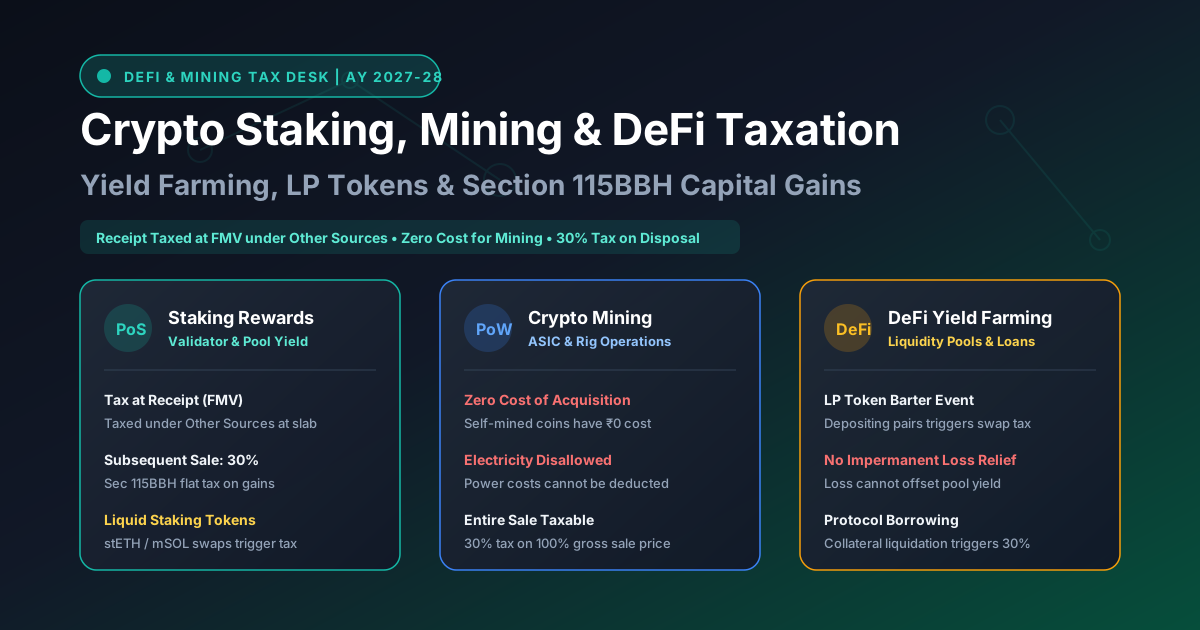
In Assessment Year 2027-28 (Financial Year 2026-27), decentralized blockchain activities—encompassing Proof of Stake (PoS) validation, Proof of Work (PoW) mining rigs, liquid staking protocols, and automated market maker (AMM) liquidity pools—face aggressive scrutiny from the Indian Income Tax Department. The regulatory architecture splits protocol participation into two distinct direct tax phases: accrual/receipt taxation at normal income tax slab rates under Section 56(2) (Income from Other Sources), followed by a punitive flat 30% tax (+4% cess) under Section 115BBH upon disposal or conversion. Crypto miners face extreme fiscal headwinds due to the complete statutory disallowance of electricity, data, and ASIC hardware depreciation under Section 115BBH provisos.
Table of Contents
- 1. Consensus Mechanisms & Decentralized Yield Generation
- 2. Proof of Stake (PoS) Staking: Double-Stage Taxation Rules
- 3. Operational Infographic: Web3 Tax Classification Across Protocol Pillars
- 4. Liquid Staking Derivatives (stETH, rETH) & Swap Realization
- 5. Proof of Work (PoW) Mining: The Zero Cost & Disallowed Expenses Crisis
- 6. Analytical Matrix: Staking vs. Mining vs. Liquidity Pools
- 7. DeFi Liquidity Pools (AMM), LP Tokens & Impermanent Loss
- 8. Decentralized Lending Protocols (Aave, Compound) & Collateral Liquidations
- 9. Reporting in ITR-2 & ITR-3: Schedule OS, Schedule VDA & Schedule FA
- 10. Comprehensive Real-World Numerical Case Studies
- 11. Frequently Asked Questions (FAQ)
1. Consensus Mechanisms & Decentralized Yield Generation
Decentralized public blockchains do not rely on central banks or corporate registrars to validate transactions and secure network ledgers. Instead, they utilize cryptographic economic consensus mechanisms:
- Proof of Work (PoW): Specialized computational hardware (ASIC miners, GPU rigs) consumes high volumes of electrical energy to solve cryptographic puzzles. Miners who successfully propose a valid block receive native blockchain coins (e.g., Bitcoin, Kaspa) along with network transaction fees.
- Proof of Stake (PoS): Token holders commit their capital (e.g., 32 Ethereum) into validator nodes to secure the network. Validators are selected deterministically to validate blocks and earn newly minted protocol tokens and priority gas fees.
- Decentralized Finance (DeFi) Yield Farming: Investors deposit pairs of tokens into smart contract liquidity pools (such as Uniswap V3, Curve, or Balancer) to facilitate automated algorithmic trading. In exchange, depositors receive Liquidity Provider (LP) tokens and earn a proportional share of trading fees, often augmented by native governance farming rewards.
While the Web3 community views these operations as organic mathematical rewards or passive interest, the Indian direct tax system classifies them strictly through the statutory lens of Section 2(47A) (Virtual Digital Assets), Section 56(2) (Income from Other Sources), and Section 115BBH (Flat 30% Tax).
2. Proof of Stake (PoS) Staking: Double-Stage Taxation Rules
Staking rewards earned from running an independent validator node, delegating tokens to a validation service, or staking through centralized exchanges undergo two distinct statutory tax events:
Event 1: Tax on Receipt of Staking Rewards
When staking rewards are credited to your non-custodial wallet address or exchange balance, new property has come into existence and been delivered to you without monetary payment. Under Indian tax law:
- The fair market value (FMV) of the rewarded cryptocurrency on the date and time of receipt is taxable under Section 56(2) as Income from Other Sources.
- This amount is added to your total income and taxed at your normal progressive income tax slab rates (which range up to 39% under the Old Regime or 30% plus applicable surcharge and cess under the New Regime).
- Because these tokens are received as income for services/capital lockup, the statutory ₹50,000 gift threshold under Section 56(2)(x) does not protect them; commercial or contractual protocol rewards are taxable from the very first rupee.
Event 2: Tax on Subsequent Disposal or Swap
When the validator subsequently sells, transfers, or swaps those accumulated staking rewards for INR, fiat-pegged stablecoins (USDT/USDC), or another cryptocurrency, a second taxable event is triggered under Section 115BBH:
Taxable Capital Gain = Sale Consideration − Stepped-Up Cost of Acquisition (FMV taxed at Event 1)
Under Section 49(4), the cost basis is stepped up to the FMV previously subjected to tax under Section 56(2). The incremental gain is taxed at a flat rate of 30% plus 4% cess (effective 31.20%). If the token price declines after receipt, however, the resulting capital loss cannot be offset against the income recognized at Event 1, creating an acute asymmetry for the taxpayer.
3. Operational Infographic: Web3 Tax Classification Across Protocol Pillars
The technical architecture diagram below categorizes the precise direct tax treatments applied across Staking, Proof of Work Mining, and DeFi Yield Farming under Indian tax law.
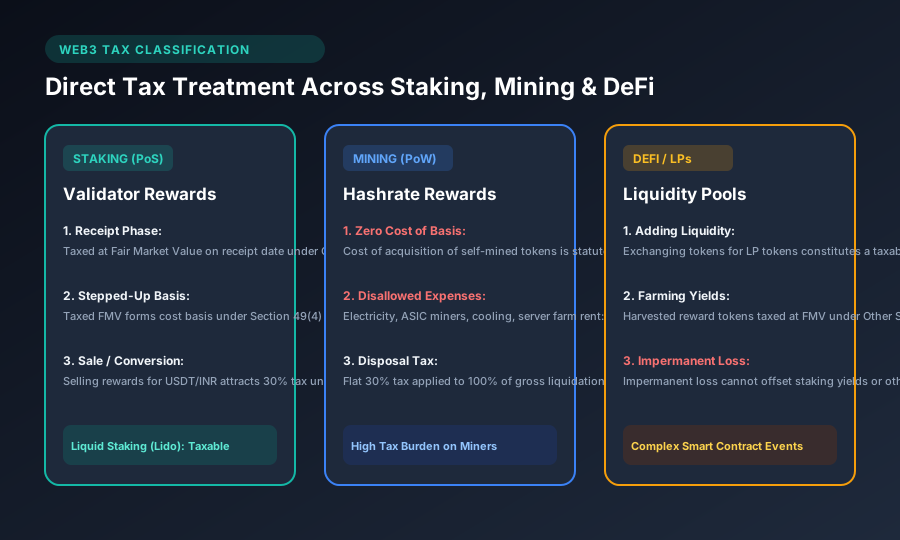
As illustrated across the three pillars:
- Staking (PoS): Rewards are characterized by a two-tier tax regime: slab tax at accrual/receipt, followed by 30% VDA capital gains upon realization.
- Mining (PoW): Disallowance of electricity and mining rigs eliminates standard business accounting, treating 100% of gross mined revenue as pure capital gain.
- DeFi Liquidity Pools: Smart contract interactions trigger multiple hidden "transfers" under Section 2(47), while impermanent loss is legally ignored.
4. Liquid Staking Derivatives (stETH, rETH) & Swap Realization
Due to the capital-intensive requirement of locking up 32 ETH to run an Ethereum validator, millions of crypto investors utilize liquid staking protocols such as Lido (stETH) or Rocket Pool (rETH). These protocols issue a synthetic ERC-20 token representing the underlying deposited coin plus accrued staking yields.
Is Depositing ETH for stETH a Taxable Event?
Under Section 2(47) of the Income-tax Act, a "transfer" includes the sale, exchange, or relinquishment of the asset. When an investor deposits 10 ETH into the Lido smart contract and receives 10 stETH:
- The investor has surrendered legal and cryptographic possession of 10 native Ethereum.
- The investor has received 10 units of a brand new, distinct Virtual Digital Asset (stETH contract address on the Ethereum network).
- Under CBDT Circular No. 13 of 2022, crypto-to-crypto swaps constitute an exchange of VDAs.
- If the Fair Market Value of the 10 stETH received on the date of deposit exceeds the historical purchase cost of the 10 ETH, the investor has realized a taxable capital gain under Section 115BBH, triggering an immediate flat 30% tax liability—even though the investor never cashed out into Indian Rupees!
Rebasing Tokens vs. Value-Accruing Tokens
Liquid staking tokens utilize two distinct technical accounting models, each carrying different tax implications:
| Token Model | Representative Protocols | Technical Mechanism | Direct Tax Treatment in India |
|---|---|---|---|
| Rebasing Tokens | Lido (stETH) | Token balance in your wallet increases daily (1 stETH = 1 ETH) | Every daily increment in token count constitutes a taxable receipt under Section 56(2) at daily FMV. |
| Value-Accruing Tokens | Rocket Pool (rETH), Marinade (mSOL) | Token quantity remains constant; exchange rate increases over time (e.g., 1 rETH = 1.09 ETH) | No daily income receipt. Tax is deferred until the token is redeemed or swapped, taxed entirely at 30% under Section 115BBH. |
5. Proof of Work (PoW) Mining: The Zero Cost & Disallowed Expenses Crisis
Cryptocurrency mining under the Indian direct tax code represents perhaps the most punitive tax structure in the global digital asset ecosystem. The statutory language of Section 115BBH combined with CBDT administrative instructions creates severe structural liabilities for Indian mining farms.
The Zero Cost of Acquisition Rule
Under Section 115BBH(1), tax is computed on the income from the transfer of a Virtual Digital Asset. In standard asset taxation, cost of acquisition includes expenses incurred to create or produce the asset. However, under the first proviso to Section 115BBH(2)(a):
"No deduction in respect of any expenditure (other than cost of acquisition, if any) or allowance or set off of any loss shall be allowed to the assessee under any provision of this Act..."
The Ministry of Finance and CBDT have clarified that for self-mined cryptocurrency, the Cost of Acquisition is ZERO (NIL). Because no purchase consideration was paid to another person to acquire the coin, the taxpayer is deemed to have acquired the coin at zero cost.
Complete Disallowance of Mining Operating Expenses
Commercial cryptocurrency mining requires massive real-world operating and capital expenditures:
- Electrical Power: Industrial electricity bills often consume 60% to 80% of gross mined revenue. 100% Disallowed.
- ASIC / GPU Hardware Depreciation: Multi-crore investments in Antminer or Whatsminer rigs lose computational value over 24-36 months. Depreciation under Section 32 is 100% Disallowed.
- Facility Lease, Cooling & High-Speed Internet: Server warehouse rental, industrial HVAC cooling chillers, and fiber optic connectivity are 100% Disallowed.
The Mathematical Absurdity of Indian Mining Taxes
Consider an Indian mining farm that mines 1 Bitcoin during FY 2026-27:
- Gross market value of 1 BTC mined and sold: ₹60,00,000.
- Electricity consumed to mine that 1 BTC: ₹40,00,000.
- Hardware amortization and facility overhead: ₹12,00,000.
- Actual economic profit earned by the miner: ₹60,00,000 − (₹40,00,000 + ₹12,00,000) = ₹8,00,000.
Under Section 115BBH, the miner is not taxed on the ₹8,00,000 economic profit. The miner is taxed at a flat 30% plus 4% cess on the entire gross revenue of ₹60,00,000:
Tax Payable = 31.20% × ₹60,00,000 = ₹18,72,000
The miner earned an economic profit of ₹8,00,000, but owes the Indian Income Tax Department ₹18,72,000 in income tax! Operating an ASIC mining farm in India results in an effective tax rate of over 234% of net profit, resulting in insolvency.
6. Analytical Matrix: Staking vs. Mining vs. Liquidity Pools
The statutory parameters contrasting PoS staking, PoW mining, and DeFi liquidity pools are summarized in the matrix below.

| Tax Criterion | PoS Staking Rewards | PoW Crypto Mining | DeFi Liquidity Pools (AMM) |
|---|---|---|---|
| Initial Tax Event | Other Sources at FMV (Slab rates) | No tax at mint; full tax on disposal | Swap tax on LP deposit + Yield slab |
| Deemed Cost of Basis | Stepped-up FMV u/s 49(4) | ZERO (NIL) Statutorily | FMV of deposited token pair |
| Hardware / Power Deduction | Disallowed against 30% sale tax | 100% Disallowed (Sec 115BBH Proviso) | Gas fees 100% disallowed |
| Disposal Tax Rate | Flat 30% on incremental capital gain | Flat 30% on 100% of gross sale proceeds | Flat 30% on pool redemption surplus |
| Loss Offsetting Rights | Prohibited under Sec 115BBH(2)(b) | Prohibited under Sec 115BBH(2)(b) | Impermanent loss cannot be set off |
| TDS Section 194S | 1% on liquidation via Indian broker | 1% on gross sale consideration | 1% on crypto-to-crypto pool exits |
7. DeFi Liquidity Pools (AMM), LP Tokens & Impermanent Loss
Decentralized exchanges like Uniswap, Curve, and PancakeSwap operate without centralized order books. Instead, they rely on automated liquidity pools funded by peer investors who deposit paired tokens (e.g., 50% ETH and 50% USDT).
The Barter Swap Trap Upon Pool Entry
When you transfer 1 ETH and 2,500 USDT into a Uniswap liquidity pool, the smart contract takes possession of your tokens and mints a specific number of Liquidity Provider (LP) tokens (e.g., UNI-V2 or an ERC-721 NFT for Uniswap V3 positions) to your wallet.
Under Indian direct tax jurisprudence, this smart contract interaction constitutes a disposition and barter transfer:
- You have transferred 1 ETH and 2,500 USDT (two distinct VDAs).
- You have acquired an LP token (a third distinct VDA).
- If the market value of your 1 ETH at the time of pool entry was ₹2,50,000, and you originally acquired it for ₹1,80,000, you have realized an unrealized gain of ₹70,000.
- Under Section 115BBH, you must report and pay 30% tax on the ₹70,000 gain (₹21,840) for the year you entered the pool, even though your capital remains locked in decentralized contracts!
Impermanent Loss: The Non-Deductible Phantom Loss
When the price ratio of deposited tokens diverges significantly from the deposit date, automated market makers rebalance the pool, resulting in "impermanent loss" (the user ends up with fewer appreciated tokens and more depreciated tokens compared to simply holding the assets in a cold wallet).
When an LP withdraws their liquidity from the pool, this impermanent loss becomes permanent. However, under Section 115BBH(2)(b):
- No loss from the transfer of any VDA can be set off against any other income or VDA gain.
- Therefore, if a user experiences a ₹1,00,000 impermanent loss upon exiting a pool, that loss is completely dead. It cannot be used to offset the LP trading fee yield earned, nor can it offset capital gains on other crypto sales.
8. Decentralized Lending Protocols (Aave, Compound) & Collateral Liquidations
Decentralized lending protocols allow users to deposit crypto as collateral and borrow other digital assets (such as borrowing USDT against collateralized Bitcoin).
Taxation of Collateral and Borrowed Capital
- Depositing Collateral: Transferring BTC or ETH into an Aave liquidity pool in exchange for interest-bearing tokens (aTokens) is treated as a token swap under Section 2(47), requiring capital gain evaluation at deposit.
- Borrowing Funds: Taking a loan of stablecoins does not constitute income under Indian tax law; it represents a capital liability. However, spending or swapping those borrowed stablecoins triggers standard Section 115BBH and Section 194S rules.
- Accrued Protocol Interest: The interest yield received on deposited collateral is treated as taxable income under Section 56(2) (Income from Other Sources) at normal slab rates.
The Collateral Liquidation Catastrophe
If the market price of your collateral crashes and breaches the loan-to-value (LTV) liquidation threshold, the smart contract automatically sells your collateral to liquidators on the open market to settle the debt. In the eyes of the Indian Income Tax Department, a smart contract liquidation constitutes an involuntary transfer (sale) under Section 2(47). If the market value of the liquidated collateral exceeds your original acquisition cost, you must pay flat 30% tax under Section 115BBH on the gain—even though your collateral was forcefully seized and you lost your crypto!
9. Reporting in ITR-2 & ITR-3: Schedule OS, Schedule VDA & Schedule FA
Taxpayers engaged in staking, mining, and DeFi yield farming must file either ITR-2 (if personal passive investor) or ITR-3 (if running an active crypto business/proprietorship).
Multi-Schedule Reporting Checklist
- Schedule OS (Income from Other Sources):
- Report gross staking rewards received during the financial year valued at their receipt-date Fair Market Value.
- Report decentralized lending interest and protocol governance rewards.
- Ensure this income is added to your total income for normal slab taxation.
- Schedule VDA (Virtual Digital Assets):
- Every liquid staking token swap (ETH to stETH), LP token entry/exit, staking reward sale, and mined coin liquidation must be entered line-by-line.
- For mined coins, enter Cost of Acquisition as ₹0.00.
- For sold staking rewards, enter Cost of Acquisition as the stepped-up FMV previously reported in Schedule OS.
- Schedule FA (Foreign Assets):
- Resident individuals holding non-custodial Web3 wallets (MetaMask, Phantom, Ledger) interacting with global decentralized smart contracts must report foreign digital holdings under Table A3 / Table G.
- Failure to disclose foreign crypto holdings in Schedule FA can attract a ₹10,00,000 penalty under Section 43 of the Black Money Act, 2015.
10. Comprehensive Real-World Numerical Case Studies
Case Study A: Solana Staking Validator Node Yield
Background: Harish stakes 500 SOL in a validator pool on 1 April 2026. Across FY 2026-27, he earns 35 SOL in staking rewards distributed in bi-weekly tranches. The average Fair Market Value of SOL on the receipt dates corresponds to a cumulative value of ₹3,50,000. Harish falls in the 30% tax slab under the New Regime.
Tax Event 1 (Receipt Phase - FY 2026-27):
- Income reported under Schedule OS: ₹3,50,000.
- Income tax payable at slab rate (30% + 4% cess): $31.2\% \times ₹3,50,000 = \mathbf{₹1,09,200}$.
- Under Section 49(4), the Cost of Acquisition for the 35 SOL is registered at ₹3,50,000 (₹10,000 per SOL).
Tax Event 2 (Disposal Phase - 15 February 2027):
- Harish sells all 35 SOL on an Indian exchange when SOL price surges to ₹14,000 per SOL.
- Gross Sale Consideration = $35 \times ₹14,000 = \mathbf{₹4,90,000}$.
- Stepped-up Cost of Acquisition u/s 49(4) = ₹3,50,000.
- Taxable Capital Gain u/s 115BBH = $₹4,90,000 - ₹3,50,000 = \mathbf{₹1,40,000}$.
- Tax under Section 115BBH (31.20%) = $₹1,40,000 \times 31.2\% = \mathbf{₹43,680}$.
- Section 194S TDS deducted by exchange at 1% of gross consideration = $1\% \times ₹4,90,000 = \mathbf{₹4,900}$.
- Total combined tax liability = ₹1,09,200 (Stage 1) + ₹43,680 (Stage 2) = ₹1,52,880.
Case Study B: The PoW Mining Rig Reality
Background: Devendra sets up an ASIC mining rig in Jaipur for Kaspa (KAS) mining. During FY 2026-27, he mines tokens worth ₹10,00,000 upon liquidation. His documented operational costs are:
- Electricity bills: ₹6,50,000.
- High-speed internet lease: ₹50,000.
- Rig hardware depreciation: ₹2,00,000.
- Total real expenses incurred: ₹9,00,000. Real cash profit: ₹1,00,000.
Direct Tax Assessment under Section 115BBH:
- Cost of Acquisition of self-mined tokens = ₹0.00.
- Deduction for electricity, internet, and depreciation = ₹0.00 (100% Disallowed).
- Taxable Capital Gain under Section 115BBH = ₹10,00,000.
- Tax Payable (30% + 4% cess) = $31.2\% \times ₹10,00,000 = \mathbf{₹3,12,000}$.
- Net Financial Position: Devendra earned ₹1,00,000 in real cash profit, but must pay ₹3,12,000 in tax. His venture ends in a net cash loss of ₹2,12,000 solely due to direct tax rules!
11. Frequently Asked Questions (FAQ)
How are crypto staking rewards taxed in India?
Crypto staking rewards trigger two taxable events: First, upon receipt in your wallet, the Fair Market Value (FMV) of the rewarded tokens is taxable under "Income from Other Sources" at your normal income tax slab rates. Second, when you subsequently sell or convert those reward tokens, the incremental gain (Sale Price minus taxed FMV) is taxed at a flat rate of 30% plus 4% cess under Section 115BBH.
Can cryptocurrency miners deduct electricity and ASIC hardware costs?
No. Under the first proviso to Section 115BBH(2)(a), no deduction in respect of any expenditure (other than direct cost of acquisition) or allowance shall be allowed. For self-mined cryptocurrency, the cost of acquisition is legally treated as ZERO (NIL). Mining hardware depreciation, electricity bills, cooling systems, and internet facility leases are 100% disallowed. Miners must pay a flat 30% tax on the entire gross sale proceeds.
Does depositing tokens into a DeFi liquidity pool (e.g., Uniswap) trigger tax?
Yes. When you deposit a token pair (such as ETH and USDC) into an automated market maker liquidity pool and receive an LP token in exchange, you have transferred your original tokens in exchange for another Virtual Digital Asset. Under Section 2(47), this constitutes a taxable barter transfer, triggering a flat 30% tax under Section 115BBH on any unrealized capital gain embedded in the deposited tokens.
Can I claim a tax deduction for impermanent loss in DeFi liquidity pools?
No. Section 115BBH(2)(b) strictly prohibits the set-off of any loss arising from the transfer of a Virtual Digital Asset against any other income or any other VDA. Impermanent loss incurred while providing decentralized liquidity cannot be deducted from your trading profits or staking yield.
Are liquid staking tokens like Lido stETH or Rocket Pool rETH taxable upon minting?
Under the strict interpretation of Section 2(47), swapping ETH for stETH involves relinquishing native Ethereum in exchange for a distinct ERC-20 token representing a staked claim. If the fair market value of stETH on the swap date exceeds your original acquisition cost of ETH, an immediate 30% tax under Section 115BBH applies to that capital gain.
How should staking and mining income be disclosed in ITR-2 or ITR-3?
Staking rewards received during the year must be disclosed in Schedule OS (Income from Other Sources) at their receipt-date FMV. When staking rewards or mined coins are liquidated, each sale must be reported line-by-line in Schedule VDA, using the stepped-up FMV as the cost of acquisition for staking, or ₹0 for mined tokens. Non-custodial foreign wallets holding these assets must be declared in Schedule FA.