NFT & Airdrop Taxation in India: Section 2(47A), Section 56(2)(x) & 30% VDA Rules (FY 2026-27)
Statutory Summary: The Web3 Direct Tax Landscape
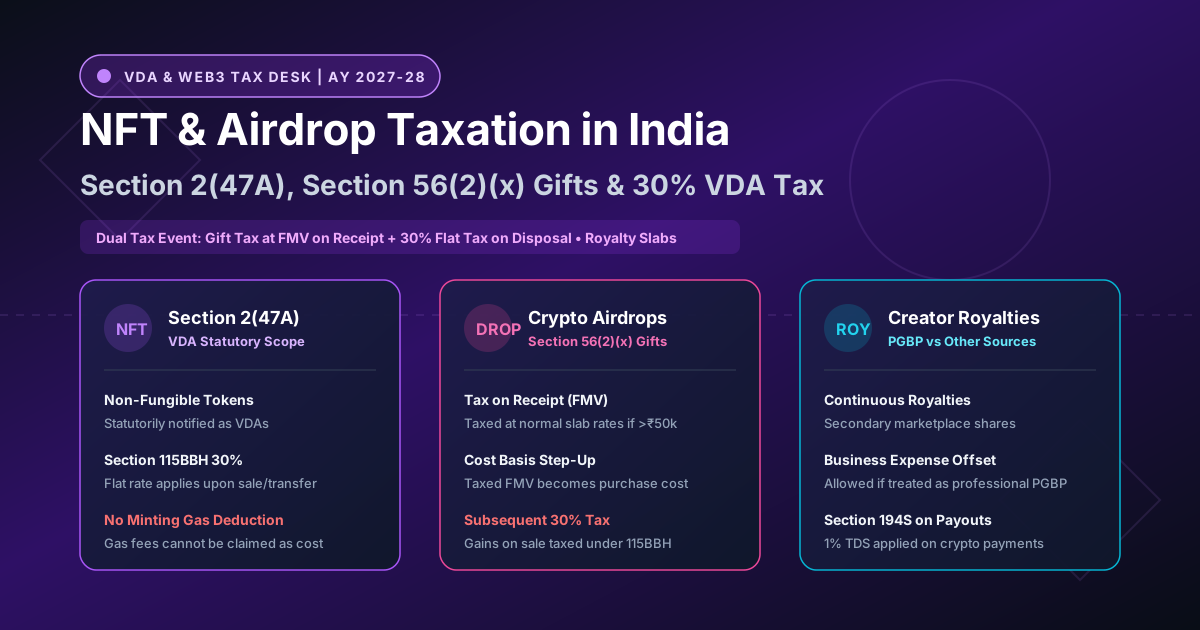
In Assessment Year 2027-28 (Financial Year 2026-27), the taxation of Non-Fungible Tokens (NFTs) and cryptocurrency airdrops in India is characterized by a sophisticated dual-stage taxation mechanism. NFTs are explicitly incorporated into the definition of Virtual Digital Assets (VDAs) under Section 2(47A) and CBDT Notification No. 74/2022. Free crypto airdrops and minted digital collectibles trigger a double tax event: first as gift income under Section 56(2)(x) at fair market value upon receipt, followed by a flat 30% tax (+4% cess) under Section 115BBH upon subsequent sale or swap, utilizing the stepped-up cost basis provisions of Section 49(4). Digital creators, meanwhile, navigate distinct treatment between professional PGBP income and passive VDA transfers.
Table of Contents
- 1. Section 2(47A) & CBDT Notification 74/2022: What Constitutes an NFT?
- 2. The Dual-Stage Taxation of Crypto Airdrops
- 3. Operational Infographic: Two-Stage Airdrop & NFT Tax Journey
- 4. Section 49(4) Cost of Acquisition Step-Up Mechanics
- 5. NFT Resale Taxation: Section 115BBH & Disallowance of Gas Fees
- 6. Analytical Matrix: Resellers vs. Creators vs. Airdrop Recipients
- 7. Digital Artists & Creator Royalties: PGBP vs. VDA Head of Income
- 8. Offshore Marketplaces (OpenSea, Blur) & TDS Section 194S
- 9. Reporting in ITR-2 & ITR-3: Schedule VDA, OS & Schedule FA
- 10. Comprehensive Real-World Numerical Case Studies
- 11. Frequently Asked Questions (FAQ)
1. Section 2(47A) & CBDT Notification 74/2022: What Constitutes an NFT?
The Finance Act 2022 introduced clause (47A) to Section 2 of the Income-tax Act, 1961, creating a statutory definition for "Virtual Digital Asset" (VDA). Section 2(47A)(a) specifically includes:
"A non-fungible token or any other token of similar nature, by whatever name called, which is generated through cryptographic means and satisfies such conditions as may be prescribed."
To establish clear boundaries, the Central Board of Direct Taxes issued Notification No. 74/2022 / F. No. 370142/29/2022-TPL, defining an NFT as a cryptographic token that gives the buyer or holder proof of ownership of a unique digital asset that is not fungible or interchangeable.
Statutory Exclusions from the NFT Definition
Crucially, the CBDT notification created an explicit carve-out for real-world asset tokenization. The following digital tokens are excluded from the definition of an NFT / VDA:
- An NFT whose transfer results in the transfer of ownership of underlying tangible assets (e.g., fractionalized physical real estate, physical bullion, or motor vehicles).
- The transfer of ownership of such underlying tangible asset must be legally enforceable under the applicable civil or property laws of India.
If an NFT represents pure digital art, gaming skins, profile pictures (PFPs), music rights, or virtual metaverse land, it is fully classified as a Virtual Digital Asset and subjected to the rigorous 30% tax regime under Section 115BBH. Conversely, if a token represents title to physical agricultural land registered under the Indian Registration Act, 1908, the token transfer is taxed under traditional capital gains rules (Section 45 to Section 55) rather than the punitive VDA regime.
2. The Dual-Stage Taxation of Crypto Airdrops
In the Web3 ecosystem, decentralized protocols (such as Uniswap, Arbitrum, Optimism, Celestia, and LayerZero) frequently distribute native governance tokens directly to user wallets free of charge as "airdrops" to reward early testnet participation or protocol liquidity provision. Many Indian users mistakenly assume that because an airdrop is "free money from the blockchain," no tax liability arises until the tokens are converted into Indian Rupees.
From an Indian direct tax perspective, this assumption is fundamentally erroneous. An airdrop creates two distinct taxable events across its lifecycle:
Event 1: Tax on Receipt under Section 56(2)(x)
Under Section 56(2)(x) of the Act, where any person receives from any person any property without consideration, and the aggregate fair market value (FMV) of such property exceeds ₹50,000 during the financial year, the entire FMV is chargeable to income-tax under the head "Income from Other Sources".
- Virtual Digital Assets are "Property": Explanation to Section 56(2) was explicitly amended to include Virtual Digital Assets within the definition of property.
- Valuation Date: The tokens are valued at their opening Fair Market Value on the global exchanges (e.g., CoinMarketCap or Binance) on the exact date and timestamp when the tokens land in the recipient's wallet.
- Tax Rate at Receipt: The value is taxed at the assessee's normal progressive income tax slab rates (which can reach up to 39% under the Old Regime or 30% + cess under the New Regime for high earners).
- The ₹50,000 Threshold: If total gifts (including cash gifts, jewelry, real estate, and crypto airdrops from non-relatives) do not exceed ₹50,000 in aggregate across the entire financial year, zero tax is payable at the time of receipt.
Event 2: Tax on Subsequent Sale under Section 115BBH
When the recipient subsequently decides to sell, swap, or liquidate those airdropped tokens for USDT, Bitcoin, or INR, a second taxable event occurs under Section 115BBH. The gain is taxed at a flat rate of 30% plus 4% cess (effective 31.20%). The critical question that arises is: What is the cost of acquisition used to calculate this capital gain?
3. Operational Infographic: Two-Stage Airdrop & NFT Tax Journey
The visual framework below demonstrates the chronological interaction between Section 56(2)(x) gift taxation upon wallet receipt and Section 115BBH VDA taxation upon market disposal.

As detailed in the architecture diagram above, the two stages operate sequentially:
- Stage 1 (Receipt Phase): Determines whether the initial receipt is a taxable gift. If the ₹50,000 threshold is breached, tax is paid at slab rates, and the value is permanently recognized as an asset purchase price on the taxpayer's capital account.
- Bridge Mechanism (Section 49(4)): Prevents catastrophic double taxation by stepping up the acquisition cost to match the exact valuation taxed under Section 56(2)(x).
- Stage 2 (Disposal Phase): Captures only the incremental market appreciation between the receipt date and the liquidation date at the flat 30% VDA rate.
4. Section 49(4) Cost of Acquisition Step-Up Mechanics
To avoid unconstitutional double taxation where the same economic value is taxed twice under two different heads, the Income-tax Act incorporates Section 49(4):
"Where the capital gain arises from the transfer of a property, the value of which has been subject to tax under clause (x) of sub-section (2) of section 56, the cost of acquisition of such property shall be deemed to be the value which has been taken into account for the purposes of the said clause (x)."
Scenario A: Airdrop Value Exceeded ₹50,000 Upon Receipt
Suppose an investor receives 2,000 governance tokens via an airdrop on 1 June 2026. On that date, each token is worth ₹100 on centralized exchanges, making the gross receipt worth ₹2,00,000. Because ₹2,00,000 > ₹50,000, the investor reports ₹2,00,000 in Schedule OS and pays slab tax (e.g., 30% slab = ₹62,400 with cess).
On 15 December 2026, the token rallies to ₹250 each. The investor sells all 2,000 tokens for ₹5,00,000. Under Section 49(4), the Cost of Acquisition is stepped up to ₹2,00,000. The taxable capital gain under Section 115BBH is:
Taxable Gain = ₹5,00,000 (Sale Consideration) − ₹2,00,000 (Stepped-up FMV Cost) = ₹3,00,000
The investor pays 30% tax on ₹3,00,000 (₹93,600 with cess). The investor does not pay 30% on the full ₹5,00,000, because ₹2,00,000 was already taxed at receipt.
Scenario B: Airdrop Value Was Under ₹50,000 Upon Receipt
Now consider an airdrop of 1,000 tokens worth ₹30 each on receipt (total value ₹30,000). The recipient receives no other gifts during the financial year. Because ₹30,000 ≤ ₹50,000, the receipt is completely exempt under Section 56(2)(x), and zero tax was paid at Stage 1.
Because no value was "subject to tax under clause (x) of sub-section (2) of section 56", Section 49(4) cannot apply! Therefore, the Cost of Acquisition is treated as NIL (₹0). When the investor later sells these tokens for ₹1,50,000, the entire ₹1,50,000 constitutes taxable gain under Section 115BBH, attracting a flat 30% tax (₹46,800 with cess).
5. NFT Resale Taxation: Section 115BBH & Disallowance of Gas Fees
For collectors and investors who purchase Non-Fungible Tokens on marketplaces like OpenSea, Magic Eden, or Blur with the intention of flipping them for profit, taxation is strictly governed by Section 115BBH.
Disallowance of Blockchain Gas Fees and Platform Commissions
In standard real-estate or equity investing, transfer fees, brokerage, stamp duty, and legal fees are fully deductible as transfer expenses under Section 48. In sharp contrast, the first proviso to Section 115BBH(2)(a) states:
"No deduction in respect of any expenditure (other than cost of acquisition, if any) or allowance or set off of any loss shall be allowed to the assessee under any provision of this Act in computing the income referred to in clause (a) of sub-section (1)."
This statutory embargo produces harsh commercial realities for NFT traders:
- Ethereum / Solana Gas Fees: Network execution fees paid to miners or validators to approve minting, approving contracts, or executing marketplace transfers are 100% disallowed. Even if a trader paid 0.2 ETH (worth ₹50,000) in gas fees during high network congestion, zero rupees can be claimed as a deduction.
- Marketplace Listing Fees: OpenSea or Blur platform transaction fees (typically 0.5% to 2.5%) cannot be deducted.
- Creator Royalty Deductions: If a secondary sale automatically routes a 5% royalty to the original artist via smart contracts, the seller is still assessed on the gross sale consideration, without deduction of the deducted royalty, unless the marketplace contract structure defines the seller's entitlement net of royalty at source.
Total Prohibition on Setting Off NFT Losses
Under Section 115BBH(2)(b), losses incurred on worthless or "rugged" NFTs cannot be offset against profitable NFT trades, nor against gains on Bitcoin, Ethereum, or any other asset class. If a trader buys 5 NFTs for ₹1 Lakh each (spending ₹5 Lakhs), 4 drop to zero value (loss of ₹4 Lakhs), and 1 sells for ₹3 Lakhs (profit of ₹2 Lakhs), the trader has lost ₹2 Lakhs in overall capital. Despite this real financial loss, the trader must pay 30% tax on the ₹2 Lakhs profit (₹62,400 tax), while the ₹4 Lakhs loss is permanently forfeited.
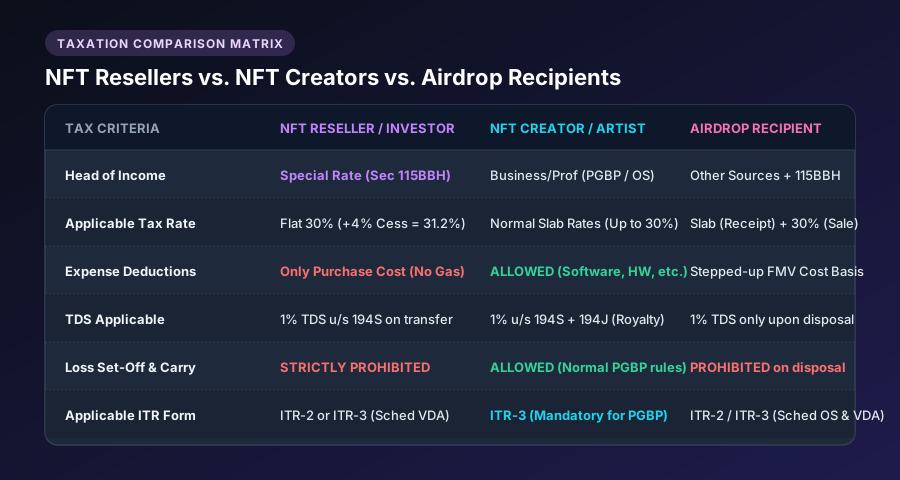
6. Analytical Matrix: Resellers vs. Creators vs. Airdrop Recipients
The operational and tax requirements across different market roles within the Web3 ecosystem are contrasted in the table below.
| Compliance Dimension | NFT Reseller / Investor | NFT Creator / Digital Artist | Crypto Airdrop Recipient |
|---|---|---|---|
| Primary Tax Head | Special Rate (Section 115BBH) | PGBP (Section 28) or Other Sources | Other Sources [56(2)(x)] + 115BBH |
| Applicable Tax Rate | Flat 30% (+4% Cess = 31.2%) | Normal Slab Rates (Up to 30% + cess) | Slab Rate (Stage 1) + 30% (Stage 2) |
| Expense Deductibility | Strictly Purchase Cost Only | Full Deductions Allowed (HW/SW) | Stepped-up FMV Cost u/s 49(4) |
| Loss Set-Off Rights | 100% Prohibited | Allowed against non-salary income | Prohibited on Stage 2 disposal |
| TDS Withholding | 1% u/s 194S on sale | 1% u/s 194S + 10% u/s 194J | 1% u/s 194S upon eventual sale |
| Applicable ITR Form | ITR-2 or ITR-3 (Schedule VDA) | ITR-3 (Mandatory for PGBP) | ITR-2 / ITR-3 (Sched OS & VDA) |
7. Digital Artists & Creator Royalties: PGBP vs. VDA Head of Income
One of the most fiercely debated questions in direct tax jurisprudence is whether an original digital artist who mints and sells their own artwork as an NFT is governed under the punitive Section 115BBH regime or under traditional business/professional income provisions (PGBP).
Primary Mint Sales vs. Secondary Royalties
- Primary Minting Sales: When an artist mints their own artwork and sells it on a platform like Foundation or SuperRare, the artist did not acquire the NFT from anyone else. There is no "cost of acquisition" in the traditional sense. While the Department frequently attempts to categorize all token transfers under Section 115BBH, tax professionals argue that creating art constitutes a personal profession or business governed under Section 28 of the Act.
- Professional Expense Deductions under PGBP: If an artist files under PGBP using ITR-3, Section 37(1) allows deduction of all wholly and exclusively incurred expenses:
- High-performance computer hardware and GPU depreciation under Section 32.
- Subscriptions to 3D modeling software (Blender, Cinema 4D, Adobe Creative Cloud).
- Studio broadband, studio rental, and promotional marketing costs.
- Network gas fees incurred specifically to deploy smart contracts.
- Secondary Smart Contract Royalties: Most NFT smart contracts encode a perpetual creator royalty (e.g., 5% or 10% on every subsequent secondary resale). Because these royalty payments are received passively as income arising from intellectual property licensing, they are categorized under Income from Other Sources or Business Income, taxable at normal slab rates.
GST Implications for Indian NFT Creators
Indian artists selling NFTs to domestic or overseas collectors must evaluate Goods and Services Tax (GST). Digital art and tokens delivered electronically fall under Online Information and Database Access or Retrieval (OIDAR) services. If annual worldwide turnover exceeds ₹20 Lakhs, GST registration is compulsory. Sales to Indian buyers attract 18% GST. Export sales to overseas buyers with foreign currency receipts qualify as zero-rated export of services under Section 16 of the IGST Act, provided a Letter of Undertaking (LUT) is filed.
8. Offshore Marketplaces (OpenSea, Blur) & TDS Section 194S
The vast majority of global NFT trading occurs on non-custodial decentralized platforms headquartered outside India, such as OpenSea, Magic Eden, Blur, and Tensor. These platforms do not operate Indian banking rails and do not deduct Section 194S TDS.
The Transacting Counterparty's Direct Withholding Obligation
As analyzed under our Section 194S Crypto TDS Guide, whenever an Indian resident transfers a Virtual Digital Asset, 1% TDS applies if annual consideration exceeds statutory thresholds (₹50,000 for Specified Persons, ₹10,000 for others).
- If an Indian resident sells an NFT on OpenSea to another Indian resident, the Indian buyer is legally required to deduct 1% TDS and file Challan Form 26QE.
- However, because decentralized blockchain smart contracts are pseudonymous and counterparties cannot ascertain each other's geographical residency or tax identities, automated withholding on non-custodial marketplaces is practically impossible.
- Self-Compliance Safe Harbor: Indian sellers trading on offshore platforms should document every transaction hash, download historical contract notes from Etherscan/Solscan, convert foreign currency / crypto sale proceeds into INR at the prevailing State Bank of India TT buying rate on the transaction date, and pay self-assessment tax under Section 140A.
9. Reporting in ITR-2 & ITR-3: Schedule VDA, OS & Schedule FA
Reporting digital assets on the Income Tax e-Filing portal requires meticulous completion of multiple schedules to prevent automated scrutiny notices under Section 143(1) or Section 148A.
Schedule VDA Reporting Protocol
Every single NFT sale or airdrop disposal must be reported line-by-line within Schedule VDA of ITR-2 or ITR-3. The schedule requires:
| Column Header | Required Entry | Regulatory Guidance |
|---|---|---|
| Date of Acquisition | DD/MM/YYYY | Date minted, bought, or received via airdrop |
| Date of Transfer | DD/MM/YYYY | Date sold, swapped, or gifted |
| Head of Income | Capital Gains / Business | Select appropriate statutory classification |
| Cost of Acquisition | Amount in INR | Purchase price or stepped-up FMV u/s 49(4); ₹0 if untaxed airdrop |
| Consideration Received | Gross INR Proceeds | Full value of crypto or fiat received on transfer date |
| Income from Transfer | Consideration − Cost | Auto-computed; negative figures are not permitted to set off positive figures |
Foreign Assets Reporting: Schedule FA
Under the Black Money (Undisclosed Foreign Income and Assets) and Imposition of Tax Act, 2015, any resident taxpayer who holds assets outside India must disclose them in Schedule FA. If you hold NFTs or airdropped tokens in non-custodial Web3 wallets (e.g., MetaMask, Phantom, Ledger) or on offshore centralized exchanges (Binance, Bybit), direct tax professionals strongly advise disclosing foreign digital accounts under Table A3 (Foreign Equity and Debt Interest) or Table G (Other Capital Assets) to eliminate the risk of the ₹10 Lakh penalty for non-disclosure under Section 43 of the Black Money Act.
10. Comprehensive Real-World Numerical Case Studies
Case Study A: Airdrop Recipient Double Tax Mechanics
Background: Rohit, a Web3 developer, receives an airdrop of 5,000 Layer-2 tokens on 15 May 2026. On that date, the token lists on global exchanges at ₹60 per token (total fair market value = ₹3,00,000). Rohit has a corporate salary of ₹24 Lakhs per annum (falling in the 30% slab under the New Tax Regime).
Stage 1 (Receipt Event - FY 2026-27):
- Gross FMV received = ₹3,00,000 (> ₹50,000 gift threshold).
- Chargeable under Section 56(2)(x) as Income from Other Sources.
- Tax at 30% slab + 4% cess = $31.2\% \times ₹3,00,000 = \mathbf{₹93,600}$.
- Under Section 49(4), Rohit's official Cost of Acquisition is permanently recorded as ₹3,00,000.
Stage 2 (Disposal Event - 20 January 2027):
- Rohit sells all 5,000 tokens when the price rises to ₹110 per token.
- Total Gross Sale Consideration = $5,000 \times ₹110 = \mathbf{₹5,50,000}$.
- Cost of Acquisition deducted under Section 49(4) = ₹3,00,000.
- Net Taxable Gain under Section 115BBH = $₹5,50,000 - ₹3,00,000 = \mathbf{₹2,50,000}$.
- Tax under Section 115BBH (30% + 4% cess) = $31.2\% \times ₹2,50,000 = \mathbf{₹78,000}$.
- Total combined tax across both stages = ₹93,600 + ₹78,000 = ₹1,71,600.
Case Study B: NFT Reseller Flip with Disallowed Gas Fees
Background: Ananya buys a generative art NFT on OpenSea on 10 July 2026 for 1 ETH when Ethereum is priced at ₹2,50,000. She pays 0.04 ETH (₹10,000) in network gas fees. On 10 November 2026, she sells the NFT for 1.8 ETH when Ethereum is priced at ₹2,60,000 (gross sale value = ₹4,68,000). She incurs a 2.5% OpenSea platform fee (₹11,700) and 0.02 ETH (₹5,200) in gas fees on the sale.
Tax Computation under Section 115BBH:
- Gross Sale Consideration: ₹4,68,000.
- Cost of Acquisition: ₹2,50,000 (Purchase price of 1 ETH).
- Disallowed Expenses:
- Purchase gas fee (₹10,000) = Disallowed (₹0).
- Sale gas fee (₹5,200) = Disallowed (₹0).
- OpenSea marketplace commission (₹11,700) = Disallowed (₹0).
- Taxable Capital Gain: $₹4,68,000 - ₹2,50,000 = \mathbf{₹2,18,000}$.
- Tax Payable (31.20%): $₹2,18,000 \times 31.2\% = \mathbf{₹68,016}$.
11. Frequently Asked Questions (FAQ)
Are cryptocurrency airdrops taxable upon receipt in India?
Yes. When a taxpayer receives airdropped tokens without consideration, it constitutes a receipt of "property" under Section 56(2)(x) of the Income-tax Act. The fair market value (FMV) of the tokens as on the date of receipt is taxable under "Income from Other Sources" at normal progressive income tax slab rates, provided the aggregate value of all gifts received during the financial year exceeds ₹50,000.
What is the cost of acquisition when selling an airdropped cryptocurrency?
Under Section 49(4) of the Income-tax Act, if an airdrop was subjected to tax under Section 56(2)(x) at its Fair Market Value upon receipt, that taxed FMV becomes the official Cost of Acquisition for computing capital gains under Section 115BBH upon subsequent sale. However, if the airdrop was not taxed upon receipt (e.g., aggregate gifts were below ₹50,000), the cost of acquisition is treated as ZERO, and the entire sale consideration is taxed at a flat 30%.
Are all Non-Fungible Tokens (NFTs) classified as Virtual Digital Assets?
Under Section 2(47A)(a) read with CBDT Notification No. 74/2022, NFTs are statutorily classified as VDAs. However, the notification specifically excludes NFTs whose transfer results in the transfer of ownership of an underlying tangible asset (such as real estate or physical gold), provided the transfer of that tangible asset is legally enforceable under applicable property laws.
Can an NFT artist deduct minting gas fees and software costs from their revenue?
If the NFT creator operates as a commercial artist or studio reporting income under "Profits and Gains of Business or Profession" (PGBP) using ITR-3, legitimate business expenses (design software subscriptions, rendering hardware depreciation, and studio expenses) can be deducted under Section 37(1). However, if an individual is merely an investor/reseller taxed under Section 115BBH, gas fees and platform listing charges are 100% disallowed.
Can I offset losses incurred on an NFT sale against profits made on Bitcoin or Ethereum?
No. Section 115BBH(2)(b) strictly prohibits setting off a loss incurred from the transfer of any Virtual Digital Asset against income from the transfer of any other VDA. If you incur a ₹2 Lakh loss selling an NFT on OpenSea, that loss cannot offset your ₹5 Lakh gain on Bitcoin. The Bitcoin gain is taxed at 30%, and the NFT loss is permanently lost.
Do Indian NFT creators receiving secondary royalties have to pay 18% GST?
Yes, if the creator's aggregate turnover across all business activities exceeds the mandatory GST registration threshold (₹20 Lakhs for services in most states, or ₹10 Lakhs in special category states). Online information and database access or retrieval (OIDAR) rules or domestic digital services rules apply, requiring GST registration and payment of 18% GST on royalty receipts.