Section 115BBH Cryptocurrency Taxation in India: Flat 30% Tax & Loss Rules (FY 2026-27)
1. Legislative Genesis: Finance Act 2022 & Section 2(47A) VDA Definition
Prior to April 1, 2022, cryptocurrency taxation in India existed in a state of regulatory ambiguity. Taxpayers and chartered accountants categorized crypto profits alternately as capital gains under Section 45 (applying 20% LTCG with indexation or 15% STCG) or as speculative/business profits under Section 28, claiming standard business expenditure and offsetting trading losses against equity gains.
To establish an uncompromising statutory ring-fence around decentralized digital assets, Parliament intervened through the Finance Act, 2022. The legislature inserted a new definition under Section 2(47A) defining a "Virtual Digital Asset" (VDA) and enacted a dedicated charging provision under Section 115BBH of the Income-tax Act, 1961.
What Qualifies as a Virtual Digital Asset Under Section 2(47A)?
The statutory definition of a VDA is intentionally exhaustive, encompassing any information, code, number, or token (not being Indian currency or foreign legal tender) generated through cryptographic means or otherwise, providing a digital representation of value exchanged with or without consideration. This statutory net explicitly covers:
- All Cryptocurrencies: Bitcoin (BTC), Ethereum (ETH), Solana (SOL), Ripple (XRP), meme coins (DOGE, SHIB), and altcoins.
- Stablecoins: USDT (Tether), USDC, DAI, even though pegged 1:1 to fiat currencies like the US Dollar.
- Non-Fungible Tokens (NFTs): Digital artwork, collectible tokens, metaverse land parcels, and gaming tokens.
- Governance & Utility Tokens: Decentralized exchange (DEX) tokens, liquidity provider (LP) tokens, and smart contract protocol assets.
What is Explicitly Excluded from VDA Classification?
Under CBDT notifications, the following digital instruments are explicitly excluded from Section 2(47A): (1) Gift cards or discount vouchers redeemable for goods/services, (2) Loyalty points, reward points, or airline air miles without cash encashability, and (3) The Central Bank Digital Currency (CBDC / e-Rupee) issued by the Reserve Bank of India, which is statutory sovereign legal tender governed by ordinary cash tax rules.
2. The Four Punitive Pillars of Section 115BBH
Section 115BBH represents one of the most stringent direct tax regimes in global fiscal jurisprudence. Unlike normal commercial capital assets or business enterprises, Virtual Digital Assets are treated akin to speculative horse racing and lottery winnings under Section 115BB. The statute rests on four foundational mandates:
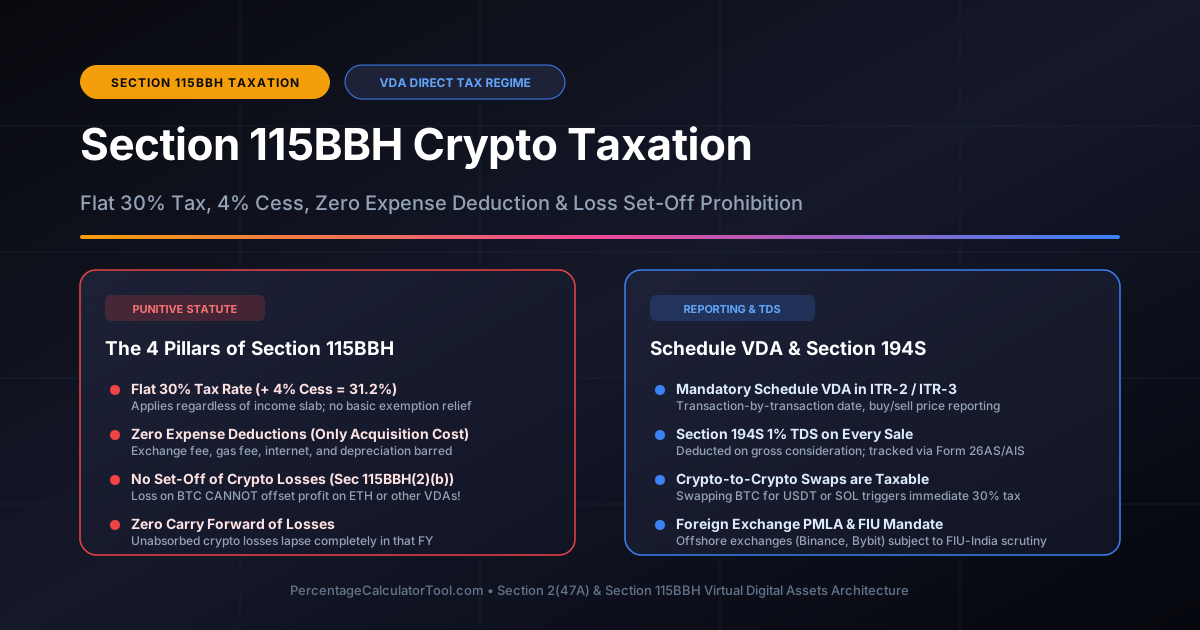
Pillar 1: Flat 30% Tax Rate (Effective 31.20% Minimum)
Under Section 115BBH(1), where the total income of an assessee includes any income from the transfer of any virtual digital asset, the income tax payable shall be the aggregate of the amount of income tax calculated on such net VDA income at the rate of thirty per cent (30%).
On top of this 30% flat tax, the statutory 4% Health and Education Cess is mandatory, elevating the baseline tax to 31.20%. For high-income earners, standard high-income surcharges (10%, 15%, or 25%) compound this liability, pushing the peak marginal tax rate on crypto gains to 39.00% under the New Tax Regime!
Pillar 2: Complete Disallowance of Expenses (Proviso to 115BBH(2)(a))
The statute explicitly decrees: "No deduction in respect of any expenditure (other than cost of acquisition, if any) or allowance or set off of any loss shall be allowed to the assessee under any provision of this Act in computing the income referred to in clause (a) of sub-section (1)."
Every operational cost associated with digital asset operations—exchange trading commissions, deposit fees, fiat off-ramp bank charges, gas fees paid to Ethereum/Solana validators, electricity bills incurred for validation, hardware ledger purchases, algorithmic trading bots, and tax software subscriptions—is 100% legally disallowed!
Pillar 3: Absolute Ban on Basic Exemption Limit Adjustments
For resident individual taxpayers, Section 112 and Section 112A provide a statutory relief mechanism: if your salary, business, and interest income fall short of the basic tax exemption limit (₹4,00,000 under the New Tax Regime for FY 2026-27), the unexhausted basic exemption can be adjusted against long-term capital gains. Section 115BBH completely denies this adjustment!
If an unemployed graduate or student with zero other income earns ₹2,00,000 on crypto trading, they cannot claim the ₹4,00,000 basic exemption. They are legally obligated to file an ITR and pay ₹62,400 in direct income tax (31.20% of ₹2,00,000).
Pillar 4: No Section 87A Rebate on Crypto Income
While the New Tax Regime provides a full tax rebate under Section 87A for individuals earning up to ₹7,00,000 (effectively paying zero tax on normal income up to ₹7,75,000 with standard deduction), the CBDT and CPC filing utilities strictly disallow Section 87A rebates against special rate income taxed under Section 115BBH. Crypto profits pay 30% tax from the very first rupee of gain.
3. The Loss Set-Off & Carry Forward Ban: Deconstructing Section 115BBH(2)(b)
The most brutal and financially devastating provision in Indian crypto tax law is codified in Section 115BBH(2)(b):
"Section 115BBH(2)(b): No set off of any loss incurred in transfer of the virtual digital asset shall be allowed against income computed under any other provision of this Act to the assessee and such loss shall not be allowed to be carried forward to succeeding assessment years."
The Double Lock on Crypto Losses
The Central Board of Direct Taxes (CBDT) issued extensive clarifications through parliamentary debates and circulars confirming that the prohibition operates at two distinct legal levels:
- Inter-Head Set-Off Barred: A loss suffered in crypto trading cannot be set off against salary income, business profits, house property rental yields, or capital gains from listed shares or mutual funds.
- Intra-Head (Crypto-to-Crypto) Set-Off Barred: A loss suffered on one virtual digital asset CANNOT even be set off against a profit earned on another virtual digital asset during the very same financial year! Each individual coin transaction is an isolated, watertight taxable compartment.
- Zero Carry Forward: Under Sections 70 through 74, losses from equity shares or business operations can be carried forward for 8 consecutive assessment years to offset future profits. Section 115BBH strictly bars carry forward: any crypto loss incurred in FY 2026-27 completely extinguishes and dies on March 31, 2027.
The Fatal Netting Fallacy
Many novice traders calculate their year-end P&L by subtracting total losses from total gains in their exchange summary. This is illegal under Section 115BBH. The Income Tax Department's AIS (Annual Information Statement) tracks every positive sale reported under Section 194S TDS. The Assessing Officer will demand tax on the gross sum of all winning trades, completely disallowing the losing trades.
4. Allowable Cost of Acquisition vs. Disallowed Trading Expenses
Because the statute permits only the deduction of the "cost of acquisition", establishing what legally constitutes acquisition cost is vital for every taxpayer.
| Expenditure Item | Deductible Under Section 115BBH? | Statutory Reason & Compliance Rule |
|---|---|---|
| Direct Purchase Price | YES (100% Allowed) | The exact purchase consideration paid to acquire the specific token/coin. |
| Exchange Trading Commissions (Maker/Taker) | NO (Disallowed) | Characterized as ancillary transaction expenditure, barred by Section 115BBH(2)(a). |
| Blockchain Network Gas Fees | NO (Disallowed) | Gas fees paid to miners/validators on Ethereum/Polygon cannot be added to cost basis. |
| Depreciation on Mining Rigs / Computers | NO (Disallowed) | Depreciation under Section 32 is explicitly barred against special rate VDA income. |
| Electricity & Internet Broadband Bills | NO (Disallowed) | Operational overheads cannot be deducted under any circumstance. |
| Hardware Wallet (Ledger / Trezor) | NO (Disallowed) | Capital asset for custody; cannot be set off against trading income. |
| Crypto Tax Software / Advisory Subscriptions | NO (Disallowed) | Administrative compliance cost; fully disallowed under the proviso. |
5. The Crypto-to-Crypto Swap Trap: FMV Valuation & Dual Tax Events
A massive point of failure for crypto investors in India is the belief that taxes are only triggered when digital assets are converted back into fiat currency (Indian Rupees) in a bank account. This assumption is legally catastrophically wrong.
The Mechanics of a Crypto-to-Crypto Swap
Under Section 2(47) of the Income-tax Act, a "transfer" includes the sale, exchange, or relinquishment of an asset. When you swap 1 Bitcoin for 20 Ethereum or trade Solana for USDT on a decentralized exchange (like Uniswap, Raydium, or PancakeSwap), an exchange of capital assets occurs. The transaction triggers two simultaneous tax consequences:
- Disposal of Surrendered Asset: You are deemed to have sold the Bitcoin at its prevailing Fair Market Value (FMV) in Indian Rupees on the date and second of the transaction. If the FMV exceeds your original purchase price of that Bitcoin, you have realized a taxable capital profit subject to an immediate 30% tax under Section 115BBH!
- Acquisition of New Asset: The FMV of the Bitcoin on the transaction date becomes the new cost of acquisition for the 20 Ethereum units acquired.
- Section 194S TDS Trigger: Under Section 194S(1), a crypto-to-crypto swap requires 1% TDS on both legs of the transaction! On domestic Indian exchanges (like CoinDCX or WazirX), the platform automatically deducts and deposits 1% TDS on both sides. On foreign decentralized exchanges, the obligation legally falls on the Indian user to pay the 1% TDS through Form 26QE.
6. Mathematical Anomaly Infographic: The 156% Effective Tax Shock
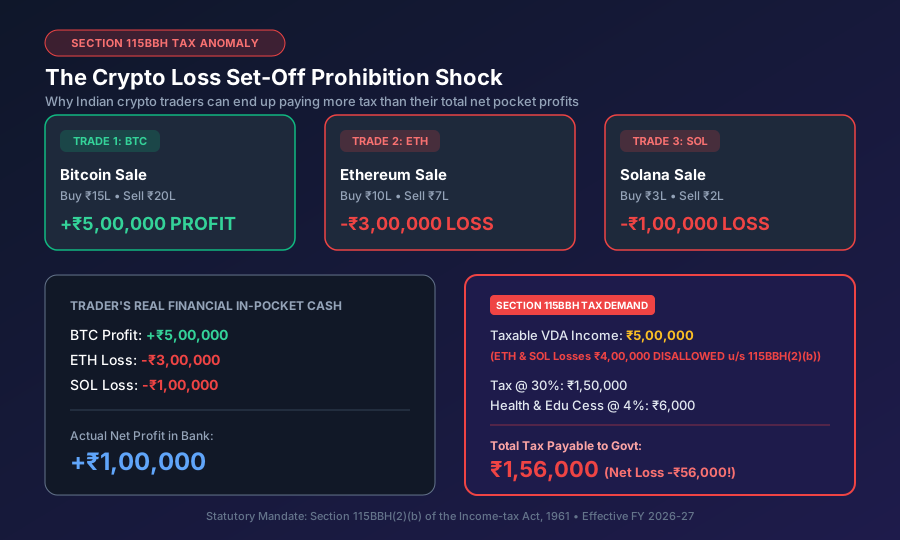
To witness the devastating impact of the Section 115BBH(2)(b) loss set-off prohibition, consider the real-world case of an active Indian swing trader who conducts three trades during FY 2026-27:
Detailed Financial Autopsy of the 3 Trades
- Trade 1 (Bitcoin): Bought at ₹15,00,000, Sold at ₹20,00,000. Profit = +₹5,00,000.
- Trade 2 (Ethereum): Bought at ₹10,00,000, Sold at ₹7,00,000. Loss = -₹3,00,000.
- Trade 3 (Solana): Bought at ₹3,00,000, Sold at ₹2,00,000. Loss = -₹1,00,000.
The Economic Reality: The trader deposited ₹28,00,000 total capital and withdrew ₹29,00,000. Their actual cash gain in their bank account is ₹1,00,000 (+₹5L - ₹3L - ₹1L).
The Section 115BBH Tax Reality: Under Section 115BBH(2)(b), the ₹3,00,000 Ethereum loss and the ₹1,00,000 Solana loss are legally disregarded. The Assessing Officer computes tax strictly on the standalone ₹5,00,000 Bitcoin gain:
- Gross Taxable VDA Income: ₹5,00,000
- Tax @ 30%: ₹1,50,000
- Health & Education Cess @ 4%: ₹6,000
- Total Tax Payable: ₹1,56,000
The trader earned ₹1,00,000 in real cash, but must pay ₹1,56,000 in tax to the government! Their effective tax rate on actual pocket profit is 156.0%, plunging their net financial balance into a deficit of -₹56,000! This mathematical reality makes high-frequency crypto trading in India financially unsustainable without rigorous risk management.
7. Asset Class Comparison Matrix: Crypto vs. Equities vs. F&O
The following analytical matrix benchmarks Section 115BBH crypto taxation against other common investment and trading asset classes under Indian tax law for FY 2026-27 (AY 2027-28):
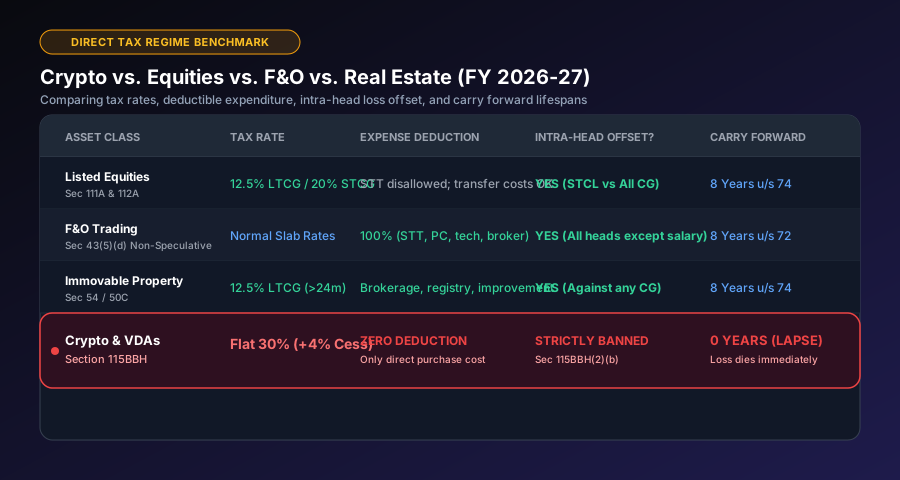
| Statutory Parameter | Virtual Digital Assets (Sec 115BBH) | Listed Equity Shares (Sec 111A/112A) | F&O Derivatives (Sec 43(5)) | Immovable Property (Sec 54/50C) |
|---|---|---|---|---|
| Tax Rate | Flat 30% (+4% Cess) | 12.5% LTCG / 20% STCG | Normal Slab Rates (0% to 30%) | 12.5% LTCG (>24 Months) |
| Basic Exemption Adjustment? | NO (Denied completely) | YES (For resident individuals) | YES (Normal business income) | YES (For resident individuals) |
| Allowable Deductions | Only direct buy cost | Transfer expenses (brokerage/SEBI fee) | 100% of all expenses (STT, PC, tech) | Brokerage, registration & improvements |
| Intra-Head Loss Set-Off? | BANNED U/S 115BBH(2)(b) | YES (STCL against STCG/LTCG) | YES (Loss offsets all F&O gains) | YES (Offsets other capital gains) |
| Inter-Head Loss Set-Off? | BANNED | BANNED (Capital loss walled) | YES (Offsets all heads except salary) | BANNED |
| Carry Forward Lifespan | 0 YEARS (Extinguishes in FY) | 8 Years (u/s 74) | 8 Years (u/s 72) | 8 Years (u/s 74) |
8. Schedule VDA Compliance in ITR-2 / ITR-3: Step-by-Step Reporting
If you have transacted in cryptocurrencies, NFTs, or token swaps during the financial year, you cannot file Form ITR-1 (Sahaj) or ITR-4 (Sugam). You are statutorily mandated to file either ITR-2 (for salaried individuals and investors) or ITR-3 (for individuals carrying on business/profession).
Structure of Schedule VDA in the Income Tax Return
The Income Tax Department requires transaction-level disclosure under Schedule VDA (Income from transfer of Virtual Digital Assets). The table requires the following mandatory fields for every single sale or swap:
- Date of Acquisition: The exact date you bought or received the crypto.
- Date of Transfer: The exact date you sold or swapped the token.
- Head under which income to be taxed: Select "Capital Gain" or "Business Income". (Note: Regardless of the head selected, the tax rate remains flat 30% under Section 115BBH!).
- Cost of Acquisition: The actual purchase price in INR. If acquired via airdrop or gift, special valuation rules apply under Section 56(2)(x).
- Consideration Received: The gross sale proceeds in INR before deducting 1% TDS.
- Income from Transfer of VDA: Consideration minus Cost of Acquisition (only positive numbers are aggregated; losses are set to zero in the calculation engine).
All positive outcomes from Schedule VDA are totaled and transferred to Schedule SI (Special Income) and Schedule Part B-TI (Total Income), where 30% tax is automatically calculated by the CPC e-filing portal.
9. Offshore Exchanges, FIU-India Compliance & PMLA Scrutiny
A frequent question asked by Indian traders is: "If I trade exclusively on offshore international platforms like Binance, Bybit, KuCoin, or OKX, does the Income Tax Department know about my crypto transactions?"
The Regulatory Reality: FIU-India & PMLA Enforcement
In December 2023, the Ministry of Finance and the Financial Intelligence Unit - India (FIU-IND) issued compliance show-cause notices to major offshore cryptocurrency exchanges and blocked their URLs and mobile applications in India under the Prevention of Money Laundering Act (PMLA), 2002. Subsequently, exchanges like Binance and KuCoin registered directly with FIU-IND as reporting entities, paid penalties, and complied with Indian AML/CFT reporting mandates.
How the Income Tax Department Detects Unreported Crypto
The Income Tax Department utilizes multiple overlapping data funnels to identify non-filers:
- P2P Banking Trail: When Indian traders buy or sell USDT via Peer-to-Peer (P2P) bank transfers on Binance or Bybit, banks report high-frequency IMPS/NEFT transactions under Statement of Financial Transactions (SFT) codes. Large unexplained P2P inflows are automatically flagged on the Insight Portal.
- Section 194S TDS Deductions: If you trade on any FIU-registered exchange, 1% TDS is reported against your PAN in Form 26AS. If your AIS shows ₹10 Lakhs in VDA sale transactions under Section 194S, but your ITR omits Schedule VDA, an automated defective return notice under Section 139(9) or reassessment notice under Section 148 is generated.
- Penalties for Misreporting (Section 270A): Concealing crypto income is categorized as "under-reporting in consequence of misreporting of income", attracting a penalty of 200% of the tax payable, plus mandatory interest under Sections 234A, 234B, and 234C.
Simulate Your Post-Tax Investment Yields
Model your exact tax liability across New vs. Old Tax Regimes, calculate capital gains exposure, and evaluate post-tax returns across asset classes with our verified calculation engines.
10. Frequently Asked Questions (FAQ)
What is the exact tax rate on cryptocurrency and Virtual Digital Assets (VDAs) in India?
Under Section 115BBH of the Income-tax Act, 1961, any income arising from the transfer of a Virtual Digital Asset (VDA) is taxed at a flat rate of 30%. In addition, an applicable Health and Education Cess of 4% is levied, bringing the effective base tax rate to 31.20%. If total income triggers surcharge thresholds (e.g., above ₹50 Lakhs), applicable surcharges further increase the effective rate.
Can I offset a loss incurred on one cryptocurrency (e.g., Bitcoin) against a profit on another (e.g., Ethereum)?
No. Section 115BBH(2)(b) strictly prohibits the set-off of any loss arising from the transfer of a Virtual Digital Asset against income from the transfer of any other VDA. For example, if you make a profit of ₹5 Lakhs on Bitcoin and suffer a loss of ₹3 Lakhs on Ethereum, you cannot net them out. You must pay a flat 30% tax on the entire ₹5 Lakhs Bitcoin profit, while the ₹3 Lakhs Ethereum loss is completely ignored.
Can I claim deductions for exchange trading fees, gas fees, or internet expenses under Section 115BBH?
No. Under the first proviso to Section 115BBH(2)(a), no deduction in respect of any expenditure (other than the direct cost of acquisition of the VDA) or allowance or set-off of any loss shall be allowed. Trading platform commissions, deposit/withdrawal fees, blockchain gas fees, electricity bills, hardware wallet purchases, and computer depreciation are 100% disallowed.
Can an individual with no other income adjust their basic exemption limit against crypto gains?
No. Unlike normal capital gains under Sections 112 and 112A where an unexhausted basic exemption limit can reduce tax for resident individuals, Section 115BBH does NOT permit any basic exemption adjustment. A college student or homemaker with zero salary who earns ₹1,00,000 on crypto must pay ₹31,200 tax (30% + 4% cess) even though their total income is well below the basic exemption threshold.
Are crypto-to-crypto swaps (such as exchanging BTC for USDT or ETH) taxable in India?
Yes. Swapping one cryptocurrency for another constitutes a "transfer" under Section 2(47) of the Income-tax Act. The fair market value of the received cryptocurrency as on the date and time of the swap is treated as the full sale consideration. Any gain over the acquisition cost of the surrendered crypto attracts an immediate 30% tax under Section 115BBH, and 1% TDS applies under Section 194S.