Intraday Trading Tax Rules in India: Speculative Business Income, Section 73 & 4-Year Carry Forward Guide (FY 2026-27)

Executive Compliance Snapshot: Intraday Equity Taxation (AY 2027-28)
If you buy and sell equity shares on the same trading day without taking delivery in your demat account, Indian tax law classifies your profits not as capital gains, but as Speculative Business Income under Section 43(5). Intraday profits are taxed at your normal personal income tax slab rates (up to 30% plus cess). More crucially, speculative losses live inside the strict Section 73 "Walled Garden": they can never be offset against F&O profits, capital gains, or salary, and have an accelerated 4-year carry forward expiration window. Filing ITR-3 is legally mandatory.
Table of Contents
- 1. Section 43(5) Definition: What Makes Intraday Trading Speculative?
- 2. The Crucial Divergence: Intraday Equity vs. F&O Derivatives
- 3. Tax Rates Applied: Why Concessional Capital Gains Rates Don't Apply
- 4. The Section 73 Walled Garden: Strict Loss Set-Off Limitations
- 5. The 4-Year Carry Forward Lifespan & The July 31 Guillotine
- 6. Absolute Turnover Calculation: The ICAI Formula with Real Numbers
- 7. Section 44AB Tax Audit & Why Section 44AD is Strictly Barred
- 8. Allowable Business Deductions to Minimize Taxable Intraday Profits
- 9. Frequently Asked Questions (FAQs)
1. Section 43(5) Definition: What Makes Intraday Trading Speculative?
In the Indian financial markets, tens of thousands of retail market participants trade cash equities on a day-trading basis, entering positions at 9:15 AM and squaring them off before the market close at 3:30 PM. While traders think of this as quick stock trading, Chapter IV-D of the Income-tax Act, 1961 applies a very specific statutory lens.
Under Section 43(5) of the Income-tax Act, a "speculative transaction" is defined as:
"A transaction for the purchase or sale of any commodity, including stocks and shares, periodically or ultimately settled otherwise than by the actual delivery or transfer of the commodity or scrips."
Because intraday equity trades are squared off internally within the broker's clearing system before the end of the trading session, no actual transfer of shares occurs to or from your Depository Participant (NSDL or CDSL) demat account. Delivery is neither taken nor given. Consequently, the transaction satisfies all criteria of Section 43(5) and is statutorily designated as Speculative Business Activity.
2. The Crucial Divergence: Intraday Equity vs. F&O Derivatives
One of the most frequent errors made by Indian retail traders is assuming that intraday cash equity trading and futures & options (F&O) trading are governed by the same tax provisions. Legally, they belong to completely distinct statutory universes.
| Compliance Feature | Intraday Cash Equity | Futures & Options (F&O) | Delivery Equity (Cash) |
|---|---|---|---|
| Governing Provision | Section 43(5) General Rule | Section 43(5)(d) Specific Carve-Out | Section 2(14) & Section 45 |
| Statutory Nature | Speculative Business | Non-Speculative Business | Capital Asset (Investment) |
| Loss Set-Off Scope | ONLY Speculative Profits (Sec 73) | Rent, Capital Gains, Interest (Sec 71) | Capital Gains Only (Sec 70) |
| Carry Forward Lifespan | Strictly 4 Assessment Years | 8 Assessment Years | 8 Assessment Years |
| Presumptive Tax (44AD) | PROHIBITED (Sec 44AD(6)) | Permissible (6% Digital Turnover) | Not Applicable |
| Mandatory ITR Form | ITR-3 | ITR-3 (or ITR-4 if 44AD) | ITR-2 (if salaried) |
Why this divergence? In 2005, the Parliament enacted clause (d) to Section 43(5), granting an explicit exemption to derivatives traded on recognized exchanges to encourage market liquidity and risk management. However, no such carve-out was ever granted to intraday cash equity trading. Thus, intraday equity remains locked in the speculative category.

Figure 1: Comparison between speculative intraday equity trading and non-speculative derivatives, illustrating the Section 73 loss walled garden.
3. Tax Rates Applied: Why Concessional Capital Gains Rates Don't Apply
Under Indian tax law, concessional tax rates—such as 20% Short-Term Capital Gains under Section 111A or 12.5% Long-Term Capital Gains under Section 112A—are strictly reserved for transactions that fall under the head "Capital Gains".
Because Section 43(5) classifies intraday trading as a business activity, the income derived from it is categorized under "Profits and Gains of Business or Profession" (PGBP). There is no special, concessional, or flat tax rate for speculative business profits.
Your net speculative profit (gross intraday gains minus allowable business expenses) is added directly to your total taxable income. It is taxed at your applicable personal income tax slab rate:
- Under the New Tax Regime (Section 115BAC): Taxed at slab rates progressing from 5% to 30%, with Section 87A rebate available if total income does not exceed ₹7,00,000 (or ₹12,75,000 for salaried employees with marginal relief).
- Under the Old Tax Regime: Taxed at progressive slabs (5%, 20%, 30%), plus applicable surcharge and 4% Health and Education Cess.
4. The Section 73 Walled Garden: Strict Loss Set-Off Limitations
The single most dangerous trap for active retail day traders is the restrictive loss set-off framework established by Section 73 of the Income-tax Act. Tax practitioners refer to Section 73 as a "walled garden" because speculative losses are legally segregated from all other financial gains.
The Section 73(1) Absolute Rule
Section 73(1) stipulates that any loss computed in respect of a speculative business carried on by the assessee shall NOT be set off except against profits and gains, if any, of another speculative business.
| Income Head / Source | Can Intraday Speculative Loss Offset This Income? | Statutory Reason |
|---|---|---|
| Other Intraday Equity Trades | YES (Allowed) | Both constitute speculative business under Section 43(5). |
| F&O Derivative Profits | NO (Strictly Prohibited) | F&O is non-speculative (Section 43(5)(d)); Section 73 bars cross-offset. |
| Short-Term Capital Gains (STCG) | NO (Strictly Prohibited) | Capital gains fall under a different head of income. |
| Long-Term Capital Gains (LTCG) | NO (Strictly Prohibited) | Prohibited under Section 73(1). |
| Salary Income | NO (Strictly Prohibited) | Barred under Section 71(2A) and Section 73(1). |
| Bank FD Interest / Dividends | NO (Strictly Prohibited) | Other sources income cannot absorb speculative losses. |
Real-World Trap Scenario: Suppose in FY 2026-27, a trader makes a profit of ₹5,00,000 in Nifty Options (F&O) and suffers a loss of ₹4,00,000 in intraday cash equities. The trader cannot net them out to pay tax on ₹1,00,000. Under Section 73, the trader must pay tax on the entire ₹5,00,000 F&O profit, while the ₹4,00,000 intraday loss must be carried forward!
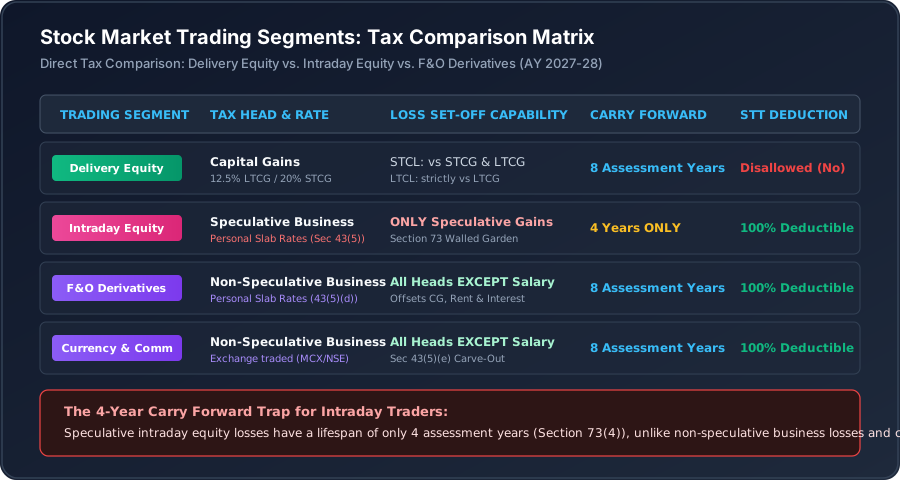
Figure 2: Comprehensive matrix contrasting tax heads, rates, loss set-off capabilities, carry forward limits, and STT deductibility across market segments.
5. The 4-Year Carry Forward Lifespan & The July 31 Guillotine
When an intraday trader ends the financial year with unabsorbed speculative losses, Section 73(4) governs the carry-forward mechanism. Here, traders face an accelerated expiration timeline compared to other investment losses.
Unlike normal business losses (Section 72) and capital losses (Section 74) which can be carried forward for 8 consecutive assessment years, a speculative business loss can be carried forward for a maximum of ONLY 4 consecutive Assessment Years immediately succeeding the year of loss.
If you do not generate sufficient speculative intraday profits within those 4 years to absorb the loss, the remaining loss expires permanently and provides zero tax relief.
The Section 139(1) Mandatory Due Date Rule
Under Section 80 of the Income-tax Act, read with Section 139(3), no loss shall be carried forward unless the return of income is filed on or before the due date prescribed under Section 139(1) (31st July for non-audit individual traders). If you file a belated return under Section 139(4), your right to carry forward speculative losses is permanently revoked.
6. Absolute Turnover Calculation: The ICAI Formula with Real Numbers
In intraday trading, the value of the shares bought or sold is irrelevant for calculating turnover. Because contracts are squared off on the same day without delivery, taking total transaction values would distort reality.
The Institute of Chartered Accountants of India (ICAI) prescribes the Absolute Profit and Loss Method for computing intraday trading turnover:
Intraday Turnover = ∑ |Positive Differences (Profits)| + ∑ |Negative Differences (Losses)|
Step-by-Step Numerical Example
Consider an active retail trader, Priya, executing three intraday cash equity trades on NSE through Groww:
| Trade | Buy Price | Sell Price | Quantity | Trade Value | Gross P&L | Turnover Added |
|---|---|---|---|---|---|---|
| Trade 1 (Tata Motors) | ₹950 | ₹965 | 500 Shares | ₹4,75,000 | + ₹7,500 (Profit) | ₹7,500 (|Profit|) |
| Trade 2 (Reliance Ind) | ₹2,900 | ₹2,880 | 300 Shares | ₹8,70,000 | - ₹6,000 (Loss) | ₹6,000 (|Loss|) |
| Trade 3 (State Bank) | ₹820 | ₹832 | 1,000 Shares | ₹8,20,000 | + ₹12,000 (Profit) | ₹12,000 (|Profit|) |
| TOTALS FOR THE TRADING SESSION | + ₹13,500 (Net P&L) | ₹25,500 (Turnover) | ||||
Notice the critical distinction: Although Priya transacted shares worth more than ₹21 Lakhs in buy value, her statutory Intraday Turnover is just ₹25,500. Her net taxable profit before allowable business expenses is ₹13,500.
7. Section 44AB Tax Audit & Why Section 44AD is Strictly Barred
Two major compliance questions confront every day trader: Is a tax audit required? Can I use the presumptive taxation scheme under Section 44AD?
The Absolute Statutory Bar on Section 44AD
Many online articles incorrectly suggest that intraday traders can declare a presumptive profit of 6% under Section 44AD and avoid accounting. This is a severe legal fallacy.
Sub-section (6) of Section 44AD explicitly states that the provisions of Section 44AD shall NOT apply to:
- A person carrying on profession as referred to in Section 44AA(1);
- A person earning income in the nature of commission or brokerage; or
- A person carrying on any agency business or speculative business.
Because intraday equity trading is speculative business under Section 43(5), Section 44AD is statutorily unavailable to intraday traders! You cannot file ITR-4 or declare 6% profit. You must file ITR-3 with actual books.
When is a Tax Audit Mandatory under Section 44AB?
Because all stock exchange trades are 100% digital, the relevant tax audit turnover limit under Section 44AB(a) is ₹10,00,00,000 (Ten Crore Rupees).
- If Intraday Turnover > ₹10 Crore: Tax audit by a Chartered Accountant is mandatory. You must file Form 3CB-3CD.
- If Intraday Turnover ≤ ₹10 Crore: No tax audit is required under Section 44AB(a), provided you maintain proper books of accounts under Section 44AA.
8. Allowable Business Deductions to Minimize Taxable Intraday Profits
Because speculative trading is classified as a business activity, Section 30 through Section 37 grant intraday traders the legal right to claim all operational business expenses incurred to execute trades:
- Securities Transaction Tax (STT): Fully deductible under Section 36(1)(xv). (STT paid on intraday trades is 0.025% on the sell side).
- Brokerage, Exchange & SEBI Turnover Charges: 100% deductible as direct business costs.
- GST Paid on Brokerage & Services: Fully allowable as business expense.
- Hardware Depreciation (Section 32): 40% Written Down Value (WDV) depreciation on trading laptops, desktops, and multiple display monitors.
- Software Subscriptions: TradingView Pro, charting plugins, screener tools, and API data feeds.
- Connectivity & Utilities: Broadband internet charges, mobile recharge, and proportionate home office electricity expenses.
Compute your take-home pay and overall slab tax across salary and trading business using our Income Tax Calculator and calculate your monthly take-home with our In-Hand Salary Calculator.
9. Frequently Asked Questions (FAQs)
Q1: Why is intraday equity trading classified as speculative business income?
Under Section 43(5) of the Income-tax Act, 1961, any transaction for the purchase or sale of any commodity, including stocks and shares, which is settled otherwise than by the actual delivery or transfer of the commodity or scrips, is defined as a 'speculative transaction'. Because intraday equity trades are squared off before market close on the same day without taking demat delivery, they are legally classified as speculative business income.
Q2: Can intraday trading losses be set off against F&O derivative profits or capital gains?
No. Under Section 73(1) of the Income-tax Act, losses incurred in a speculative business can strictly be set off ONLY against profits from another speculative business. They CANNOT be set off against non-speculative business income (such as Futures and Options profits), nor against capital gains, salary, house property, or interest income.
Q3: For how many years can speculative intraday trading losses be carried forward?
Under Section 73(4), unabsorbed speculative business losses can be carried forward for a maximum of 4 consecutive Assessment Years immediately succeeding the assessment year in which the loss was incurred. This is substantially shorter than non-speculative business losses and capital losses, which can be carried forward for 8 years.
Q4: Can an intraday trader opt for presumptive taxation under Section 44AD?
No. Section 44AD(6) explicitly bars speculative businesses from the presumptive taxation scheme. An intraday equity trader cannot declare a presumptive 6% net profit under Section 44AD. All intraday equity traders must report actual profits or losses based on books of accounts in Form ITR-3.
Q5: How is trading turnover calculated for intraday equity trades?
According to the ICAI Guidance Note, intraday trading turnover is calculated as the sum of the absolute values of all positive and negative settlement differences across all trades during the financial year (|Profits| + |Losses|). For example, if you make a profit of ₹12,000 on one trade and a loss of ₹8,000 on another, your turnover is ₹20,000, while your net taxable profit is ₹4,000.