Section 194S TDS on Crypto & Virtual Digital Assets: 1% Deduction, Thresholds & P2P Guide (FY 2026-27)
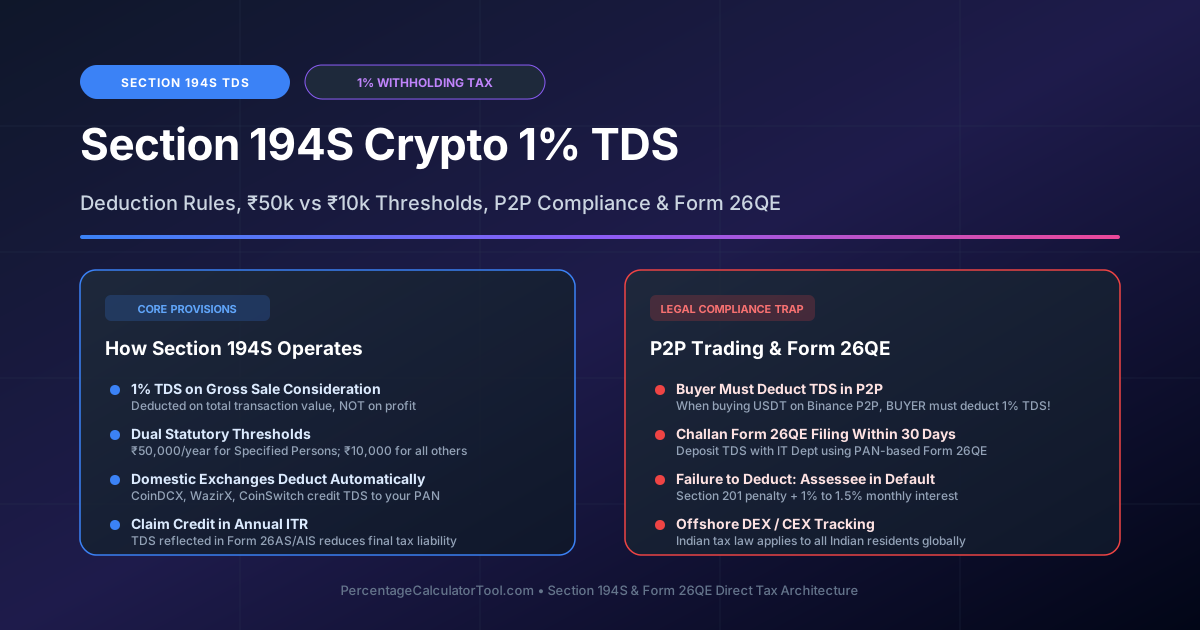
Statutory Summary: Section 194S Compliance Mandate
Introduced by the Finance Act 2022 and reinforced for Assessment Year 2027-28 (Financial Year 2026-27), Section 194S of the Income-tax Act, 1961 mandates a 1% Tax Deducted at Source (TDS) on any payment made to a resident individual or entity upon the transfer of a Virtual Digital Asset (VDA). While Indian centralized crypto exchanges deduct this tax automatically on order execution, peer-to-peer (P2P) traders on offshore platforms (such as Binance, Bybit, or KuCoin) face direct statutory liabilities. In P2P trades, the buyer is legally responsible for withholding 1% TDS, filing Challan-cum-statement Form 26QE, and issuing Form 16D. Failure to comply triggers severe interest, 100% financial penalties under Section 271C, and potential prosecution.
Table of Contents
- 1. Legislative Background & Architecture of Section 194S
- 2. "Specified Person" Classification & Deduction Thresholds
- 3. Compliance Architecture: Indian Exchanges vs. P2P Trades
- 4. Peer-to-Peer (P2P) Mechanics: The Buyer's Withholding Duties
- 5. Crypto-to-Crypto Swaps & Dual TDS Under CBDT Circular 13/2022
- 6. Step-by-Step Procedure: Filing Challan Form 26QE & Issuing Form 16D
- 7. Analytical Matrix: Centralized vs. P2P vs. DEX Compliance
- 8. Section 206AB Higher TDS & Penalties for Non-Compliance
- 9. Claiming TDS Credits, AIS/TIS Reconciliation & Refund Rules
- 10. Comprehensive Real-World Numerical Case Studies
- 11. Frequently Asked Questions (FAQ)
1. Legislative Background & Architecture of Section 194S
Before the enactment of the Finance Act 2022, the cryptocurrency and Virtual Digital Asset ecosystem in India operated within an opaque regulatory vacuum. While transactions generated substantial taxable income, assessing officers found it extraordinarily arduous to reconstruct transaction volumes, identify counter-parties, or detect concealed speculative profits on decentralized networks and offshore exchange order books.
To dismantle this structural asymmetry, Parliament inserted two interconnected provisions into the statute:
- Section 115BBH: A substantive charging section imposing a flat 30% tax (plus applicable surcharge and 4% cess) on gross gains derived from the transfer of VDAs, completely disallowing expense deductions (other than purchase cost) and prohibiting intra-asset or inter-head loss set-offs.
- Section 194S: An evidentiary, information-gathering withholding mechanism designed not primarily as a revenue-raising tool, but as an indelible digital audit trail. By mandating a 1% TDS on every transfer consideration, the Central Board of Direct Taxes (CBDT) systematically captures every fiat-to-crypto, crypto-to-fiat, and crypto-to-crypto transaction within the taxpayer's Annual Information Statement (AIS) and Taxpayer Information Summary (TIS).
Under Section 194S(1), any person responsible for paying to a resident any sum by way of consideration for transfer of a Virtual Digital Asset shall, at the time of credit of such sum to the account of the resident or at the time of payment thereof by any mode, whichever is earlier, deduct an amount equal to one per cent (1%) of such sum as income-tax thereon.
Key Direct Tax Insight: Gross Consideration vs. Net Gain
TDS under Section 194S is calculated on the total gross consideration paid to the seller, not on the seller's profit or net capital gain. For instance, if an investor sells Bitcoin for ₹10,00,000 having bought it for ₹9,80,000 (a profit of only ₹20,000), the 1% TDS is ₹10,000 (1% of ₹10,00,000), not 1% of ₹20,000. Even if the asset is sold at an outright loss, 1% TDS must be deducted from the full sale payout.
2. "Specified Person" Classification & Deduction Thresholds
Section 194S provides distinct statutory thresholds to protect small, casual retail investors from oppressive administrative overheads while ensuring institutional and high-volume commercial traders are rigorously monitored. Under Section 194S(2), no deduction is required if the aggregate value of consideration during the financial year does not exceed specific statutory limits.
Definition of a "Specified Person" u/s 194S(3)
A "Specified Person" is defined explicitly as an individual or a Hindu Undivided Family (HUF) who fulfills either of the following conditions:
- Condition A: Does not have any income under the head "Profits and gains of business or profession" (PGBP) during the current financial year (e.g., salaried employees, pensioners, housewives, or passive investors earning only capital gains and dividend/interest income).
- Condition B: Possesses income from business or profession, but total sales, gross receipts, or turnover from business does not exceed ₹1 Crore (or gross professional receipts do not exceed ₹50 Lakhs) during the financial year immediately preceding the financial year in which the VDA transfer occurs.
Statutory Exemption Thresholds
| Buyer Classification | Statutory Criteria | Annual Consideration Threshold | TAN Requirement (Sec 203A) | Compliance Form |
|---|---|---|---|---|
| Specified Person | Individual/HUF with no business income, or turnover ≤ ₹1 Cr (Profession ≤ ₹50L) | ₹50,000 per financial year | No TAN Required (Exempt u/s 194S(3)) | Challan Form 26QE (PAN-based) |
| Non-Specified Person | Companies, LLPs, Partnership Firms, AOPs, or Individuals with turnover > ₹1 Cr / ₹50L | ₹10,000 per financial year | Mandatory TAN Required | Form 26Q (Quarterly TDS Return) |
Once aggregate transactions exceed the threshold during the financial year, the obligation to deduct TDS applies. Importantly, the CBDT has clarified that once the threshold is breached, the deduction applies to the transaction that crosses the threshold and all subsequent transactions; the deduction does not retrospectively invalidate prior exempt transactions below the limit, although best practice for high-volume traders is to track cumulative consideration meticulously.
3. Compliance Architecture: Indian Exchanges vs. P2P Trades
The operational burden of Section 194S varies radically depending on the transaction channel utilized by the taxpayer. In centralized domestic venues, platform infrastructure automates statutory compliance. In peer-to-peer or cross-border architectures, the onus shifts entirely to the transacting parties.
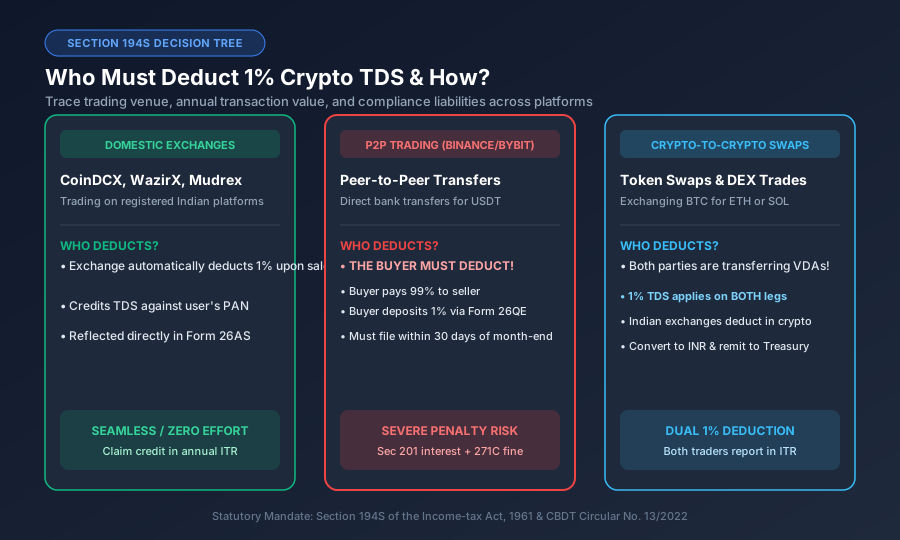
As illustrated in the operational flowchart above, the compliance trajectory bifurcates based on whether transactions occur via an FIU-registered Indian exchange or via direct counterparty P2P matching:
- Registered Indian Centralized Exchanges: The exchange operates as the designated deductor. When a user executes a sell order, the exchange holds back 1% of the gross INR proceeds, credits net funds to the user's wallet, aggregates deductions across its order book, deposits the bulk TDS to the government using Challan 281/Form 26Q, and generates quarterly Form 16A certificates. The seller's only obligation is to ensure their PAN is linked.
- P2P Trading Platforms (Binance, Bybit, KuCoin): The offshore platform acts merely as an escrow agent and communications facilitator. The platform does not deduct Indian TDS. Consequently, by force of law, the individual Indian buyer paying INR is legally classified as the deductor. The buyer must collect the seller's PAN, deduct 1%, pay the seller 99%, remit the 1% to the Income Tax Department via Form 26QE within 30 days of month-end, and deliver Form 16D to the seller.
4. Peer-to-Peer (P2P) Mechanics: The Buyer's Withholding Duties
Peer-to-Peer (P2P) trading represents the most acute compliance risk for Indian cryptocurrency participants. Many retail investors mistakenly believe that because an exchange user interface displays a "Buy" button, the exchange handles all regulatory taxes. In reality, in a P2P trade, the exchange never touches the fiat currency; INR moves directly from the buyer's Indian bank account (via IMPS, UPI, or NEFT) to the seller's Indian bank account.
The Legal Status of P2P Buyer as Deductor
Under Section 194S(1), the statutory duty to deduct is placed squarely on "any person responsible for paying to a resident any sum by way of consideration for transfer of a virtual digital asset". In a P2P trade:
- The Buyer is the payer of consideration (money).
- The Seller is the transferor of the VDA (e.g., releasing USDT from escrow).
- Therefore, the Buyer is the statutory deductor.
If you purchase 1,000 USDT on Binance P2P from an Indian seller at an agreed rate of ₹90 per USDT (total consideration ₹90,000), and you are a Specified Person whose cumulative purchases exceed ₹50,000 for the year, you cannot lawfully transfer ₹90,000 to the seller. Doing so constitutes a direct violation of Chapter XVII-B of the Income-tax Act.
The P2P Execution Dilemma
In standard P2P merchant order books, sellers demand the full invoice amount (e.g., ₹90,000) and will refuse to release crypto if they receive ₹89,100 (net of 1% TDS). If a buyer pays the full ₹90,000 without withholding, the buyer must gross up and pay the 1% TDS (₹900) out of their own pocket using Form 26QE to protect themselves from penal proceedings under Section 201 and Section 271C. Failure to deposit this TDS leaves an undeniable paper trail through banking and UPI logs that the Income Tax Department's data-matching systems can easily trace.
5. Crypto-to-Crypto Swaps & Dual TDS Under CBDT Circular 13/2022
One of the most complex areas of digital asset taxation occurs when an investor trades one cryptocurrency directly for another—such as trading Bitcoin (BTC) for Ethereum (ETH), or exchanging Solana (SOL) for Tether (USDT)—without converting back into Indian Rupees.
The Barter Dilemma Under Section 194S(1) Proviso
The first proviso to Section 194S(1) addresses non-cash consideration:
"Provided that in a case where the consideration for transfer of virtual digital asset is—
(a) wholly in kind or in exchange of another virtual digital asset where there is no part in cash; or
(b) partly in cash and partly in kind, but the part in cash is not sufficient to meet the liability of deduction of tax in respect of whole of such consideration,
the person responsible for paying such consideration shall, before releasing the consideration, ensure that tax required to be deducted has been paid in respect of the consideration for the transfer of virtual digital asset."
In response to widespread industry confusion, the Central Board of Direct Taxes issued Circular No. 13 of 2022 (dated 22 June 2022), providing comprehensive clarifications:
- Both Parties are Sellers and Buyers: In a crypto-to-crypto barter, Person A transfers Asset X to Person B, and Person B transfers Asset Y to Person A. Legally, Person A is transferring a VDA to Person B, and Person B is transferring a VDA to Person A. Consequently, both legs attract 1% TDS under Section 194S.
- Role of Registered Exchanges: When a crypto-to-crypto trade occurs on a registered Indian exchange:
- The exchange acts as an intermediary for both parties.
- To eliminate double cash-flow friction, the exchange is permitted to deduct 1% TDS on both legs in kind (in the respective tokens) and immediately convert those tokens into INR on its internal primary markets at the prevailing market rate at the end of the trading window.
- The exchange deposits the resulting INR TDS with the government and reports the transaction on behalf of both participants.
- Non-Exchange and Decentralized Wallet Swaps: If you perform a token swap on a decentralized exchange (such as Uniswap, PancakeSwap, or Raydium) or execute an off-chain wallet-to-wallet exchange, there is no centralized broker to automate compliance. Under the law, both parties must evaluate the fair market value of the assets transferred, calculate 1% TDS, pay the challan under Form 26QE, and exchange proof of payment before releasing the private keys or executing the transaction.
6. Step-by-Step Procedure: Filing Challan Form 26QE & Issuing Form 16D
For individuals and HUFs categorized as Specified Persons, compliance does not require registering for a corporate Tax Deduction Account Number (TAN). The CBDT introduced Form 26QE, an integrated, PAN-based Challan-cum-statement modeled after Form 26QB (property TDS) and Form 26QC (rent TDS).
Step-by-Step Filing Workflow on the Income Tax Portal
- Access the e-Filing Portal: Navigate to the official Income Tax portal (
eportal.incometax.gov.in) and log in using your personal PAN credentials. - Navigate to e-Pay Tax: Select e-File > e-Pay Tax from the top navigation bar. Click on the New Payment button.
- Select Form 26QE: In the payment options grid, locate the card labeled TDS on Virtual Digital Assets (Form 26QE) and click Proceed.
- Enter Transacting Parties' Details:
- Confirm your PAN details as the Buyer / Payer.
- Enter the Seller / Payee's PAN. The system will auto-fetch and display the masked name of the seller for verification. (If the seller refuses to provide a valid PAN, Section 206AA mandates TDS at 20%).
- Provide Transaction Details:
- Date of Agreement / Transfer.
- Total Value of Consideration (the gross INR amount paid for the crypto).
- Mode of Payment (Bank transfer, UPI, barter/in-kind).
- The portal automatically computes the 1% TDS liability.
- Execute Tax Payment: Remit the computed 1% tax using Net Banking, Debit Card, UPI, or NEFT/RTGS. Upon successful processing, download the Challan Receipt containing the BSR Code, Challan Number, and Tender Date.
- Filing Deadline: Under Rule 31A of the Income-tax Rules, Form 26QE must be submitted within 30 days from the end of the month in which the deduction is made. For example, if you executed a P2P trade on 14 October 2026, the challan must be paid and filed on or before 30 November 2026.
- Download & Issue Form 16D: Within 15 days from the due date of furnishing Form 26QE, log into the TRACES portal (
tdscpc.gov.in), navigate to the Downloads tab, request Form 16D, and deliver the digitally signed TDS certificate to the crypto seller.
7. Analytical Matrix: Centralized vs. P2P vs. DEX Compliance
Navigating the regulatory landscape requires understanding the exact distribution of compliance burdens across different trading platforms and execution mechanisms.
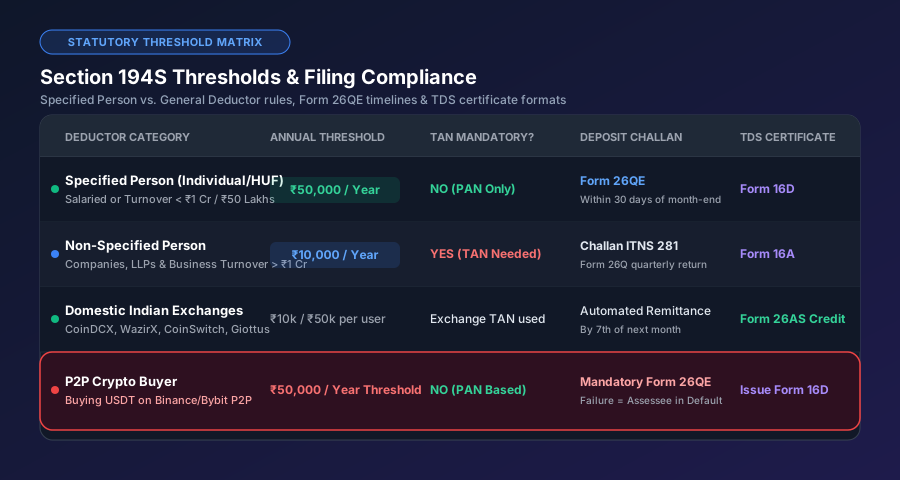
| Compliance Parameter | Registered Indian CEX | P2P on Offshore Exchanges | Decentralized Exchanges (DEX) |
|---|---|---|---|
| Primary Deductor | Exchange Platform | Indian Resident Buyer | Both Counterparties / Traders |
| Deduction Mechanism | Automated upon order execution | Manual deduction before fiat payout | Manual computation per swap |
| Applicable Form | Form 26Q (Quarterly via TAN) | Form 26QE (Challan-cum-statement) | Form 26QE (Barter basis) |
| Audit Trail in AIS/TIS | Immediate & fully automated | Captured only if 26QE filed | Self-reported under Schedule VDA |
| Non-Compliance Exposure | Borne by exchange entity | Severe personal liability for buyer | Scrutiny notice under Sec 148A |
8. Section 206AB Higher TDS & Penalties for Non-Compliance
The Income-tax Act contains stringent anti-avoidance measures designed to penalize non-filers of income tax returns and buyers who neglect their withholding duties.
Higher Withholding Under Section 206AB
Section 206AB mandates a higher rate of TDS for payments made to a "specified person" (in the context of non-filing, distinct from Section 194S terminology). If a crypto seller:
- Has not filed their Income Tax Return for the assessment year preceding the current financial year for which the time limit under Section 139(1) has expired; and
- The aggregate TDS and TCS deducted/collected in their case was ₹50,000 or more in that previous financial year.
In such cases, the payer is statutorily bound to deduct TDS at the higher of the following rates:
- Twice the rate specified in the relevant provision (2 × 1% = 2%); or
- At the rate of 5%.
Consequently, buyers dealing with habitual non-filers face a mandatory 5% TDS deduction under Section 206AB. Indian exchanges check counterparty PAN compliance programmatically through the CBDT's compliance verification API.
Statutory Penalties for Section 194S Defaults
| Section of Act | Nature of Default | Statutory Penalty / Consequence |
|---|---|---|
| Section 201(1) | Failure to deduct or pay TDS | Buyer declared "Assessee-in-Default"; recovery of entire unpaid tax from buyer |
| Section 201(1A)(i) | Delayed deduction of TDS | Simple interest at 1% per month from date tax was deductible to date actually deducted |
| Section 201(1A)(ii) | Delayed deposit of deducted TDS | Simple interest at 1.5% per month from date of deduction to date of actual payment |
| Section 271C | Failure to deduct whole or any part of tax | Direct penalty equal to 100% of the amount of tax not deducted or paid |
| Section 234E | Late filing of Form 26QE | Fee of ₹200 per day for every day default continues (capped at TDS amount) |
| Section 276B | Willful failure to pay TDS to the government | Rigorous imprisonment between 3 months and 7 years, along with fine |
9. Claiming TDS Credits, AIS/TIS Reconciliation & Refund Rules
A prevalent misconception among cryptocurrency investors is that deducting or suffering a 1% TDS absolves them of further tax obligations. In truth, Section 194S TDS is merely an advance withholding credit, not a final tax assessment.
How 1% TDS Interacts With Section 115BBH 30% Tax
When you sell cryptocurrency, 1% of the sale price is withheld and remitted to the government under your PAN. At the end of the financial year:
- You must compute your net taxable gains across every individual VDA transaction under Section 115BBH.
- Apply the flat 30% tax rate plus 4% Health and Education Cess (effective 31.20% or higher with surcharge).
- Compare your total computed tax liability against the aggregate 1% TDS deducted under Section 194S (as reflected in Form 26AS and AIS Schedule TDS-2).
- Pay the remaining balance via Self-Assessment Tax (Challan 280) under Section 140A before filing your ITR.
Can You Claim a Refund of Section 194S TDS?
Yes, under specific circumstances. If your total advance tax and 1% TDS payments exceed your total computed tax liability under Section 115BBH and other income heads, the excess amount is 100% refundable.
For example, consider an active day-trader who executes ₹2,00,00,000 worth of crypto sales across the year. The exchanges deduct ₹2,00,000 (1%) as TDS. However, because crypto market conditions were unfavorable, the trader's total net capital gains across winning trades amounted to only ₹3,00,000 (with total tax liability at 31.2% amounting to ₹93,600). The trader's total tax liability is ₹93,600, while ₹2,00,000 was deducted as TDS. Upon filing ITR-2 or ITR-3, the trader will receive an income tax refund of ₹1,06,400 credited directly to their pre-validated bank account, along with interest computed at 0.5% per month under Section 244A.
Crucial Loss Reporting Caveat
Remember that under Section 115BBH(2)(b), you cannot set off losses from losing crypto trades against winning crypto trades. You cannot argue that your aggregate net crypto income is zero simply because your losses exceeded your profits. Tax is payable on the sum of all positive trades, irrespective of negative trades.
10. Comprehensive Real-World Numerical Case Studies
Case Study A: P2P Purchase on Binance by a Salaried Professional
Background: Rajesh is a software engineer earning ₹28 Lakhs per annum with no business income. In September 2026, he decides to enter the crypto market. He completes two P2P purchases on Binance from an Indian seller, Suresh (PAN: ABCDE1234F):
- Trade 1 (10 Sept 2026): Buys 300 USDT at ₹90 = ₹27,000.
- Trade 2 (25 Sept 2026): Buys 500 USDT at ₹92 = ₹46,000.
Statutory Analysis:
- Rajesh is a Specified Person under Section 194S(3) (salaried individual with no PGBP income).
- His statutory threshold is ₹50,000 during FY 2026-27.
- Trade 1: Cumulative consideration = ₹27,000 (< ₹50,000 threshold). No TDS deduction required.
- Trade 2: Cumulative consideration reaches ₹73,000 (breaching the ₹50,000 limit).
- Rajesh must deduct 1% TDS on Trade 2. Gross consideration = ₹46,000. TDS = 1% of ₹46,000 = ₹460.
- Filing Obligation: Rajesh does not need a TAN. He must log into the e-filing portal, file Form 26QE before 31 October 2026, deposit ₹460, and issue Form 16D to Suresh within 15 days of the due date.
Case Study B: Crypto-to-Crypto Arbitrage Trade
Background: Vikram holds 1 Bitcoin which he purchased in 2024 for ₹35,00,000. On 15 November 2026, when Bitcoin's fair market value is ₹70,00,000, Vikram swaps his 1 BTC directly for 75,000 USDT on an Indian exchange.
Tax & TDS Mechanics:
- Section 115BBH Capital Gain:
- Full Sale Consideration: ₹70,00,000 (FMV of USDT received).
- Cost of Acquisition: ₹35,00,000.
- Taxable Capital Gain: ₹35,00,000.
- Tax Payable under Sec 115BBH (30% + 4% cess): ₹35,00,000 × 31.2% = ₹10,92,000.
- Section 194S TDS Deduction:
- The exchange deducts 1% TDS on the gross consideration of ₹70,00,000 = ₹70,000.
- The exchange withholds USDT equivalent to ₹70,000 and remits ₹70,000 in fiat INR to the Central Government under Vikram's PAN.
- Net Advance Tax / Self-Assessment Tax payable by Vikram at ITR filing = ₹10,92,000 − ₹70,000 TDS credit = ₹10,22,000.
11. Frequently Asked Questions (FAQ)
What is the statutory threshold for 1% TDS deduction under Section 194S?
Under Section 194S, TDS is deducted at 1% of the gross sale consideration. The annual threshold is ₹50,000 for a "Specified Person" (an individual or HUF not having business income, or having business turnover below ₹1 Crore / professional receipts below ₹50 Lakhs in the prior year). For all other buyers (companies, LLPs, partnership firms, and business persons exceeding audit limits), the threshold is strictly ₹10,000 per financial year.
Who is responsible for deducting 1% TDS in Peer-to-Peer (P2P) crypto trading?
In P2P transactions on platforms like Binance, Bybit, or KuCoin, the Indian resident buyer who pays fiat currency (INR) to purchase crypto is legally mandated as the deductor under Section 194S. The buyer must obtain the seller's PAN, deduct 1% from the payment, deposit the TDS to the Central Government using Challan-cum-statement Form 26QE within 30 days from the end of the month, and issue TDS certificate Form 16D to the seller.
Does a salaried individual buying crypto need a Tax Deduction Account Number (TAN) to deposit Section 194S TDS?
No. Under Section 194S(3) read with the Income-tax Rules, a "Specified Person" (such as a salaried individual or HUF with no business income) is exempt from obtaining a TAN under Section 203A. They can furnish the TDS challan-cum-statement using their own Permanent Account Number (PAN) via Form 26QE on the official e-Filing portal.
How is Section 194S TDS handled in crypto-to-crypto swaps (e.g., BTC for USDT)?
In a crypto-to-crypto swap, both parties are transferring a Virtual Digital Asset and receiving another VDA in return. Under CBDT Circular No. 13 of 2022, both legs of the transaction attract 1% TDS under Section 194S based on the fair market value of the respective VDAs. On registered Indian exchanges, the platform automatically deducts 1% in crypto or equivalent INR from both users. In direct non-custodial wallet swaps, both users must verify that challans are paid before completing the exchange.
What are the penalties if a P2P buyer fails to deduct or deposit TDS under Section 194S?
Failure to deduct TDS attracts penal interest under Section 201(1A) at 1% per month from the date deduction was due to the date of actual deduction, and 1.5% per month from the deduction date to the actual deposit date. Furthermore, the Assessing Officer can impose a penalty under Section 271C equal to 100% of the unpaid TDS amount, and the buyer may be treated as an "assessee-in-default" under Section 201(1).
Can a crypto trader claim a refund of 1% TDS deducted under Section 194S?
Yes. Section 194S TDS is not a final tax; it is a withholding mechanism to track transactions. The deducted TDS reflects in the seller's AIS, TIS, and Form 26AS. When filing ITR-2 or ITR-3, the seller computes their final tax liability under Section 115BBH (30% + cess). If the total advance tax and TDS exceed the final computed tax liability (or if the gross receipts resulted from trades where capital loss occurred, though crypto losses cannot offset profits), excess TDS can be claimed as an income tax refund with interest under Section 244A.